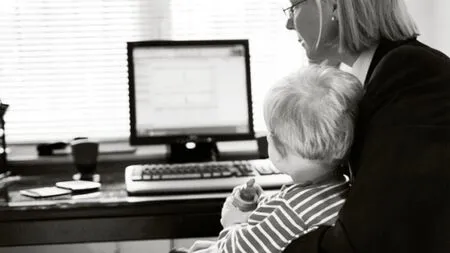
It's Rare to See a Child in the Workplace, but It Really Shouldn't Be
2019-07-19 02:00:04ByKaitlinSolimine
英語學習(上半月) 2019年3期
By Kaitlin Solimine
T he morning before I was presenting a paper at a Beat Generation1. beat generation: 垮掉的一代,指二戰后美國出現的一批年輕人,他們對現實生活不滿,蔑視傳統觀念,在服飾和行為方面摒棄常規,追求個性自我表現。Studies conference in Paris, the babysitter I'd arranged to watch my daughter texted to say she couldn't make it. Worried I'd have to cancel the presentation, I asked the organizers, two men, if they knew of any last-minute babysitters.
“Bring her!” they said. “We're fathers of six kids between us. We'll watch her.”
So, with trepidation2. trepidation: 驚恐,不安。, I did. While I presented my work in an auditorium, the director and my moderator entertained my daughter by letting her draw on the w hiteboard and then,3. auditorium: 會堂,禮堂; moderator:(討論、會議等的)主持人。to my horror, the w alls. During the Q&A, my daughter demanded to nurse4. nurse: (孩子)吃奶。. As she did, her diaper5. diaper: 尿布。leaked onto my pants. Afterward, several people came up to me to laud6. laud: 贊美,稱贊。my bringing her. A middle-aged woman reminisced that one of her favorite memories was bringing her daughter to her thesis defense.7. reminisce: 回憶;thesis defense: 論文答辯。
Unfortunately, my experience is not the norm. For most w orking women, bringing their children to work or having a f lexible schedule is not an option. When f lexibility is offered, like in the case of this Londonbased investment banker, it comes w ith a huge caveat: Advancement is less likely for parents,8. caveat:(作決定或行動前必須注意的)警告,告誡;advancement:(事業上的)提升,晉升。usually mothers, who request f lexibility. This can hit single parents—currently 35% of US children live in single-parent households—particularly hard.
在美國,越來越多工作相對彈性的家長把小孩帶到工作場合,這也受到越來越多人的接納和歡迎。事實上,和從前不同的是,人們的工作屬性和家庭屬性正日益緊密地結合在一起。如何讓孩子更好地“適配”于工作場合,是需要正視和解決的社會問題,也是家長尋求工作與生活平衡的新途徑。
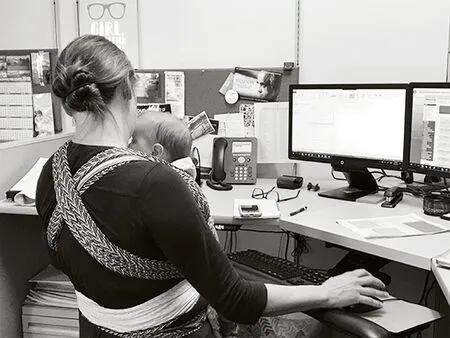
While one solution may be for companies to offer new parents the ability to bring their babies to their w orkplace or offer on-site9. on-site: 現場的,就地的。childcare, as of 2016, only 200 companies had official policies allowing children to be present at a workplace during working hours. And, of course, there are many industries (construction, factory w ork, and medicine, for example) where allowing children at the workplace would be dangerous. Moreover, it is often those parents who are in most need of f lexibility—single parents or those in low-w age jobs—w ho are least likely to have it.
I have been deeply privileged to have a partner w ho w orks a more traditional job, so I could take time to build a career with more f lexibility for child rearing10. rear: 撫養。: I co-founded a remote-work startup, published a novel and w ent on a book tour, all while a new mother. Yet my partner regularly scoffs11. scoff: 嘲弄,嘲笑。when I ask him to bring our daughter to work with him—what would his clients think? Company culture and industry standards obviously play a huge role in the “bring a kid to work” idea. When an industry like my partner's (real estate f inance) is made up almost entirely of men, it becomes even more difficult to shift the culture, though I w as pleased to overhear him recently on a call from home say, “I'm working from home today, so you may hear my toddler screaming,” which precipitated12. precipitate: 促成,促使。a longer parenting conversation w ith his client, also a father.
While not common, bringing children to work is a rising phenomenon and seemingly most visible in governance. Take New Zealand's prime minister, Jacinda Ardern, for example. Ardern made news for bringing her three-month-old to the UN General Assembly13. UN General Assembly: 聯合國大會。. Recognizing her circumstances are different from the general public's, she said, “If I can do one thing, and that is to change the way we think about these things, then I will be pleased we have achieved something.”
Likewise, Australian senator Larissa Waters was lauded last year for breastfeeding her baby while voting on a resolution in parliament.14. senator: 參議員;resolution: (會議等的)正式決定,決議。Closer to home, Illinois senator Tammy Duckw orth successfully spearheaded15. spearhead: 為……帶頭,當……的先鋒。a groundbreaking resolution to allow children under the age of one onto the US Senate f loor.In a less deliberate case of workplace-family intersection, there's the viral video of Professor Robert Kelly's children bursting onto the scene of his BBC interview.16. deliberate: 故意的;viral: 像病毒般傳播的;burst onto: 突然出現 (或來到)。The incident raised a variety of questions about why he didn't address the presence of his children as well as arguments about how his w ife retrieved17. retrieve: 領回。the children. Interestingly, Kelly said he thought the intrusion of his children meant he'd “blown it in front of the whole world.”18. intrusion: 闖入;blow it: 搞砸。Kelly's assumption that the visibility of his children during the interview w ould somehow tarnish his credibility as an academic speaks to the fact that we still harbor assumptions that our children aren't welcome and that it's unprofessional to take an interview or a work call w hile home (yet in a 2016 survey, 43% of working adults said they spent some time working remotely).19. 凱利認為在采訪過程中,他孩子的出現將會在一定程度上損害他作為學者的公信度,這說明事實上我們還是持有自己的孩子不受歡迎的想法,并且認為在家里進行采訪或打工作電話很不專業(但根據2016年的一個調查研究,43%的上班族都遠程工作過)。tarnish: 損害,玷污(名譽或形象);credibility: 可靠性,可信性;harbor: v. 懷有。
Like the widespread support for Kelly's mishap, I am fortunate I never felt my child's presence was offensive to my audience—not even when she ran onto the stage at a literary festival, crawled on my lap and started nursing.20. mishap: 小事故,小錯誤;crawl: 爬行。To the contrary, many students in the audience, especially w omen, noted it was inspiring and empowering21. empowering: 給予(某人)權力的,使自主的。that I wasn't ashamed of my intersecting role of mother and professional.
And why should I be? The reality is that most Americans can no longer rely on the traditional nuclear family22to raise the next generation. Our villages have dissolved, and w hile w e often call on family, friends or, as is usually the case, paid childcare to f ill in the gaps, the idea that our w ork identities are somehow fully separate from our home selves clearly has damaging consequences for all.23. 我們的生活社群已經解體,盡管我們經常求助家人、朋友,或通常情況下花錢去找兒童托管來彌補這個缺口,但我們所持的工作屬性和家庭屬性是完全分開的這一觀念顯然會產生很嚴重的后果。dissolve:(使)解體。Women often feel like they're “failing” as mothers and in their careers. “Doing it all” has really just meant the bulk of24. the bulk of: 大多數,大部分。the emotional labor in a household falls to women.
I wonder w hat the w orld w ould look like if children were more integrated into the workplace. What if more parents (and, given the gender pay gap, especially w omen) had access to resources that allow ed them the ability to balance family and career? What if (and here's a big wish) caring for another human being was considered valuable w ork, even something w orthy of mentioning on a résumé?
One of my earliest, fondest memories of my mother is the click of her heels on our hardwood f loors on the mornings she readied for work. Although she only worked part-time at a small insurance agency she inherited from her parents, I knew the office well—the smell of burnt coffee, the typewriter I'd play with while my mother worked. As a child, I didn't realize how lasting that inf luence w ould be, how I respected both my mother's independence at work and also her introduction of me to her working self.
In bringing this generation of children to working events or offices, we're teaching them a valuable lesson about work-life balance, as well as the intersecting identities w e inhabit25. inhabit: 存在于,身處于。on a daily basis. My hope is that, when these children become our world's leaders, they'll remember we didn't shut them out of w ork spaces. As a result, they w ill build the policies and support systems for a more equitable and enjoyable workplace.