基于量子人工魚群和模糊核聚類算法的網絡入侵檢測模型研究
2019-07-18 12:03:17李根
軟件工程 2019年6期
關鍵詞:網絡安全
李根
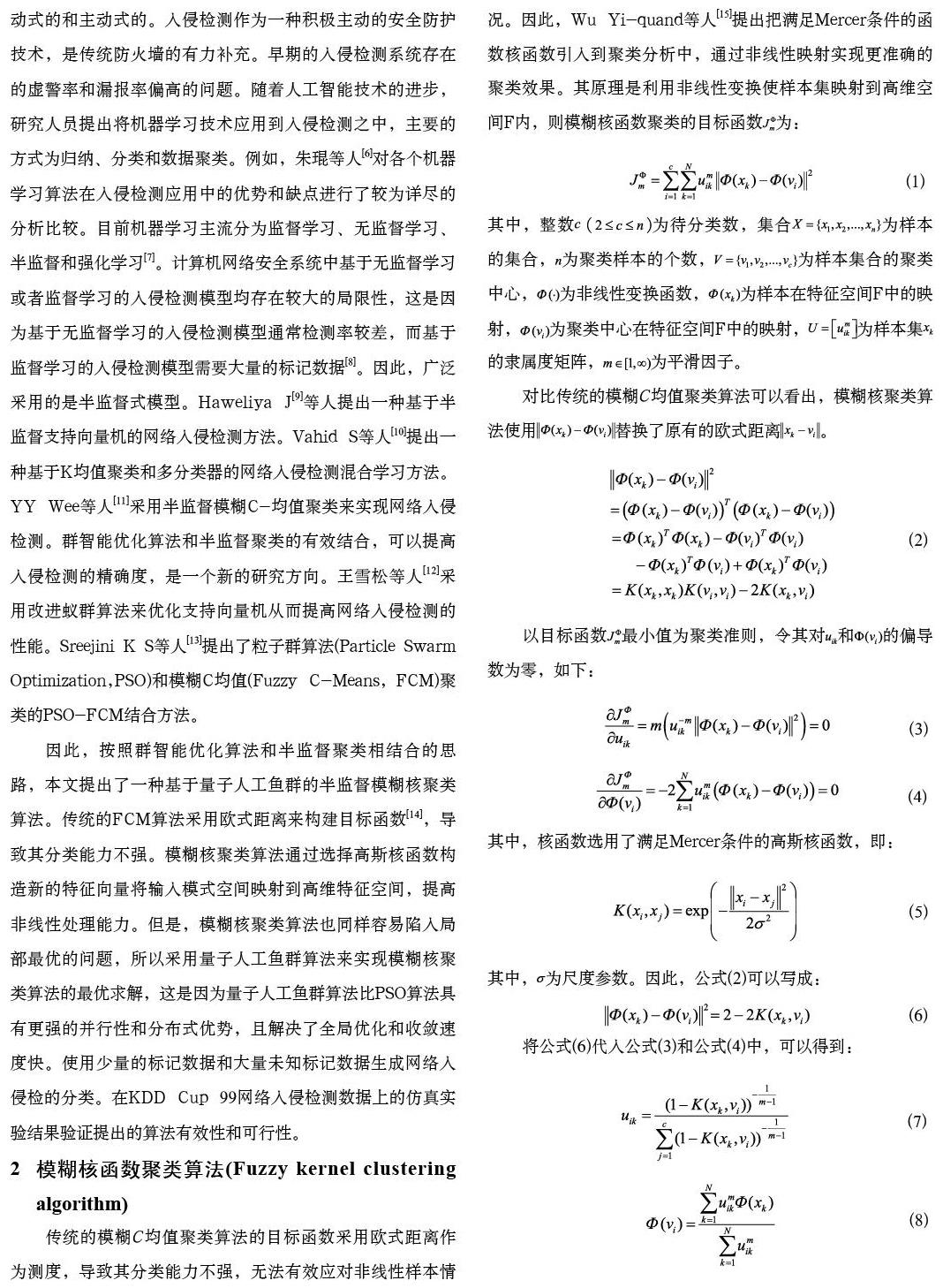
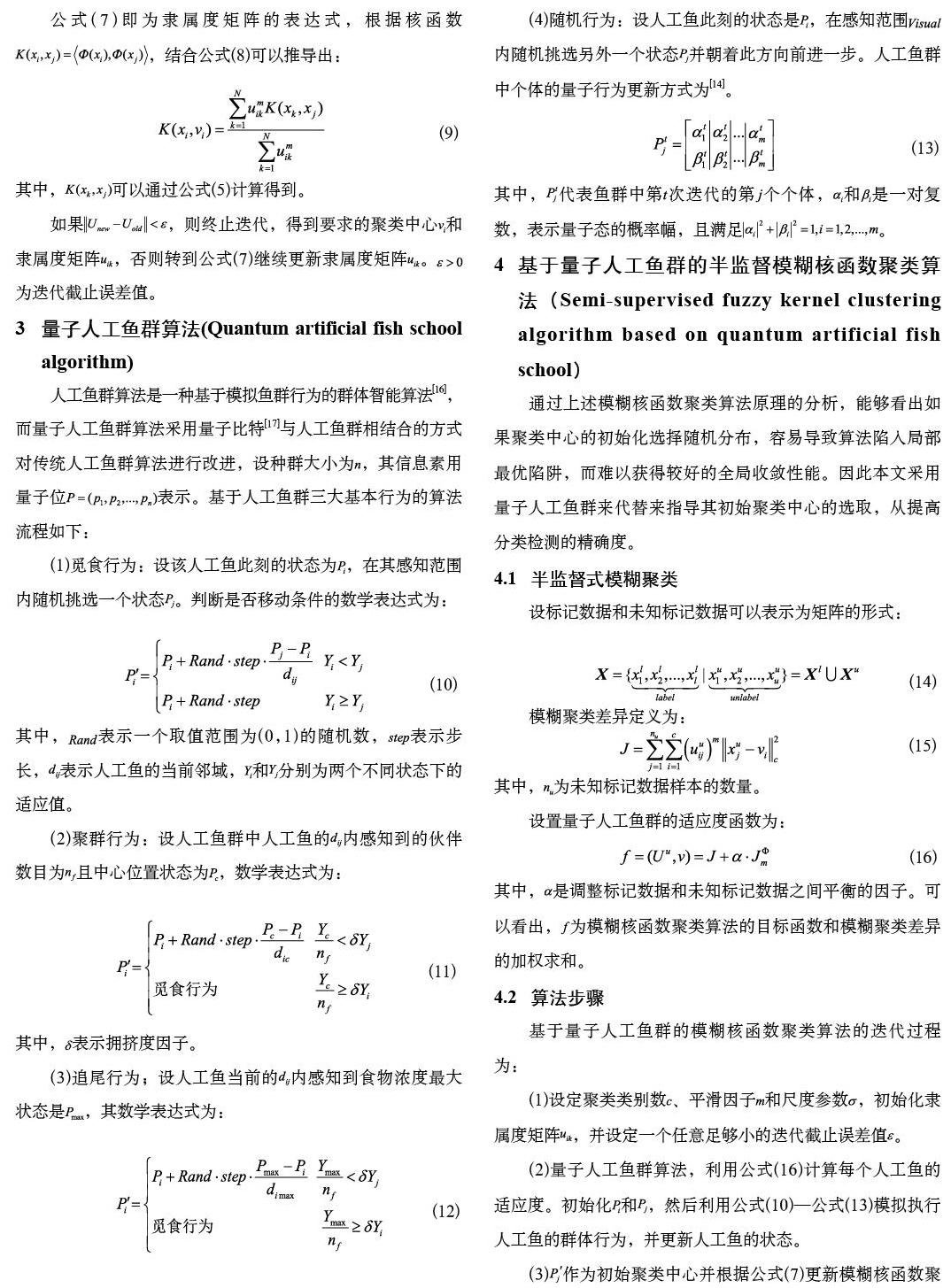
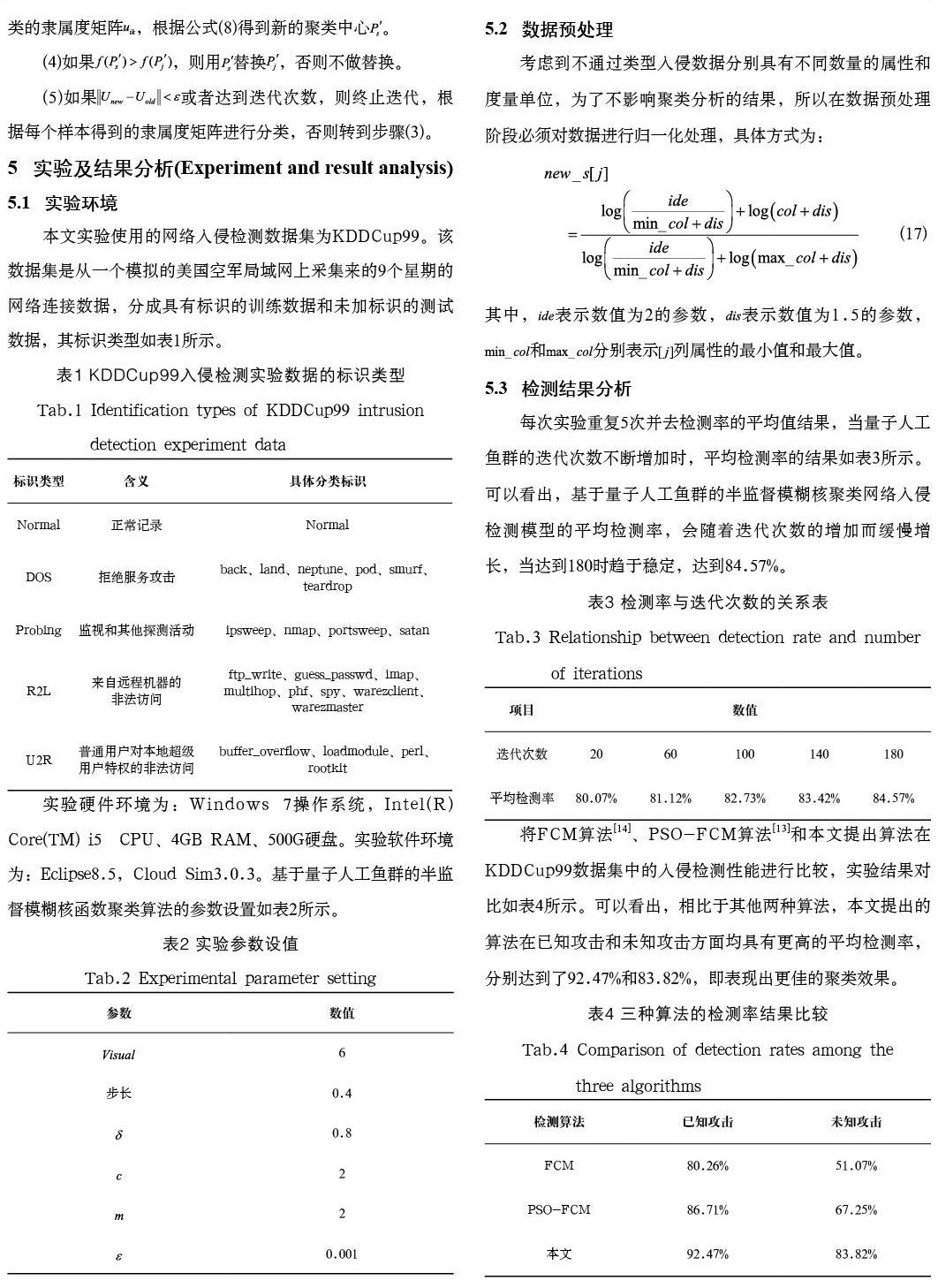
摘 ?要:針對基于傳統模糊C均值聚類的網絡入侵檢測模型存在分類效果不佳,且容易出現局部極值的問題,提出了一種基于量子人工魚群的半監督模糊核聚類算法。該算法使用少量的標記數據和大量未知標記數據生成網絡入侵檢的分類,并通過核距離的方式構建了模糊C均值聚類算法的新目標函數,此外,結合了量子人工魚群算法來解決模糊核聚類算法的全局最優解問題,適用于并行執行架構。在KDD Cup 99網絡入侵檢測數據上的仿真實驗結果表明,相比于基于FCM和PSO-FCM的入侵檢測模型,以及基于此提出的算法入侵檢測模型具有更好的檢測率。
關鍵詞:網絡安全;入侵檢測;量子人工魚群;半監督學習;C均值聚類
中圖分類號:TP393.8 ? ? 文獻標識碼:A
Abstract:Aiming at the problem that the network intrusion detection model based on traditional fuzzy C-means clustering has poor classification effect and the local extremum is easy to occur,the paper proposes a semi-supervised fuzzy kernel clustering algorithm based on quantum artificial fish school optimization.The algorithm uses a small amount of tag data and a large amount of unknown tag data to generate the classification of network intrusion detection,and constructs a new objective function of fuzzy C-means clustering algorithm by means of kernel distance.In addition,it is combined with quantum artificial fish school optimization algorithm to solve the global optimal problem of the fuzzy kernel clustering algorithm,which is applicable to the parallel execution architecture.The simulation results on the KDD Cup 99 network intrusion detection data show that the intrusion detection model based on the proposed algorithm has better detection rate than that based on FCM and PSO-FCM.
Keywords:network security;intrusion detection;quantum artificial fish school;semi-supervised learning;C-means clustering
1 ? 引言(Introduction)
伴隨著互聯網技術的不斷普及,網絡支付和網購等的得帶了飛速的發展,個人、企業和政府部門對網絡的依賴性已經越來越高,網絡安全的重要性問題也是日益突出。但是,網絡的安全問題其實涉及很多方面,且由于先天性發展問題,安全漏洞在網絡協議中無處不在,導致黑客入侵事件和計算機病毒的泛濫[1-3]。如果不能有效遏制這種現象,將會給整個國家乃至整個社會帶來巨大的災難。因此,網絡安全問題己成為世界各界十分最關注的問題之一。
現階段的網絡安全防護技術大致可以分為兩種[4,5]:被動式的和主動式的。入侵檢測作為一種積極主動的安全防護技術,是傳統防火墻的有力補充。早期的入侵檢測系統存在的虛警率和漏報率偏高的問題。隨著人工智能技術的進步,研究人員提出將機器學習技術應用到入侵檢測之中,主要的方式為歸納、分類和數據聚類。例如,朱琨等人[6]對各個機器學習算法在入侵檢測應用中的優勢和缺點進行了較為詳盡的分析比較。目前機器學習主流分為監督學習、無監督學習、半監督和強化學習[7]。計算機網絡安全系統中基于無監督學習或者監督學習的入侵檢測模型均存在較大的局限性,這是因為基于無監督學習的入侵檢測模型通常檢測率較差,而基于監督學習的入侵檢測模型需要大量的標記數據[8]。因此,廣泛采用的是半監督式模型。Haweliya J[9]等人提出一種基于半監督支持向量機的網絡入侵檢測方法。Vahid S等人[10]提出一種基于K均值聚類和多分類器的網絡入侵檢測混合學習方法。YY Wee等人[11]采用半監督模糊C-均值聚類來實現網絡入侵檢測。群智能優化算法和半監督聚類的有效結合,可以提高入侵檢測的精確度,是一個新的研究方向。王雪松等人[12]采用改進蟻群算法來優化支持向量機從而提高網絡入侵檢測的性能。Sreejini K S等人[13]提出了粒子群算法(Particle Swarm Optimization,PSO)和模糊C均值(Fuzzy C-Means,FCM)聚類的PSO-FCM結合方法。
因此,按照群智能優化算法和半監督聚類相結合的思路,本文提出了一種基于量子人工魚群的半監督模糊核聚類算法。傳統的FCM算法采用歐式距離來構建目標函數[14],導致其分類能力不強。模糊核聚類算法通過選擇高斯核函數構造新的特征向量將輸入模式空間映射到高維特征空間,提高非線性處理能力。但是,模糊核聚類算法也同樣容易陷入局部最優的問題,所以采用量子人工魚群算法來實現模糊核聚類算法的最優求解,這是因為量子人工魚群算法比PSO算法具有更強的并行性和分布式優勢,且解決了全局優化和收斂速度快。使用少量的標記數據和大量未知標記數據生成網絡入侵檢的分類。在KDD Cup 99網絡入侵檢測數據上的仿真實驗結果驗證提出的算法有效性和可行性。
2 ?模糊核函數聚類算法(Fuzzy kernel clustering algorithm)
6 ? ?結論(Conclusion)
本文提出了一種基于量子人工魚群的半監督模糊核聚類算法,將群智能優化算法和半監督聚類有效結合到一起。通過選擇高斯核函數構造新的目標函數,解決了傳統的FCM算法分類能力不強和非線性處理的問題。此外,采用量子人工魚群算法來實現模糊核聚類算法的最優求解,解決了容易陷入局部最優的問題。網絡入侵實驗使用少量的標記數據和大量未知標記數據生成半監督分類檢測,克服了單一基于監督學習或無監督學習的入侵檢測算法的局限。但是對于某些固定的標識類型,如R2L,本文算法仍表現不夠理想,存在一定的誤檢情況;此外量子人工魚群其他參數對檢測性能的影響,后續將針對這兩方面進行進一步研究。
參考文獻(References)
[1] Chen G,Gong Y,Xiao P,et al.Physical Layer Network Security in the Full-Duplex Relay System[J].IEEE Transactions on Information Forensics & Security,2015,10(3):574-583.
[2] Shin S,Wang H,Gu G.A First Step Toward Network Security Virtualization:From Concept To Prototype[J].IEEE Transactions on Information Forensics & Security,2015,10(10):2236-2249.
[3] Zhou Q,Luo J.The Study on Evaluation Method of Urban Network Security in the Big Data Era[J].Intelligent Automation & Soft Computing,2017(5):1-6.
[4] Liyanage M,Abro A B,Ylianttila M,et al.Opportunities and Challenges of Software-Defined Mobile Networks in Network Security[J].IEEE Security & Privacy,2016,14(4):34-44.
[5] Xiang W,Shi W,Yang X,et al.Efficient Network Security Policy Enforcement With Policy Space Analysis[J].IEEE/ACM Transactions on Networking,2016,24(5):2926-2938.
[6] 朱琨,張琪.機器學習在網絡入侵檢測中的應用[J].數據采集與處理,2017,32(3):479-488.
[7] Giusti A,Guzzi J,Dan C C,et al.A Machine Learning Approach to Visual Perception of Forest Trails for Mobile Robots[J].IEEE Robotics & Automation Letters,2017,1(2):661-667.
[8] Buczak A L,Guven E.A Survey of Data Mining and Machine Learning Methods for Cyber Security Intrusion Detection[J].IEEE Communications Surveys & Tutorials,2017,18(2):1153-1176.
[9] Haweliya J,Nigam B.Network Intrusion Detection using Semi Supervised Support Vector Machine[J].International Journal of Computer Applications,2014,85(9):27-31.
[10] Vahid S,Ahmadzadeh M.KCMC:A Hybrid Learning Approach for Network Intrusion Detection using K-means Clustering and Multiple Classifiers[J].International Journal of Computer Applications,2015,124(9):18-23.
[11] Wee Y Y,Cheah W P,Tan S C,et al.A method for root cause analysis with a Bayesian belief network and fuzzy cognitive map[J].Expert Systems with Applications,2015,42(1):468-487.
[12] 王雪松,梁昔明.改進蟻群算法優化支持向量機的網絡入侵檢測[J].計算技術與自動化,2015(2):95-99.
[13] Sreejini K S,K.Govindan V.Severity Grading of DME from Retina Images:A Combination of PSO and FCM with Bayes Classifier[J].International Journal of Computer Applications,2014,81(16):11-17.
[14] Zhou K,Yang S.Exploring the uniform effect of FCM clustering:A data distribution perspective[J].Knowledge-Based Systems,2016,96(C):76-83.
[15] WU Yi-quan,CAO Peng-xiang,WANG Kai,et al.Meat Image Segmentation Using Fuzzy Local Information C-Means Clustering for Generalized or Mixed Kernel Function[J].Modern Food Science & Technology,2015,31(7):130-136.
[16] Duan Q,Mao M,Pan D,et al.An improved artificial fish swarm algorithm optimized by particle swarm optimization algorithm with extended memory[J].Kybernetes,2016,45(2):210-222.
[17] Fei T,Zhang L,Sun Y,et al.The Location Selection of Distribution Centre Based on DNA Artificial Fish Swarm Algorithm[J].Journal of Computational & Theoretical Nanoscience,2016,13(2):1406-1414.
作者簡介:
李 ?根(1981-),男,碩士,講師.研究領域:大數據分析,網絡安全.
猜你喜歡
兒童故事畫報·智力大王(2025年3期)2025-03-09 00:00:00
工會博覽(2023年27期)2023-10-24 11:51:28
科學大眾(中學)(2019年2期)2019-04-08 02:26:40
中國生殖健康(2019年10期)2019-01-07 01:21:04
信息安全研究(2018年12期)2018-12-29 11:01:46
小學生必讀(中年級版)(2018年4期)2018-07-05 06:00:48
湖北警官學院學報(2017年3期)2017-06-21 09:25:51
信息安全與通信保密(2016年3期)2016-08-23 01:23:32
互聯網天地(2016年1期)2016-05-04 04:03:20
信息安全研究(2015年3期)2015-02-28 20:18:17