Who Will Triumph in the Horticulture Industry?
2019-06-19 19:16:30BystaffreporterSUNCHAO
CHINA TODAY 2019年6期
By staff reporter SUN CHAO
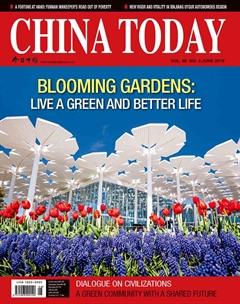
THE World Horticultural Exhibition held 20 years ago in Kunming catalyzed the development of Chinas horticultural industry. The International Horticultural Exhibition 2019, held in Beijing from April to October this year, has set up a platform for horticultural cooperation and exchange among many countries, and also serves as a stage to showcase the progress of Chinas horticultural industry.
China is one of the most important cradles of horticultural plants in the world, as a slew of horticultural plants have been cultivated here for more than 3,000 years. The rich variety of plants and the sophisticated traditional horticultural methods are unparalleled globally. Since the reform and openingup of China, with the constant adjustment of the agricultural industrial structure in China, the horticultural industry with fruits, vegetables, tea, flowers, traditional Chinese medicine, silkworm breeding, and mulberry growing as pillars, has developed rapidly, benefitting the peoples livelihood.
Horticultural Consumption Growing
Zhao Xiaolan, a 60-year-old resident of Tianjin, built a 20-square-meter terrace on the top of her house as a vegetable garden, in which she grows tomatoes, chili peppers and cucumbers. The output of each season was able to satisfy the daily needs of the whole family.
Zhao Xiaolans vegetable seedlings are purchased via the Internet. After some time, a lot of neighbors in her community began to grow vegetables on their terraces just like her. Neighbors gathered and excit-edly exchanged experiences of planting potted vegetables, and shared vegetables grown by themselves.
With the continuous refinement of gardeningrelated products such as green planting, outdoor lighting, and decorative works of art, the demand for horticultural products has gradually increased. The change in consumer focus has resulted in an increase in horticultural products and services, and the business forms have diversified.
Zhang Yu, who resides in Miyun District, Beijing, turned his vegetable plot into a garden last year, growing more than a dozen kinds of flowers, such as roses, peonies, and tulips. Fruit trees were also planted, and a miniature stone-made mountain was placed, transforming his yard into a miniature garden. He noted that as he turned old, he became less capable of cultivating land, and consequently turned the vegetable plot into a garden, which looked pleasant. Now Zhang Yus miniature garden has become a place where relatives and friends often meet.
More young people have started to order flowers. The flower ordering services include monthly packages and home delivery once a week. Customers can pick flowers and pay via WeChat, the whole process taking only two minutes. For most urban consumers, the price of ordering flowers is favorable, and the order and delivery process are also convenient. This in turn has become a new fashionable trend with young people.
The huge population base and the level of economic and social development make China a big market of family horticulture. Although the consumption of horticultural products is increasing, the development of the horticultural industry needs cooperation from multiple sectors. Li Li, an official of the National Agricultural Technology Promotion Service Center of the Ministry of Agriculture and Rural Affairs, believes that social awareness of the horticultural industry should be enhanced, and more measures to improve horticultural production and consumption are needed.
Flowers as a Medium to Drive Regional Development
In the early spring of 2019, in the greenhouses of the lily production base in Donghai County, Jiangsu Province, Li Bingjian was picking budding lilies. This year, the market is in good condition and the price is good as well. More than 10,000 greenhouses for freshcut flowers have been built in Donghai, with the total area of 2,000 hectares. The county is now the largest lily production base with the most diverse varieties in Jiangsu, producing more than 500 million freshcut flowers per year, and boosting the income of 2,000 rural households.
Since the 1980s, the planting area and output of horticultural plants in China have been increasing continuously, and the scale of production has been expanding. In addition, with scientific and technological progress over recent years, the output per unit area has skyrocketed.
The vigorous development of horticultural industry has increased farmersincome and agricultural efficiency, balanced the trade between China and some other countries, and become one of the important industries of the agricultural and rural economy.
“Flowers not only beautify the environment, but have also made me rich,” Zhang Aiguo, a florist in Sanpu Village, said with contentment. He began planting flowers with his parents in 2008. Over the past decade, his greenhouses increased from four to 20, and he also become a broker, building a cold storage of nearly 300 square meters to preserve freshcut flowers and bulbs. His annual income nears RMB one million, which has inspired more than 20 farmers around him to grow fresh-cut flowers.
Speaking of the development of the horticultural industry in Donghai, Gao Meifeng, the county magistrate, said that Donghai, with its favorable climate and soil conditions, had further promoted the structural reform of the agricultural supply side and guided farmers to develop flower planting. The county integrates all kinds of funds to build hydropower, ditches, and other supporting facilities for the base. In addition to this, it cooperates with financial institutions to help the villagers access financial support including loans. The county agricultural committee has also developed an agricultural technology work app, set up the “Donghai Flower WeChat Group,” and invited technical experts to answer questions in a timely manner. The countys Shuangdian Town has planted more than 1,000 hectares of flowers, and “Shuangdian Lily”has been granted CGIIA (China Geographic Indications Industry Association) certification.
Donghai holds flower exhibitions every two years, and has set up distribution centers in more than 20 large and medium-sized cities throughout the country to achieve a seamless connection between production and the constantly expanding market space. Gao Meifeng pointed out that at present, 60 percent of fresh-cut lilies in Shanghai are from Donghai.
At the same time, flowers are used in Donghai as a way to give full play to the advantages of its lakes and hot springs, and accelerate the development of tourism. The construction of Shuangxi Lake lily-themed park in the west of the county, which integrates beautiful flower decorations and tourism, not only improves the citys facilities, but also provides a display and exchange platform for the fresh-cut flower industry, and upgrades the overall industrial level.
Constantly tapping the potential of agricultural development and building a strong modern agricul- tural county, Donghai has formed six leading flower industries, such as Shuangdian fresh-cut flowers and Huangchuan strawberries. Donghai has also launched the strategy of rural revitalization, which will organically combine rural tourism and eco-tourism oriented agriculture to develop local features, promote integration of tourism and agriculture, and build a unique rural tourism industrial ecosystem. The booming rural tourism will bring more business opportunities to Donghai, and enable more farmers to live a prosperous life.
Starting from 2016, China began building towns with distinctive local features. By 2020, it will cultivate about 1,000 such towns. Some of them will use flowers as a characteristic industry to produce a variety of high-value-added products, and greatly extend and expand the flower industry chain.
Over the past 20 years, with the rapid development of Chinas flower industry, the variety of flower products has become increasingly abundant. Freshcut flowers, potted flowers, garden plants, and other new products have continuously emerged, making China the worlds largest flower production base, an important flower consumer, and a key flower import and export country. Ornamental plants account for half of the flower industry, with their planting area accounting for about 57 percent. The production area of seedlings and flowers is more than two million hectares, and more than 40 billion seedlings are produced annually, with an annual output value of more than RMB 450 billion.
Cultivation facilities have also developed from bamboo sheds and solar greenhouses to intelligentenvironment-controlled multi-span greenhouses. More and more enterprises have adopted advanced technologies such as fertigation and tidal irrigation for flower planting. At the same time, the planting level has been continuously improved, the mainstream potted flower planting technology has matured, and become more standardized, and the quality of some enterprises products is of the international level.
With advanced cultivation techniques, continuous supply in all seasons has been achieved. It not only guarantees the needs of residents, but farmers in differing regions also have gained advanced experiences during the development.
Li Li cited as an example that the Ministry of Agriculture and Rural Affairs launched a modern agricultural industry technology system in 2007, which included 13 horticultural technology sub-systems, such as citrus, apple, vegetables, tea, silkworm breeding, and mulberry growing. Each sub-system has a certain number of scientists and regional comprehensive experimental stations, and promotes the application of scientific research results through research and demonstration of experimental stations.
Maintaining the Momentum
Historically, the horticultural industry in China was based on the household contract responsibility system, that was dominated by family-based small-scale operations. Li Li believes that although the pace of land transfer and cooperation in some areas has gradually increased with the acceleration of urbanization and agricultural modernization, the operation of family farms and loose farmer cooperative organizations still dominate operational modes. Taking vegetables as an example, 60 percent of Chinese vegetable farms are smaller than one hectare in size, while only about three percent are larger than 6.7 hectares.
In recent years, the comparative benefits of horticultural crops, especially fruits and vegetables, have declined due to the sharp increase in production costs.
However, Li Li is optimistic about the prospects of Chinas horticultural industry. She said that compared with the three major grain crops, the horticultural industry still has higher profits, and remains the leading industry for poverty alleviation and rural revitalization.
In Li Lis view, the horticultural crop industry should take the supply-side structural reform and the adjustment of planting structure as an opportunity to optimize industry structure, reduce inefficient supply, increase effective supply, and improve supply quality; It should introduce green production modes, and accelerate the promotion of green technology with the priority on resource preservation and environmental protection; it should develop a batch of horticultural products with regional characteristics in combination with the creation of areas of competitive edge on certain agricultural products; it also should adjust industrial structure, develop make-to-order production, cultivate the processing industry, and extend the industrial chain.
“China will take the International Horticultural Expo as an opportunity to vigorously promote the opening-up and development of its horticultural industry.” Li Li pointed out that the horticultural industries of various countries including planting fruits, vegetables, and flowers, both competitive and complementary. The Chinese government will increase international exchanges, cooperation, and development of the horticultural industry under the principle of mutual benefit and win-win results, and upgrade horticultural trade.
Li Li also stressed the importance of giving full play to the comparative advantages of horticultural crops in various countries, promoting the trade of intellectual property rights and production technology exchanges, strengthening the interaction between the departments in charge of production and marketing, catalyzing the “going out and bringing in” of superior horticultural products all over the country, sharing the development opportunities brought by the Belt and Road Initiative, promoting the sustainable development of the global horticultural industry, and constantly striving to increase farmers income and the connectivity of markets.