Silk Flowers,Beijing Style
2019-06-19 19:16:30BystaffreporterJIAOFENG
CHINA TODAY 2019年6期
By staff reporter JIAO FENG
THE Beijing silk flower evolved from a time- honored craft to make floral hair pins with fine textiles. In ancient times when the Spring Festival approached, families bought firecrackers for their sons and silk flowers for their daughters. Its a millennium-old tradition that women and girls wore artificial flowers in their hair, as can be seen in ancient paintings. Since fresh flowers were hard to come by during winter months ancient Chinese made silk flowers as suitable alternatives. Today artificial flowers are no longer used as hair ornaments, but still loved as home decorations.
Flower Market Street
Huashi, meaning Flower Market, is a two-km-long street in south Beijing. During the Ming Dynasty (1368-1644) it was the place to store logs used for the construction of the Forbidden City, and was hence named Shenmu (Heavenly Log) Street. In the Qing Dynasty (1644-1911), traders, mostly those of artificial flowers, gathered there on the fourth, 14th, and 24th day of each month. Gradually a number of small studios making silk, velvet, and paper flowers for headwear, bouquets, and food decorations (on peach-shaped birthday cakes, birthday noodles, and moon cakes, etc.) emerged. The street was therefore renamed Huashi.
The artificial flowers sold in the street closely resembled real ones, attracting buyers from all over the country. Soon word spread that the best silk flowers in China were from Beijing, and the best silk flowers in Beijing were from Huashi. Business thrived in the street until the Japanese army occupied Beijing in the 1930s. Though the flower market does not exist anymore, the streets name remains.
The Beijing silk flower is finely crafted and brightly colored. It first won international fame when the work of a Qing artist was awarded by the 1915 Panama Pacific International Exposition. Though not worn today by women on their heads, it is widely used for costumes of Chinese operas, floral arrangements, and potted landscapes. The art entered the Beijing intangible cultural heritage list in 2007 and the national list the following year.
A Family Business for Five Generations
As silk was expensive, silk flowers were mostly supplied to the royal family and its staff. They were therefore also known as the palace flower. A Dream of Red Mansions wrote of an instance of Aunt Xue sending a box of palace flowers to girls of the Jia family as gifts, indicating that they were not cheap even for noble ladies at the time. The fad of wearing silk flowers among women peaked during the Qing Dynasty, resulting in a spike in the demand and variety of designs. Noble women wore different flowers at different times of the day and different occasions, and according to their social status. The Imperial Household Department ran a section especially in charge of the manufacturing of artificial flowers for the emperors harem and flower arrangements at royal banquets. Artisans in the trade were given the appellation ‘Huaer,” meaning flower, before their family names as a show of respect.
Huaer Jin was a family living in the southern part of Beijing who was commissioned to make silk flowers for headpieces of the Qing empress dowager, empress, and princess. Jin Tieling is the fifth-generation heir of the craft in the family. Like other folk artists, he was exposed to the art and became interested in it from a very young age. In 1987 he followed in the footsteps of his father and joined the Beijing Silk Flowers Factory.
In the early years of his career, Jin visited all the flower stores and floral exhibitions he could find, and solicited opinions on his work from horticulturists. Thanks to these efforts, his skills improved fast. In 1982, at the age of 26, he won a national prize for his silk chrysanthemums.
“What I saw and heard (in my family) laid a solid foundation (for my career). But whats more important is to practice it passionately and diligently every day. There is no shortcut in learning a craft,”Jin stated. In the early 1980s he made the first trip to Guangzhou, where he saw many flowers that didnt grow in Beijing. He bought two crates of them, and carried them back on a shoulder pole. “Every plant is unique, so is every flower and every leaf. Only through close observation can I make good silk flowers,” he explained.
Relentless Pursuit of Perfection
Nowadays fresh flowers are available year round, but the demand for artificial ones hasnt die out. They are loved for the merits of being everlasting, allergyfree, and hassle-free.
The making of Beijing silk flowers is a delicate manual process involving one to two dozen steps. Different types of silk and tulle are chosen for different kinds of flowers. The fine, soft textile has to be hardened with starch or flour paste before it is cut, dyed, sculpted, and assembled. It is not unusual to spend two or three months on one single work. “I can reproduce any flower on the planet with silk,” Jin said confidently.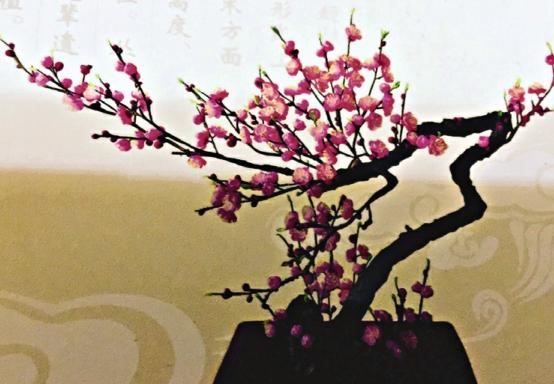
With advances in technology, machines today can take over part of the silk flower manufacturing. Jin, however, insists on doing it entirely manually. He admits that machines can make nice flowers, which nevertheless look the same, and are lifeless. By contrast, every hand-crafted one is unique in its own right.
As the fifth-generation practitioner of the art, Jin doesnt sit on the established laurels of his family, but is eager to experiment and push the envelope. He showed the reporter a bonsai of Magnolia denudate, saying the buds are made of a new synthetic material that better resembles the furry buds of the flower than crepes, the conventional material choice. “To make artificial flowers as real as fresh ones has been the mission of my family over the past generations. Silk flowers are beautiful, and carry good wishes – not fading, not withering. This is not only my wish for my work, but also the craft my family has been practicing.”
Jin, in his 60s, regularly gives lectures in communities, schools, and enterprises, doing on site demonstration of the art. “I feel like I am sowing seeds, seeds of love for this art, among more people,” he said.