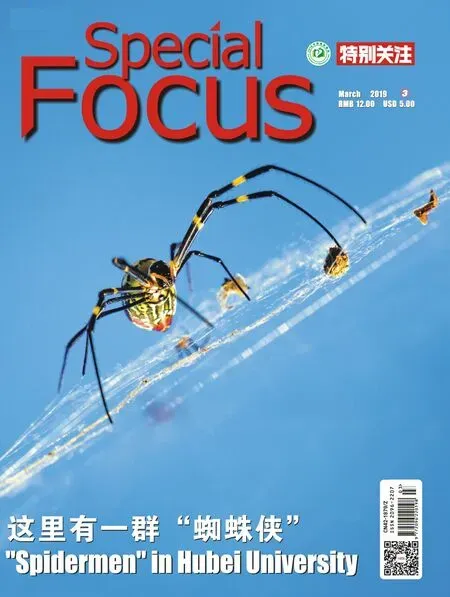
“Spidermen” in Hubei University
2019-04-11 06:57:10TextbyMaYalunTangLinPhotosbySuZhuolin
Special Focus 2019年3期
Text by Ma Yalun & Tang Lin Photos by Su Zhuolin

Hubei University, an important provinciallevel university in Wuhan, the capital city of Central China's Hubei Province, is proud to boast a team of talented spider researchers and scientists in its School of Life Sciences.
Prof. Zhao Jingzhao, Prof. Chen Jian, Prof. Jiao Xiaoguo, and their graduate students, forming a long line of four generations, have pooled together and made great achievements in the research of spiders. Recently, a paper named “Prolonged milk provisioning in jumping spiders” was released in Science, a top SCI journal, marking the joint effort of Prof. Jiao Xiaoguo, Associate Prof. Zhang Shichang of Hubei University and Chen Zhanqi and Quan Ruichang of Xishuangbanna Tropical Botanical Garden, Chinese Academy of Sciences. This paper composed their great contribution to the field of biology for their initial discovery in breastfeeding in invertebrates. It is noteworthy that Chen Zhanqi, the first author of the paper, was also a graduate of Hubei University.
A World of Spiders
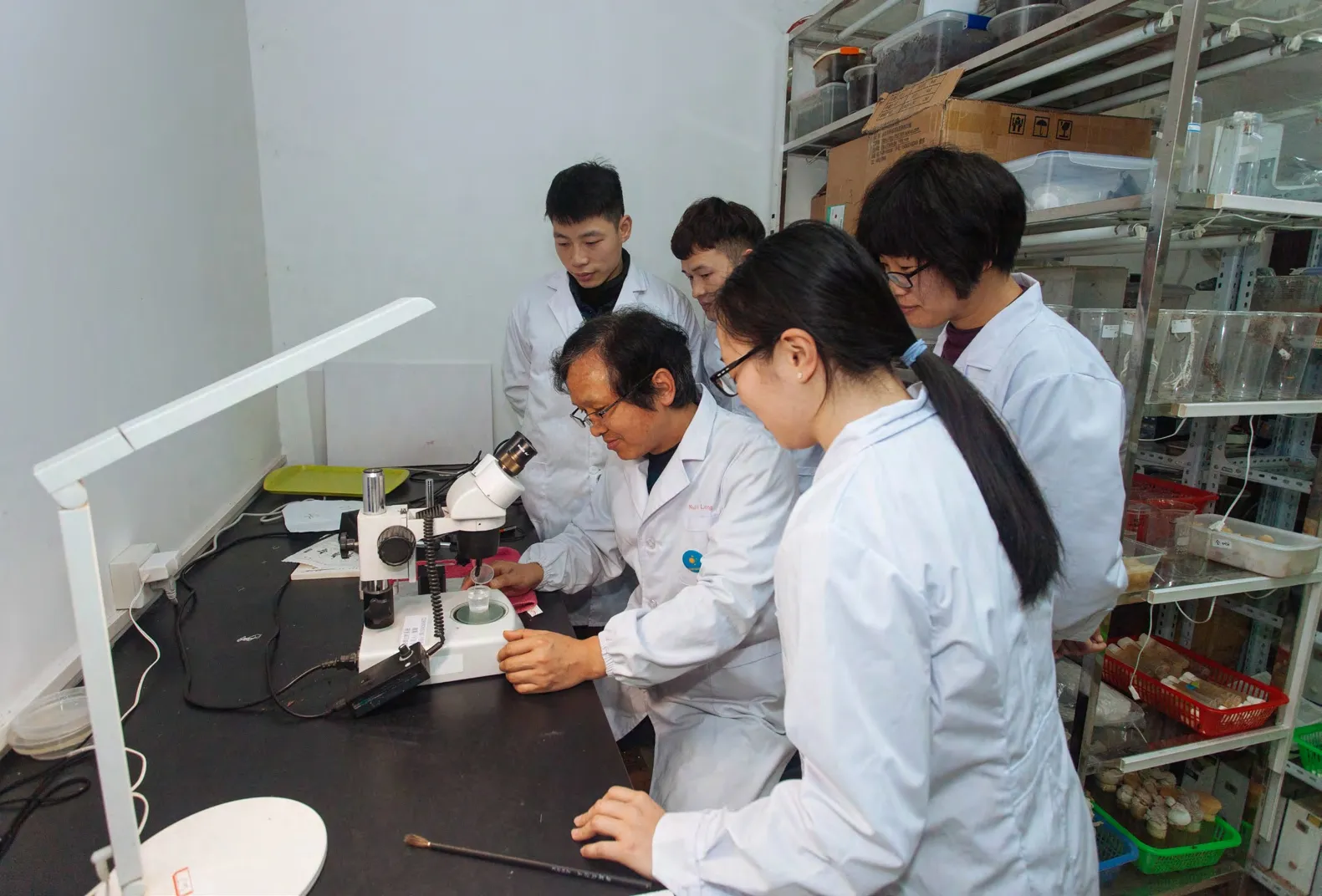
Entering one of the spider laboratories in Hubei University, we saw rows of shelves, as high as 2 meters each. The shelves are filled with various bottles and jars in which spiders of different varieties live. These spiders come from all over the world, including some remote corners of China. This small laboratory is a giant world of spiders, where all the famous spiders, such as Tarantulas and black widow spiders can be seen.
Prof. Jiao told us that his research team mainly focuses on the research dealing with pardosa pseudoannulatas, pardosa astrigeras, and bird-eating spiders.
We observed closely the birdeating spiders from Hainan Province in China and South America. They are likely to dig out caves in wet mud and hide there. These spiders, covered with brown straight hair, as if combed by the barber, remind us of the spider spirits in the Journey to the West. This kind of spider is nocturnal, and lives on insects. One bird-eating spider, hiding in its cave, stretches its legs, making good preparation to attack in a timely manner. The gray and black bulges on the front end of the legs are its claws. It is magical that the claw does not snag things when the spider isn't attacking, but when it starts to attack, the claws grip tightly on prey. Prof. Jiao further explained spiders' secrets concerning venom, limb coordination, and weaving skills. He put a bird-eating spider on the back of one hand, and touched it with the other while speakingto us, “Spiders are not as toxic or dangerous as most people think.”

After we left the laboratory, Prof. Jiao guided us to the specimen room, where seven researchers were studying spider specimens. A lady turned on the light, moved past the meters-high file cabinets, and explained to us the categories of specimens.
“Here is where more than 100,000 spider specimens are kept.”
The cabinets are full of glass bottles, one after another. Immersed in formalin liquid, spiders, big and small, still are bright in color and their thin hairs are intact. Prof. Jiao explained to us that these spiders were all collected or bred by the team. Chen Jian, the vice dean of the School of Life Sciences, takes the lead in the research of the diversity of species amongst spiders. He and his team travel hundreds of thousands miles every year to search for spiders of different species in mountains and caves around China. So far, they have left their footprints in Xinjiang, Tibet, Yunnan, Guizhou, and many other remote regions. Tombs, caves, high mountains, and virgin woodlands are the ideal places for them to seek new spiders.
Bright Future for the Application and Marketing of Spiders
In the 1970s, when Hubei University was called Wuhan Teachers College, Zhao Jingzhao, a teacher then, was designated to study the prevention and control of farmland crop creatures. He found that spiders are a natural remedy for pests in cotton fields, which ushered in the beginning of the application of spiders for biological control.
After 50 successive years of development, Hubei University leads in the research of spiders in China. The School of Life Sciences has nurtured hundreds of doctoral and master's graduates since then. Right now 40 students are pursuing their doctoral and master's degrees at the center. Hubei University is now on the path of internationalization in its research. For example, they invited Prof. Ingi Agnarsson from the University of Vermont from the US and Prof. Matjaz Kuntner from Slovenia to work here as visiting professors.
At present, many other universities in China also have spider research centers, which embrace many scholars, and have attained great achievements and expanded the field of research on spiders. With government sponsorship and funding, spider research now has a good academic climate, and more and more talents have blossomed at a faster speed.
Nowadays, the research of spiders mainly focus on the study of Arachnids and their application in pest control and prevention, as well as applications in Bionics and Material Science. With the application of spiders in biological control, pesticides will be used less, thus soil and water contamination will continue to decrease. Application in Bionics and Material Science also provides potential for development in many fields. The spider web, with characteristics of high intensity, fast elongation rates, and good tenacity, can be applied to the textile, medical, and military industries. What's more, progresses have been achieved in the treatment of rheumatism using the venom from the spiders. The study of spiders' limb coordination will definitely shed light on advanced construction equipment, rescue work, and other fields.
這里有一群“蜘蛛俠”
文/馬亞倫 唐琳 攝影/蘇卓琳
在中國(guó)中部湖北省省會(huì)武漢,有一所省重點(diǎn)大學(xué)——湖北大學(xué)。這所大學(xué)的生命科學(xué)學(xué)院里,活躍著中國(guó)力量最強(qiáng)的一群“蜘蛛俠”。
他們星火傳承,從趙敬釗到陳建到焦曉國(guó)再到年輕的研究生團(tuán)隊(duì),四代同功,在蜘蛛研究領(lǐng)域取得不少成就。不久前國(guó)際權(quán)威學(xué)術(shù)期刊《科學(xué)》雜志上刊登的論文《一種跳蛛的長(zhǎng)期哺乳行為》,就是該院焦曉國(guó)教授、張士昶副教授與中科院西雙版納熱帶植物園科研人員陳占起、權(quán)銳昌等合力完成的。他們首次發(fā)現(xiàn)無(wú)脊椎動(dòng)物類似于哺乳動(dòng)物的哺乳行為,這是對(duì)世界生物學(xué)領(lǐng)域的貢獻(xiàn)。值得一提的是,論文第一作者陳占起也是該院碩士畢業(yè)生。

蜘蛛的世界
走進(jìn)該院實(shí)驗(yàn)室,一排排高2米左右的架子映入眼簾,架上擠滿了各式各樣的瓶瓶罐罐,瓶?jī)?nèi)飼養(yǎng)著大大小小物種不同的蜘蛛。它們或來(lái)自世界各地,或來(lái)自中國(guó)偏遠(yuǎn)地方的某一個(gè)角落。一個(gè)小小的室驗(yàn)室竟是一只只蜘蛛的乾坤。狼蛛、黑寡婦……大凡知名,這里全有。
據(jù)焦曉國(guó)教授介紹,他們主要研究擬環(huán)紋豹蛛、星豹蛛和捕鳥(niǎo)蛛。我們近距離觀察了來(lái)自海南、美洲等地的捕鳥(niǎo)蛛。它們?cè)诔睗竦耐晾锱倭硕囱ǎ瑢⒆约赫麄€(gè)兒藏在里面,全身清晰可見(jiàn)密生的棕褐色細(xì)毛,像理發(fā)師梳理過(guò)的頭發(fā),干凈、晶瑩發(fā)亮,令人想起《西游記》里的蜘蛛精。這種蜘蛛多在夜間活動(dòng),以各種昆蟲(chóng)為食。藏在洞穴里的捕鳥(niǎo)蛛,全力張開(kāi)頭腹部的腳,隨時(shí)作出進(jìn)攻的架勢(shì),腳趾前一二節(jié)上灰黑肉突的部分是它的吸盤,腿部前端灰黑肉突的部分是它的爪子。神奇的是,不進(jìn)攻時(shí)爪部沒(méi)吸力,一旦進(jìn)攻,吸力就很大,可以把毛筆頭上的毛牢牢吸住。焦教授說(shuō),蜘蛛的奧秘還很多,諸如毒液、步足協(xié)調(diào)、編織技巧等都非常值得深入研究。
焦教授把一只捕鳥(niǎo)蛛放在自己的手背上,邊用另一只手撫摸蜘蛛邊說(shuō):“其實(shí)蜘蛛并不像人們想象的那么毒,那么可怕。”
從實(shí)驗(yàn)室出來(lái),焦教授帶我們參觀了蜘蛛標(biāo)本室。七八位研究員正在進(jìn)行標(biāo)本研究。一位女士把燈打開(kāi),并把一排排幾米高的蜘蛛檔案柜移動(dòng)開(kāi),給我們講解標(biāo)本分類情況。
這里存放著10萬(wàn)多個(gè)蜘蛛樣本。一個(gè)個(gè)玻璃器皿擠滿了檔案柜,一個(gè)種類挨著一個(gè)種類。大大小小的蜘蛛浸泡在福爾馬林液中,仍能看到鮮艷的顏色和細(xì)長(zhǎng)的絨毛。焦教授介紹,這些蜘蛛標(biāo)本都是團(tuán)隊(duì)親自捕捉或培養(yǎng)的。該院副院長(zhǎng)陳建是蜘蛛物種多樣性研究的領(lǐng)頭人,他和他的團(tuán)隊(duì)每年都要跑數(shù)萬(wàn)公里,常年在全國(guó)各地的山野洞穴中尋找不同種類的蜘蛛,足跡遍布新疆、西藏、云南和貴州等偏遠(yuǎn)省區(qū),古墓荒洞、深山老林,是他們最喜歡的去處。

蜘蛛應(yīng)用前景廣闊
20世紀(jì)70年代,湖北大學(xué)還叫武漢師范學(xué)院,該校趙敬釗教授(當(dāng)時(shí)只是講師)受命開(kāi)展農(nóng)田生物防治研究。他發(fā)現(xiàn)蜘蛛是棉田害蟲(chóng)的天敵,由此拉開(kāi)利用蜘蛛開(kāi)展生物防治的研究序幕。
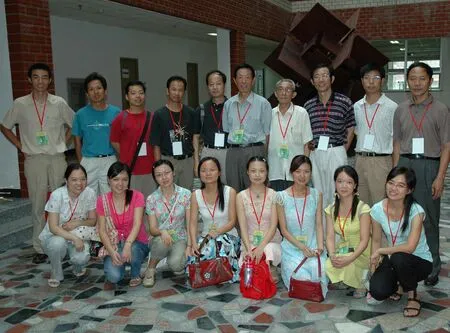
陳建教授(后排左三)、趙敬釗教授(后排左五)和他們的同事Professor Chen Jian, Professor Zhao Jingzhao and their colleagues
經(jīng)過(guò)近50年的發(fā)展,湖北大學(xué)蜘蛛研究全國(guó)聞名,已培養(yǎng)博士和碩士研究生數(shù)百名,實(shí)驗(yàn)室現(xiàn)有40多名博士和碩士研究生。為促進(jìn)其國(guó)際化發(fā)展,該校還邀請(qǐng)了美國(guó)佛蒙特大學(xué)的安內(nèi)爾森教授和斯洛文尼亞的康特納教授擔(dān)任客座教授。
如今,中國(guó)多所大學(xué)都有蜘蛛研究團(tuán)隊(duì),蜘蛛研究呈現(xiàn)學(xué)者輩出、成果豐碩、研究領(lǐng)域不斷拓展的局面。國(guó)家也鼓勵(lì)開(kāi)展生物學(xué)領(lǐng)域研究,科研條件得到很大改善,人才培養(yǎng)速度也大大加快。

目前,蜘蛛研究重點(diǎn)在蛛形研究和應(yīng)用研究。后者又分病蟲(chóng)害防治及材料學(xué)、仿生學(xué)應(yīng)用,其中,病蟲(chóng)害防治旨在減少農(nóng)藥施用、降低污染、保護(hù)土壤和水資源。蜘蛛在材料學(xué)和仿生學(xué)應(yīng)用方面擁有廣闊的發(fā)展空間。蜘蛛絲具有高強(qiáng)度、高伸長(zhǎng)率、高韌性等特點(diǎn),在紡織、醫(yī)療、軍事等領(lǐng)域都有廣闊應(yīng)用前景;蛛毒在治療風(fēng)濕病方面已經(jīng)取得進(jìn)展;蜘蛛多足協(xié)調(diào)的研究,必將為施工、救援等工具領(lǐng)域創(chuàng)新提供新的操控系統(tǒng)理論。
猜你喜歡
中學(xué)生天地(A版)(2022年6期)2022-07-14 12:39:26
體育科技文獻(xiàn)通報(bào)(2022年3期)2022-05-23 13:46:54
天津外國(guó)語(yǔ)大學(xué)學(xué)報(bào)(2021年3期)2021-08-13 08:32:18
遼金歷史與考古(2021年0期)2021-07-29 01:06:54
大學(xué)(2021年2期)2021-06-11 01:13:48
大學(xué)(2021年2期)2021-06-11 01:13:12
海峽姐妹(2020年12期)2021-01-18 05:53:08
民主與法制(2020年16期)2020-08-24 06:54:50
科技傳播(2019年22期)2020-01-14 03:06:54
民用飛機(jī)設(shè)計(jì)與研究(2019年4期)2019-05-21 07:21:24