Connecting China and the World
2019-02-20 20:34:50BystaffreporterMALI
CHINA TODAY 2019年2期
By staff reporter MA LI

“In the past decade, the number of Chinese- learning students in French primary schools, middle schools, and universities has increased manyfold. Chinese has become a popular second foreign language in France following Spanish, German, and Italian,” said Christian Lagarde, vice president of Université de Montpellier, at the 13th Confucius Institute Conference.
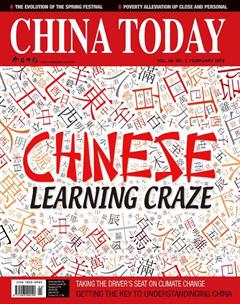
With the ascent of Chinas international standing and the expansion of its opening-up, China is having more exchanges with other countries in fields ranging from economy and politics, to culture. The study of the Chinese language is sweeping across the world. So far, more than 60 countries have put the Chinese language courses in their school curriculums. The number of people learning the language has soared from 30 million in 2004 to over 100 million at present. “In 2005, only 200 middle schools in the U.S. ran Chinese courses with Chinese-learning students numbering merely 20,000. By 2016, the figure had exceeded 400,000,” said Guo Jiaoyang, director of the Division of American and Oceanian Confucius Institutes of the Confucius Institute Headquarters.
In order to boost international communication and exchanges, and introduce its language to the rest of the world, China started the non-profit program of Confucius Institutes in 2004 to teach the Chinese language and promulgate Chinese culture overseas. This program draws on the experience of other countries, including the U.K., France, and Germany, in promoting their languages globally. According to Guo, with the expansion of the program and the materialization of more opening-up policies of China, Chinese language learning fervor has been rising in countries like the U.S., Russia, and in those along the Belt and Road.
Chinese President Xi Jinping has stressed on several occasions that the Confucius Institute is a window and bridge for exchanges between Chinese and other languages and cultures. It is a program of China and the world as well. With the joint efforts of Chinese and local partners, the teaching and services of Confucius Institutes worldwide have been steadily improved, and their cultural activities are now even more robust. The institutes meet the demand of the people of other countries to learn Chinese, and makes positive contributions to pragmatic cooperation in economy and trade.
The Confucius Institute works for cultural diversity under the tenet of cultural integration through language learning. By the end of last November, 548 Confucius Institutes and 1,193 Confucius Classes had been established in 154 countries and regions around the world, with 30 institutes founded in 2018 alone.
A Bridge Between Hearts
Dennis Delehanty, 66, is the oldest student of the Confucius Institute at the George Mason University of the U.S. With a long career in foreign affairs and postal service with the U.S. government, Delehanty has learnt several languages. By reading the classic works of Lao She, Ba Jin, Shen Congwen, Mo Yan, and other Chinese authors, he felt the richness of Chinese culture and the inclusiveness and resilience of the Chinese nation, he told China Today.
In the opinion of Delehanty, Confucian thinking and the tenets of the Confucius Institute bring China and the world together. He believes that Chinese learning is more than mastering a language; it creates an emotional bond. This is the institutes contribution to humankind. He hopes that more young people around the world will learn Chinese at the local Confucius Institutes, and hence learn more about China and join hands to build a better future.
The Confucius Institute of the University of Sheffield at present holds 200 classes, which have enrolled 14,000 students over the past several years. Keith Burnett, former president of the university and council member of the Council of the Confucius Institute Headquarters, lauded the Chinese teachers and staff members of the institute as nongovernmental envoys, through whom communities and individuals around the world feel the kindness and devotion of China. He said that China excels at construction of infrastructures such as bridges, but the most important bridge for human communication is not built with iron, steel, or stone. He thanks China for its efforts to build bridges between hearts around the world that promote understanding between China and the rest of the world.
In addition to giving classes, the Confucius Institute also organizes rich cultural events to introduce Chinese culture. “The Confucius Institute is the outcome of the reform and opening-up of Chinas educational sector and its reaching out to the world; it is also a successful example of educational exchanges and cooperation between China and other countries, and is an example of promoting friendly ties through culture,” said Chinas Vice Education Minister Tian Xuejun.
Serving Multilateral and Bilateral Cooperation
“I fell in love with Chinese culture in the process of learning Chinese. At the recommendation of the Confucius Institute, I fortunately got a job with the China Road and Bridge Corporation (CRBC). Thereby China and the Mombasa-Nairobi Railway become part of my life,” said Eric, a student of the Confucius Institute at the University of Nairobi, in Chinese.
The Confucius institute at the University of Nairobi is the first in Africa. It provides Chinese language courses plus vocational training programs to cultivate professionals who are versed in both Chinese language and other specialized techniques, for which there is a solid demand due to the construction of the Mombasa-Nairobi Railway.
Along with Eric, about two dozen of his schoolmates were recommended to CRBC. He was later promoted to the position of executive director of the first train running on the Mombasa-Nairobi Railway. Some of the other students became train drivers, technicians, and attendants. Eric believes that learning the Chinese language offers them a broader stage of personal development.
“They are known to everyone in Kenya who knows the Mombasa-Nairobi Railway. They are critical to the train operation, and credited for the smooth performance of the line since it was launched,” said Issac Mbeche, vice president of the University of Nairobi and head of its Confucius Institute.
Many Confucius Institutes have opened, in addition to the Chinese language, other practical courses, including commerce, traditional Chinese medicine, and other skills, doing their share for building a community of shared future for all humankind, and pursuing common prosperity and development of countries around the world.
According to the Confucius Institute Headquarters, or Hanban, there are now 153 Confucius institutes and 149 Confucius classes at primary and middle schools in 54 countries along the Belt and Road. These institutes offer courses on skills needed by local people in addition to the Chinese language. Meanwhile, some of them have established Belt and Road research centers and Marine Silk Road Confucius Institutes, which host lectures, forums, and conferences on the Belt and Road, lending brain power to the development of the initiative.
The Confucius Institute also serves as an intermediary and facilitator for cooperation between China and other Belt and Road countries in various fields. For instance, the institute at the Khon Kaen University of Thailand initiated a program to teach staff working on the high-speed train; a school in Ukraine offers training for the national airline; one in Belarus cultivates Chinese-speaking professionals for industrial parks jointly built by the two countries there; and another one in Tajikistan offers training for local staff members of a Chinese company operating in the country.
According to the deputy Hanban chief Ma Jianfei, over the past few years, the services of the Confucius Institute have expanded from preschool to university, from degree to non-degree study, from entry-level Chinese learning to business Chinese, travel Chinese, advanced translation, academic research, and more. More than two million foreign citizens have attended the institute, which has organized various Chinese language proficiency exams with the cumulative participants numbering 15 million.
Over the past 13 years, the Confucius Institute has played a unique role in promoting mutual understanding, seeking common ground, promoting cooperation, and enhancing friendship, bringing China closer to the rest of the world.