Tasting the World with a New Perspective
2019-02-20 20:34:50ByWANGKUAN
CHINA TODAY 2019年2期
By WANG KUAN

IN the 1990s, Fuchsia Dunlop decided to visit China after reading articles about the country for several months. The ensuing one-month backpacking trip exposed the English woman to a wide range of Chinese food.
“The dishes and soups I had even in the cheapest and plain eateries were better than what I had in the U.K.,” Dunlop recalled.
The last stop of her trip was Chengdu, the capi- tal of southwest Chinas Sichuan Province. Dunlop learned from friends that Sichuan food represents one of Chinas best cuisines, and when the spicy flavor of Sichuan pepper exploded in her mouth, something inside her changed forever.
After she returned to London, Dunlop made the decision to study in China at Sichuan University. When she wrote down “studying Chinese policies on ethnic groups” on the application form as the reason for a scholarship, what she really had in mind was Sichuan dishes like eggplants with garlic sauce and braised fish with fermented bean paste sauce.
Her journey eventually led her to become the most knowledgeable English person on Chinese food. She has since written many books on Chinese cuisine, including Sharks Fin and Sichuan Pepper, which was translated into Chinese in 2018.
According to Chen Xiaoqing, known for directing the documentary of A Bite of China, Dunlop is the most insightful foreign writer who vividly depicts Chinese cuisine in a compelling and accurate way. What she presents to the readers is not just food, but also the profound traditions and tremendous changes occurring in the country behind the flavors.
Sichuan Cuisine with a Golden Touch
Dunlops mother was an English teacher at Oxford University. Her students from around the world used to gather in the family kitchen for meals, giving young Dunlop the chance to taste delicacies of various countries.
From those youthful days, cooking has always been Dunlops passion, which she finally brought to full fruition in Chengdu.
Chengdu has been known as a culinary capital and a city of leisurely life since the Tang Dynasty (618-907). It also reminded Dunlop of the Mediterranean cities where people could have a comfortable life without too much work, thanks to the clement climate and nutrient soil. Likewise, residents in Chengdu could spend a whole day in a teahouse, chatting and sipping, without feeling guilty.
Chinese cuisine has four culinary traditions, allencompassing Shandong cuisine, light and delicate Huaiyang cuisine, simple but elaborate Cantonese cuisine, and the most popular Sichuan cuisine. What distinguishes Sichuan cuisine is the miracle created by the most common ingredients. For example, the ingredients for eggplants with garlic sauce only include pork and eggplants. After being fried, eggplants have a soft and slippery texture in the mouth, similar to ice cream.
Apart from the hospitable and friendly Sichuan people, Dunlop also encountered and fell in love with Sichuan pepper, a different kind of pepper from those in South America. The locally produced ingredient is the earliest Chinese pepper and the soul of Sichuan cuisine. It is like the popping candy in the spice world.
In her spare time, Dunlop liked to cycle in and out of the alleys of downtown Chengdu. She soon got to know every single classic Sichuan delicacy, from chicken salad to braised fish with fermented bean paste sauce, stir-fried pork kidney, Sichuan noodles with peppery sauce, and Sichuan dumplings. She found the best eatery of Sichuan noodles and became a loyal patron.
Rapt in exploring local delicacies, Dunlop found herself immune to the smothering heat, hazy air, and inconveniences of life in a foreign country. However, her passion went beyond just enjoying the food. She also wanted to learn how to cook it herself. This desire led to her enrolment in a culinary school for a three-month training program on Sichuan cuisine.
Calibrating the Perfect Mouthful
The teacher was moved by her passion for local food and accepted her as a student. Dunlop started the study with a chefs outfit, two Chinese textbooks, one on culinary theories and one on Sichuan food recipes, and one Chinese kitchen knife.
She was the first and only foreigner in the culinary school, which often caused disruptions in the class of 50, who were mainly from rural areas. They were friendly but shy, and would blush at the sight of her.
Instead of a wide range of cooking utensils as usually found in a Western kitchen, Chinese people, no matter their gender or age, rely on a simple knife in creating culinary magic. A simple stainless-steel knife, with a cleaver-like blade and wooden handle, is literally able to perform every task in the kitchen. You can soften the meat by beating it with the blunt edge; use the wooden handle to grind Sichuan peppers; or press and smash the ginger or garlic with either side of its cleaver. “The best part is that you can use it as a spatula and carry everything on the chopping board to the pot,” marveled Dunlop.
While studying at the culinary school, she started her days early. Breakfast would be any delicacy she encountered, be it rice porridge or spicy Sichuan dumplings. After classes, she went to find the hidden eateries around the city and asked to work as an apprentice in kitchens who would accept her. She gradually became well known and was often greeted by owners of restaurants or food stands along her way to class. Some would simply say hello, while others invited her to the kitchen to make a dish.
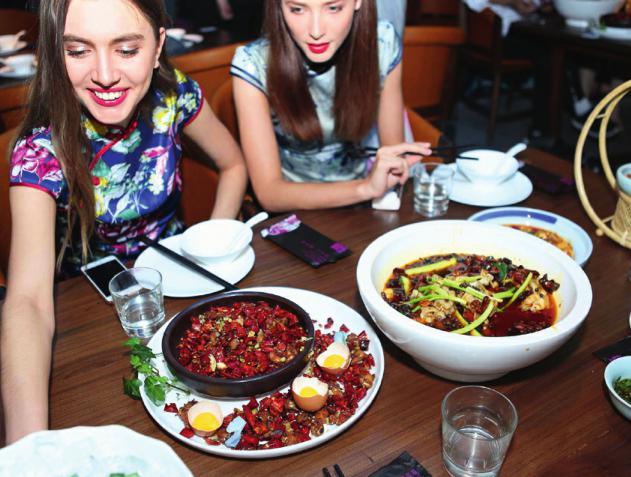
To Dunlop, what makes Sichuan cuisine special is the art of seasoning. Sichuan chefs are good at tantalizing the palate with a combination of basic ingredients. “They first awaken your tongue with a proper amount of chili oil, and then tantalize it with tingling and numbing Sichuan peppers. The spicy sweetness kisses your palate, and the fried chili mesmerizes you. Then, you get some comfort from the sweet and sour taste. A sip of nutrient-dense soup closes the meal, leaving you totally refreshed. Eating Sichuan food is as thrilling as riding a roller coaster. The compound taste is truly complicated and profound,” she said.
Dunlop believes that when a man is tired of Sichuan cuisine, he is tired of life, a twist on the wise words of the English writer Samuel Johnson.
Helping Westerners Learn about Real Chinese Food
After returning to London, Dunlop furthered her studies on Chinese affairs by enrolling for a masters degree in a university. While she worked on her dissertation on Sichuan cuisine, she found there was neither an authentic Sichuan restaurant nor cookbook in London, a city boasting diverse cultures.
Western people had complicated feelings about Chinese food. They liked the taste, but regarded the dishes as extremely unhealthy. Chinese takeaways were common, but regarded as cheap food made by poor immigrants. Dunlop realized that many Westerners were unaware that China preserves some of the worlds best culinary traditions, and that Chinese food is all-encompassing.
“The best way to change their mindset was to give them a cookbook. I wanted to tell them Chinese culinary culture is the best in the world. Its methods of matching ingredients to create diverse dishes are really incomparable.”
At the beginning, her first book was declined by six publishers. It was only in 2001 that her book Sichuan Cookery was published, and later lauded by the Observer Food Monthly. With several publications and major awards, Dunlop was recognized as the most knowledgeable English person on Sichuan cuisine.
She observed that Western peoples views on Chinese food have changed tremendously. “It started about 10 years ago. We now have nice restaurants serving Cantonese, Sichuan, Hunan food, and special dishes from northeast China [in London]. As a result, people have begun to realize that Chinese food is not as simple as they used to believe,” said Dunlop.
However, her journey had no shortage of challenges. This led her to recall the simple lifestyle of the former generations in China, which has been carried on by the poor and the health conscious. A bowl of rice or noodles, lightly-seasoned fresh seasonal vegetables, a variety of tofu dishes, some fruit, and some meat or fish constitute a nutritious daily diet.
“The modern Western diet contains too much dairy and animal protein. Its not healthy. The traditional Chinese diet is different. It minimizes damage to the environment, and maintains balanced nutrition with a pleasant taste and attractive appearance. After years of studying cooking, I find this is the best lifestyle,” she said.
In fact, Chinese people have also experienced great changes in terms of mindsets on eating over the years, from times of famine, to experiencing delicious flavors and valuing the balance of diet. When people get rich after experiencing a long period of food shortage, they become compulsive overeaters. But that impulse is declining. More and more people are valuing green healthy food, reducing their ammount of meat intake and stopping food waste.
Dunlop believes the older generation Chinese are really masters of a balanced diet. They are well aware of how to adjust the diet based on season, age, and health conditions. “I was impressed that almost everyone [of a certain age] knows how to maintain a healthy diet.”
The more she learns about Chinese cuisine, the more deeply she realizes that she is thinking and leading a Chinese lifestyle. In cold damp winter days, she knows people have to eat warmer foods, and adds one more spoon of chili oil in her breakfast; whereas in smothering hot summer days, she will have some refreshing sour food.
Studying the glossaries in Chinese cookbooks led her to learn the Chinese language. “In Chinese, when someone gets jealous in a relationship, people say he or she is eating vinegar; while people experience sufferings in life, Chinese use tasting something bitter to describe the situation. I am trying to record what I have observed in life in my books,” she said, hoping the books could help people of different cultures better understand each other.
“After being immersed in an alien culture for years, you will change. Most significantly, you will never see the world with a simple single perspective. This is why I believe cross-culture communication is helpful. It will improve your compassion and comprehension. You will find a different perspective, respect people with different views and find common ground,” she said.