
基于 4-甲基-3-苯基-5-(2-吡啶基)-1,2,4-三唑的CuⅡ、NiⅡ和CdⅡ配合物的合成、晶體結構及性質
2019-01-14 06:00:30何衛衛馮肆洋瞿志榮王作祥
無機化學學報 2019年1期
何衛衛 馮肆洋 瞿志榮*, 唐 輝 王作祥*,
(1杭州師范大學有機硅化學及材料技術教育部重點實驗室,杭州 311121)
(2東南大學化學化工學院,南京 211189)
In the past few decades,the transition metal complex composed of inorganic metal ions and organic ligands has attracted great attention from scientists due to their tailorable structures and promising properties in different fields[1-3].Among them,1,2,4-triazole and its derivatives are important compounds which have gained great attentions in recent years,since they play a crucial role in many fields such as medical science[4-7],biological science[8-10]and so on[11-13].At the same time,a new family of energetic salts has been synthesized recently based on the 1,2,4-triazole derivative[14].Moreover,coordination polymers consisting of 1,2,4-triazole derivative and other materials have been synthesized and demonstrated for the first time intrinsic proton conduction by a coordination network[15].Besides,much attention has also been paid to 1,2,4-triazole compounds for their versatile coordination modes[16-20]in coordination chemistry.
Although many metal complexes with substituted 1,2,4-triazole have been synthesized and characterized[18-25], the copperⅡ,nickelⅡ and cadmiumⅡcomplexes with 4-methyl-3-phenyl-5-(2-pyridyl)-1,2,4-triazole have not been reported so far.Herein we report the crystal structures and spectroscopic properties of four complexes,[CuL2Cl]Cl·H2O (1),[NiL2(H2O)2](NO3)2(2),[CuL2(H2O)2](ClO4)2(3)and[CdL2(NO3)2]·CH3CN (4),where L=4-methyl-3-phenyl-5-(2-pyridyl)-1,2,4-triazole.
1 Experimental
1.1 Chemicals and measurement
The reagents and solvents used were analytical grade without further purified.Melting points were determined using an X4 digital microscopic melting point apparatus and uncorrected.The C,H,N elemental analyses were performed on a Perkin-Elmer 240 analyzer.1H NMR spectrum was measured with a Bruker Avance 300 spectrometer at ambient temperature in CDCl3using TMS as an internal reference.Infrared spectra were determined on a Prestige-21 FTIR spectrometer from 400~4 000 cm-1using KBr pellets.Thermogravimetric analyses were obtained on a NETZSCH′s TG209C thermogravimetric analyzer in nitrogen atmosphere at heating rate of 10 ℃·min-1.UV-Vis spectra were measured on U-6000PC spectrometer in ethanol solutions.Fluorescence emission spectra were taken using F-2700FL spectrometer in ethanol solutions.Powder XRD measurements were performed using a Bruker D8 advanced X-ray diffractometer equipped with graphite monochromated Cu Kα (λ=0.154 18 nm)radiation(40 kV,40 mA)with 2θranging from 5°to 60°at room temperature.
1.2 Synthesis of L
The ligand L was synthesized by the following process:oxalylchloride (7.7 mL,90 mmol)was added to a solution of N-methylbenzamide (12.15 g,90 mmol)and 2,6-lutidine (21.0 mL,180 mmol)in CH2Cl2(300 mL)at 0℃ under nitrogen atmosphere.The mixture was stirred for 40 min,and 2-picolinic acid hydrazide(12.33 g,90 mmol)was added.The reaction mixture was stirred for 5 h at room temperature,and then the volatiles were removed.The residue was dissolved in NaHCO3(sat)(300 mL)and refluxed for 3 h at 100 ℃.The water phase was extracted with CHCl3.The organic phase was dried over MgSO4,and concentrated.Recrystallization from EtOAc gave white crystals(10.7 g,yield 50.4%).m.p.152~153℃.Anal.Calcd.for C14H12N4(%):C 71.17,H 5.12,N 23.71.Found(%):C 71.26,H 5.01,N 23.63.1H NMR (300 MHz,CDCl3):δ4.069(s,3H),7.338~7.341(d,1H),7.350~7.369(m,1H),7.525 ~7.552 (m,2H),7.697 ~7.721 (m,2H),7.826~7.869 (m,1H),8.344~8.364 (d,1H).8.680~8.684(d,1H).MS (m/z):[M+H]+237.1.IR (KBr,cm-1):3 052,3 011,2 971,1 588,1 486,1 470,1 444,1 431,1 278,1 150,1 078,991,790,738,706.
1.3 Synthesis of complex 1
To a warm solution of L (0.236 g,1.0 mmol)in 30 mL acetonitrile,CuCl2·2H2O (0.085 g,0.5 mmol)was added with stirring,then the solution turned green immediately.The solution was filtrated,and the filtrate was left to evaporate slowly at room temperature.Several days later,green crystals were collected (Yield:0.223 g,71.4%).A single crystal was picked out to measure the structure by X-ray single crystal diffraction.Anal.Calcd.for C28H26Cl2CuN8O(%):C 53.81,H 4.19,N17.93;Found(%):C 53.57,H 4.01,N 17.64.IR (KBr,cm-1):3 098,3 058,2 924,1 609,1 501,1 472,1 445,1 252,1 082,1 047,793,779,734,703.UV (λmax/nm):245,277.
1.4 Synthesis of complex 2
The synthesis of 2 was same as that of 1 except that Ni(NO3)2·6H2O (0.145 g,0.5 mmol)was used instead of CuCl2·2H2O.Purple crystals were collected(Yield:0.292 g,84.5% ).Anal.Calcd.for C28H28N10NiO8(%):C 48.65,H 4.08,N 20.26;Found(%):C 48.31,H 3.87,N 20.51.IR (KBr,cm-1):3 076,3 028,2 957,1 611,1 501,1 472,1 384,1 315,1 166,1 111,1 048,776,734,707.UV (λmax/nm):248,282.
1.5 Synthesis of complex 3
The synthesis of 3 was similar to that of 1 except that 0.472 g L (2.0 mmol)and 0.371 g Cu(ClO4)2·6H2O(1.0 mmol)were used.Blue crystals were obtained(Yield:0.638 g,82.7% ).Anal.Calcd.for C28H28Cl2CuN8O10(%):C 43.62,H 3.66,N 14.53;Found(%):C 43.74,H 3.48,N 14.71.IR (KBr,cm-1):3 122,3 080,2 965,2 003,1 614,1 506,1 475,1 446,1 362,1 311,1 256,1 145,1 121,1 085,780,717,703,624.UV (λmax/nm):246,278.
1.6 Synthesis of complex 4
The synthesis of 4 was same as that of 1 except that Cd(NO3)2·4H2O (0.154 g,0.5 mmol)was used instead of CuCl2·2H2O.Colorlesscrystalswerecollected(Yield:0.303 g,81.0% ).Anal.Calcd.for C30H27Cd N11O6(%):C 48.04,H 3.63,N 20.54;Found(%):C 48.24,H 3.71,N 20.42.IR (KBr,cm-1):3 060,2 965,2 922,2 254,1 601,1 493,1 470,1 439,1 384,1 317,1 168,1 039,789,730,703.UV (λmax/nm):250,277.
1.7 X-ray crystallography
The picked single crystals were placed on a Bruker Smart APEXⅡCCD X-ray single crystal diffractometer (λ=0.071 073 nm),and the data were collected at 296(2)K.The crystal structures were solved by direct methods and refined on F2by fullmatrix least squares procedures using SHELXTL software[29]. All non-hydrogen atoms were refined anisotropically,and all hydrogen atoms on carbon atoms were allowed to ride on the parent atoms geometrically.The hydrogen atoms of water molecules were found from the Fourier map,but not refined anisotropically.Crystallographic data of complexes 1~4 are shown in Table 1,selected bond lengths and bond angles for 1~4 are shown in Table 2,and H-bonding and C-H…π interactions for 1~4 are shown in Table 3~6,respectively.
CCDC:1854277,1;1854278,2;1854289,3;1854284,4.
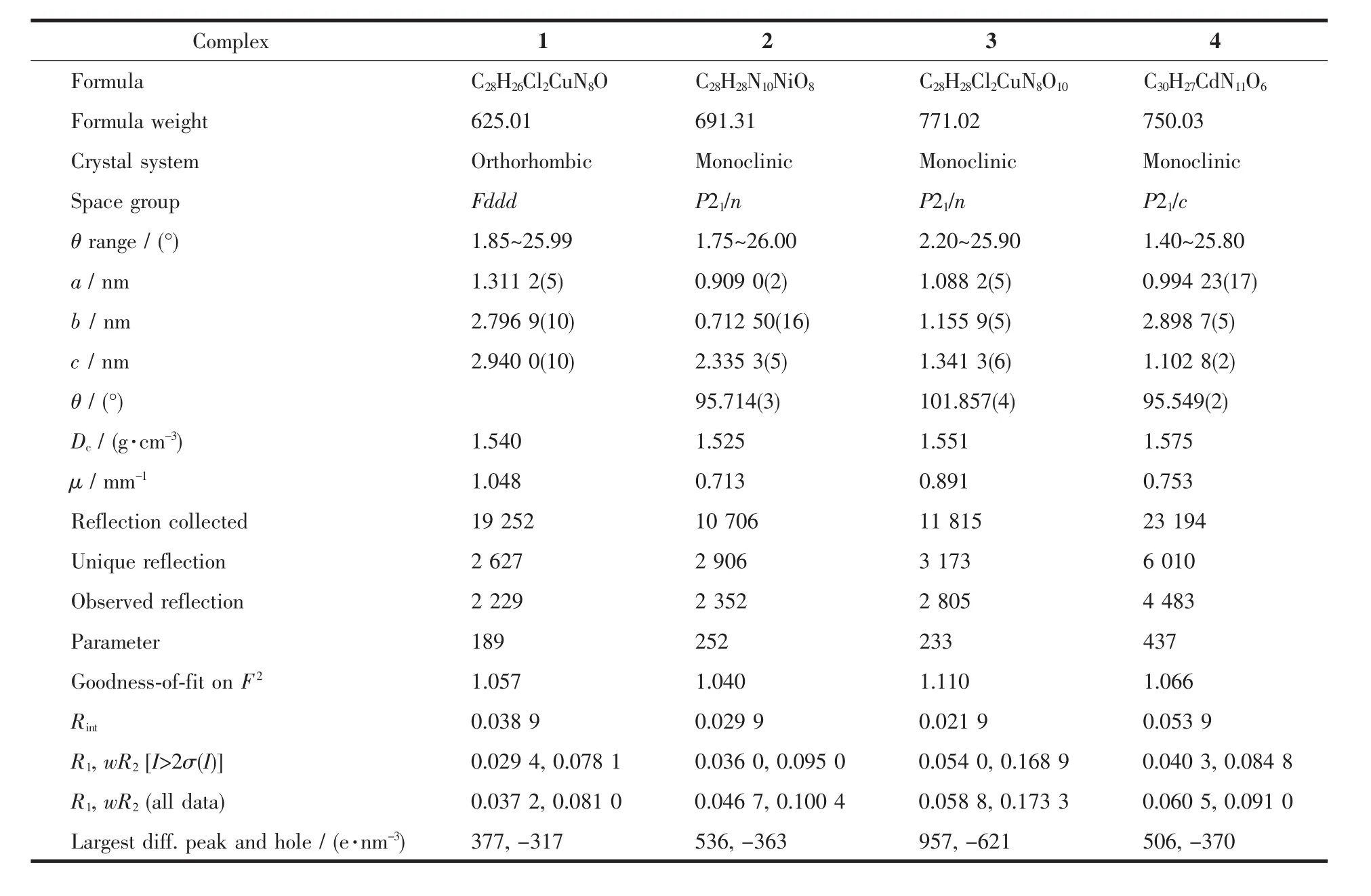
Table 1 Crystal data and structure refinement for complexes 1~4

Table 2 Selected bond lengths(nm)and bond angles(°)for 1~4
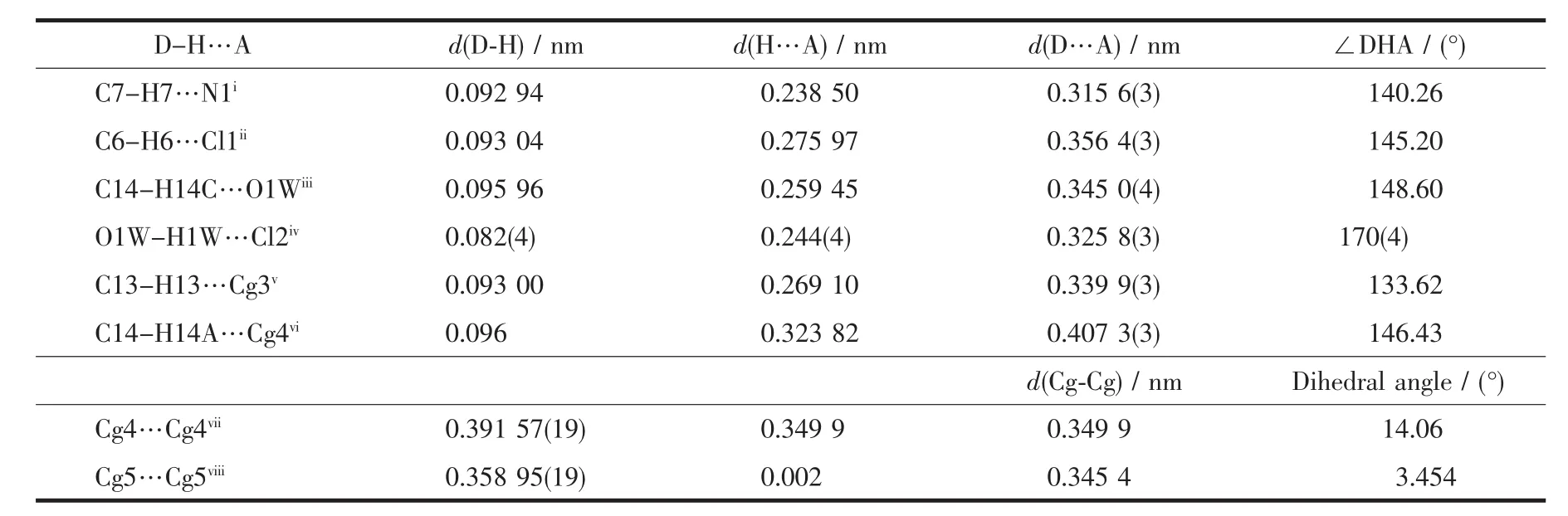
Table 3 H-bonding,C-H…πandπ…πinteractions parameters for 1

Table 4 H-bonding,C-H…πandπ…πinteractions parameters for 2

Table 5 H-bonding,C-H…πandπ…πinteractions parameters for 3
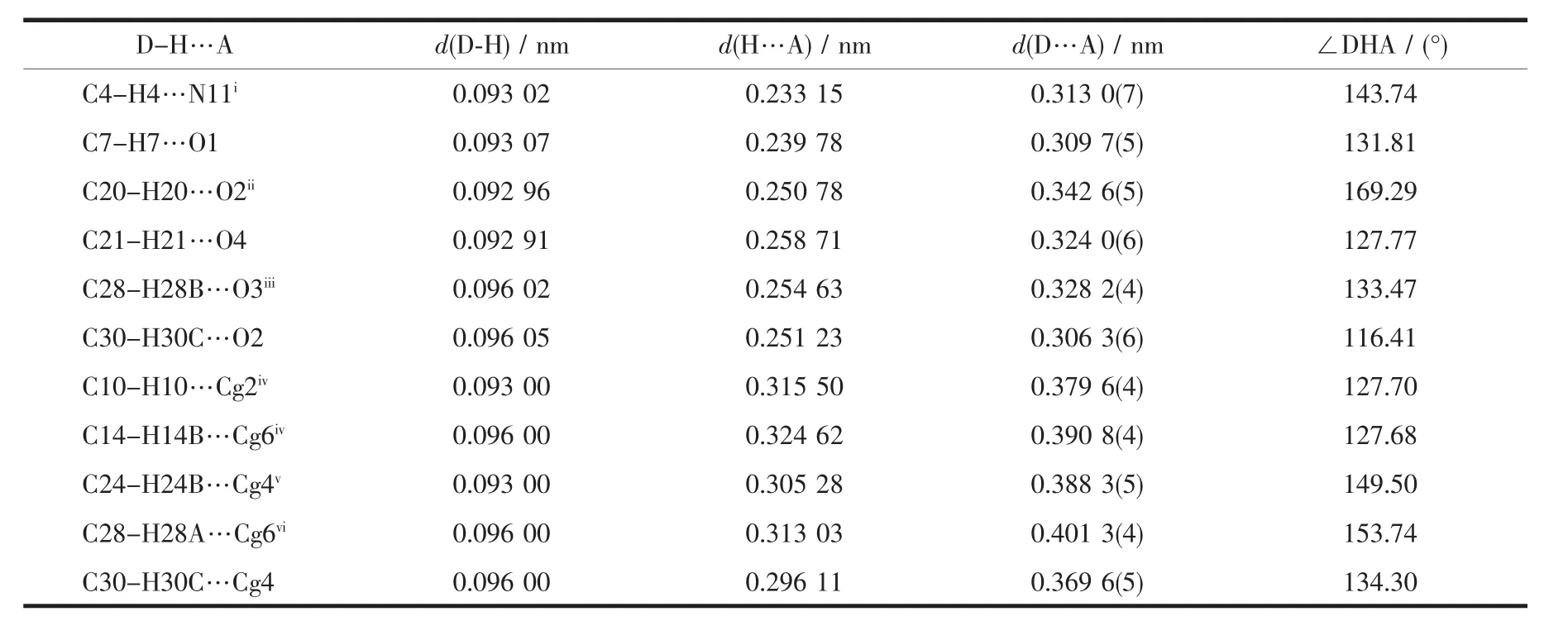
Table 6 H-bonding and C-H…πinteractions parameters for 4
2 Results and discussion
2.1 Crystal structure of[CuL 2Cl]Cl·H 2O(1)
The crystal structure of 1 belongs to orthorhombic system with space group Fddd.The asymmetric unit of 1 consists of one [CuL2Cl]+,one Cl-and one lattice water.The crystal structure of 1 is shown in Fig.1a.Two nitrogen atoms from 1,2,4-triazole rings(N2 and N2i)and two nitrogen atoms from pyridine rings (N4 and N4i)are almost in the same plane and coordinated to the center Cu1Ⅱion,and the Cl1 atom coordinated to the Cu1Ⅱion at the axial position.All these coordinated atoms make the central Cu1Ⅱion form a distorted tetragonal pyramid geometry [CuN4Cl].The bond lengths of Cu1-N2,Cu1-N4 and Cu1-Cl1 are 0.197 87(16),0.206 88(17)and 0.252 57(12)nm,respectively.The 1,2,4-triazole ring and pyridine ring are almost coplanar,the dihedral angle between them is 1.79°.Four hydrogen-bonding interactions are found in 1 (Fig.1b and Table 3),including one H-bonding interaction between the water and uncoordinated Clanion,and other three non-classical hydrogen bonds interactions.Two weakπ…πinteractions are involved between the pyridine ring and the neighboring benzene ring.There are also two C-H…πinteractions C13-H13…Cg3v(Symmetry codes:v3/4-x,y,7/4-z)and C14-H14A…Cg4vi(Symmetry codes:vi3/2-x,-y,3/2-z).All these interactions link the molecules of complex 1 into a three-dimensional network structure(Fig.1).
2.2 Crystal structures of[NiL 2(H2O)2](NO3)2(2)and[CuL 2(H 2O)2](ClO4)2(3)
The crystal structure of 2 belongs to monoclinic system with space group P21/n.The asymmetric unit of 2 consists of one[NiL2(H2O)2]2+and one NO3-.The central Ni1Ⅱion is coordinated by four nitrogen atoms (N2,N2i,N4 and N4i)from ligand L and two oxygen atoms from two water molecules (O1W and O1Wi).All these atoms coordinated in trans-mode and make the central Ni1Ⅱion form a distorted octahedral geometry [NiN4O2] (Fig.2a).The bond lengths of Ni1-N2,Ni1-N4 and Ni1-O1W are 0.203 22 (17),0.210 36(17)and 0.210 73(16)nm,respectively.The oxygen atoms in NO3-ions are in thermal disorder.Three H-bonding interactions are found in 2(Fig.2b and Table 4),and two C-H … π interactions exist between C12-H12…Cg5iii(Symmetry codes:iii5/2-x,-1/2+y,1/2-z)and C14-H14A…Cg5iv(Symmetry codes:iv3/2-x,1/2+y,1/2-z).All these interactions help to form three-dimensional network structure of 2(Fig.2).
The crystal structure of complex 3 is similar to 2,with the central Cu1Ⅱions having distorted octahedral geometries[CuN4O2].Thecrystal structureof 3 and 3D stacking are shown in Fig.3.

Fig.1 (a)Structure of 1 with Cl-ions and lattice water molecules omitted for clarity;(b)H-bonding and C-H…π interactions in 1;(c)3D stacking of 1

Fig.2 (a)Structure of 2 with nitrate ions omitted for clarity;(b)H-bonding and C-H…π interactions in 2;(c)3D stacking of 2
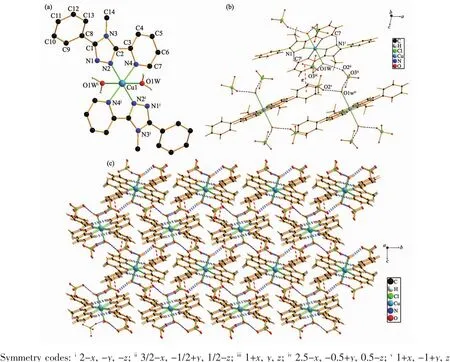
Fig.3 (a)Structure of 3 with Clions omitted for clarity;(b)Hydrogen-bonding and π…π interactions in 3;(c)3D stacking of 3
2.3 Crystal structure of[CdL 2(NO3)2]·CH 3CN(4)
The crystal of 4 belong to the monoclinic system with space group P21/c.Two 1,2,4-triazole ring nitrogen atoms (N2 and N6),two pyridine ring nitrogen atoms(N4 and N8)and two oxygen atoms (O1 and O4)of two NO3-ions are coordinated to the central Cd1Ⅱion,and the central Cd1Ⅱion has a distorted octahedral geometry [CdN4O2] (Fig.4a).As the nitrogen atoms coordinated to the Cd1Ⅱion,the corresponding bond lengths are slight different(Cd1-N2 0.234 6(3),Cd1-N6 0.232 0(3)nm,Cd1-N4 0.241 6(3)nm,Cd1-N8 0.245 8(3)nm).

Fig.4 (a)Structure of 4;(b)H-bonding interactions in 4;(c)3D stacking of 4
There are six non-classical H-bonding interactions in 4 (Fig.4b and Table 6),which are C4-H4…N11i(Symmetry codes:i2-x,-1/2+y,3/2-z),C7-H7…O1,C20-H20…O2ii(Symmetry codes:ii2-x,1-y,1-z),C21-H21…O4,C28-H28B…O3iii(Symmetry codes:iii-1+x,y,z)and C30-H30C…O2.There are also several C-H…π interactions in the crystal (Table 5).Three-dimensional network structure of 4 is formed by all these interactions (Fig.4).
2.4 Spectral characterization
2.4.1 IR and UV-Vis spectroscopy
In the IR spectrum of free ligand L,the bands of 1 588 and 1 486 cm-1are attributed to the aromatic ring skeleton vibration absorption.When the nitrogen atoms on the triazole and pyridine rings(such as N2 and N4)coordinated with metal ions in 1~4,the corresponding absorption bands were blue-shifted[30].The bands of 1 609 and 1 501 cm-1were observed in complex 1,while those for complex 2 are 1 611 and 1 501 cm-1,1 614 and 1 506 cm-1for complex 3,and 1 601 and 1 493 cm-1for complex 4,respectively(Fig.5).In the UV-Vis spectra of 1~4 in ethanol solutions with the concentration of 10 μmol·L-1measured at room temperature (Fig.6), ε1=7.6×10⁴L·mol-1·cm-1,ε2=9.1×10⁴L·mol-1·cm-1,ε3=0.66×10⁵L·mol-1·cm-1,ε4=0.75×10⁵L·mol-1·cm-1.All the complexes showed intense absorption bands at ~250 and ~280 nm,which are attributed to the π-π*and n-π*transitions.

Fig.5 IR spectra of 1~4

Fig.6 UV spectra of 1~4
2.4.2 Luminescence properties
The emission spectra of 1~4 in ethanol solutions with the concentration of 10 μmol·L-1were measured at room temperature (Fig.7).The slit of excitation and emission is 2 nm.Using rhodamine 6G (ΦF=0.85 in ethanol)as the reference,the formula for calculating the fluorescence quantum yield is as follows:

Where subscript sample and std represent the sample and the reference material,respectively,I represents the fluorescence integral strength,A represents the absorbance,n represents the refractive index.The fluorescence quantum yields of 1~4 were 0.63,0.56,0.65 and 0.58,respectively.In the emission spectra of 1 and 3,a broad emission maximum at 351 and 350 nm were observed with excitation at 257 and 256 nm,the emission maximum for 2 and 4 were at 352 and 355 nm with excitation at 280 and 275 nm,respectively.All these are caused by π-π*transitions in the ligands.

Fig.7 Excitation and emission spectra of 1~4
2.4.3 Thermogravimetric analyses (TGA)and PXRD
The thermal stabilities of 1,2 and 4 were determined at the temperature range of 30~800 ℃ in nitrogen atmosphere (Fig.8).For complex 1,the weight loss was 2.12%at 120℃due to loss of the lattice water (Calcd.2.88%).Complex 1 decomposed sharply between 200 and 500℃.The weight loss was 77.45%at 800 ℃,and the residue was CuCl2(Calcd.78.48%).Complex 2 are stable below 75°C.The weight loss was 5.49%at 160℃due to loss of water molecules(Calcd.5.21%),and it decomposed rapidly above 250℃.Complex 4 started to lose the weight above 50℃.It first lost the lattice acetonitrile molecule,and decomposed sharply above 250℃.The weight loss was 68.40%at 660 ℃ ,and the residue was Cd (NO3)2(Calcd.68.48%).

Fig.8 TGA curves of 1,2 and 4
Powder X-ray diffraction (PXRD)patterns of 1~4 were determined (Fig.9).The as-synthesized peak positions were in agreement with the simulated XRD patterns,which indicates the single phase purity of all complexes.

Fig.9 PXRD patterns of 1~4
3 Conclusions
Four complexes based on 4-methyl-3-phenyl-5-(2-pyridyl)-1,2,4-triazole were synthesized,and their structures were determined by X-ray crystallography,IR,UV-Vis,fluorescence measurement,TGA and PXRD.The central Cu1Ⅱion in 1 has a distorted tetragonal pyramid geometry[CuN4Cl],and the central metal ions in 2~4 have distorted octahedral geometries.Hydrogen bonds,C-H…πinteractions andπ…π stacking interactions make them form three-dimensional networks.Complexes 1~4 all show fluorescence properties with the fluorescence quantum yield being 0.63,0.56,0.65 and 0.58,respectively.
猜你喜歡
科學大眾(2023年17期)2023-10-26 07:38:38
幼兒畫刊(2022年11期)2022-11-16 07:22:36
中國交通信息化(2021年4期)2021-07-21 09:23:34
科技知識動漫(2017年7期)2017-08-09 19:52:45
科技知識動漫(2017年5期)2017-05-11 21:34:16
科技知識動漫(2017年4期)2017-04-15 22:24:55
傳媒評論(2017年12期)2017-03-01 07:04:58
科技知識動漫(2017年2期)2017-02-06 20:59:46
汽車與安全(2016年5期)2016-12-01 05:21:55
科技知識動漫(2016年10期)2016-10-18 20:35:00
