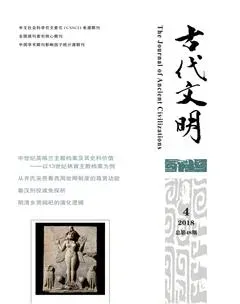
Contents and Abstracts
2018-12-10 09:06:16
古代文明 2018年4期
Title: Great Works by Great Pen, Distinct Views in Distinct Eyes: The Preface to ….………….……………………………………………………….………………………………/3
Gong Yushu, Professor, School of Foreign Languages, Peking University, Beijing, 100871, China.
This is the preface towritten by Prof.Yushu Gong.Both authors are eminent Assyriologists.They don’t only work in the same academic fi eld, but also belong to the same school found by late Prof.Zhichun Lin (aka Ri-Zhi).Nevertheless, they have disparate research interests and follow respective traditions of British and German scholarship.In this preface, Prof.Gong gives a general and critical review of Prof.Wu’s works, recalls their mutual college life, and expresses his own consideration of scholarly researches, among which there are quite a lot of insights deserving to share with the academia here.
Title: The Chinese Translation and Annotation of in Hittite Version…………………………………………………………………………………………………………/10
Li Zheng, Professor, Research Centre of Eastern Literature, Department of Western Asia Studies & School of Foreign Languages, Peking University, Beijing, 100871, China.
The text under the titleis an important document for the study of Hittite history.It is in this edict that the removal of the former successor from the throne and an appointment of a new successor by Hattusili I were mentioned, and a series of political conf l icts within the royal family were also written down.Moreover, this signif i cant decision of Hattusili I and what he portrayed himself in the text set up a good image of a Hittite king in Hittite kingdom, and answered the question in which kind of personality the Hittite king should have.This text was the critical historical source for understanding the succession to the Hittite Throne and the domestic situation of political reign during the early period of Hittite kingdom.
Hattusili I; Testamentary Edict; Successor to the throne; Translation and Annotation
Title: On the “Germani” in of Tacitus…………………………………………………………………/15
Yu Xinxiao, Ph.D.Candidate, School of History and Culture, Northeast Normal University, Changchun,Jilin, 130024, China; Gong Xiuhua, Professor, School of History and Culture, Northeast Normal University,Changchun, Jilin,130024, China.
“Germani” written by Tacitus and other western classical writers is often translated to “日耳曼人 ”in Chinese writings, which is often misunderstood as a nation.Inof Tacitus and other classical works, it was found that the “Germani” originated from the geographical concept of “Germania”, and it was the general name of all the inhabitants who lived in the “Germania”.If “Germani” is translated to “日耳曼尼亞人 ” in Chinese writings, it is more likely to highlight the origin of the name “Germani” and the general meaning that it represented all the inhabitants in the “Germania”.
Germani; Germania; Tacitus;
………..….………/25
Yang Shaojie, Ph.D.Candidate, Department of History, Sun Yat-sen University, Guangzhou,Guangdong, 510275, China.
As for the research of medieval ecclesiastical history, the medieval bishops’ registers are essential and important materials.In the twentieth century, along with the growing up of the local record societies,the medieval bishops’ registers began to be reorganized and published, that promoted the usage of these materials in the study of the ecclesiastical history.During this process, inf l uenced by newer theories and research methodologies, researchers of the bishops’ registers gradually shifted their attention from institutional history to social history.Accordingly, the value of this series of materials is further recognized.
Medieval; England; Bishops’ Registers; Local Record Society
Title: A Study of Fu Yue ’s Life based upon in the Tsinghua Bamboo-slips…….………/35
Liu Guangsheng, Professor, Confucius Institute, Qufu, Shandong, 273100, China.
Many scholars believed that Fu Yue (傅說) was originally from Fuyan (傅巖).Based on the Tsinghua bamboo-slips, we now know that he was more likely from the North Sea State (北海之州) which is geographically different from Fuyan where he merely stayed once a time as a visitor.The previously available records indicate that Fu Yue is skillful at civilian affairs.Other than that,(傅說之命) shows that he is the commander in the war against Shi Wei (豕韋).The Tsinghua bamboo-slips positively expanded our vision to understand Fu Yue.
Tsinghua bamboo-slips;; Fu Yue; King Wu Ding; Shi Zhong
……………………………………………………………………………/43
Du Yong, Professor, School of History and Culture, Tianjin Normal University, Tianjin, 300387, China.
Rejecting some scholars’ opinion about the origin of the Xing (井 ) clan of the Western Zhou, this study argues that the Xing clan is actually the offspring of Marquis Xing, which means that it is a branch originally from the Zhou royal clan.The Fief of the Xing is located in the area near Fufeng (扶風) of the present Shanxi province.As a glorious noble clan during the mid-Western Zhou dynasty, several members from this clan held important positions in the court.By examination of the history of the Xing clan, it can be seen that the hereditary system is commonly operated together with the system of bureaucracy.The male adult members of the noble clan are not all guaranteed to get off i cial positions.Other than that, only the recognized virtuous persons might be appointed to take those positions.This practice helped the Western Zhou to keep an elite serving in the political sphere.
Xing clan; Fief; Hereditary system; Function of respecting virtuous persons
……………/56
Sun Zhimin, Associate Professor, College of Humanities and Social Sciences, Hebei Agricultural University, Baoding, Hebei, 071001, China.
During the Qin and Han Dynasties, a sentenced criminal might receive a punishment reduction based on the occasional issued amnesty of an emperor, or, by the application of the penalty commutation system regulated by the Criminal Code.Remission by amnesty order can only be granted to a small number of criminals.The so called(赦降) practice makes it possible for some sentenced criminals to change their ways to serve their sentences, to shorten their service periods, and to change their status as a criminal.The practice called(赦贖) means to pay a fi ne to avoid serving in jail.In conclusion, there are different possibilities or ways for a criminal during the Qin and Han Dynasties to lawfully reduce the received punishment.
: Service in jail; reduction and remit; Decree for pardon
………/68
Wang Yajie, Instructor, Department of History, School of Social Development, Langfang Normal College,Langfang, Hebei, 065000, China.
Liu Lian (劉璉), the eldest son of Liu Ji (劉基), was involved in the political disputes at the early Ming period because of his family background.Record about his life is rare and many mysteries remain to the present.This paper invests the time period of Liu Lian serving as the Assistant Administrator of Jiangxi Province and concluded that it was started from the winter of the tenth year of Emperor Hongwu’s reign and ended by the June of the twelfth year of Emperor Hongwu’s reign.He was eventually poisoned to death by Hu Weiyong (胡惟庸).
Liu Lian; The Assistant Administrator of Jiangxi province; death
…………………………………………………………/73
: Wang Wei, Lecturer, School of History and Culture, Xinyang Normal University, Xinyang, Henan,464000, China.
After Hongwu and Yongle periods, the Ming political atmosphere began to be less harsh.Accordingly,a tendency of the family members of the court off i cials to contact local off i cials for private gain developed.In such a situation, the saying(屏跡公門) , keeping away from government, increased to be seen in the writings of the scholar-off i cials, such as in their letters to other family members.In different contexts, this saying refers to different meanings, including prohibition of family members to deal with governmental off i cials for personal gains, prohibition of themselves to disturbing the local governmental affairs for personal reasons, prohibition of the retired off i cials to interfere governmental decisions for personal reasons.Gradually,became a major standard in the assessment and evaluation of all off i cials.In this stage, this saying was not only a ref l ection of the Confucian self-cultivation ideas, but also a practical strategy of the scholar-off i cials to maintain their position and reputation.
Ming Dynasty; Scholar-off i cials;; letters to home
…/83
Zhao Kesheng, Professor, Department of History, Hainan Normal University, Haikou, Hainan, 571158, China.
The evolution of the cults of Local virtuous person shrines in the Ming and Qing Dynasties was mainly carried out in three aspects: overall regulation, administration, and internal structure.The government played a key role in the evolution by two ways.The fi rst was by providing direct institutional support, from placing the shrines in the local off i cial academies to the formation of the Yongzheng and Qianglong style administration system.The second was by changing the internal structure and function of the shrines, including changing the local icons or adding other type of persons into the shrines to diversify the function of these shrines.
Ming and Qing Dynasties; the cults of local virtuous persons; evolution
Title: The Inheritance of the Heian Japan Rite of to the Tang Rites and Its Later Localization…/91
Yun Huafang, Lecturer, School of History and Culture, Luoyang Normal University & Heluo Culture International Research Center, Luoyang, Henan, 471934, China.
(釋奠) is an Chinese rite to show respect to ancient sage-scholars.In early eighth century,when Japan established the Daigaku-ryō system by imitating the Tang practice, the rite ofwas also introduced to Japan.In the early times of the Heian Period, Mikado Saga further developed this rite with certain Japanese characters.The agenda of the Japaneseincludes not only the preparation,sacrif i ce, and lecture, but also poetry banquet and in palace discussion.Lecture was an important stage for the teachers of Daigaku-ryō to show their talent.Poetry banquet was an occasion for literati to express their respect to Confucius and the teachers, as well as their loyalty to the Mikado.The in palace discussion,on the other hand, was a compromised way for the Mikado to participate in the rite of.is fundamentally a performance to respect Confucian orthodoxy which is mutually complemented each other with the ruling orthodoxy.When the imperial power is weaken and the Daigaku-ryō declines, the Confucian orthodoxy represented by the rite ofwould also be decayed.
Japan; early Heian period;; the Kaiyuan Rite of the Great Tang; Engishiki
…………………………………………………………………/99
: Yao Xiaodong, Associate Professor, School of Humanities and Communications, Shanghai Normal University, Shanghai, 200234, China.
Since the mid-ninth century, the Japanese Shingon monks continually visited Tang China.Their experiences in China and achievements after returning home present the new trends of the Tang-Japan exchanges.First of all, the Japanese monks mainly took the vessels of the Tang merchants for their voyage, suggesting that the Tang merchants became the intermediaries facilitating the Japan and China communication.Secondly, the Shingon monks visited China as individuals usually stayed in China for longer time and visited more Buddhist temples or sacred Buddhist relics, including the Esoteric Buddhist temples, Tiantai Mountain, and Wutai Mountain.Thirdly, esoteric teachings, practices, ritual procedures,and means became the main knowledge for the Shingon monk sought to acquire.
Shingon Monk; Tang merchants; visit China; guarding the state; Esoteric Buddhism
…………………………………/109
Lai Zebing, Ph.D.Candidate, Chinese Academy of Social Sciences University, Beijing, 102488, China;Tang Kaijian, Professor, Department of History, University of Macau, Macau, China.
Macau and Nagasaki played important roles in the Portugal-Japan trade in the post 1570 age.In the beginning, Portuguese Carraca went to Japan almost every year.While the Portuguese made more prof i t than Japan, the trade was prof i table to both sides.Two events affected the trade in early seventeenth century.In 1608, some Japanese carried by Shuinsen were killed in Macau.In 1610, some Portuguese carried by Carraca were killed in Nagasaki.These events brought the trade between Portugal and Japan was stopped until a settlement was made in about one year later.Although these two events did not fully stop the Portuguese-Japanese trade, the monopoly position of the Portuguese in the trade with Japan did start to decline after these events.
Ming Dynasty; Macau; Nagasaki; Japanese Shuinsen; Portuguese Carraca
Title:The Translator’s Commentary to …………/119
Xu Jialing, Professor, School of History and Culture, Northeast Normal University, Changchun, Jilin,130024, China.
………….……………………………………………………………………/123
…………………….…….……………….…………………….….….………………/cover page 2
…………….…………..….……………………………………….…..……….……/cover page 3