新型艦空導彈聯調測試故障檢測技術研究
2018-10-20 11:01:44周松良涂金鑫
智能計算機與應用 2018年5期
周松良 涂金鑫
Abstract: During the technical preparation of a new ship-to-air missile before loading, it is necessary to carry out the test of all-bomb connection, and to realize the fault detection and elimination, so as to ensure the connectivity of the missile circuit system. Based on multi-sensor fusion tracking recognition and correlation spectrum feature extraction, a fault detection technique for missile joint test is proposed. The sensor array is used to collect the output signal of ship-to-air missile's full projectile connectivity circuit. The spectrum analysis and association rule feature extraction are used to extract the fault feature, and the spectrum decomposition and fuzzy decision are applied to the missile test signal. The spectral feature extraction method is used to mine the associated attribute features of the transmission information of the ship-to-air missile joint test system, and the fault category is judged according to the difference of the distribution of the associated attributes. To realize the accurate detection and identification of ship-to-air missile joint test fault, the hardware design of ship-to-air missile joint test fault detection system is carried out, mainly including the AD module of the fault detection system and the program loading module. Human-machine interaction module is also developed in hardware. The simulation results show that the fault diagnosis ability of this method is good and the ability to distinguish fault features is better. The fault detection efficiency of the joint test during the preparation of the missile stage conversion technology is improved.
引言
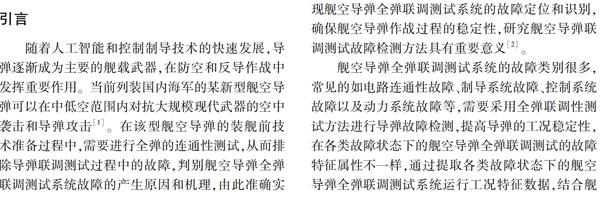
隨著人工智能和控制制導技術的快速發展,導彈逐漸成為主要的艦載武器,在防空和反導作戰中發揮重要作用。當前列裝國內海軍的某新型艦空導彈可以在中低空范圍內對抗大規模現代武器的空中襲擊和導彈攻擊[1]。在該型艦空導彈的裝艦前技術準備過程中,需要進行全彈的連通性測試,從而排除導彈聯調測試過程中的故障,判別艦空導彈全彈聯調測試系統故障的產生原因和機理,由此準確實現艦空導彈全彈聯調測試系統的故障定位和識別,確保艦空導彈作戰過程的穩定性,研究艦空導彈聯調測試故障檢測方法具有重要意義[2]。
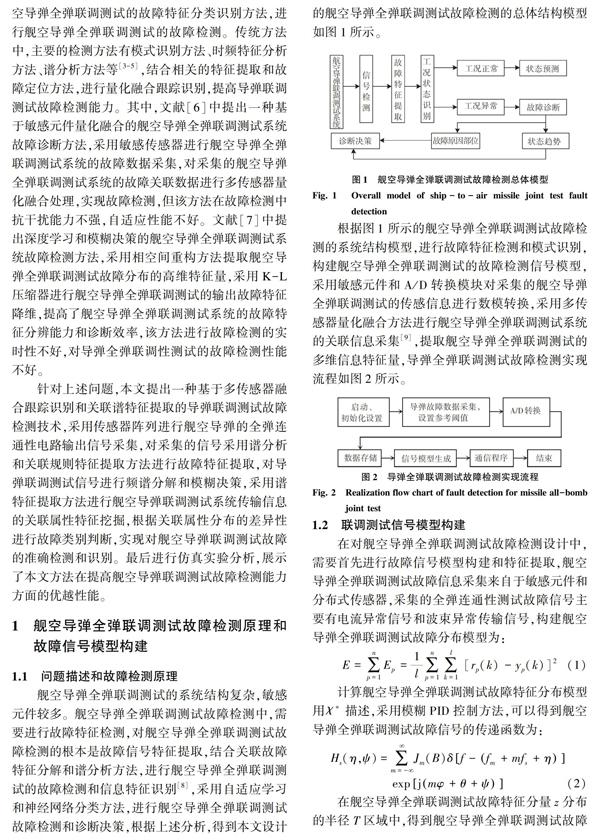
艦空導彈全彈聯調測試系統的故障類別很多,常見的如電路連通性故障、制導系統故障、控制系統故障以及動力系統故障等,需要采用全彈聯調性測試方法進行導彈故障檢測,提高導彈的工況穩定性,在各類故障狀態下的艦空導彈全彈聯調測試的故障特征屬性不一樣,通過提取各類故障狀態下的艦空導彈全彈聯調測試系統運行工況特征數據,結合艦空導彈全彈聯調測試的故障特征分類識別方法,進行艦空導彈全彈聯調測試的故障檢測。傳統方法中,主要的檢測方法有模式識別方法、時頻特征分析方法、譜分析方法等[3-5],結合相關的特征提取和故障定位方法,進行量化融合跟蹤識別,提高導彈聯調測試故障檢測能力。其中,文獻[6]中提出一種基于敏感元件量化融合的艦空導彈全彈聯調測試系統故障診斷方法,采用敏感傳感器進行艦空導彈全彈聯調測試系統的故障數據采集,對采集的艦空導彈全彈聯調測試系統的故障關聯數據進行多傳感器量化融合處理,實現故障檢測,但該方法在故障檢測中抗干擾能力不強,自適應性能不好。文獻[7]中提出深度學習和模糊決策的艦空導彈全彈聯調測試系統故障檢測方法,采用相空間重構方法提取艦空導彈全彈聯調測試故障分布的高維特征量,采用K-L壓縮器進行艦空導彈全彈聯調測試的輸出故障特征降維,提高了艦空導彈全彈聯調測試系統的故障特征分辨能力和診斷效率,該方法進行故障檢測的實時性不好,對導彈全彈聯調性測試的故障檢測性能不好。
針對上述問題,本文提出一種基于多傳感器融合跟蹤識別和關聯譜特征提取的導彈聯調測試故障檢測技術,采用傳感器陣列進行艦空導彈的全彈連通性電路輸出信號采集,對采集的信號采用譜分析和關聯規則特征提取方法進行故障特征提取,對導彈聯調測試信號進行頻譜分解和模糊決策,采用譜特征提取方法進行艦空導彈聯調測試系統傳輸信息的關聯屬性特征挖掘,根據關聯屬性分布的差異性進行故障類別判斷,實現對艦空導彈聯調測試故障的準確檢測和識別。最后進行仿真實驗分析,展示了本文方法在提高艦空導彈聯調測試故障檢測能力方面的優越性能。
1艦空導彈全彈聯調測試故障檢測原理和故障信號模型構建
1.1問題描述和故障檢測原理
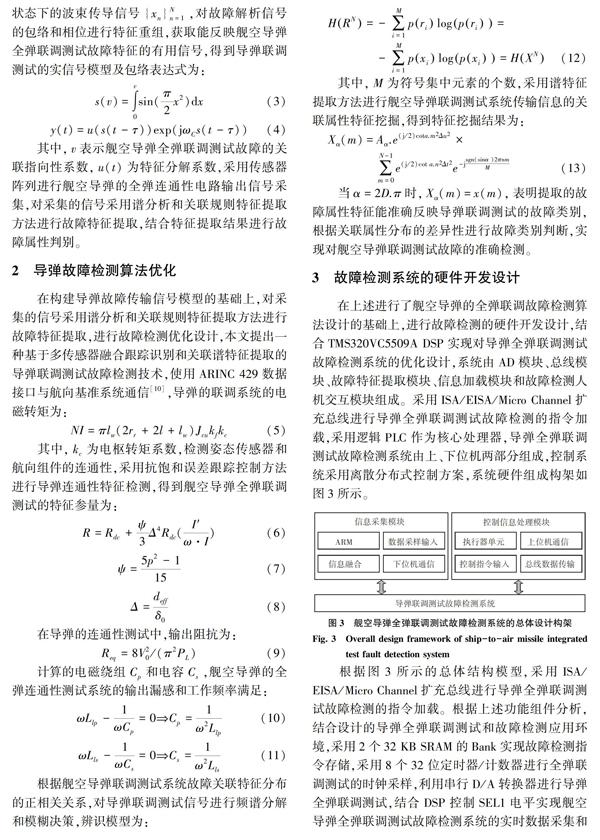
艦空導彈全彈聯調測試的系統結構復雜,敏感元件較多。艦空導彈全彈聯調測試故障檢測中,需要進行故障特征檢測,對艦空導彈全彈聯調測試故障檢測的根本是故障信號特征提取,結合關聯故障特征分解和譜分析方法,進行艦空導彈全彈聯調測試的故障檢測和信息特征識別[8],采用自適應學習和神經網絡分類方法,進行艦空導彈全彈聯調測試故障檢測和診斷決策,根據上述分析,得到本文設計的艦空導彈全彈聯調測試故障檢測的總體結構模型如圖1所示。
猜你喜歡
當代陜西(2021年17期)2021-11-06 03:21:36
瘋狂英語·新策略(2019年10期)2019-12-13 08:43:28
電子制作(2019年15期)2019-08-27 01:12:00
當代陜西(2019年10期)2019-06-03 10:12:04
學苑創造·A版(2018年11期)2018-02-01 06:29:20
數學小靈通·3-4年級(2017年9期)2017-10-13 08:10:54
讀者(2017年5期)2017-02-15 18:04:18
中國生物醫學工程學報(2017年6期)2017-02-10 05:11:45
噪聲與振動控制(2015年4期)2015-01-01 07:08:21
河南科技(2014年23期)2014-02-27 14:19:15