
超低酸催化纖維素一鍋法制取糠醛工藝優化
2018-10-11 10:13:42徐桂轉陳炳霖張少浩王冬祥
農業工程學報 2018年19期
徐桂轉,陳炳霖,張少浩,王冬祥,李 凱
?
超低酸催化纖維素一鍋法制取糠醛工藝優化
徐桂轉1,2,陳炳霖1,2,張少浩1,2,王冬祥1,李 凱1
(1. 河南農業大學機電工程學院,鄭州 450002; 2. 農業部農村可再生能源新材料與裝備重點試驗室,鄭州 450002)
5-乙氧基甲基糠醛(5-ethoxymethylfurfural,EMF)是一種新型液體生物燃料,具有較高的能量密度和優良的燃燒性能,被視為未來潛在的燃料替代物。該文利用酸質量為乙醇質量0.1%的硫酸催化纖維素與乙醇在高壓反應釜中一鍋法制取EMF。首先進行單因素試驗,然后利用響應面Box-Behnken模型研究不同影響因素對超低酸催化纖維素制取EMF收率的影響,對EMF制取工藝條件進行優化。結果表明:在反應時間、反應溫度和底物濃度3個影響因素中,反應時間對超低酸催化纖維素一鍋法制取EMF收率影響最大。根據Box-Behnken模型獲得最佳反應條件:反應溫度200 ℃、反應時間75 min、底物濃度30 g/L進行試驗驗證,EMF實際平均收率為14.93%,與理論預測值相對誤差為2.03%,說明該模型具有較好的預測性。該研究首次提出以超低酸催化纖維素直接制取EMF,并優化了超低酸催化纖維素制取EMF的工藝條件,可為成本低廉、產量豐富的纖維素生物質制取EMF提供借鑒和參考。
纖維素;酸度;生物燃料;超低酸;5-乙氧基甲基糠醛;一鍋法
0 引 言
生物質經酸催化水解、脫水可生成重要的平臺化合物—5-乙氧基甲基糠醛(5-Ethoxymethylfurfural, EMF),被認為是極具潛力的液體燃料[1]。EMF的能量密度為 8.7 kW·h/L具有與汽油(8.8 kW·h/L)和柴油(9.7 kW·h/L)相近的能量密度,遠高于乙醇的能量密度(6.1 kW·h/L),能與石化柴油以5%~25%的比例混溶,而其顆粒排放物、氮氧化物及硫氧化物排放量遠遠低于石化柴油,可以作為生物柴油替代石化柴油或作為燃料添加劑使用[2-3]。
目前,用于制備EMF的原料主要有:5-羥甲基糠醛(5-Hydroxymethylfurfural, HMF)等平臺化合物和果糖、蔗糖、菊粉、葡萄糖等生物質糖類。以HMF為原料時,EMF收率通常高于83%[4-5],如Liu等[5]以HMF為原料,EMF產率高達91.5%。以果糖為原料時,EMF產率為60%~90%[6-8];以菊粉為原料時,EMF產率為53%~62%[9-10];以蔗糖為原料時,EMF產率為33~43%[11-12];以葡萄糖原料時,由于受葡萄糖異構化限速的影響,EMF的產率通常較低,如Lew等[13]利用復合催化劑催化葡萄糖制取EMF,其產率最高為31%。可以看出,以生物質糖類為原料時,其內部果糖小分子含量越高,則越容易發生反應,得到的EMF產率也越高,即EMF收率趨勢大致為:果糖>菊粉>蔗糖>葡萄糖。以HMF和生物質糖為原料時,雖然EMF收率較高,但原料成本較高,工業化生產受到限制。
纖維素作為自然界中儲量最為豐富的綠色可再生資源,其轉化利用對社會的可持續發展意義重大[14]。然而,目前尚未有關于纖維素直接制備EMF的研究,已有的研究中[15-18],大多都是將纖維素先轉化為中間產物HMF、5-氯甲基糠醛(5-Chloromethylfurfural,CMF)和5-溴甲基糠醛(5-Bromomethylfurfural,BMF)等,然后通過中間產物獲得目標產物EMF,如Mascal等[16]將纖維素加入到含有5%氯化鋰濃鹽酸中,以二氯乙烷作為溶劑,65 ℃條件下回流、攪拌、萃取18 h后,再添加含有氯化鋰的濃鹽酸溶液繼續萃取12 h,經過蒸餾將80%的纖維素轉化為CMF,然后以乙醇為溶劑反應8 h得到EMF,收率達到95%。利用纖維素制取EMF的研究中,先轉化為CMF、HMF和BMF等中間產物,再轉化為EMF雖然可以獲得較高收率,但依然存在以下主要問題:1)中間產物分離、提純使制造工藝較為復雜、成本較高;2)液體催化劑使用量較大,對設備腐蝕性較強;3)反應時間過長;4)反應過程中添加的有機溶劑使后提取工藝復雜,增加了EMF生產成本[19-21]。
在制備EMF過程中,催化體系的選取是決定化學反應的重要因素,生物質醇解制備EMF的催化體系主要是由酸性催化劑組成,包括液體酸、固體酸和離子液體[4,22]等。傳統液體酸容易腐蝕設備、污染環境,離子液體目前制備工藝較為復雜、成本較高,而超低液體酸對設備基本沒有腐蝕,可以作為綠色催化體系看待[23],因此,超低液體酸對生物質的催化作用引起了研究者的關注[24-26]。在前期研究中,作者曾嘗試利用超低酸催化生物質糖類一鍋法合成乙酰丙酸乙酯(Ethyl levulinate, EL)和EMF,發現催化劑用量減少能夠降低對設備腐蝕和對環境的危害[8]。受此啟發,本研究嘗試利用酸質量為乙醇質量0.1%的硫酸作為超低酸催化劑,在無溶劑情況下直接催化果糖和乙醇制取EMF。首先進行單因素試驗,考察反應溫度、反應時間和底物濃度3因素對EMF收率的影響;然后根據單因素試驗結果設計響應面試驗方案,對EMF反應工藝條件進行優化,以得到超低酸催化纖維素一鍋法制取EMF的最佳工藝條件,為纖維素直接合成EMF提供一條綠色、經濟的路徑。
1 材料與方法
1.1 試驗材料
微晶纖維素,Solarbi公司;濃硫酸,AR,山東雙雙化工有限公司;乙醇,AR,天津瑞金特化學品有限公司;純凈水,娃哈哈純凈水;乙腈,HPLC,美國VBS公司;甲醇,HPLC,湖北社文化工科技有限公司;EMF,HPLC,西格瑪奧德里奇(上海)貿易有限公司;乙酸,HPLC,天津市科密歐化學試劑有限公司;濾紙和微孔濾膜等易耗品購自鄭州本地經銷商。
1.2 試驗設備
美國安捷倫公司Agilent-1260LC高效液相色譜系統,包括G1311C四元泵、G1329B自動進樣器、G1316A柱溫箱和G1314F紫外檢測器;JJ224BC型電子天平,常熟市雙杰測試儀器廠;高壓反應釜,鞏義市英峪高科儀器廠;真空抽濾機,意大利VELP公司;GM-0.20型隔膜真空泵,溶劑過濾器,天津市津騰試驗設備有限公司;TGL-16C型高速離心機,上海安亭科學儀器廠;SYU- 10-200DT型超聲波清洗機,鄭州市生元儀器有限公司。
1.3 分析與計算方法
EMF收率定義為產物中EMF的摩爾數與反應物(纖維素)的摩爾數之比,由公式(1)進行計算。
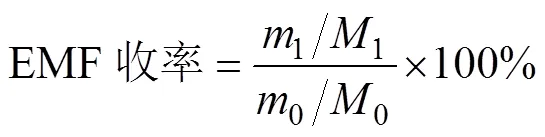
式中0和1分別為原料(纖維素)和EMF的質量,g;0(以單糖計)和1為原料和EMF的摩爾質量,分別為162和154。
1.4 試驗方法
首先進行單因素試驗,然后在單因素試驗結果上進行響應面優化試驗。單因素試驗中考查反應溫度、反應時間和底物濃度對超低酸催化纖維素制取EMF的影響。所有的試驗均在200 mL具有機械攪拌裝置的高壓反應釜中進行,首先加入80 mL乙醇溶液作為反應溶劑,催化劑為0.1%(以乙醇質量為基準)的硫酸。反應釜初始攪拌速度為250 r/min,當達到設定溫度時開始計時,并調節機械攪拌速度至500 r/min。當達到反應時間時立即取下反應器,將其放入冰水中冷卻到室溫,然后用濾紙過濾反應液,并將濾液用乙醇稀釋,經10 000 r/min高速離心30 min,取上清液進行液相色譜分析。
2 結果與分析
2.1 單因素試驗結果分析與討論
2.1.1 反應溫度對EMF收率的影響
反應溫度在醇解過程中有非常重要的作用。在進行單因素試驗時,設定反應時間為30 min,纖維素原料的底物濃度為20 g/L,乙醇用量為80 mL,催化劑為0.1%硫酸。分考察反應溫度為180、190、200、210和220 ℃時對纖維素一鍋法制取EMF收率的影響,結果如圖1所示。

注:纖維素1.6 g,乙醇80 mL,反應時間30 min,硫酸用量0.064 g。
由圖1可知,反應溫度對EMF收率有顯著的影響,EMF的收率隨著反應溫度的增加出現先增加后減少的趨勢。在反應時間相同時,隨著反應溫度的提高,EMF的收率從反應溫度為180 ℃時的5.02%提高反應溫度為200 ℃時的12.57%。但當反應溫度超過200 ℃時,EMF的收率出現明顯的下降,這可能是因為反應溫度的升高促使纖維素原料發生更多的副反應,也可能是由于目標產物在高溫條件下發生降解,這些原因造成了目標產物的生成速率遠遠小于目標產物的降解速率,從而使EMF的收率下降[27],因此確定纖維素原料單因素試驗最佳的反應溫度為200 ℃。
2.1.2 反應時間對EMF收率的影響
選取反應溫度200 ℃,纖維素底物濃度為20 g/L,考察反應時間分別為5、30、60、90和120 min時對纖維素生成EMF收率的影響,結果如圖2所示。
1.3.1 方法 采用護理工作滿意度調查問卷進行橫斷面調查,此次現況調查共發放問卷225份,回收220份,有效問卷回收率達97.78%。統計出患者對護理工作不滿意的問題并分析原因,醫院管理層領導根據原因制定落實改進措施,干預后20 d后復測患者滿意度,比較干預前后病人滿意度變化。
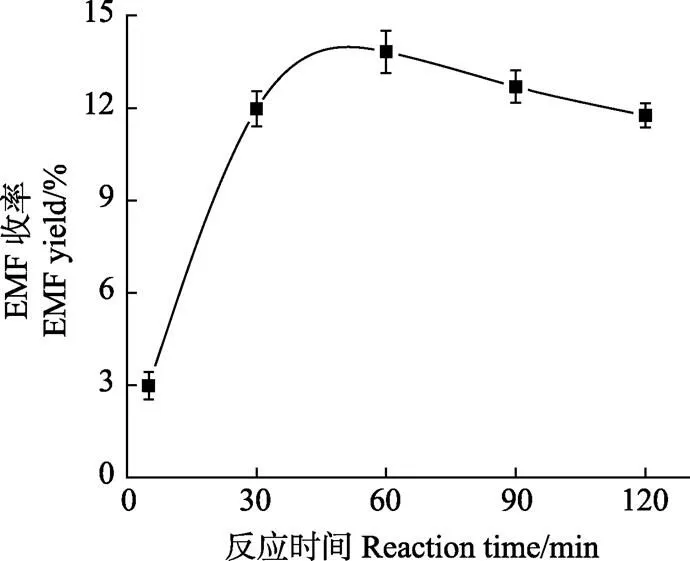
注:纖維素1.6 g,乙醇80 mL,反應溫度200 ℃,硫酸用量0.064 g。
圖2反映了EMF的收率隨著反應時間的延長出現先增加后降低的變化趨勢,在反應時間為5~30 min時,EMF收率快速增加,當反應時間達到60 min時EMF收率達到最大值,此時EMF的收率為13.32%,超過60 min后,EMF收率隨著反應時間延長開始明顯下降,當反應時間達到120 min時,EMF收率降到了11.76%。反應時間延長導致EMF收率下降可能是由于反應副產物附著在原料表面,使之與催化劑接觸面積減小,同時有部分EMF發生分解,造成了EMF收率在反應60 min后隨反應時間延長而降低。觀察反應后產物溶液的顏色變化,發現隨著時間的延長色澤逐漸加深,由淺黃色變化成深褐色,可能是由于反應時間的延長,產物中出現了更多不溶性腐殖質副產物而使溶液顏色變深[28]。適當的高溫和較短的反應時間有利于目標產物EMF的生成。由此可知,反應時間的單因素試驗最佳的反應時間為60 min。
2.1.3 底物濃度對EMF收率的影響
選取反應溫度為200 ℃,反應時間為60 min,考察纖維素原料底物濃度為10、20、30、40和50 g/L時EMF的收率,結果如圖3所示。
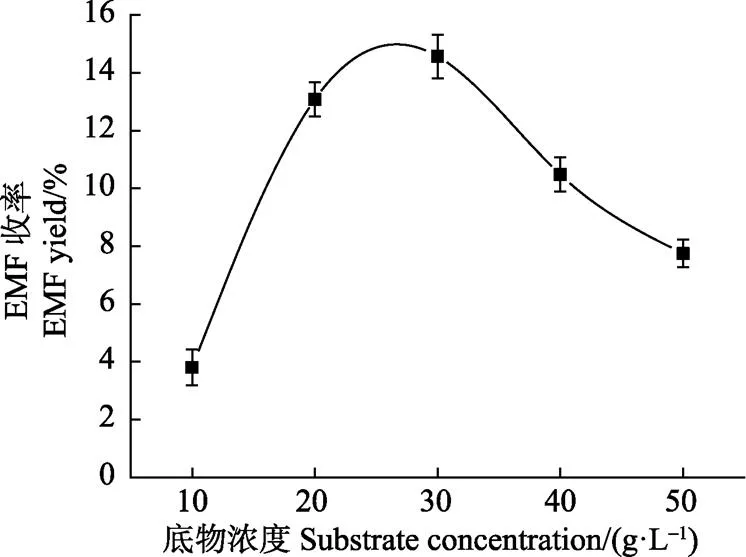
注:乙醇80 mL,反應溫度200 ℃,反應時間60 min,硫酸用量0.064 g。Note: Ethanol 80 mL, reaction temperature 200 ℃, reaction time 60 min, H2SO4 0.064 g.
由圖3可知,隨著纖維素底物濃度增加,EMF收率出現先增加后減少的現象。在纖維素底物濃度為10 g/L到30 g/L的范圍時,EMF的收率隨著底物濃度的增加而快速增加,底物濃度為10 g/L時,EMF的收率為3.81%;當底物濃度增大到20 g/L時,EMF的收率增大到13.32%,此階段EMF增長幅度最大。當纖維素濃度從20增大到30 g/L時,EMF收率增多了1.24%,達到了最大值,14.56%,此階段EMF收率增長較為緩慢。分析原因,可能是底物濃度為10 g/L時,反應中底物含量較小,反應速率較慢,此時增加底物濃度有利于反應的進行,會增大反應速度,所以從10變化到20 g/L時,增多的底物加快了EMF的生成,使得EMF收率快速增大;但當底物濃度達到20 g/L時,底物濃度對反應的影響作用已減小,當底物濃度達到30 g/L時,體系中底物濃度已經達到最大,再增多底物反而促進了逆反應的進行。所以,從圖3可以看出,當底物濃度從20變化到30 g/L時EMF收率變化較小,而從30增大到50 g/L時,EMF收率反而出現了明顯的下降,可能是由于底物濃度的增大造成原料與催化劑的接觸面積不夠,抑制了EMF的生成,或者是由于目標產物與復雜的副產物發生結合等其他的原因,造成了目標產物EMF收率下降[29]。由此可以確定底物濃度單因素試驗最佳的原料底物濃度為30 g/L。
2.2 響應面試驗結果與討論
2.2.1 響應面試驗設計
選取反應溫度、反應時間和反應物底物濃度3個因素為自變量,以EMF收率作為響應值,設計三因素三水平響應面試驗。根據單因素試驗結果,選取各因素與水平如表1所示。
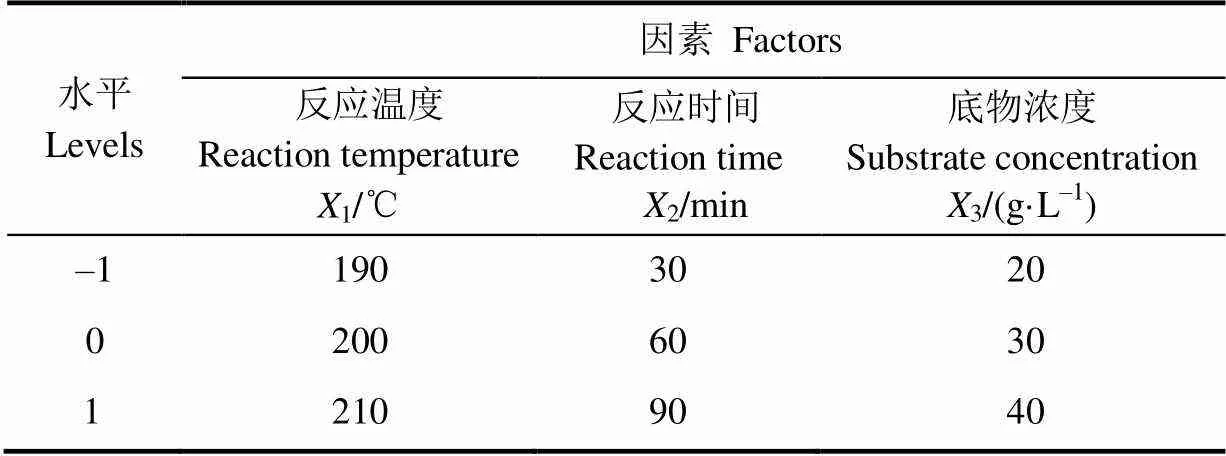
表1 響應面試驗因素與水平
根據Box-Behnken設計原理,響應面試驗設計方案及結果如表2所示。
2.2.2 響應面試驗結果分析與討論

對回歸方程各因素進行分析,該模型的一次項中,反應時間、反應溫度和底物濃度的P值分別為0.051 5,0.114 1和0.241 3,均大于0.05,為不顯著項;二次項值依次為0.000 2,0.174 3和0.020 7,其中,反應溫度和底物濃度的二次項P值小于0.05,對EMF收率影響較為顯著;從各因素交互的值可以發現,反應溫度和反應時間以及反應時間和底物濃度的交互作用最強,值為0.064 3,其次是反應溫度和底物濃度的交互作用。根據值得大小可判斷各個因素對目標產物EMF收率的影響作用依次為:反應時間>反應溫度>底物濃度。
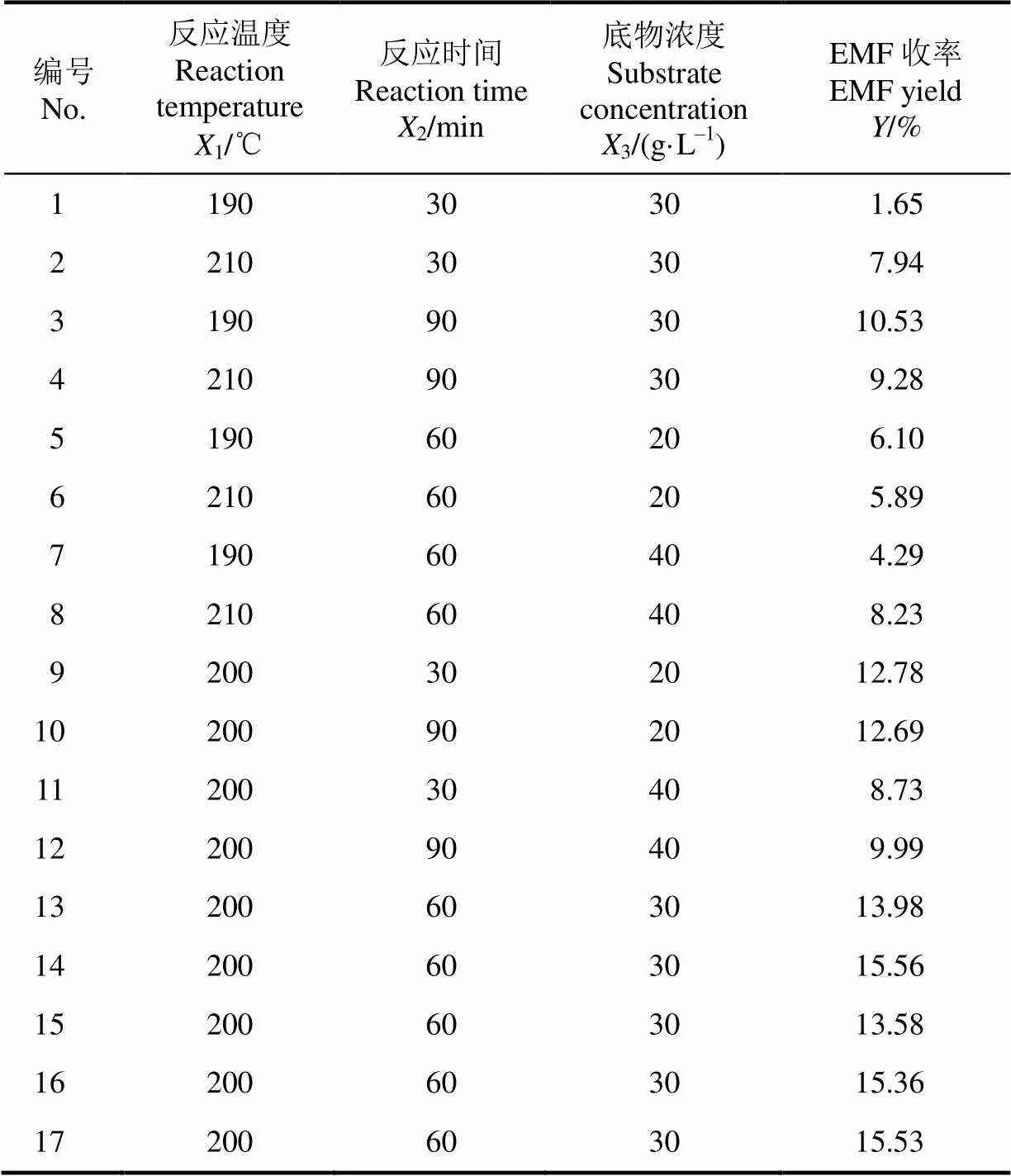
表2 響應面試驗設計及試驗結果
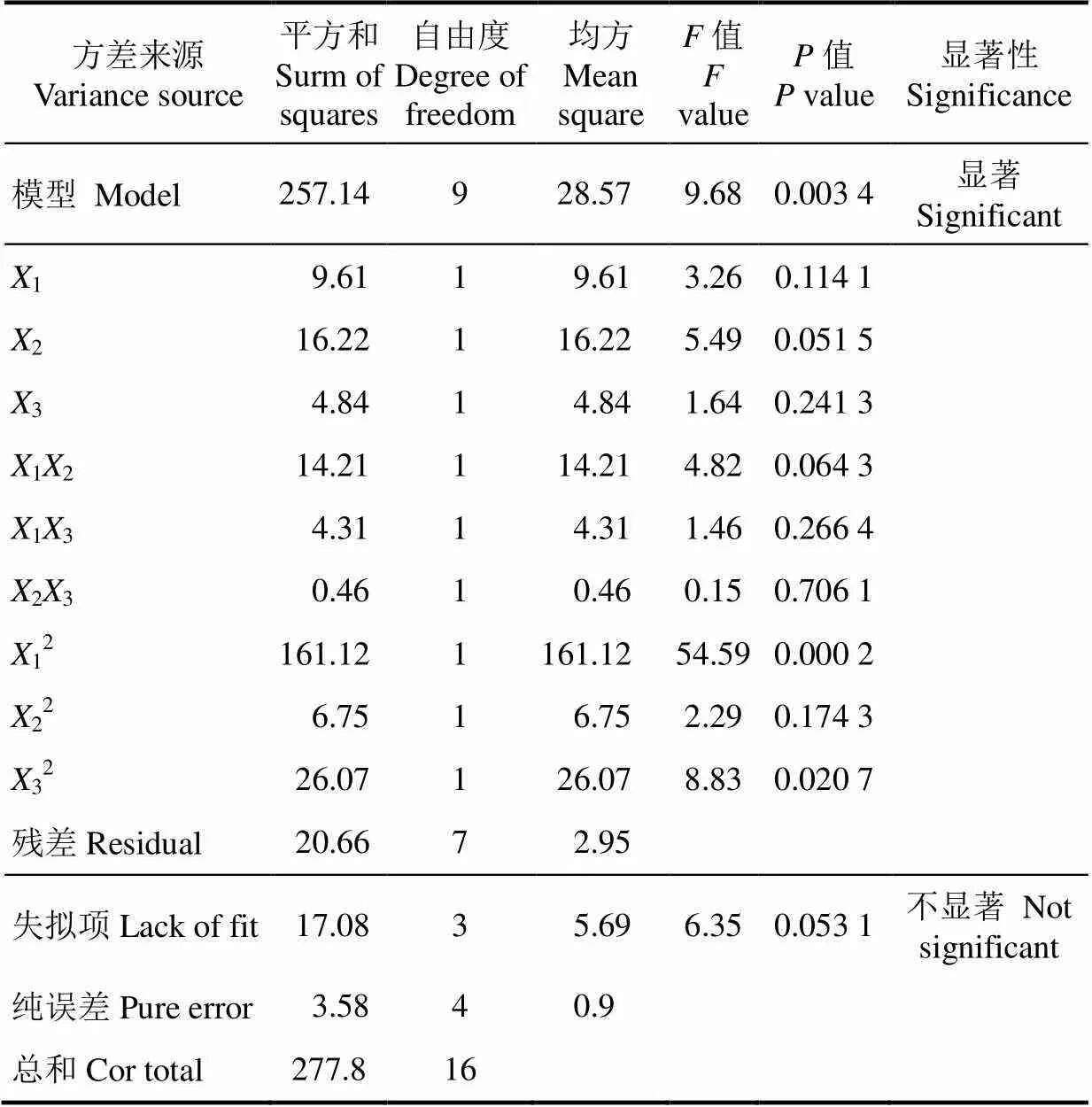
表3 回歸模型方差分析
利用Design Expert 8.0.5數據統計分析軟件對回歸模型繪制響應面圖,分析各個因素間對響應值的影響。圖4為各交互項對目標產物EMF收率作用的三維曲面圖及相應等高線圖。從圖4a可以看出,EMF收率隨反應溫度變化的曲面變化較為明顯,而隨反應時間呈現出明顯的上升趨勢。圖4b為反應溫度和底物濃度交互作用對EMF收率的影響,圖中顯示二維等高曲線呈橢圓形,三維曲面坡度明顯,表明反應溫度和底物濃度之間的交互作用對EMF收率的影響較大。在圖4c中,EMF收率隨著反應時間和底物濃度變化的曲面有明顯的坡度,說明在該實驗設計范圍內,存在極值,即響應面的最高點。
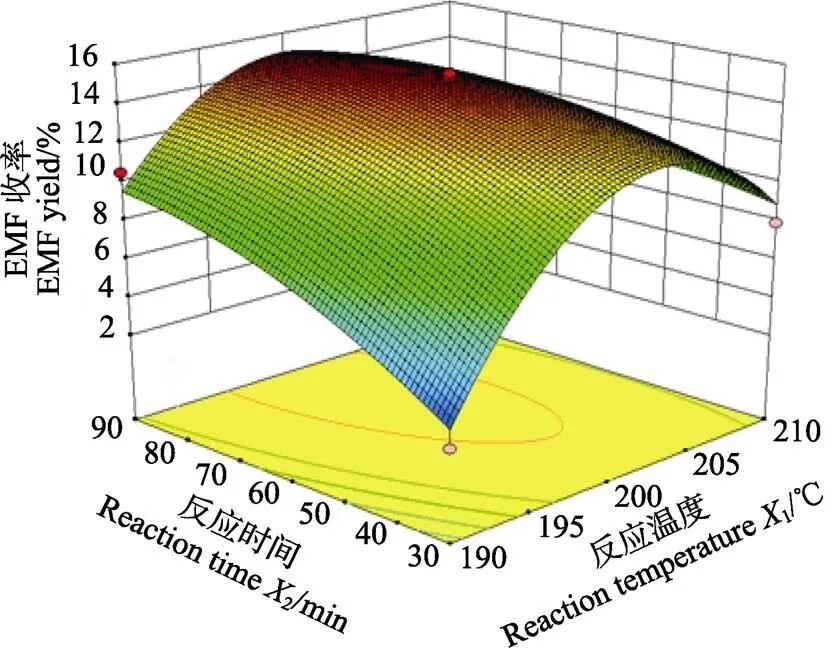
a.1和2交互作用
a. Interactions between1and2
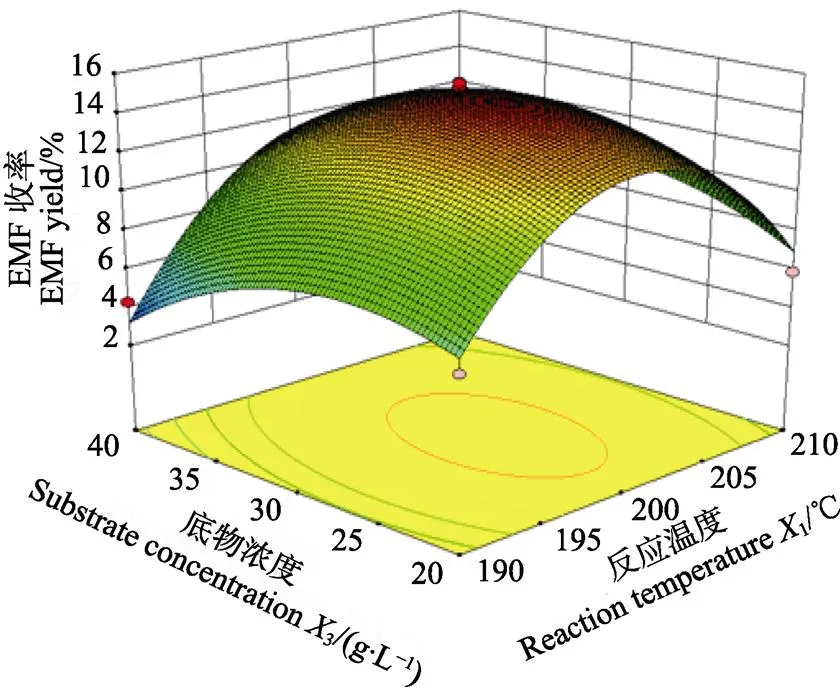
b.1和3交互作用
b. Interactions between1and3
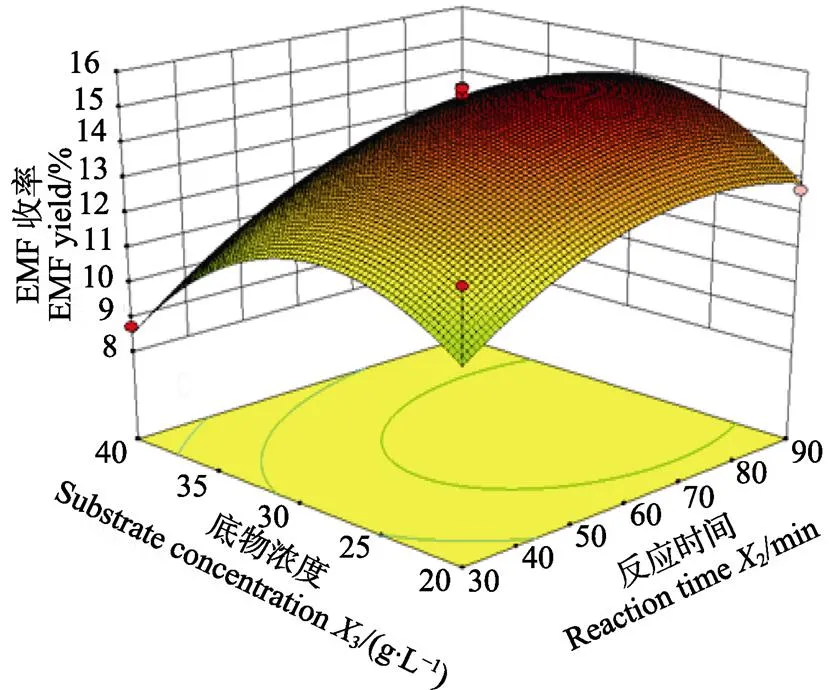
c. X2和X3交互作用
2.2.3 響應面優化工藝條件及驗證
通過對回歸模型的預測,超低質量濃度硫酸催化纖維素一鍋法制取EMF的最佳工藝條件為:反應溫度199.95 ℃、反應時間為76.50 min,底物濃度為28.79 g/L,此時預測的EMF最大收率為15.24%。考慮到工藝的可操作性,將最佳工藝條件調整為反應溫度200 ℃、反應時間75 min、底物濃度30 g/L。在此反應條件下重復3次試驗,EMF的平均收率為14.93%,與理論預測值的相對誤差為2.03%,表明模型可靠。
2.3 纖維素醇解制備不同平臺化合物的對比
將本文研究結果與文獻中利用纖維素制取EMF和EL等平臺化合物研究結果進行對比,結果如表4所示。Bredihhin等[15]用兩步法催化纖維素制取EMF,雖然收率可以達到40%,但合成工藝較為復雜、反應時間較長,且涉及到中間產物的分離、提純。除此之外,利用纖維素制取EMF目前還鮮有研究。本文利用一鍋法催化纖維素,制備工藝較為簡單、反應時間較短。由表4還可以發現,本文使用超低酸催化纖維素制取EMF的收率與文獻中利用無機酸、固體酸、混合酸和離子液體催化制取EL和乙酰丙酸甲酯(methyl levulinate, ML)的收率相近,而本文中催化劑成本較低、反應時間較短,且無有機溶劑,對環境的不利影響較小。因此,本文研究成果將為纖維素生物質直接制取EMF提供借鑒和參考。
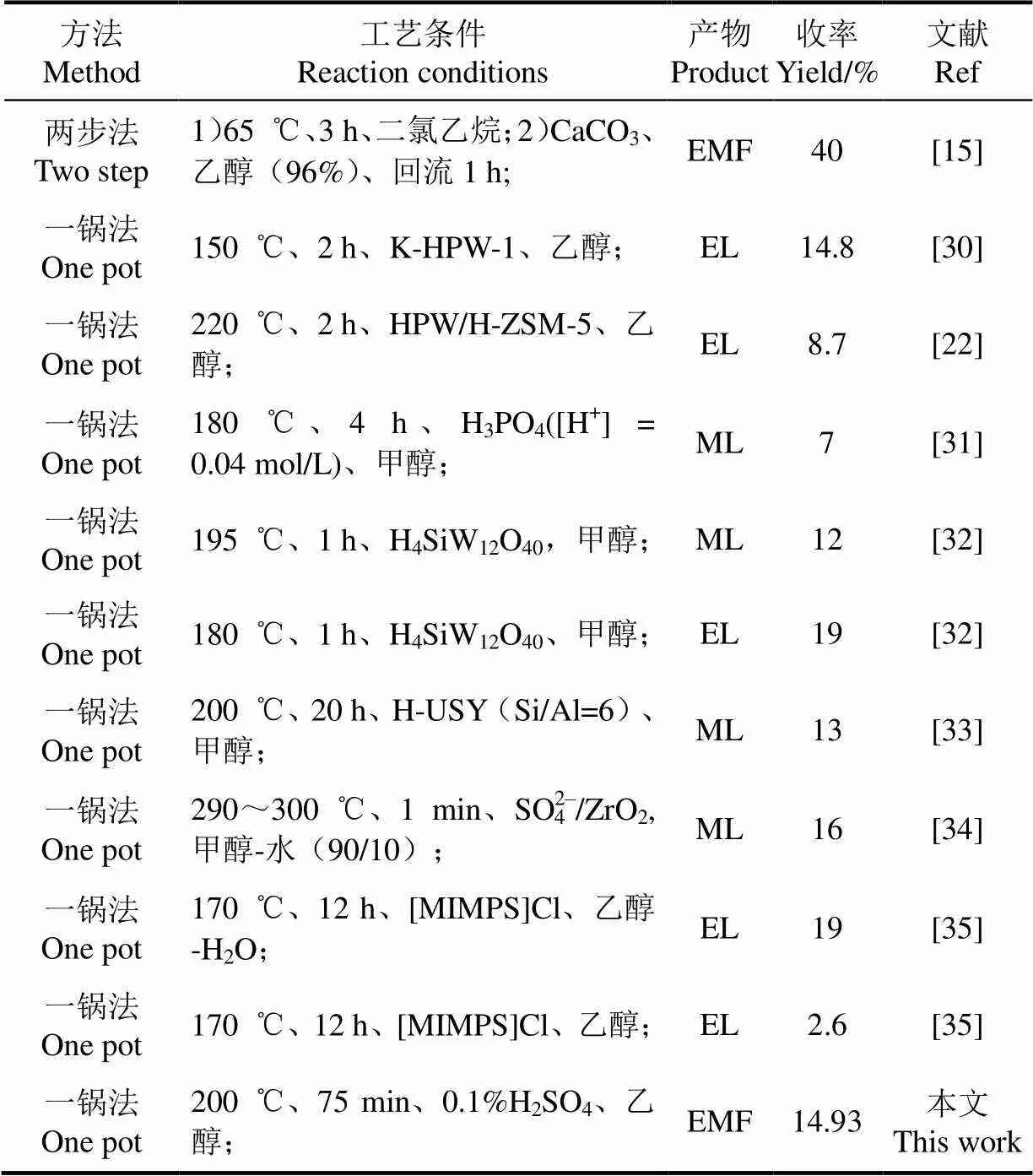
表4 纖維素制備不同平臺化合物的對比
3 結 論
本研究利用單因素和響應面試驗方法對超低質量濃度硫酸催化纖維素與乙醇一鍋法制取EMF(5- ethoxymethylfurfural)進行了研究,考察了溫度、反應時間和底物濃度3個影響因素對EMF收率的影響。結果表明,各個因素對目標產物EMF收率的影響作用依次為:反應時間>反應溫度>底物濃度。根據Box- Behnken模型預測結果,選取最佳反應條件為:反應溫度200 ℃、反應時間75 min和底物濃度30 g/L進行平行試驗驗證,得到EMF實際最大平均收率為14.93%,與理論預測值誤差為2.03%。通過與其他以纖維素為原料制取EMF研究結果對比,利用超低質量濃度的硫酸催化纖維素一鍋法制取EMF,具有工藝簡單、反應時間短、不需有機溶劑和基本上對設備不腐蝕等優點。
本文研究結果表明,利用質量濃度超低的硫酸能有效催化纖維素一鍋法制取EMF,為利用成本低廉、資源豐富的纖維素制取EMF的研究提供借鑒和參考。
[1] Zhang Zehui, Huber G W. Catalytic oxidation of carbohydrates into organic acids and furan chemicals[J]. Chemical Society Reviews, 2018, 47(4): 1351-1390.
[2] Bai Yuanyuan, Wei Lu, Yang Mengfei, et al. Three-step cascade over one single catalyst: Synthesis of 5-(ethoxymethyl)furfural from glucose over hierarchical lamellar multi-functional zeolite catalyst[J]. Journal of Materials Chemistry A, 2018, 6(17): 7693-7705.
[3] Huang Yaobing, Yang Tao, Lin Yuting, et al. Facile and high-yield synthesis of methyl levulinate from cellulose[J]. Green Chemistry, 2018, 20(6): 1323-1334.
[4] Hu Lei, Lin Lu, Wu Zhen, et al. Recent advances in catalytic transformation of biomass-derived 5-hydroxymethylfurfural into the innovative fuels and chemicals[J]. Renewable & Sustainable Energy Reviews, 2017, 74: 230-257.
[5] Liu Anqiu, Liu Bing, Wang Yimei, et al. Efficient one-pot synthesis of 5-ethoxymethylfurfural from fructose catalyzed by heteropolyacid supported on K-10 clay[J]. Fuel, 2014, 117: 68-73.
[6] Liu Bing, Zhang Zehui, Huang Kecheng. Cellulose sulfuric acid as a bio-supported and recyclable solid acid catalyst for thesynthesis of 5-hydroxymethylfurfural and 5-ethoxymethylfurfural from fructose[J]. Cellulose. 2013, 20(4): 2081-2089.
[7] Liu Anqiu, Zhang Zehui, Fang Zhongfeng, et al. Synthesis of 5-ethoxymethylfurfural from 5-hydroxymethylfurfural and fructose in ethanol catalyzed by MCM-41 supported phosphotungstic acid[J]. Journal of Industrial and Engineering Chemistry, 2014, 20: 1977-1984.
[8] Xu Guizhuan, Chen Binglin, Zheng Zhangbin, et al. One-pot ethanolysis of carbohydrates to promising biofuels: 5- ethoxymethylfurfural and ethyl levulinate: One-pot ethanolysisof carbohydrates to biofuels[J]. Asia-Pacific Journal of Chemical Engineering, 2017, 12(4): 527-535.
[9] Yuan Ziliang, Zhang Zehui, Zheng Judun, et al. Efficient synthesis of promising liquid fuels 5-ethoxymethylfurfural from carbohydrates[J]. Fuel, 2015, 150: 236-242.
[10] Chen Tao, Peng Lincai, Yu Xin, et al. Magnetically recyclable cellulose-derived carbonaceous solid acid catalyzed the biofuel 5-ethoxymethylfurfural synthesis from renewable carbohydrates[J]. Fuel, 2018, 219: 344-352.
[11] Guo Haixin, Duereh A, Hiraga Y, et al. Perfect recycle and mechanistic role of hydrogen sulfate ionic liquids as additive in ethanol for efficient conversion of carbohydrates into 5-ethoxymethylfurfural[J]. Chemical Engineering Journal, 2017, 323: 287-294.
[12] Kumari P K, Rao B S, Padmakar D, et al. Lewis acidity induced heteropoly tungustate catalysts for the synthesis of 5-ethoxymethyl furfural from fructose and 5-hydroxymethy-lfurfural[J]. Molecular Catalysis, 2018, 448: 108-115.
[13] Lew C M, Rajabbeigi N, Tsapatisis M. One-pot synthesis of 5-(ethoxymethylfurfural) from glucose using Sn-BEA and amberlyst catalysts[J]. Industrial & Engineering Chemistry Research, 2012, 51(14): 5364-5366.
[14] Deng Lin, Chang Chun, An Ran, et al. Metal sulfates- catalyzed butanolysis of cellulose: Butyl levulinate production and optimization[J]. Cellulose, 2017, 24(12): 1-13.
[15] Bredihhin A, Maeorg U, Vares L. Evaluation of carbohydrates and lignocellulosic biomass from different wood species as raw material for the synthesis of 5-bromomethyfurfural[J]. Carbohydrate Research, 2013, 375: 63-67.
[16] Mascal M, Nikitin E B. Direct, high-yield conversion of cellulose into biofuel[J]. Angewandte Chemie International Edition, 2008, 47(41): 7924-7926.
[17] Mascal M, Nikitin E B. High-yield conversion of plant biomass into the key value-added feedstocks 5-(hydroxymethyl) furfural, levulinic acid, and levulinic esters via 5-(chloromethyl) furfural[J]. Green Chemistry, 2010, 12(3): 370-373.
[18] Xiao Shaohua, Liu Bing, Wang Yimei, et al. Efficient conversion of cellulose into biofuel precursor 5-hydroxymethylfurfural in dimethyl sulfoxide–ionic liquid mixtures[J]. Bioresource Technology, 2014, 151: 361-366.
[19] Xu Guizhuan, Chang Chun, Zhu Weina, et al. A comparative study on direct production of ethyl levulinate from glucose in ethanol media catalysed by different acid catalysts[J]. Chemical Papers, 2013, 67(11): 1355-1363.
[20] Yang Yu, Hu Changwei, Abu-Omar M M. Conversion of glucose into furans in the presence of AlCl3in an ethanol- water solvent system[J]. Bioresource Technology, 2012, 116: 190-194.
[21] Yin Shanshan, Sun Jie, Liu Bing, et al. Magnetic material grafted cross-linked imidazolium based polyionic liquids: an efficient acid catalyst for the synthesis of promising liquid fuel 5-ethoxymethylfurfural from carbohydrates[J]. Journal of Materials Chemistry A, 2015, 3(9): 4992-4999.
[22] Zhao Shiqiang, Xu Guizhuan, Chang Junli, et al. Direct production of ethyl levulinate from carbohydrates catalyzed by H-ZSM-5 supported phosphotungstic acid.[J]. Bioresources, 2015, 10(2): 2223-2234.
[23] Peng Lincai, Lin Lu, Li Hui. Extremely low sulfuric acid catalyst system for synthesis of methyl levulinate from glucose[J]. Industrial Crops & Products, 2012, 40: 136-144.
[24] Xu Guizhuan, Chang Chun, Fang Shuqi, et al. Cellulose reactivity in ethanol at elevate temperature and the kinetics of one-pot preparation of ethyl levulinate from cellulose[J]. Renewable Energy, 2015, 78: 583-589.
[25] Chang Chun, Xu Guizhuan, Zhu Weina, et al. One-pot production of a liquid biofuel candidate—Ethyl levulinate from glucose and furfural residues using a combination of extremely low sulfuric acid and zeolite USY[J]. Fuel, 2015, 140: 365-370.
[26] Peng Lincai, Lin Lu, Li Hui, et al. Acid-catalyzed direct synthesis of methyl levulinate from paper sludge in methanol medium[J]. Bioresources, 2013, 8(4): 5895-5907.
[27] Zuo Miao, Le Kai, Feng Yunchao, et al. An effective pathwayfor converting carbohydrates to biofuel 5-ethoxymethylfurfural via 5-hydroxymethylfurfural with deep eutectic solvents (DESs)[J]. Industrial Crops & Products, 2018, 112: 18-23.
[28] Sun Yingnan, Zhang Qingqing, Zhang Panpan, et al. Nitrogen-doped carbon-based acidic ionic liquid hollow nanospheres for efficient and selective conversion of fructose to 5-ethoxymethylfurfural and ethyl levulinate[J]. ACS Sustainable Chemistry & Engineering, 2018, 6(5): 6771-6782.
[29] Thombal R S, Jadhav V H. Application of glucose derived magnetic solid acid for etherification of 5-HMF to 5-EMF, dehydration of sorbitol to isosorbide, and esterification of fatty acids[J]. Tetrahedron Letters, 2016, 57(39): 4398-4400.
[30] Zhao Shiqiang, Xu Guizhuan, Chang Chun, et al. Direct conversion of carbohydrates into ethyl levulinate with potassium phosphotungstate as an efficient catalyst[J]. Catalysts, 2015, 5(4): 1897-1910.
[31] Wu Xiaoyu, Fu Jie, Lu Xiuyang. One-pot preparation of methyl levulinate from catalytic alcoholysis of cellulose in near-critical methanol[J]. Carbohydrate Research, 2012, 358: 37-39.
[32] Li Hu, Fang Zhen, Luo Jia, et al. Direct conversion of biomass components to the biofuel methyl levulinate catalyzedby acid-base bifunctional zirconia-zeolites[J]. Applied Catalysis B Environmental, 2017, 200: 182-191.
[33] Saravanamurugan S, Riisager A. Zeolite catalyzed transformation of carbohydrates to alkyl levulinates[J]. Chemcatchem, 2013, 5(7):1754-1757.
[34] Rataboul F, Essayem N. Cellulose reactivity in supercritical methanol in the presence of solid acid catalysts: Direct synthesis of methyl-levulinate[J]. Industrial & Engineering Chemistry Research, 2011, 50(2): 699-704.
[35] Amarasekara A S, Wiredu B. Acidic ionic liquid catalyzed one-pot conversion of cellulose to ethyl levulinate and levulinic acid in ethanol-water solvent system[J]. Bioenergy Research, 2014, 7(4): 1237-1243.
Process optimization on 5-ethoxymethylfurfural production from cellulose catalyzed by extremely low acid in one-pot reaction
Xu Guizhuan1,2, Chen Binglin1,2, Zhang Shaohao1,2, Wang Dongxiang1, Li Kai1
(1.450002,;2.450002,)
With the inevitable depletion of non-renewable petroleum resources and the rising environmental concerns, renewable biomass has been regarded as a potential resource for sustainable supply of biofuels. The development of simple, cheap and sustainable catalytic process for the production of biofuels has become a major target. Among the promising biofuels, EMF (5-ethoxymethylfurfural) has been considered as a new generation of biofuel or fuel additive due to its unique properties, such as its liquid characteristics under room temperature, non-toxicity, high lubricity, stable flashpoint and excellent flow properties under cold conditions. Recently, an increasing number of reports have been focused on the direct conversion of carbohydrates and platform chemicals such as 5-hydroxymethylfurfural (HMF), fructose, sucrose, or inulin into EMF catalyzed by different catalysts.However, from a point of view that raw materials are cheap and rich, it is more valuable to use cellulose or cellulosic biomass instead of model compounds, such as HMF and fructose, for the production of EMF. In the existing researches, cellulose was usually used as raw material to be converted into intermediate product HMF, 5-chloromethylfurfural (CMF) or 5-bromomethylfurfural (BMF), and so on, and then the target product EMF was obtained through the intermediate product. Using cheap and renewable cellulose as the raw material, and ethanol as the solvent, and combining the dehydration of cellulose to HMF, followed by the etherification of HMF to EMF in one-pot, is a more attractive reaction pathway.This one-pot reaction avoids the isolation and purification of HMF, which saves time, energy and solvent. The side reaction of process using extremely low sulfuric acid is slight, in which standard grade stainless steel facility can be used instead of high nickel alloy, which has a significant cost advantage in the equipment. In this paper, sulfuric acid with ultra low mass concentration (0.1% of the mass of ethanol) was used as catalyst to catalyze cellulose and ethanol to produce EMF in one-pot reaction. The effects of temperature, reaction time and substrate concentration on EMF yield were firstly studied and then the response surface methodology was used to design experiments to optimize the reaction conditions. The interactions of factors and the optimum reaction conditions were obtained. The results showed that the reaction temperature was the factor that mostly impacted the one-pot EMF production from cellulose and ethanol catalyzed by sulfuric acid with ultra low mass concentration. The maximum mean EMF yield of 14.93% was obtained under the optimum reaction conditions: reaction temperature of 200 ℃, reaction time of 75 min and substrate concentration of 30 g/L, with the prediction error of 2.03%, which showed that the model had a good fitting property. Compared to other studies, the study showed that EMF can be obtained directly from cellulose catalyzed by extremely low acid in one-pot reaction for the first time. The process conditions for producing EMF from cellulose catalyzed by extremely low acid in one-pot reaction had been optimized. This study can provide reference for the EMF one-pot production from much cheaper and abundant cellulosic biomass such as agricultural wastes catalyzed by sulfuric acid with extremely low concentration.
cellulose; acidity; biofuels; extremely low acid; 5-ethoxymethylfurfural; one-pot reaction
10.11975/j.issn.1002-6819.2018.19.029
S216
A
1002-6819(2018)-19-0225-07
2018-06-08
2018-09-04
河南省基礎與前沿技術研究項目(162300410007)
徐桂轉,教授,博士,主要從事生物質能源轉換及利用技術研究。中國農業工程學會會員:徐桂轉(E041200698S)。
徐桂轉,陳炳霖,張少浩,王冬祥,李 凱.超低酸催化纖維素一鍋法制取糠醛工藝優化[J]. 農業工程學報,2018,34(19):225-231. doi:10.11975/j.issn.1002-6819.2018.19.029 http://www.tcsae.org
Xu Guizhuan, Chen Binglin, Zhang Shaohao, Wang Dongxiang, Li Kai.Process optimization on 5-ethoxymethylfurfural production from cellulose catalyzed by extremely low acid in one-pot reaction[J]. Transactions of the Chinese Society of Agricultural Engineering (Transactions of the CSAE), 2018, 34(19): 225-231. (in Chinese with English abstract) doi:10.11975/j.issn.1002-6819.2018.19.029 http://www.tcsae.org
