
噴嘴結構對氣流沖擊式速凍機鋼帶表面換熱特性的影響
2018-10-10 06:54:08柳雨嫣王金鋒
農業工程學報 2018年18期
謝 晶,柳雨嫣,王金鋒
?
噴嘴結構對氣流沖擊式速凍機鋼帶表面換熱特性的影響
謝 晶1,2,3,4※,柳雨嫣2,4,王金鋒1,2,3,4
(1. 上海水產品加工及貯藏工程技術研究中心,上海 201306;2. 上海冷鏈裝備性能與節能評價專業技術服務平臺,上海 201306;3. 食品科學與工程國家級實驗教學示范中心(上海海洋大學),上海 201306;4. 上海海洋大學食品學院,上海 201306)

噴嘴;數值模擬;傳熱;努塞爾數;射流沖擊;速凍機
0 引 言
除了目標表面的外,傳熱均勻度也是衡量沖擊射流傳熱特性的一個重要指標[10-11]。若食品在凍結過程中受冷不均勻,會直接影響凍結時間和凍品品質[12-13]。Wen等[14]進行了飛行器地面降溫模擬試驗,研究了噴嘴數量、噴嘴高度等因素對陣列空氣射流傳熱均勻性的影響規律,通過正交試驗獲得了研究范圍內傳熱均勻性最優的參數匹配方案,得出相應的表面對流傳熱系數的不均勻系數為0.20;通過添加擋板改變出口形式,不均勻系數減小了39.70%,試件局部表面傳熱均勻性得到了大幅提高。王金鋒等[15]以速凍機中V型條縫噴嘴與平直條縫孔板為研究對象,發現V型條縫噴嘴在鋼帶表面的換熱強度更強,換熱均勻性更高。
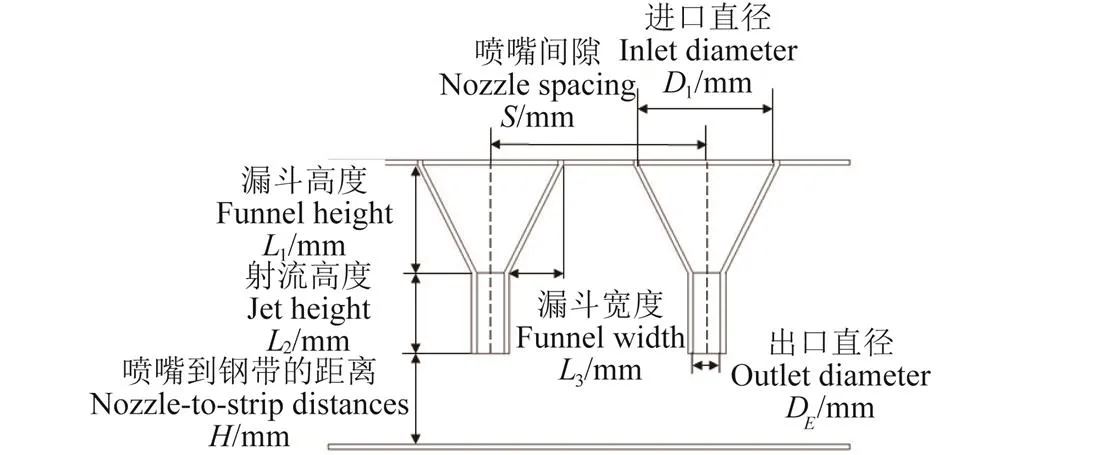
已有的文獻主要研究了不同噴嘴結構的目標表面的變化,僅有少量文獻涉及傳熱均勻性的研究。本文以沖擊式速凍試驗臺為依托,提出了一種其他文獻未涉及的新噴嘴結構即圓漏斗噴嘴,對比了圓孔和圓漏斗噴嘴結構的速凍設備內部流場的分布,從鋼帶表面和傳熱均勻度2個角度全面分析了2種噴嘴的優缺點,并對圓孔噴嘴出口處方向的速度分布進行了試驗驗證,以期為氣流沖擊式速凍機的優化設計提供理論依據。
1 數值模擬
1.1 物理模型建立
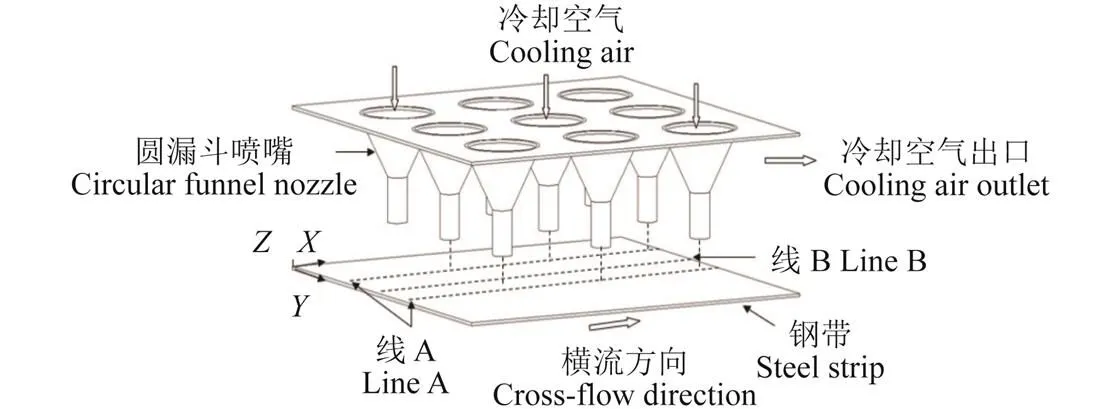
圖1a為沖擊式速凍試驗臺模型,由離心風機帶動冷卻空氣進入沖擊式速凍試驗臺靜壓箱內,通過孔板直接噴射至鋼帶表面,在限定的矩形通道內流動并由最末端的出口排出。

a. 沖擊式速凍試驗臺模型
a. Model of impacting freezing test bench

b. 圓孔噴嘴模型
b Model of circular orifice nozzle
c. 圓漏斗噴嘴模型
c. Circular funnel nozzle model
d. 圓漏斗噴嘴結構
經與南通四方冷鏈裝備股份有限公司的沖擊式隧道速凍裝置實測數據比對得出本模型靜壓箱尺寸為300 mm×300 mm×500 mm,孔板尺寸為300 mm×300 mm×2 mm,此結構尺寸下沖擊式速凍試驗臺內部流場變化與氣流沖擊式速凍機內流場變化一致。為了合理分布噴嘴結構,清晰的觀察到沖擊式速凍試驗臺內部流場的變化趨勢,本文在對沖擊式速凍試驗臺進行數值模擬研究時,等比例增大了靜壓箱和孔板的尺寸[16],分別為600 mm×600 mm×500 mm和600 mm×600 mm×2 mm,此模型結構上下對稱,故只采用1/2模型進行計算。在此模型尺寸下,圓孔和圓漏斗噴嘴的具體結構參數如表1所示。
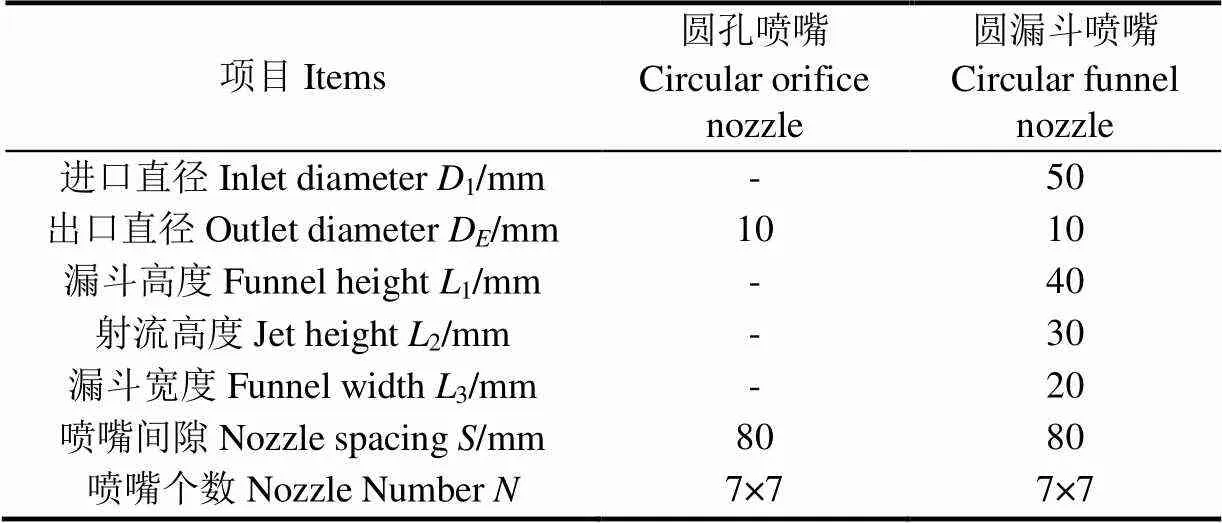
表1 噴嘴結構參數
1.2 數值模擬
1.2.2 網格劃分
將物理模型導入ANSYS15.0軟件中,進行計算區域的離散化處理,將噴嘴周圍的網格適當進行加密處理[17-18],對于圓孔噴嘴,噴嘴處加密網格最小尺寸為0.517 9 mm,整個計算域節點個數為634 363,網格單元數為2 224 215,如圖2所示。
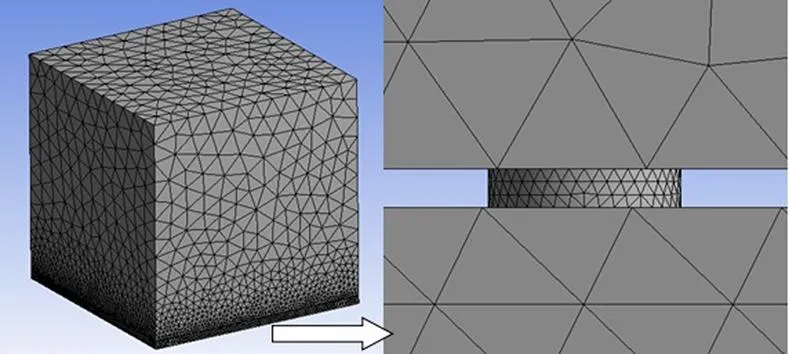
圖2 網格劃分
1.2.3 模擬參數設置
由于本文模擬的流體為空氣,為了方便模擬計算,進行了下列假設:(1)空氣為不可壓縮流體[19-20];(2)模型在正常運行過程中,沖擊式速凍試驗臺內部的流場視為穩態[21];(3)靜壓箱壁面視為絕熱[22]。
本模型內部為有限空間的強制對流換熱,流體的雷諾數Re>106,流體完全處于湍流狀態,因此,本模型采用湍流模型,由于在沖擊過程中有溫度的變化,故使用能量方程[23-24]。參考王金鋒等[15]的試驗方法并稍作修改,冷卻空氣入口壓力in=250 Pa,冷卻空氣出口壓力out=0 Pa。凍結區域冷卻空氣入口溫度設置為230 K,冷卻空氣出口溫度為235 K。冷卻空氣入口處質量流量為0.064 4 kg/s。沖擊表面為鋼帶,設置為壁面,其熱導率為16.3W/(m·℃)[15]。
1.3 模型的試驗驗證
為了驗證數值模擬的可靠性,本文進行了驗證試驗(圖3)。試驗測量的儀器設備包括TESTO-510型德圖空氣差壓儀和TESTO-425型德圖熱線式風速儀(表2)。

圖3 驗證試驗
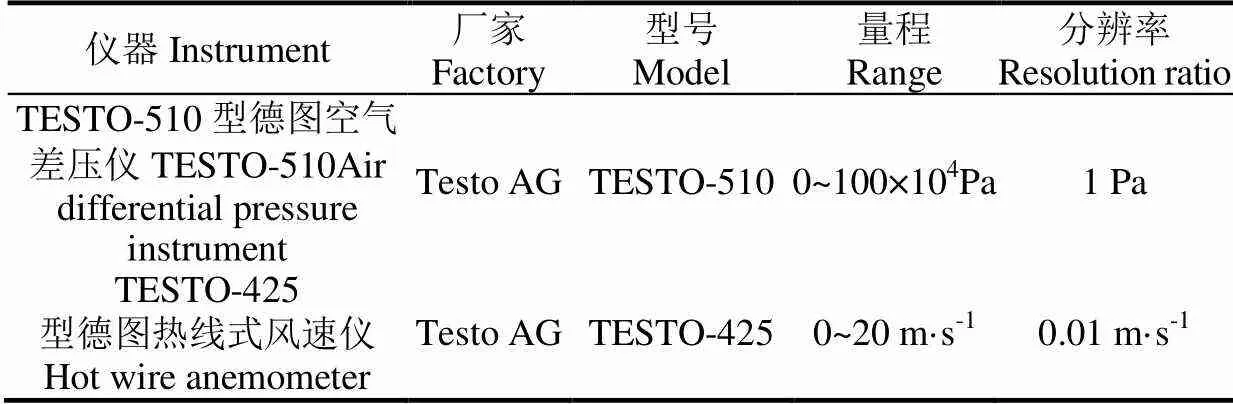
表2 測試儀器的技術參數
1.3.1 試驗方法
1.3.2 試驗結果
將試驗測量結果與數值模擬結果進行比較,如表3所示。
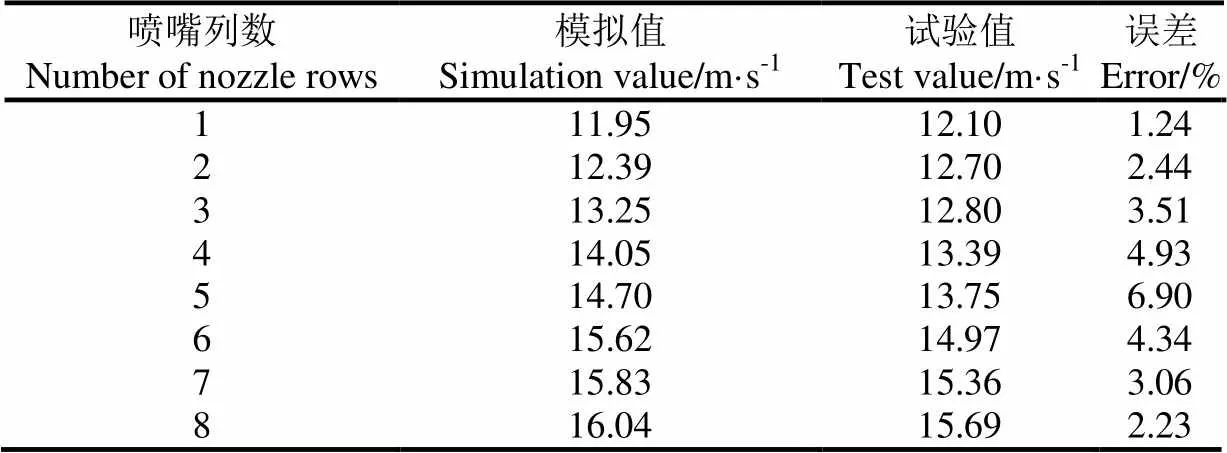
表3 各列圓孔噴嘴出口處Z方向氣流速度
由表3可見,數值模擬結果與試驗測量結果的變化趨勢是相同的,即沿孔板方向,隨著圓孔噴嘴的列數增加,噴嘴出口處方向氣流速度增加,數值模擬結果與試驗測量結果的相對誤差在1.24%~6.90%以內,因此可以確定對沖擊式速凍試驗臺的數值模擬可靠[25]。因后續的數值模擬僅對模型尺寸等比例放大,其他模擬條件設置不變,因此后續可以采用相同的數值模擬條件對速凍機的噴嘴設計方案進行分析和優化[16]。
1.4 參數的定義
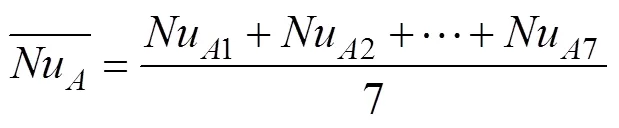
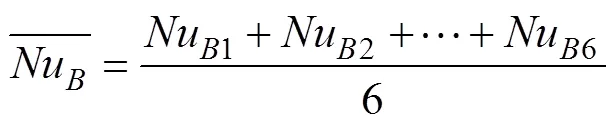
本研究在改變噴嘴到鋼帶的距離與出口直徑的比值/D條件下,從鋼帶表面和傳熱均勻度2個方面出發,分析2種噴嘴結構的鋼帶表面的換熱特性。參考Attalla等[26]的試驗方法并稍作修改,在鋼帶表面上取線A和線B(見圖1b)來具體分析鋼帶各個位置的換熱特性,線A對應每排噴嘴中心正下方,噴嘴排數為7,因此分別為線A1,A2,···,A7,線B對應每2排噴嘴間隙的中心線正下方,噴嘴間隙數為6,因此分別為線B1,B2,···,B6[26]。線A和線B上的平均努塞爾數為

2 結果與分析
2.1 鋼帶表面的傳熱強度和傳熱均勻性
圖4顯示了冷卻空氣入口壓力為in=250 Pa,冷卻空氣出口壓力out=0 Pa,凍結區域冷卻空氣入口溫度設置為230 K,出口溫度為235 K,冷卻空氣入口處質量流量為0.064 4 kg/s時,不同的噴嘴到鋼帶距離與出口直徑比值H/D的圓孔和圓漏斗2種噴嘴結構的鋼帶表面分布。由圖4可知,當H/D值一定時,圓漏斗噴嘴結構的鋼帶表面值均比圓孔結構的鋼帶表面值高。隨著H/D的增加,射流直接沖擊到鋼帶表面的速度減小,因此鋼帶表面減小。
圖5為2種噴嘴在不同H/D的線A和線B局部分布。由圖5可知,對于線A,當H/D=2和6時,圓孔噴嘴的局部較高,但圓孔噴嘴的局部的最大值與最小值之差(即極差)分別為470.80和117.19,圓漏斗噴嘴的局部極差分別為343.67和99.69,圓漏斗噴嘴的局部極差比圓孔噴嘴的低27.01%,說明圓漏斗噴嘴結構的鋼帶表面局部分布更均勻;當H/D=8和12時,圓孔噴嘴的局部極差分別為53.04和25. 21,圓漏斗噴嘴的局部極差分別為50.19和20.43,2種噴嘴結構的鋼帶表面局部極差相差不大,說明2種噴嘴結構的鋼帶表面局部分布均勻程度相差不大,但圓漏斗噴嘴結構的鋼帶表面局部較高。對于線B,當H/D=2、6、8和12時,圓漏斗噴嘴結構的鋼帶表面局部都較高,說明圓漏斗噴嘴結構的線B上的換熱強度較高。
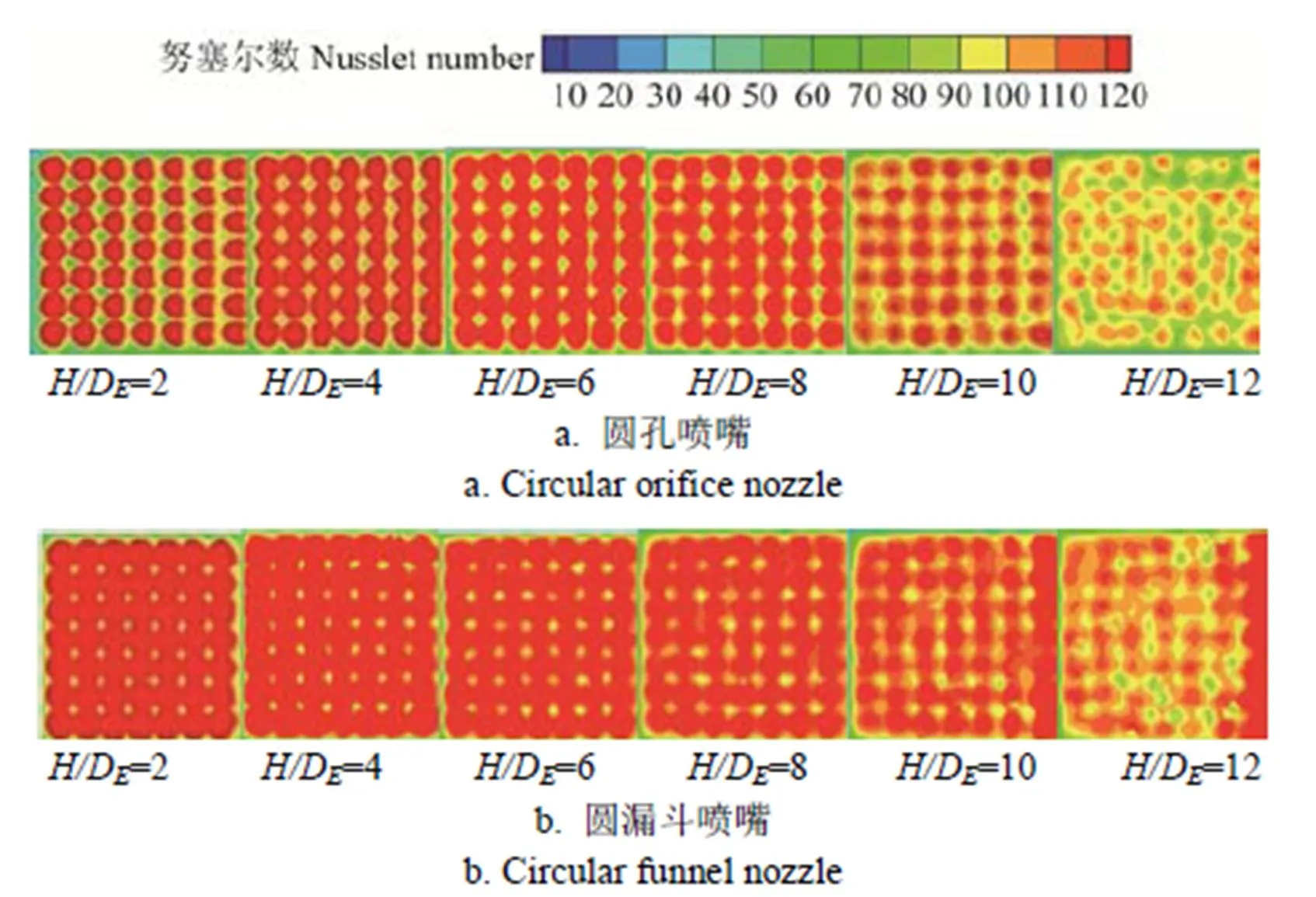
注:冷卻空氣入口壓力為Pin=250 Pa,冷卻空氣出口壓力Pout=0 Pa,凍結區域冷卻空氣入口溫度設置為230 K,出口溫度為235 K,冷卻空氣入口處質量流量為0.064 4 kg/s。H為噴嘴到鋼帶的距離,mm;DE為噴嘴出口直徑,mm。下同。
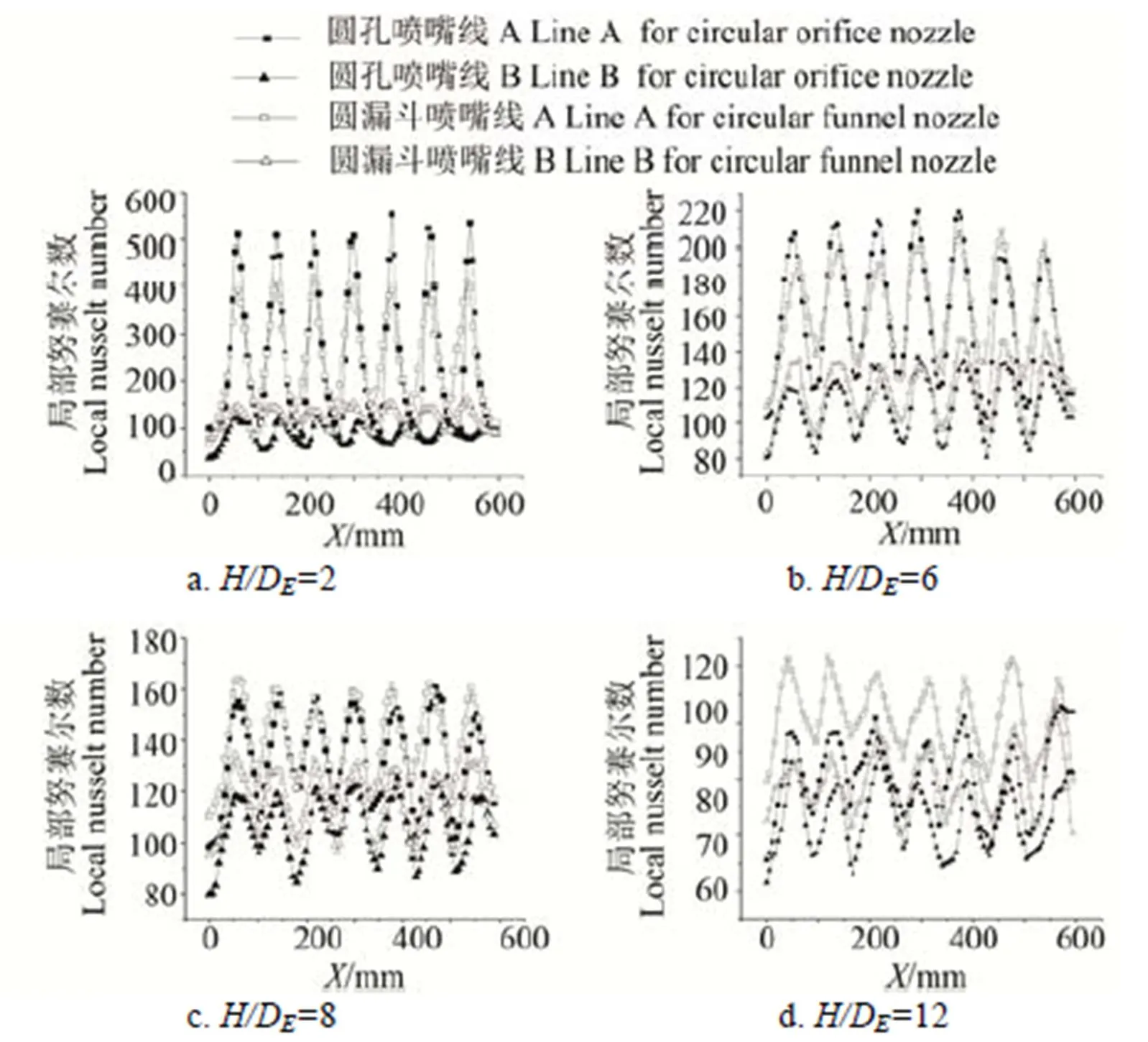
圖5 不同H/DE值的線A和線B局部Nu分布
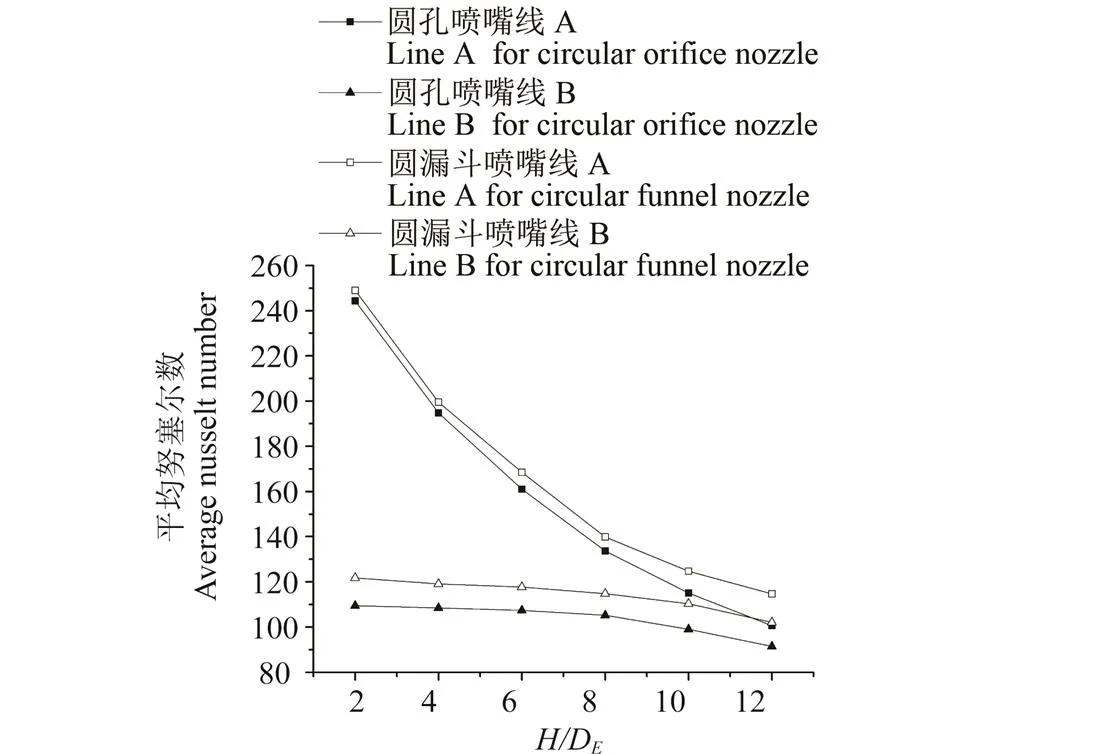
圖6 不同H/DE的線A和線B的
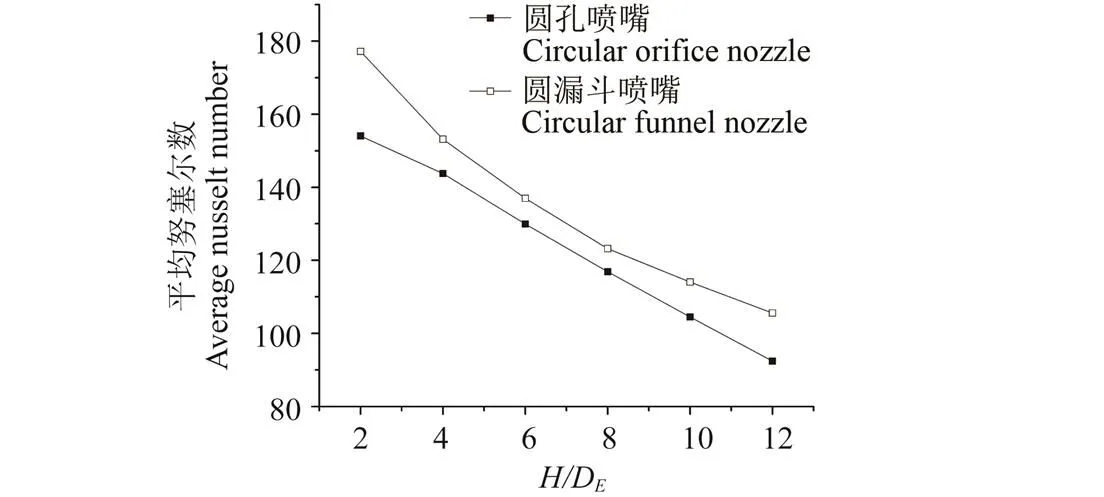
圖7 不同H/DE的鋼帶表面
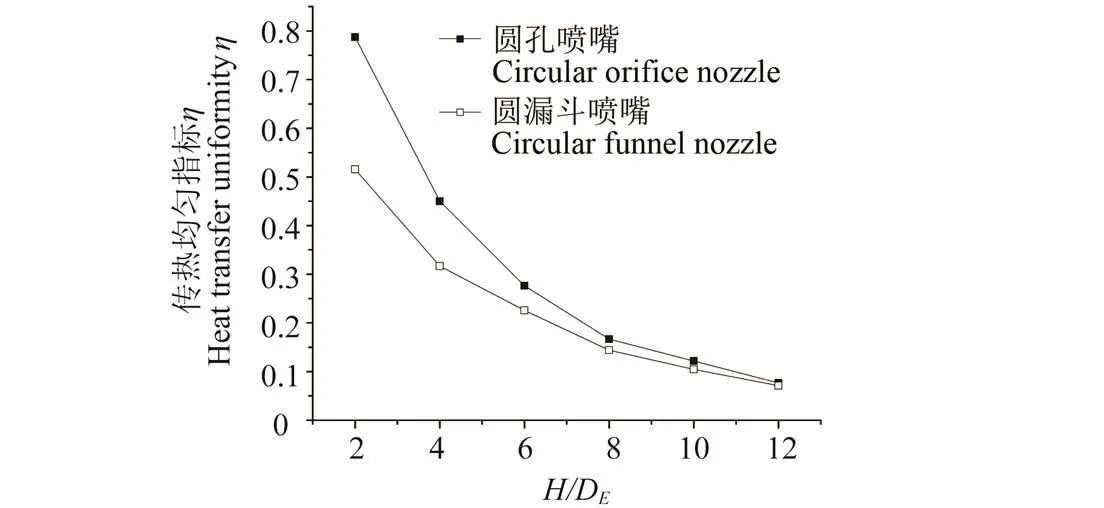
圖8 鋼帶表面傳熱的均勻性指標η隨H/DE值的變化
2.2 橫流速度分析
從圖9還可以看出,當H/D值在2~12范圍內時,圓漏斗噴嘴結構的橫流風速始終低于圓孔噴嘴的橫流風速,低4.89%~12.46%。說明圓漏斗噴嘴結構的橫流效應對沖擊射流的影響較弱,因此鋼帶表面換熱強度比圓孔噴嘴結構的換熱強度高。
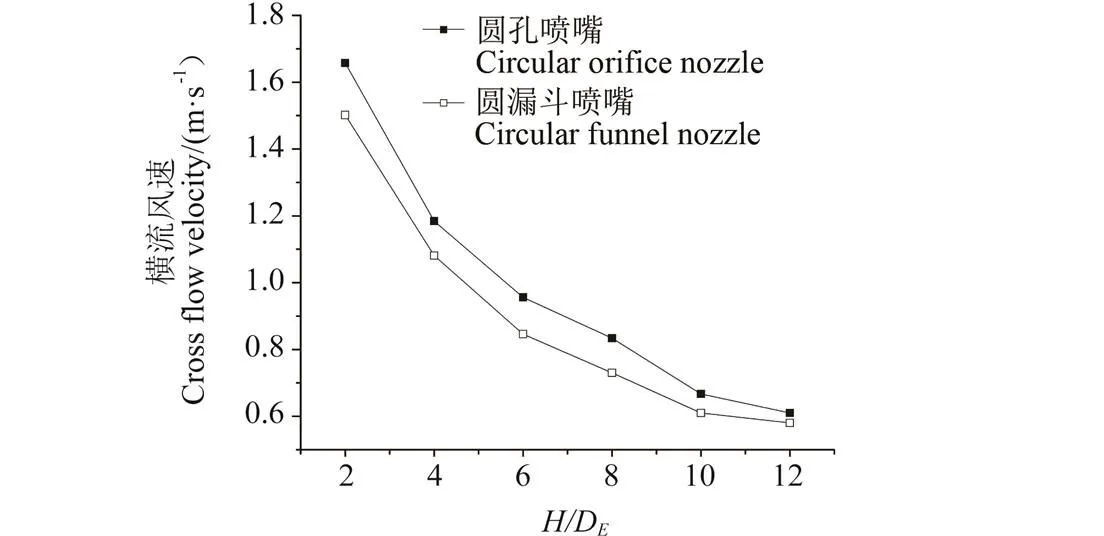
圖9 鋼帶上方10 mm處橫流風速分布
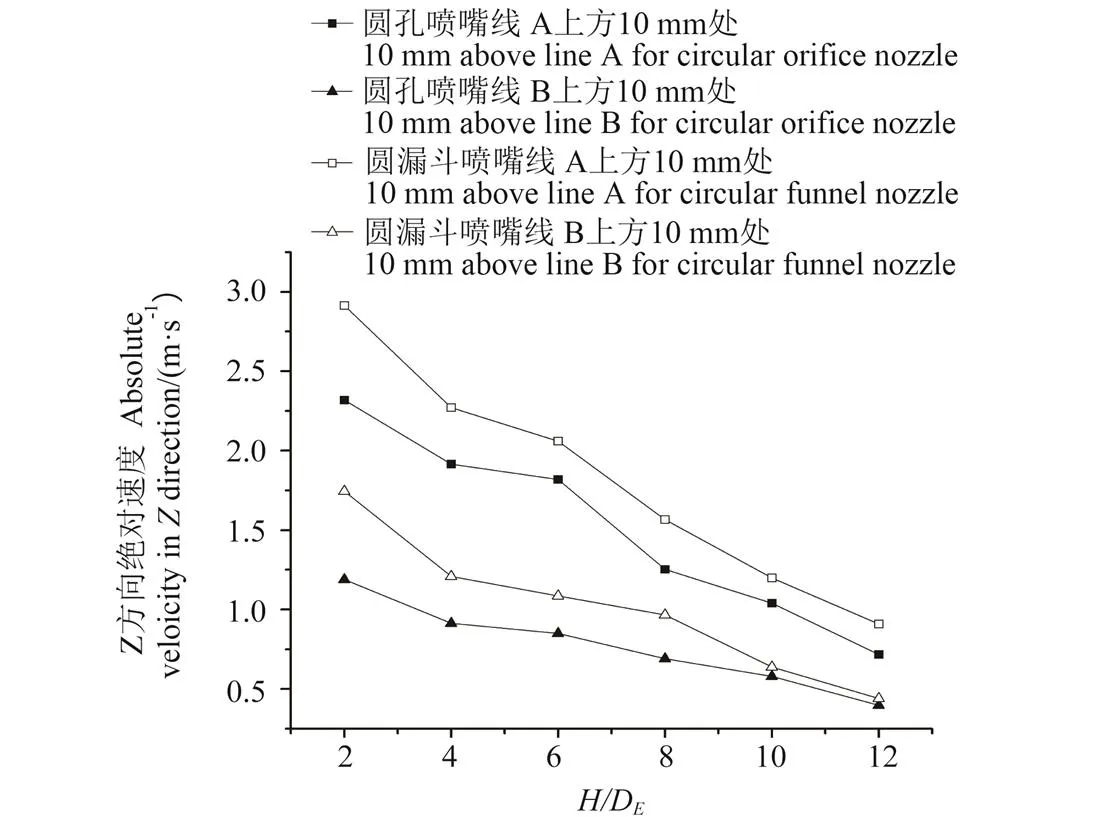
圖10 不同H/DE的線A和線B上方10 mm處Z方向絕對速度
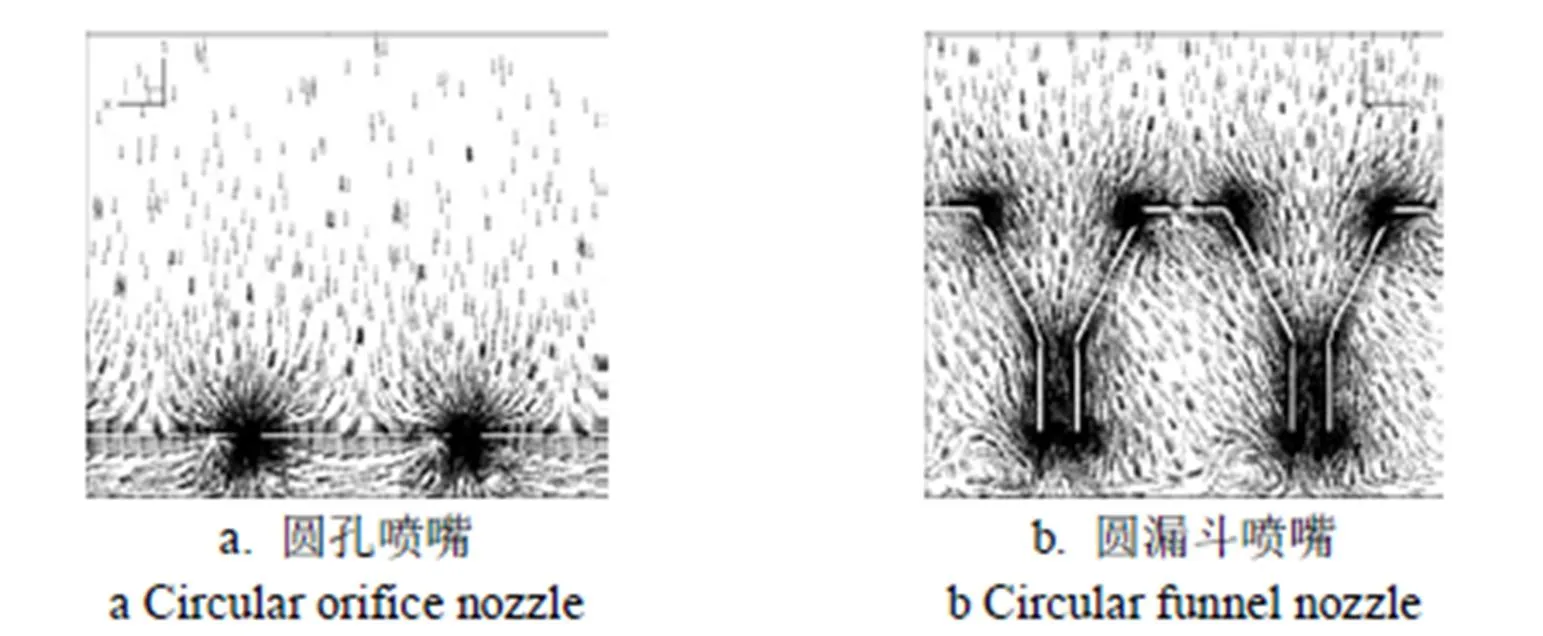
圖11 噴嘴出口氣流矢量圖
3 結 論
本文以沖擊式速凍試驗臺的噴嘴為研究對象,對比了圓孔和圓漏斗噴嘴在冷卻空氣入口處質量流量相同的情況下,改變噴嘴到鋼帶的距離對鋼帶表面換熱特性的影響,得到以下結論:
2)當H/D值在2~12范圍時,2種噴嘴結構的鋼帶表面的變化均受H/D值的影響較大,受橫流影響較小。
3)當H/D值在2~12范圍時,圓漏斗噴嘴結構的鋼帶表面傳熱均勻性指標值比圓孔噴嘴結構的值低7.06%~34.52%。隨著H/D值的增加,2種噴嘴結構的差值逐漸縮小。圓漏斗噴嘴結構的值較低,即設備內部氣流較為均勻,這有利于保證凍結的均勻性,提高食品的凍結品質。
[1] Huan Z, Ma Y, He S. Airflow blockage and guide technology on energy saving for spiral quick-freezer[J]. International Journal of Refrigeration, 2003, 26(6): 644-651.
[2] Shaikh N I, Prabhu V. Mathematical modeling and simulation of cryogenic tunnel freezers[J]. Journal of Food Engineering, 2007, 80(2): 701-710.
[3] Yang B, Chang S, Wu H, et al. Experimental and numerical investigation of heat transfer in an array of impingement jets on a concave surface[J]. Applied Thermal Engineering, 2017, 127(25): 473-483.
[4] Kumar K. Flow and heat transfer characteristics of confined noncircular turbulent impinging jets[J]. Drying Technology, 2004, 22(9): 2027-2049.
[5] Vinze R, Chandel S, M.D. Limaye, et al. Influence of jet temperature and nozzle shape on the heat transfer distribution between a smooth plate and impinging air jets[J]. International Journal of Thermal Sciences, 2016, 99: 136-151.
[6] Nuntadusit C, Wae-Hayee M, Tekasakul P, et al. Local heat transfer characteristics of array impinging jets from elongated orifices[J]. International Communications in Heat and Mass Transfer, 2012, 39(8): 1154-1164.
[7] Dano B P E, Liburdy J A, Kanokjaruvijit K. Flow characteristics and heat transfer performances of a semi-confined impinging array of jets: effect of nozzle geometry[J]. International Journal of Heat and Mass Transfer, 2005, 48(3): 691-701.
[8] Martin R H, Buchlin J M. Jet impingement heat transfer from lobed nozzles[J]. International Journal of Thermal Sciences, 2011, 50(7):1199-1206.
[9] Mangate L D, Chaudhari M B. Heat transfer and acoustic study of impinging synthetic jet using diamond and oval shape orifice[J]. International Journal of Thermal Sciences, 2015, 89: 100-109.
[10] Ianiro A, Cardone G. Heat transfer rate and uniformity in multichannel swirling impinging jets[J]. Applied Thermal Engineering, 2012, 49(1): 89-98.
[11] Yu P, Zhu K, Sun T, et al. Heat transfer rate and uniformity of mist flow jet impingement for glass tempering[J]. International Journal of Heat and Mass Transfer, 2017, 115: 368-378.
[12] Yulin L, Feng L, Juming T, et al. Radio frequency tempering uniformity investigation of frozen beef with various shapes and sizes[J].Innovative Food Science and Emerging Technologies, 2018, 48: 42-55.
[13] Li D, Zhu Z, Sun D W. Effects of freezing on cell structure of fresh cellular food materials: A review[J]. Trends in Food Science and Technology, 2018, 75:46-55.
[14] Wen Z X, He Y L, Ma Z. Effects of nozzle arrangement on uniformity of multiple impinging jets heat transfer in a fast cooling simulation device[J]. Computers and Fluids, 2018, 164(15): 83-93.
[15] 王金鋒,李文俊,謝晶,等. 兩種噴嘴結構對沖擊式速凍機流場及換熱特征的影響[J]. 食品與機械,2017,33(12):80-85+90. Wang Jinfeng, Li Wwenjun, Xie Jing, et al. Influence of two ddifferent nnozzle fforms on the flow field and heat transferring characteristics[J]. Food and Machinery, 2017, 33(12): 80-85+90.
[16] 聞建龍. 工程流體力學[M]. 北京:機械工業出版社,2011.55-65.
[17] Xu L, Jin L, Ma Y, et al. Numerical study on heat transfer by swirling impinging jets issuing from a screw-thread nozzle[J]. International Journal of Heat and Mass Transfer, 2017, 115: 232-237.
[18] Guan T, Zhang J Z, Shan Y. Convective heat transfer by a row of tab-excited impinging jets on a wedge-shaped concave surface[J]. International Journal of Thermal Sciences, 2016, 100: 37-53.
[19] Zhu X W, Zhu L, Zhao J Q. An in-depth analysis of conjugate heat transfer process of impingement jet[J]. International Journal of Heat and Mass Transfer, 2017, 104: 1259-1267.
[20] Singh D, Premachandran B, Kohli S. Effect of nozzle shape on jet impingement heat transfer from a circular cylinder[J]. International Journal of Thermal Sciences, 2015, 96: 45-69.
[21] Li Y, Li B, Qi F, et al. Flow and heat transfer of parallel multiple jets obliquely impinging on a flat surface[J]. Applied Thermal Engineering, 2018, 133(25): 588-603.
[22] Lingling C, Robin B, Bernhard W, et al. Experimental and numerical heat transfer investigation of an impingement jet array with V-ribs on the target plate and on the impingement plate[J]. International Journal of Heat and Fluid Flow, 2017, 68: 126-138.
[23] Hosain M L, Fdhila R B, Daneryd A. Heat transfer by liquid jets impinging on a hot flat surface[J]. Applied Energy, 2016, 164(15): 934-943.
[24] Hou Y, Tao Y, Huai X, et al. Numerical simulation of multi-nozzle spray cooling heat transfer[J]. International Journal of Thermal Sciences, 2018, 125: 81-88.
[25] 陳黎卿,張棟,陳無畏. 基于流固耦合的分動器齒輪兩相流動數值模擬與試驗[J]. 農業工程學報,2014,30(4):54-61. Chen Liqing, Zhang Dong, Chen Wuwei. Numerical simulation and test on two-phase flow inside shell of transfer case based on fluid-structure interaction[J]. Transactions of the Chinese Society of Agricultural Engineering (Transactions of the CSAE), 2014, 30(4): 54-61.
[26] Attalla M, Maghrabie H M, Qayyum A, et al. Influence of the nozzle shape on heat transfer uniformity for in-line array of impinging air jets[J]. Applied Thermal Engineering, 2017, 120(25): 160-169.
[27] 馬朝,嚴超,曹學偉,等. 陣列空氣射流傳熱均勻性問題的數值研究[J]. 工程熱物理學報,2016,37(11):2378-2384. Ma Cao, Yan Cao, Cao Xuewei, et al. Numerical Study on Array Air jet heat transfer uniformity[J]. Journal of Engineering Thermophysics, 2016, 37(11): 2378-2384.
[28] 葛茂生,吳普特,朱德蘭,等. 卷盤式噴灌機移動噴灑均勻度計算模型構建與應用[J]. 農業工程學報,2016,32(11):13-137.Ge Maosheng, Wu Pute, Zhu Ddlan, et al. Construction and application of mobile spraying uniformity model of hard hose traveler[J]. Transactions of the Chinese Society of Agricultural Engineering (Transactions of the CSAE), 2016, 32(11): 130-137.
[29] 張珍,謝晶. 帶有上下均風孔板的速凍裝置中流場及溫度場的數值模擬[J]. 制冷學報,2009,30(05):36-40.
Zhang Zhen, Xie Jing. Numerical simulation on flow and temperature fields in quick freezer with perforated plates[J]. Journal of Refrigeration, 2009, 30(05):36-40.
[30] Meena H C, Reodikar S A, Vinze R, et al. Influence of the shape of the orifice on the local heat transfer distribution between smooth flat surface and impinging incompressible air jet[J]. Experimental Thermal & Fluid Science, 2016, 70: 292-306.
[31] Vinze R, Chandel S, M.D. Limaye, et al. Effect of compressibility and nozzle configuration on heat transfer by impinging air jet over a smooth plate[J]. Applied Thermal Engineering, 2016, 101: 293-307.
[32] Katti V, Prabhu S V. Influence of streamwise pitch on local heat transfer distribution for in-line arrays of circular jets with spent air flow in two opposite directions[J]. Experimental Heat Transfer, 2009, 22(4): 228-256.
Effects of nozzle structures of air impinging freezer on heat transfer characteristics of steel strip surface
Xie Jing1,2,3,4※, Liu Yuyan2,4, Wang Jinfeng1,2,3,4
(1.201306,; 2.,201306;3.,201306,; 4,,201306,)
In view of the low efficiency and high energy consumption of air impinging freezer, 2 kinds of nozzle structures were compared in this paper in order to find out the best structure and improve the Nusselt number and heat transfer uniformity. Based on the impinging freezing test bench, the performance of 2 kinds of nozzle was analyzed and compared by using computational fluid dynamics (CFD) Numerical simulation technology. Theturbulence model was used. Since there was a temperature change during the jet impinging, the energy equation was selected. The cooling air inlet and outlet pressure were 250 Pa(P) and 0 Pa(P) respectively. For the frozen area, the cooling air inlet temperature was set to 230 K and outlet temperature was 235 K. The mass flow rate at the cooling air inlet is 0.064 4kg/s. The thermal conductivity of steel strip was 16.3 W/(m.°C). In order to verify the reliability of numerical simulation, experimental verification was carried out.Taking the circular orifice nozzle as an example, the outlet diameter of circular orifice nozzle wasD=10 mm, nozzle spacing was=34 mm, nozzle number was 64(8 rows×8 ranks), and the ratio between nozzle-to-strip distances and outlet diameters wasH/D=2.The absolute velocity of steel strip surface in vertical direction at the outlet nozzle (direction) was measured.The error between simulation value and test value was 1.24%6.90%, thus it could be concluded that the numerical simulation of the impinging freezing test bench was reliable. Based on the Nusselt number distribution and heat transfer uniformity on steel strip, the heat transfer characteristics on steel strip surface under the circular orifice nozzles and circular funnel nozzles at the different ratio between nozzle-to-strip distances and outlet diameters were analyzed. The results showed that when theH/Dwas in the range of 2-12, the average Nusselt number on steel strip surface under the circular funnel nozzle was about 5.41%-15.10% higher than that under the circular orifice nozzle. The change of the Nusselt number on steel strip surface under both 2 kinds of nozzle structures were greatly influenced by theH/Dand was less affected by the cross flow. The heat transfer uniformityon steel strip surface under the circular funnel nozzle was about 7.06%-34.52% lower than that of the circular orifice nozzle. As theH/Dincreasing, thedifference between the 2 kinds of nozzle structures was gradually decreased. This was because that for the circular funnel nozzle, the “convex” region which was formed between 2 kinds of nozzle structures could form a cross flow buffer zone. On the one hand, the flow direction of the cross flow was changed, so the cross flow velocity in the channel was decreased, and the adverse effect of cross flow was reduced. The average Nusselt number on steel strip surface under the circular funnel nozzle was higher, so that the heat transfer characteristics on steel strip surface was higher. On the other hand, the large vortex formed on the left side of the circular funnel nozzle enhanced the line B above the steel strip surface. The velocity indirection increased the Nusselt number on the line B, so thevalue of the steel strip surface was decreased, so that the airflow in the air impinging freezer was relatively uniformity. By comparing the structures of the 2 nozzles, it is recommended to use a circular funnel nozzle in the case of the same air supply volume to reduce the freezing time, increase the output of the air impinging freezer, and improve the quality of the frozen food.
nozzles; numerical simulation; heat transfer; nusselt number; jet impingement; freezer
10.11975/j.issn.1002-6819.2018.18.036
TP391.4; S431.9
A
1002-6819(2018)-18-0292-07
2018-05-03
2018-08-17
國家“十三五”重點研發項目課題(2016YFD0400303);上海市科委平臺能力建設項目(16DZ2280300);上海市科委公共服務平臺建設項目(17DZ2293400);上海高校青年教師培養資助計劃(ZZSHOU16013);上海海洋大學科技發展專項基金(A2-0203-17-100207);上海海洋大學博士科研啟動基金(A2-0203-17-100317)
謝 晶,女(漢族),教授,博士,博士生導師,主要從事制冷工程研究。Email:jxie@shou.edu.cn
謝 晶,柳雨嫣,王金鋒. 噴嘴結構對氣流沖擊式速凍機鋼帶表面換熱特性的影響[J]. 農業工程學報,2018,34(18):292-298. doi:10.11975/j.issn.1002-6819.2018.18.036 http://www.tcsae.org
Xie Jing, Liu Yuyan, Wang Jinfeng. Effects of nozzle structures of air impinging freezer on heat transfer characteristics of steel strip surface[J]. Transactions of the Chinese Society of Agricultural Engineering (Transactions of the CSAE), 2018, 34(18): 292-298. (in Chinese with English abstract) doi:10.11975/j.issn.1002-6819.2018.18.036 http://www.tcsae.org
猜你喜歡
童話王國·奇妙邏輯推理(2024年5期)2024-06-19 16:03:38
哲學評論(2021年2期)2021-08-22 01:53:34
中學生數理化·七年級數學人教版(2020年10期)2020-11-26 08:24:50
數學物理學報(2020年2期)2020-06-02 11:29:24
中華詩詞(2019年7期)2019-11-25 01:43:04
模具制造(2019年3期)2019-06-06 02:10:54
影視與戲劇評論(2016年0期)2016-11-23 05:26:01
光學精密工程(2016年6期)2016-11-07 09:07:19
核科學與工程(2015年4期)2015-09-26 11:59:03
現代企業(2015年9期)2015-02-28 18:56:50
