添加鋼渣恢復厭氧消化酸化系統提高沼氣產量
2018-09-03 03:29:12汪群慧任媛媛吳川福
農業工程學報 2018年17期
關鍵詞:體系
鄒 惠,高 明,汪群慧,于 淼,任媛媛,劉 凱,吳川福
?
添加鋼渣恢復厭氧消化酸化系統提高沼氣產量
鄒 惠1,2,高 明1,2,汪群慧1,2※,于 淼1,任媛媛1,劉 凱1,吳川福1,2
(1.北京科技大學能源與環境工程學院環境工程系,北京 100083; 2. 工業典型污染物資源化處理北京市重點試驗室,北京 100083)
針對厭氧消化酸化后傳統恢復產氣方法成本高,產氣率低的問題,該文通過對比研究鋼渣和堿對酸化后發酵體系的恢復作用,結果表明酸化體系添加鋼渣后累積產氣率為285.33 mL/g,較傳統法(加堿)提高了25.8%,兩組數據差異顯著。同時對恢復產氣后的pH值,總揮發性脂肪酸(total volatile fatty acid),堿度(alkalinity),揮發性脂肪酸(volatile fatty acids)進行了監測分析,發現兩組的上述數據差異并不顯著,TVFA/TA和丙酸/乙酸的比值更加有效指示兩體系恢復后的穩定性,且添加鋼渣體系較加堿體系提前8 d恢復正常。最后分析了恢復產氣后消化液中重金屬,兩體系的重金屬含量完全滿足NY/T 2065-2011沼肥施用技術規范中的相關要求,此舉提供了一種優于傳統恢復酸化液渣產氣的方式,為解決實際工程易酸化、恢復產氣成本高的問題提出了新的解決方法。
垃圾;甲烷;堿;恢復產氣;厭氧消化;鋼渣
0 引 言
《中華人民共和國住房和城鄉建設部》數據顯示[1]:中國每年生產超過5 100萬t的餐廚垃圾,大部分的處置方式是直接填埋[2]。而餐廚垃圾中含蛋白質、糖類、脂肪等占干物質的90%以上,是一種典型的“放錯了地方”的生物質能源[3],通過厭氧發酵,垃圾中40%~50%的有機成分會被轉化為生物能源,緩解中國能源緊張的狀況。
然而在餐廚垃圾厭氧消化過程中,進料過多會使得揮發性脂肪酸大量積累[4];溫度驟變,厭氧條件不夠、原料中混入有毒物質等原因都會使產甲烷菌失活[5],導致厭氧消化系統酸化,產氣量降低,嚴重的甚至會停止產氣[6-7]。對于失穩或酸化的厭氧消化系統,傳統的做法是向發酵體系中添加堿類物質(NaOH、Na2CO3、K2CO3)來調節pH值[8],但Na+和K+添加過多,除費用較高外,還會對厭氧消化系統產生抑制作用(如Na抑制質量濃度為3 500~5 500 mg/L)[9],故實際工程中常用石灰乳(Ca(OH)2)來調節pH值,因石灰乳價廉,同時鈣離子對沼氣發酵的毒性較小,但其能與系統中有機物降解所產生的CO2發生反應生成碳酸鈣,碳酸鈣的形成會導致沼渣排除管道的堵塞,同時石灰乳的加入會損失CO2,進而減少氫還原CO2途徑生成的甲烷。而石灰乳的微溶性,使得其耗量大且恢復產氣周期較長[10]。Angelidaki等[11]向餐廚垃圾中添加礦物材料(如:黏土、沸石、活性炭),利用其良好的吸附性能和粒子交換性能提高消化液的緩存能力,從而提高餐廚垃圾厭氧消化的產氣能力,但這種方法緩沖pH值能力有限,且成本較高。因此對于酸化厭氧消化體系,選擇一種快速的恢復產氣方式很有必要。
鋼渣作為煉鋼過程中產生的主要副產品,占粗鋼產量的12%~20%,含有豐富的鈣、硅,被廣泛應用于水泥生產、筑路、冶金返回料、玻璃生產中[12]。作為堿性富硅物質,鋼渣是一種潛在的厭氧發酵功能促進劑[13],鋼渣中含有的Al,Fe,Mn,Mg等多種微量元素,可作為生物催化劑,提高厭氧反應器的緩沖能力和產氣量[14]。由于其比表面積較大,可吸附污泥中的重金屬,對厭氧消化體系的氨氮也有一定的吸附能力[15]。研究表明鋼渣的加入,可以明顯提高體系的pH值[16]。因此,將鋼渣用于酸化體系,是恢復產氣的有效手段之一。
基于此,本文在酸化液渣中分別添加鋼渣,氫氧化鈉(傳統方法),同時設置不加任何物質的對照組。通過對比各試驗組恢復產氣量,揮發性脂肪酸、堿度,pH值等指標,考察酸化液渣恢復產氣情況,以期提出一種優于傳統恢復產氣的方式,解決實際工程酸化難恢復、恢復成本高等問題。
1 材料與方法
1.1 試驗材料
餐廚垃圾取自北京科技大學學生食堂,挑去骨頭、塑料袋等難降解物后,垃圾中主要包括米飯、蔬菜、肉、蛋、豆腐、面條等。餐廚垃圾營養元素分析見表1。
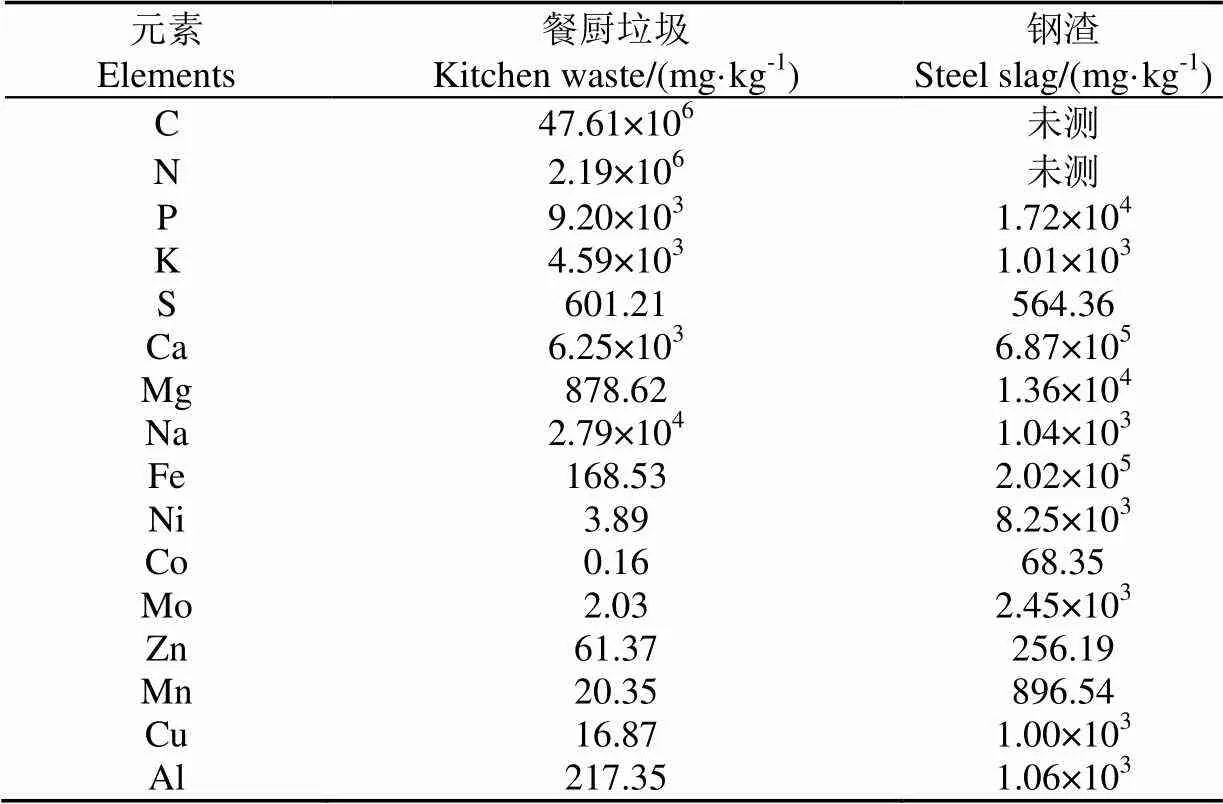
表1 餐廚垃圾及鋼渣營養元素分析
本試驗鋼渣取自首鋼集團有限公司,鋼渣為轉爐渣,經破碎-篩分-磁選、破碎-濕磨-磁選、鋼渣超細磨,其元素分析見表1,其粒徑大小為10為5.12m;50為49.33m;90為101.58m。
本試驗污泥取自北京肖家河污水處理廠厭氧消化池。污泥理化特性見表2。

表2 污泥的理化特性
1.2 試驗裝置和方法
1.2.1 試驗裝置
厭氧消化系統主要由氣浴恒溫振蕩器、發酵瓶、集氣瓶、集水瓶等部分組成。試驗分為2步,第1步為制備酸化液渣,10 L玻璃廣口瓶為發酵瓶。第2步為恢復產氣,2.5 L廣口瓶為發酵瓶。發酵瓶均以橡膠塞封口,瓶口處插入玻璃管作為連接口,然后用硅膠管連接管路,并用石蠟密封瓶口。以排水法收集產生沼氣。圖1給出了試驗裝置圖。
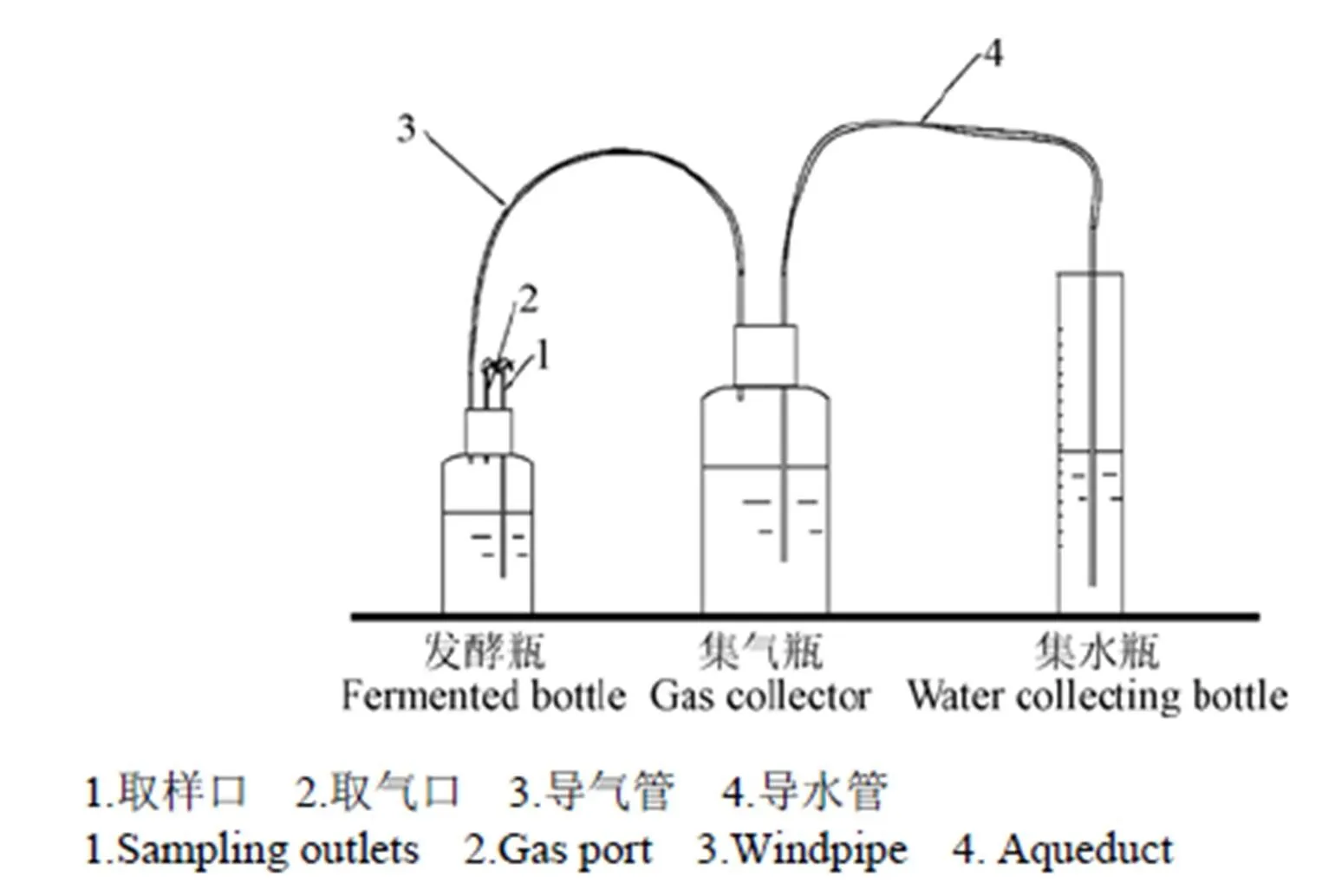
圖1 試驗裝置圖
1.2.2 酸化液渣制備
將餐廚垃圾和污泥放入10 L厭氧發酵瓶中,裝液量為8 L,其中餐廚垃圾與污泥的接種質量比為2,充分混勻后充氮氣10 min以排除殘留空氣,35 ℃下進行甲烷發酵,第4天的pH值降至6.03,同時產氣量銳減,第7天的沼液為備用的酸化液渣。
1.2.3 恢復產氣試驗
恢復產氣有3組試驗,每組試驗設置3組平行,加堿組,加鋼渣組將酸化液渣初始pH值調至7,即:在酸化液渣中分別添加1.6 g鋼渣和2.3 g NaOH,對照組不添加任何物質,各組試驗同時充入氮氣密封于35 ℃,80 r/min下進行恢復產氣試驗,考察各組能否恢復產氣。
定時取樣,分別測定揮發性脂肪酸(VFAs)、堿度(TA)、有機酸、pH值等;每天記錄產氣量。
1.3 分析方法
消化體系中的pH值采用PHS-3C型pH計測定。揮發性脂肪酸組成含量采用氣相色譜儀(GC)測定[17]。乳酸含量采用液相色譜儀(LC)測定[18]。總揮發性脂肪酸(TVFA)采用比色法測定[19]。堿度采用APAH的標準方法測定[20]。
2 結果與討論
2.1 添加鋼渣和堿對酸化系統恢復產氣效果比較
試驗分為2個階段,第1階段為酸化期(0~7 d),第2階段為恢復產氣(8~40 d)。按1.2.2節制取酸化液渣,在酸化期,餐廚垃圾接種污泥后開始產氣,但第7天系統的pH值降至5.18,厭氧消化體系酸化,此時,總揮發性脂肪酸(TVFA)積累到17.21 g/L時,體系的堿度(TA)從3.75 g/L(以CaCO3計)下降1.01 g/L,系統緩沖能力大大降低。圖2表示酸化前后厭氧系統pH值、總揮發性有機酸、總堿度及日產氣量的變化。
由圖2可知,對照組在酸化恢復期始終沒有恢復產氣,且TVFA上升至25.64 g/L,堿度一直下降直至耗盡。而加堿或鋼渣的2組當天均恢復產氣,且pH值緩慢上升,加鋼渣組的pH值上升速度和TVFA的下降速度均顯著大于加堿組,恢復期第4天的pH值就上升至7.18,且TVFA下降至12.83 g/L,而加堿組在恢復期第10天才上升至7.14,且TVFA下降至15.81 g/L。另外,加鋼渣組的pH值和總堿度TA在酸化恢復期分別穩定在7.7和12.45 g/L左右,加堿組的pH值和TA分別穩定在7.3和8.72 g/L左右,因此前者的總堿度和系統穩定性均高于后者,導致加鋼渣組厭氧發酵40 d的累積產氣率為285.33 mL/g,較加堿組提高了25.8%。這說明:①鋼渣中所含氧化鈣,氧化鎂等金屬氧化物溶于水后可形成強堿緩沖環境,提高系統的緩沖能力;②厭氧消化過程中起主導作用的是產甲烷菌,產甲烷菌的生長需要很多必需的營養物質,如:氮、磷、鉀、硫,以及金屬元素鐵、鎳、鈷、鉬、鋅、錳、銅等[21],這些營養元素在表1的餐廚垃圾及鋼渣元素分析中均可找到,餐廚垃圾中不足的微量元素由鋼渣的元素補充。Agdag等[22]研究亦表明鋼渣中含有的Fe,Zn,Cu等微量元素是多種產甲烷菌和酶系統的重要組成成分[23-24],可提高產甲烷菌活性,進而提高甲烷體系的穩定性[25];Zhang等[26]研究發現石灰渣中含有的Ca,Fe,Mn和堿性物質可提高厭氧發酵過程中氫含量,提高了沼氣產量。本試驗的結果也證實了鋼渣中含有的微量元素是其產氣率比加堿組高的重要原因。
同時,利用檢驗對加堿組和加鋼渣組的產氣率、TA、TVFA及pH值進行分析,2組各有21個樣本,產氣率,TA,TVFA及pH值的相關性分別為0.604,0.789,0.732和0.598,顯著水平分別為0.005,0.062,0.072和0.083。選取顯著水平=0.05,僅產氣率達到顯著水平<0.05,TA,TVFA及pH值的顯著水平均>0.05,因此加堿和鋼渣組的產氣率存在差異顯著,而TA,TVFA及pH值的差異不顯著。
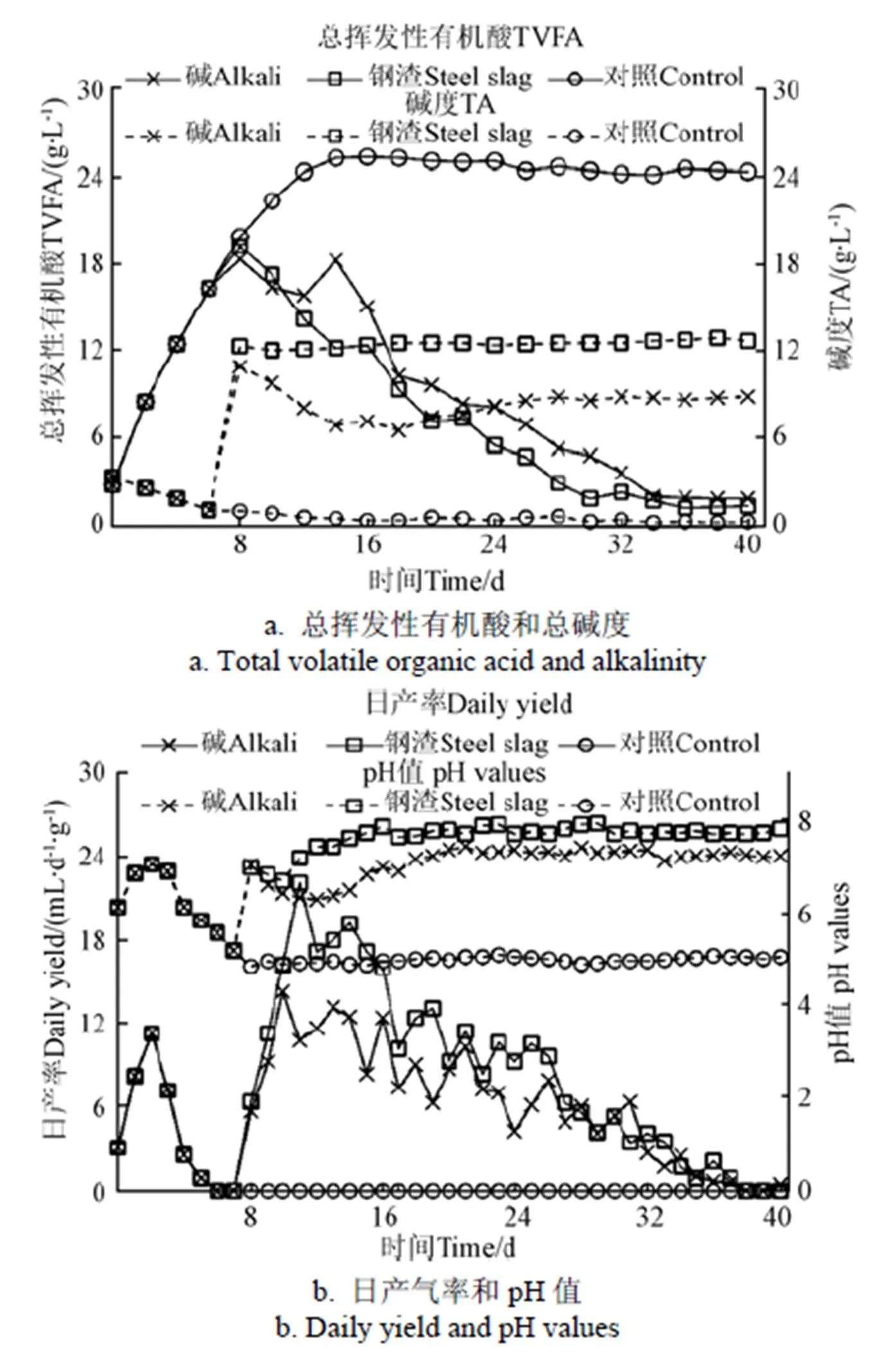
圖2 酸化前后厭氧系統總揮發性有機酸、總堿度、pH值和日產氣率的變化曲線
2.2 添加鋼渣和堿對酸化系統有機酸組分的影響
由2.1節可知,厭氧消化體系中酸化最直接的結果就是揮發性脂肪酸(VFAs)的顯著增加,其中,乙酸、丙酸、丁酸等低分子VFAs對厭氧體系反應較為敏感[27]。在一般單相厭氧體系穩定運行時,乙酸應是最主要的中間代謝產物,約占VFAs的70%[28]。但本試驗發現,在酸化期第7天,乳酸、乙酸、丙酸、丁酸質量濃度分別為9.08,5.86,3.45和1.87 g/L,其中乳酸含量占脂肪酸的45%。
添加鋼渣和堿后,3組中各種酸的變化不同,根據Boe等[29]所報道的酸化閾值。對比圖3中各酸的濃度可知,添加鋼渣各酸的恢復速度均比添加堿的恢復速度快3~4 d。酸化恢復期,恢復最快的是丁酸,其次分別是乳酸、乙酸、丙酸。乳酸恢復速率快是因為可以較快代謝為丙酸,這導致丙酸的降解速度最慢,較其他參數恢復到正常水平要慢5~6 d。從熱力學角度來看,乳酸轉化為丙酸的吉布斯自由能為?80.45 kJ/mol,是自發過程,非常容易,而丙酸轉為乙酸的吉布斯自由能為76.1 kJ/mol,同其他中間代謝產物(如乙酸、丁酸等)相比,向甲烷轉化速率最慢[30],只有在其他酸恢復正常后,丙酸的濃度才能逐漸恢復至正常含量。乙酸恢復速率相比略慢,這是由于其他的脂肪酸首先降解產生乙酸,而后才被產甲烷菌所利用。
利用檢驗分析了乙酸、乳酸、丙酸和丁酸在恢復產氣階段2組間(加堿和加鋼渣)數據變化,統計結果表明在21個樣本中,乙酸、乳酸、丙酸和丁酸的顯著水平值分別為0.064,0.068,0.076和0.098,4種酸的值均大于0.05,表明2組間4種酸在恢復產氣階段差異并不顯著。
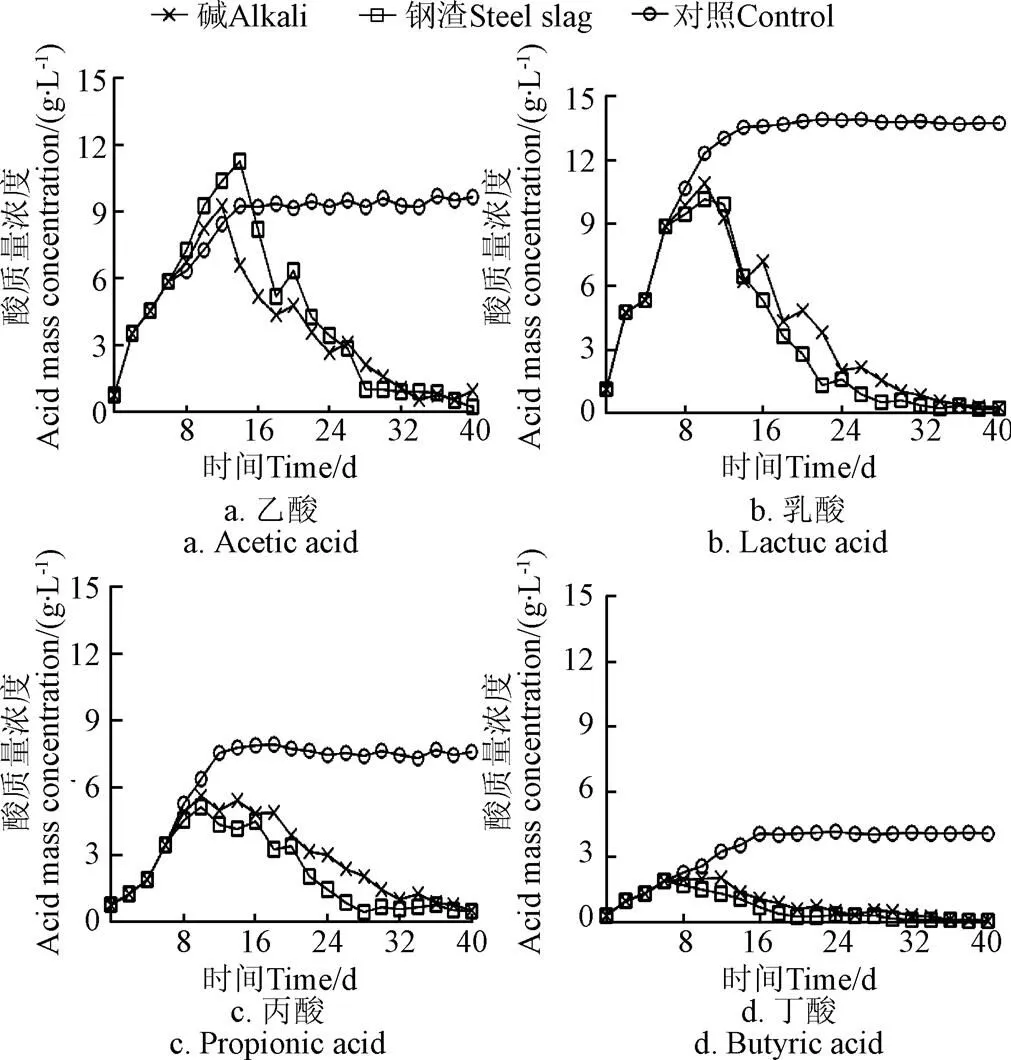
圖3 恢復產氣后乙酸、乳酸、丙酸及丁酸濃度的變化曲線
2.3 添加鋼渣和堿對酸化系統多因子綜合評價參數的影響
圖2和圖3表示酸化發生時體系的pH值、堿度、TVFA會發生明顯的改變,可見常規的單一因子可以在一定程度上反映厭氧消化體系過程不平衡,但國內外對單因子參數的閾值報道不一[31],可見單一參數并不是理想的厭氧消化系統穩定性評價指標。Li Lei等[32]研究表明,在厭氧消化過程中,總揮發性脂肪酸與堿度的比值(TVFA/TA)表明了保持系統內堿度的化合物與引起pH值降低的化合物之間的比例,可以更好、更靈敏地反映厭氧消化系統承受酸化的能力。從代謝方向來看,丙酸通常是轉化為乙酸和氫氣,Moller等[33]評價了丙酸和乙酸濃度之比(PC/AC)在反應器運行失衡時的敏感性和可靠性。因此多因子綜合評價參數(TVFA/TA和PC/AC)可作為衡量厭氧消化體系穩定性的參數。
如圖4所示,酸化發生時系統內酸形成和堿消耗之間的平衡被打破,VFA/TA從0.83迅速增至2.86。同時,乳酸、丙酸的大量生成,使得PC/AC比值從0.092迅速增至0.21。添加鋼渣和堿后,體系的堿度瞬時被提高,加鋼渣組8 d內的TVFA/TA和PC/AC比值分別降至0.38和0.081,隨后繼續下降到0.05以下;加堿組有同樣的下降趨勢,只是稍比加鋼渣組下降緩慢。
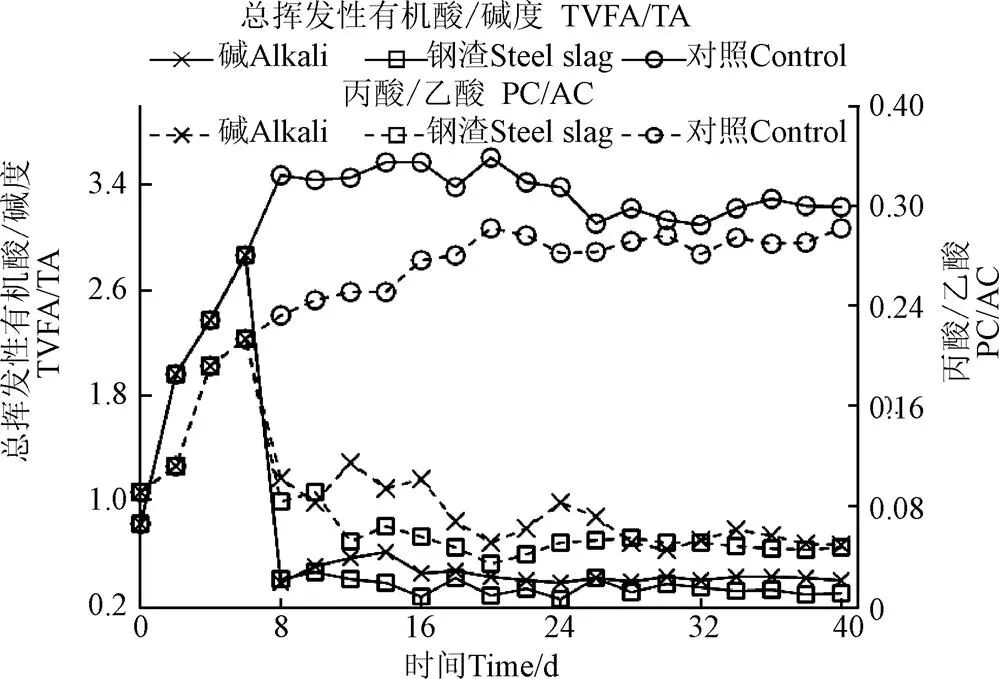
圖4 總揮發性脂肪酸/堿度(TVFA/TA)及丙酸/乙酸(PC/AC)的變化曲線
前人研究表明厭氧消化最適宜的TVFA/TA應維持在0.3~0.4之間,TVFA/TA如果超過0.8則會導致發酵狀態惡化[33];另一方面,若PC/AC比值超過0.08時系統也會開始出現抑制現象,高于0.10則會對甲烷菌產生50%的抑制[34]。加鋼渣和加堿體系產氣量與TVFA/TA、PC/AC比值的相關性與文獻報道的相似,且加鋼渣組恢復產氣穩定后的TVFA/TA,PC/AC較加堿組低,說明鋼渣的加入使得體系更加穩定,這與圖2的結論一致。
通過顯著性分析可知:加堿和加鋼渣組VFA/TA和PC/AC顯著水平值分別為0.15和0.26,2組的值均大于0.05,表明2組VFA/TA和PC/AC變化差異不顯著,這正好說明2體系恢復產氣后能較快達到穩定狀態。
2.4 恢復產氣后沼渣、沼液利用分析
鋼渣中含有部分重金屬,根據NY/T 2065-2011沼肥施用技術規范中相關技術參數,沼渣、沼液的利用對重金屬含量有嚴格要求,因此表3分析了相關幾種重金屬的含量。
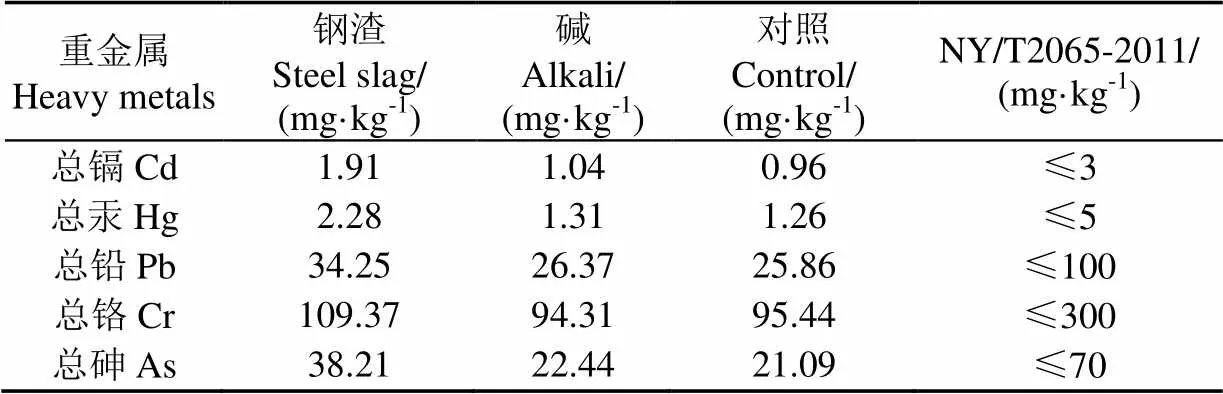
表3 不同恢復產氣下消化液中重金屬變化
由表3分析可知,添加酵母和鋼渣恢復產氣后所得消化液中重金屬含量滿足NY/T 2065-2011沼肥施用技術規范中的相關要求,即此2種恢復產氣方式不影響沼渣、沼液的利用途徑。
3 結 論
1)添加鋼渣可以恢復酸化厭氧消化體系產甲烷,累積恢復產氣率為285.33 mL/g,相比傳統恢復產氣方法(加堿),產氣量提高了25.8%。
2)餐廚垃圾厭氧消化酸化試驗恢復過程中,與單因子指示因子(pH值、總揮發性脂肪酸、堿度等)相比,組合因子(總揮發性脂肪酸/堿度、丙酸/乙酸)具有穩定性佳、指示性全面的特點,且添加鋼渣較加堿體系提前8 d恢復正常。
3)添加鋼渣恢復產氣后所得消化液中重金屬含量滿足NY/T 2065-2011沼肥施用技術規范中的相關要求,此法可作為一種新的恢復產氣方式,解決實際工程易酸化、恢復成本高及產氣率低的問題。
[1] Ministry of Housing and Urban-Rural Development of the People’s Republic of China. CJJ 184–2012 Technical code on food waste treatment[S]. China Architecture & Building Press, 2012.
[2] Ma Jingxing, Duong Thuhuang, Smits M, et al. Enhanced biomethanation of kitchen waste by different pre-treatments[J]. Bioresource Technology, 2011, 102(2): 592-599.
[3] Li Panyu, Li Ting, Zeng Yu, et al. Biosynthesis of xanthan gum byLRELP-1 using kitchen waste as the sole substrate[J]. Carbohydrate Polymers, 2016, 151: 684-691.
[4] Liotta F, D’Antonio G, Esposito G, et al. Effect of total solids content on methane and volatile fatty acid production in anaerobic digestion of food waste[J]. Waste Management & Research the Journal of the International Solid Wastes & Public Cleansing Association Iswa, 2014, 32(10): 947-953.
[5] Zhang Jishi, Sun Kewei, Wu Manchang, et al. Influence of temperature on performance of anaerobic digestion of municipal solid waste[J]. Journal of Environmental Sciences, 2006, 18(4): 810-815.
[6] Jang H M, Park S K, Ha J H, et al. Microbial community structure in a thermophilic aerobic digester used as a sludge pretreatment process for the mesophilic anaerobic digestion and the enhancement of methane production[J]. Bioresource Technology, 2013, 145: 80-89.
[7] Appels L, Baeyens J, Degrève J, et al. Principles and potential of the anaerobic digestion of waste-activated sludge[J]. Progress in Energy & Combustion Science, 2008, 34(6): 755-781.
[8] 于雷,彭劍峰,宋永會,等. 厭氧反應器的酸化及其恢復研究進展[J].工業水處理,2011,31(8):1-4. Yu Lei, Peng Jianfeng, Song Yonghui, et al. Research progress in the acidification of highly efficient anaerobic reactor and its recovery[J]. Industrial Water Treatment, 2011, 31(8): 1-4. (in Chinese with English abstract)
[9] 鄒小玲,許柯,夏興華,等.NaCl和KCl鹽度對厭氧污泥的馴化及對比產甲烷活性的影響[J]. 中國沼氣,2009,27(3):23-25.
Zou Xiaoling, Xu Ke, Xia Xinghua, et al. NaCl and KCl salinity acclimations of anaerobic sludge and their effects on specific methanogenic Activity[J]. China Biogas, 2009, 27(3): 23-25. (in Chinese with English abstract)
[10] 吳美容,張瑞,周俊,等. 溫度對產甲烷菌代謝途徑和優勢菌群結構的影響[J]. 化工學報,2014,65(5):1602-1606.
Wu Meirong, Zhang Rui, Zhou Jun, et al. Effect of temperature on methanogens metabolic pathway and structures of predominant bacteria[J]. CIESC Journal, 2014, 65(5): 1602-1606. (in Chinese with English abstract)
[11] Angelidaki I, Ahring B. Effect of the clay mineral bentonite on ammonia inhibition of anaerobic thermophilic reactors degrading animal waste[J]. Biodegradation, 1992, 3(4): 409-414.
[12] Qian Guangren, Sun D D, Tay J H, et al. Autoclave properties of kirschsteinite-based steel slag[J]. Cement and Concrete Research, 2002, 32(9): 1377-1382.
[13] Yu Xingang, Wang Hongfei, Li Yuexiang, et al. Study on the high performance coal gangue foam concrete[J]. Materials Science Forum, 2009(610/611/6112/613): 185-189.
[14] 張仙梅,云斯寧,杜玉鳳,等. 沼氣厭氧發酵生物催化劑研究進展與展望[J]. 農業機械學報,2015,46(5):141-155.
Zhang Xianmei, Yun Sining, Du Yufeng, et al. Recent progress and outlook of biocatalysts for anaerobic fermentation in biogas production process[J]. Transactions of the Chinese Society for Agricultural Machinery, 2015, 46(5): 141-155. (in Chinese with English abstract)
[15] Patel V, Patel A, Madamwar D. Effects of adsorbents on anaerobic digestion of water hyacinth-cattle dung[J]. Bioresource Technology, 1992, 40(2): 179-181.
[16] 張浩,楊剛,劉秀玉,等. 鋼渣微粉對牛糞厭氧發酵產沼氣的影響[J]. 非金屬礦,2016,39(5):45-48.
Zhang Hao, Yang Gang, Liu Xiuyu, et al. Influences of steel slag powder on anaerobic fermentation of cattle manure for biogas yield[J]. Non-Metallic Mines, 2016, 39(5): 45-48. (in Chinese with English abstract)
[17] 劉艷玲,任南琪,劉敏,等. 氣相色譜法厭氧反應器中的揮發性脂肪酸(VFA)[J]. 哈爾濱建筑大學學報,2000,33(6):31-34.
Liu Yanling, Ren Nanqi, Liu Min, et al. Analysis of volatile fatty acid(VFA) in anaerobic bio-reactor by gas chromatography[J]. Journal of Harbin University of Civil Engineering and Architecture, 2000, 33(6): 31-34. (in Chinese with English abstract)
[18] Liu Yanling, Ren Nanqi, Liu Min, et al. Analysis of Volatile Fatty Acid(VFA) in anaerobic bio-reactor by gas chromatography[J]. Journal of Harbin University of Civil Engineering and Architecture, 2000, 33(6): 31-34.
[19] 馬瑞,歐陽嘉,李鑫,等. 高效液相色譜法同時測定生物質乳酸發酵液中有機酸及糖類化合物[J]. 色譜,2012,30(1):62-66.
Ma Rui, Ou Yangjia, Li Xin, et al. Simultaneous determination of organic acids and saccharine in lactic acid fermentation broth from biomass using high performance liquid chromatography[J]. Chinese Journal of Chromatography, 2012, 30(1): 62-66. (in Chinese with English abstract)
[20] 任南琪,王愛杰. 厭氧生物技術的原理及應用[M]. 北京:化學工業出版社,2004.
[21] Li Lei, He Qingming, Wei Yunmei, et al. Early warning indicators for monitoring the process failure of anaerobic digestion system of food waste[J]. Bioresource Technology, 2014, 171: 491.
[22] Agdag O N, Sponza D T. Effect of alkalinity on the performance of a simulated landfill bioreactor digesting organic solid wastes[J]. Chemosphere, 2005, 59(6): 871.
[23] Clark P B,Hillman P F. Enhancement of anaerobic digestion using duckweed (Lemna minor) enriched with iron[J]. Water Environment Manage Journal, 1995, 10(2): 92-95.
[24] Demirel B, Scherer P. Trace element requirements of agricultural biogas digesters during biological conversion of renewable biomass to methane[J]. Biomass and Bioenergy, 2011, 35(3): 992-998.
[25] Lei Zhongfang, Chen Jiayi, Zhang Zhengya, et al. Methane production from rice straw with acclimated anaerobic sludge: Effect of phosphate supplementation[J]. Bioresource Technology, 2010, 101(12): 4343-4348.
[26] Zhang Jishi, Wang Qinqing, Jiang Jiamguo. Lime mud from paper-making process addition to food waste synergistically enhances hydrogen fermentation performance[J]. International Journal of Hydrogen Energy, 2013, 38: 2738-2745.
[27] Jacobi H F, Moschner C R, Hartung E. Use of near infrared spectroscopy in monitoring of volatile fatty acids in anaerobic digestion[J]. Water Science and Technology, 2009, 60(2): 339-346.
[28] 賈傳興. 有機垃圾厭氧消化系統失衡預警機制研究[D]. 重慶:重慶大學,2010.
Jia Chuanxing. Study on the Imbalance and Early-warning Mechanism in Anaerobic Digestion of Organic Wastes[D]. Chongqing: Chongqing University, 2010. (in Chinese with English abstract)
[29] Boe K, Batstone D J, Steyer J P, et al. State indicators for monitoring the anaerobic digestion process[J]. Water Research, 2010, 44(20): 5973-5980.
[30] Nielsen H B, Uellendahl H, Ahring B K. Regulation and optimization of the biogas process: Propionate as a key parameter[J]. Biomass & Bioenergy, 2007, 31(11): 820-830.
[31] 吳唯民,胡紀華,顧夏聲. 厭氧污泥的最大比產甲烷速率(U_(max.CH4))的間歇試驗測定法[J]. 中國給水排水,1985(4):33-38.
Wu Weimin, Hu Jihua, Gu Xiasheng. Maximum specific methane production rate of anaerobic sludge and its measurement by batch test[J]. China Water & Wastewater, 1985(4): 33-38. (in Chinese with English abstract)
[32] Li Lei, He Qingming, Wei Yunmei, et al. Early warning indicators for monitoring the process failure of anaerobic digestion system of food waste[J]. Bioresource Technology, 2014, 171: 491-494.
[33] Moller H B, Nielsen A M, Nakakubo R, et al. Process performance of biogas digesters incorporating pre-separated manure[J]. Livestock Science, 2007, 112(3): 217-223.
[34] Wang Lihong, Wang Qunhui, Cai Weiwei, et al. Influence of mixing proportion on the solid-state anaerobic co-digestion of distiller’s grains and food waste[J]. Biosystems Engineering, 2012, 112(2): 130-137.
Biogas recovery and yield improvement of acidification system by adding steel slag
Zou Hui1,2, Gao Ming1,2, Wang Qunhui1,2※, Yu Miao1, Ren Yuanyuan1, Liu Kai1, Wu Chuanfu1,2
(1.100083; 2.100083)
With the problems of high cost and low biogas yield in traditional acidification recovery method of anaerobic digestion (AD), the paper selected steel slag added in the biogas production recovery method, which was the by-product of steel making, and the effect of steel slag on the recovery after acidification was compared with that of alkali. The results showed that the acidification system could be restored by adding steel slag and alkali on the first day, and the cumulative biogas production rate on the 40thday was 285.33 mL/g with the steel slag adding, which was increased by 25.8% compared with the traditional method of adding alkali. At the same time, the pH values, total volatile fatty acid (TVFA), alkalinity (TA), and volatile fatty acids (VFAs) of the steel slag and alkali groups after recovering biogas production were monitored and analyzed. The TVFA was slowly decreased till exhausted and the TA was basically around 12.45 g/L in steel slag group; on the contrary, the TVFA increased in first 2 days and then decreased and the TA slowed down till 8.72 g/L in alkali group. And thetest was used to analyze the data variation of biogas yield, TA, TVFA and pH value in alkali and steel slag groups (each group had 21 samples), the significant level of the biogas yield (0.005) was less than 0.05, while the significant levels of TA, TVFA and pH value were more than 0.05. Therefore, the biogas yield in the 2 groups was significantly different, but the difference of TA, TVFA and pH value was not significant. Meanwhile, the trend of acetic acid, propionic acid, butyric acid and lactic acid was observed. The results demonstrated that the recovery rate of each kind of acid in steel slag group was 3-4 d faster than that in alkali group, and the order of recovery rate was successively butyric acid, lactic acid, acetic acid and propionic acid; the significant levels of acetic acid, lactic acid, propionic acid and butyric acid were 0.064, 0.068, 0.076 and 0.098, respectively, all greater than 0.05, which indicated that the differences among the 4 kinds of acids were not significant in the recovery stage. The ratio of TVFA to TA and the ratio of propionic acid to acetic acid were studied, and the results indicated the 2 ratios in 2 groups were both at the best level after recovery for 15 d, and on the 8thday the 2 ratios in steel slag group dropped to 0.38 and 0.081, respectively, and then decreased to below 0.05;there was the same trend in alkali group. Thevalues of the ratio of VFA to TA and the ratio of propionic acid to acetic acid between alkali treatment and steel slag treatment were 0.15 and 0.26, respectively, which were all more than 0.05, indicating that the changes of data in these 2 ratios were not significant. This showed that the 2 systems could be recovered quickly in the recovery stage. At the last, the content of heavy metals in the digestive juice after recovery was analyzed, and the results indicated that the 2 kinds of biogas producing methods fully satisfied the requirements of the technical specification of NY/T 2065-2011 biogas fertilizer application. The paper provides a way to recover biogas from the traditional regen acidification liquid, which solves the problems of the easy acidification of the actual engineering and the high cost of the recovery of biogas production.
wastes; methane; alkali; recovery biogas production; anaerobic digestion; steel slag
2018-04-19
2018-07-17
國家自然科學基金資助項目(51578063,51708024)
鄒 惠,博士生,主要從事有機廢物資源化利用。Email:zhqjxf_163@163.com
汪群慧,教授,博士生導師,主要從事固體廢物的資源化與能源化、環境生物技術、污水處理等領域的研究。Email:wangqh59@sina.com
10.11975/j.issn.1002-6819.2018.17.030
X705
A
1002-6819(2018)-17-0229-06
鄒 惠,高 明,汪群慧,于 淼,任媛媛,劉凱,吳川福. 添加鋼渣恢復厭氧消化酸化系統提高沼氣產量[J]. 農業工程學報,2018,34(17):229-234. doi:10.11975/j.issn.1002-6819.2018.17.030 http://www.tcsae.org
Zou Hui, Gao Ming, Wang Qunhui, Yu Miao, Ren Yuanyuan, Liu Kai, Wu Chuanfu. Biogas recovery and yield improvement of acidification system by adding steel slag[J]. Transactions of the Chinese Society of Agricultural Engineering (Transactions of the CSAE), 2018, 34(17): 229-234. (in Chinese with English abstract) doi:10.11975/j.issn.1002-6819.2018.17.030 http://www.tcsae.org
猜你喜歡
商品與質量(2021年43期)2022-01-18 05:31:22
杭州(2020年23期)2021-01-11 00:54:42
新世紀智能(數學備考)(2020年11期)2021-01-04 00:38:16
中國外匯(2019年17期)2019-11-16 09:31:14
中國衛生(2015年12期)2015-11-10 05:13:40
現代企業(2015年1期)2015-02-28 18:43:18
汽車零部件(2014年5期)2014-11-11 12:24:28
新高考·高一物理(2014年1期)2014-09-18 01:26:07
浙江人大(2014年1期)2014-03-20 16:19:53
終身教育研究(2012年4期)2012-03-25 10:41:11