Wuhan Ferries, Past and Present
2018-08-31 05:57:56ByLucPauwelsBelgium
Special Focus 2018年8期
關鍵詞:示意圖
By Luc Pauwels [Belgium]
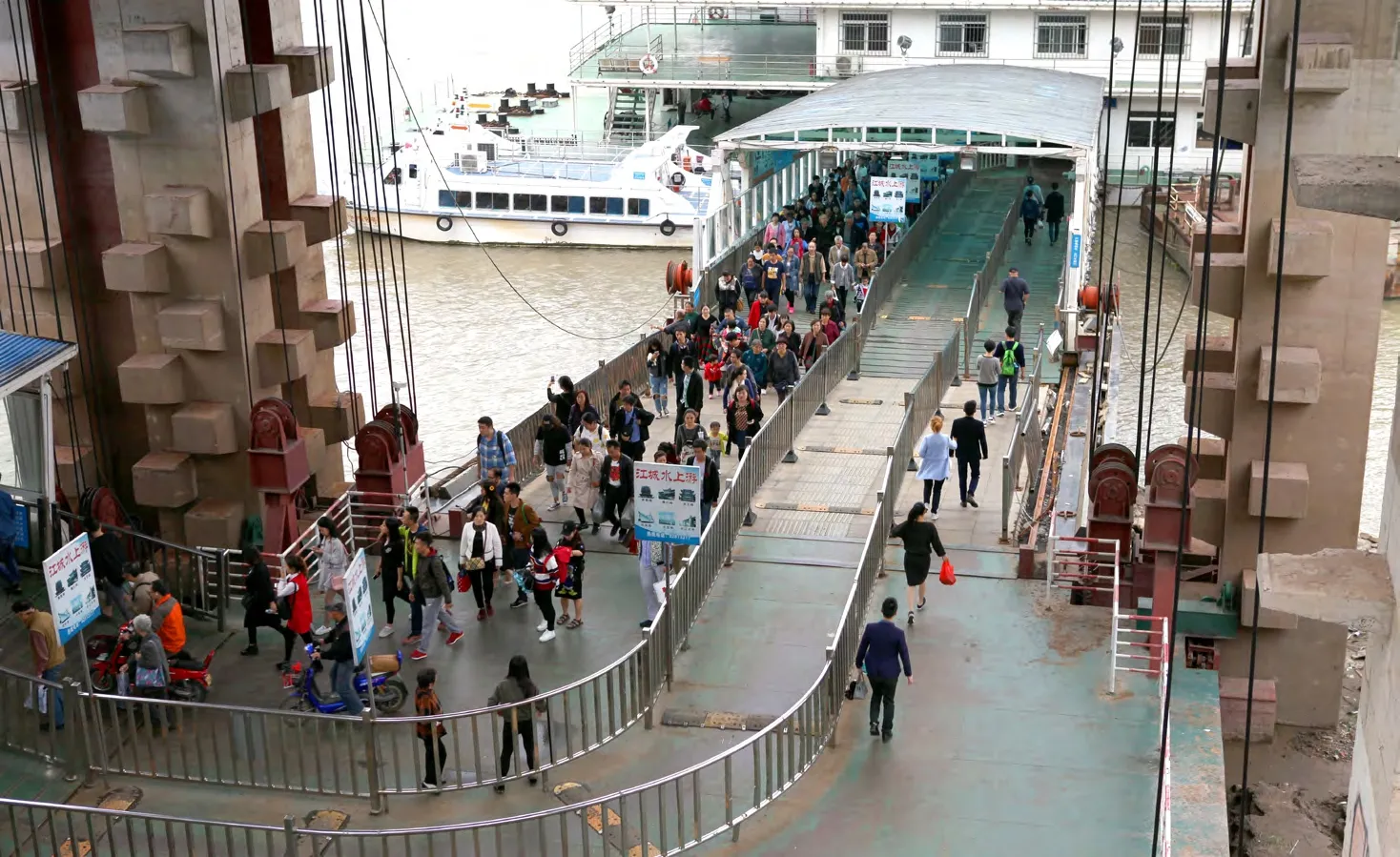
Crossing a river by ferry has always been a magical experience for me, with its horns blaring loudly, people scattered on the lower and upper decks, unexpected gusts of wind,and plumes of smoke spewing from the chimney. I must have been six or seven years old the first time I took a ferry from my hometown, Ostend in Belgium, to Dover, a city along the south-coast of the UK. In fact, my father was a captain for the ferry company;he would take me up to the bridge from which I would have the best views of the immense sea and the white cliffs of Dover.
Later on, while traveling around the world, I would discover more ferry crossings,ranging from the crowded Hong Kong ferry between Kowloon and Hong Kong Island, to the Chao Praya River ferry taking visitors and locals to historical temples around Bangkok, or even to the small bamboo-and-rope rafts carrying people, their large luggage, and motorcycles across the swollen rivers of West-African jungles.
So, naturally, when I moved to Wuhan in June 2006, one of the first things I did was cross the mighty Yangtze River by ferry.I made my way to the Jianghan Road Ferry Pier, passing the historical Jianghan Customs House. Here, I purchased a single journey ticket for just 1.5 yuan. I then got onboard and positioned myself on the lower deck, with the bicycles and motorcycles.
“How long does it take to cross?” I asked one of the motorcyclists in broken Chinese.
“About a quarter of an hour,” he responded.
The upper deck had only a few passengers, most of them either watching the heavy and often hectic boat traffic on the river or staring at the Great Yangtze River Bridge.
It was in 1896 that the HouJi(厚記) ferry company established by Mr. Feng Qijun (馮啟均) kickstarted the ferrying industry in Wuhan; it began with just two wooden steam-powered ferry boats. Despite the high cost of establishing a ferry company(an initial investment of 13,000 taels), the service soon proved to be profitable, and four years later two more boats were added to the fleet.
More ferry companies soon entered the market in Wuhan,resulting in seven Chineseowned and two foreign-owned companies in operation by 1906,all covering separate sections along the Yangtze and Han Rivers.The Chinese ferry companies covered the crossings between Hankou Port and the Hanyang industrial area at the confluence of the two rivers as well as across the Yangtze River to Wuchang,the administrative center of Wuhan.
The foreign ferry companies had to run their businesses from the Yuehan Pier in Hankou,located at the end of Yiyuan Road in the German concession area.The Yuehan Pier was mainly used for ferrying foreign railway technicians who were living in the Hankou concession areas while working in Wuchang on the Yuehan railway that would link Wuhan, in the center of Mainland China, to Guangzhou in the south.
1906 was a monumental year for Wuhan, with Hankou becoming the final station on the Jinghan railway, the first railway link constructed on Chinese territory. In the same year, construction was being started on the Yuehan railway,with Wuchang as its starting point. In between there was the Yangtze River ferry service,shipping locals, travelers, traders,and railway technicians across the Yangtze and Han rivers. For Wuhan ferry companies, it was a golden time.
It has been twelve years since my first voyage on the Wuhan ferry, and with Wuhan heavily investing in preserving its heritage, I am now eager to learn more about the 122 year history of the modern ferry service in Wuhan. I reached out to a wellconnected friend in hope of being introduced to someone who could tell me more about the history of Wuhan’s ferries from an everyman’s perspective. My friend then introduced me to Mr. Yuan Houxiang (袁 厚 翔), a retired bus driver and Wuhan transport history buff.
We met in a Hankou cafe inside the historical former British Concession area, which had since been converted into a modern bookshop. We began talking about the history of Wuhan’s ferry services, and I was amazed at the depth of his knowledge on the subject. “By the end of the 1920’s the local government had established one large transportation company for ferry and bus transportation,”Mr. Yuan began, “absorbing all previously existing ferry companies and setting out the first bus lines throughout the main arteries of the city.” He later added that two ferry lines were being reserved for ferryinggovernment officials and army staff across the Yangtze and Han rivers.
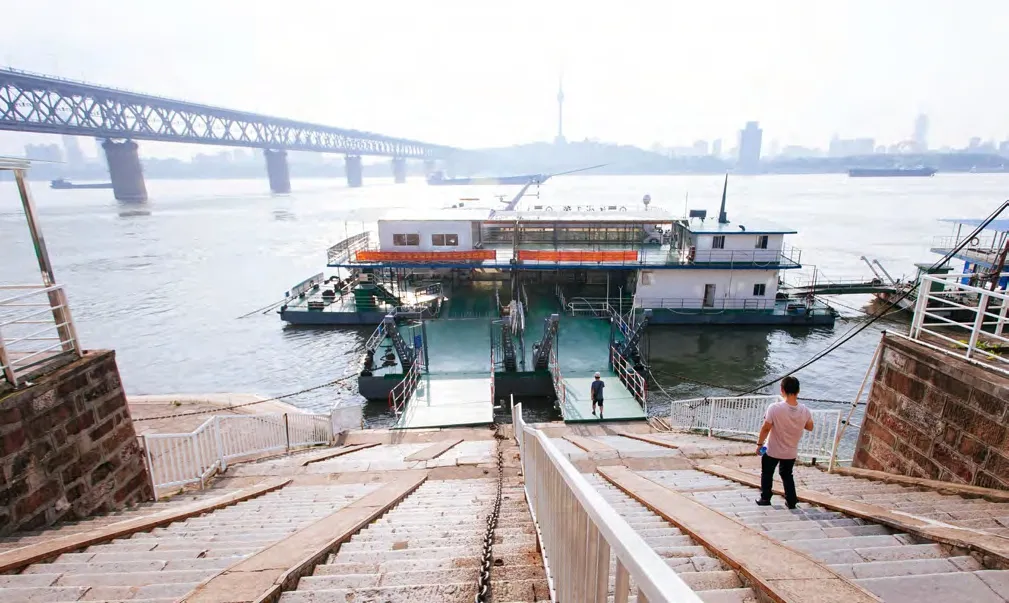
清風拂面,鳴笛聲聲,輪渡緩緩駛入長江。這江城日常一景,背后卻有著悠遠的歷史與無盡的故事……
“And then from March 1937 on, trains and train passengers bound for Beijing and Guangzhou were being ferried across the Yangtze River, using the Xujia Pier—just to make continuous railway transportation between the southern and northern China possible,” he continued.“And train wagons were being shipped across the Yangtze River separately from the train passengers about every hour.”
I listened with great interest to all the information Mr. Yuan was passionately sharing with me. I asked him if there were any interesting incidents in Wuhan’s ferry-crossing history.
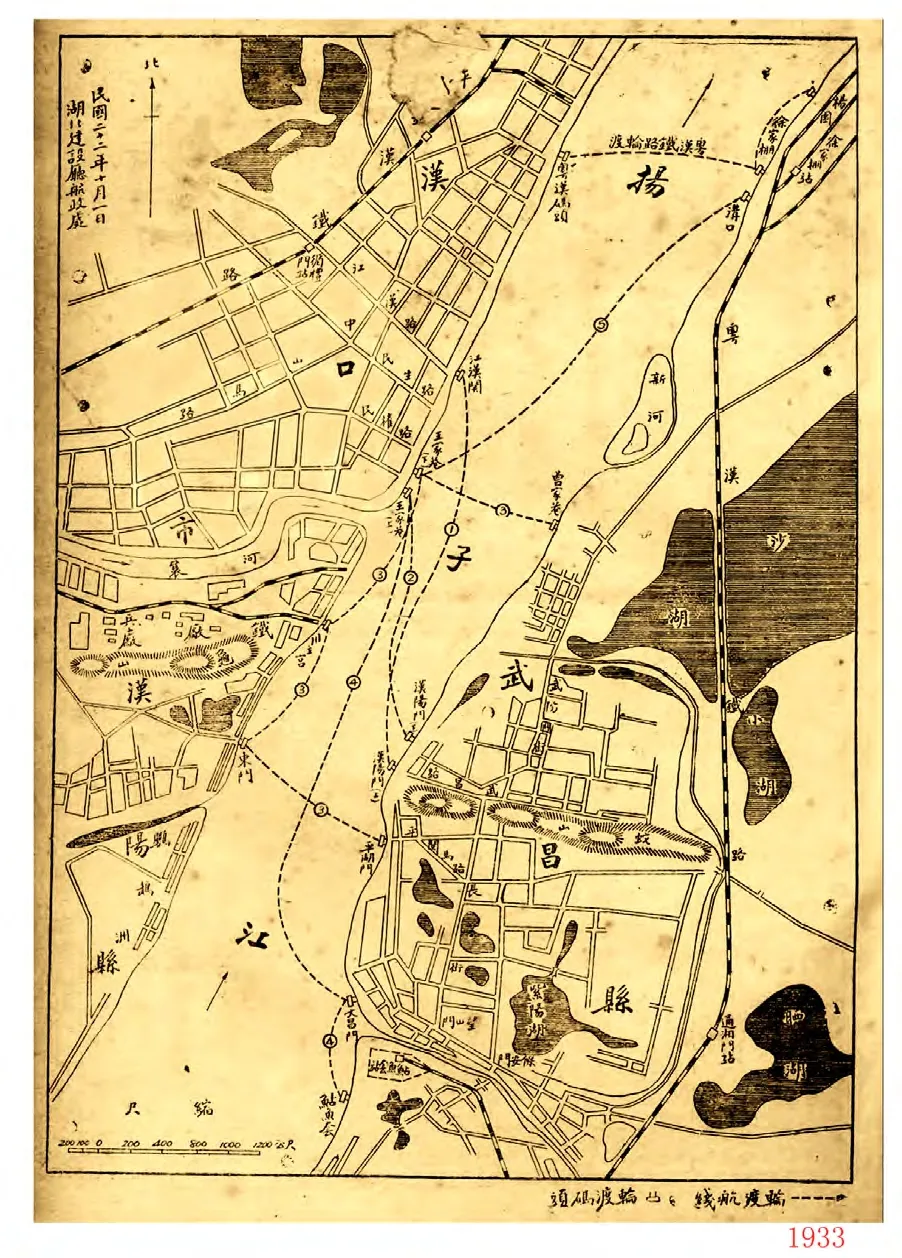
1993年武漢輪渡線路圖Ferry lines of Wuhan in 1993
“Once, in 1938,” he told me,“a train wagon that had not been attached well to the ferry, fell off and into the waters of the Yangtze River…”
“Ouch!” I exclaimed. “How did they resolve that in 1938?” Mr.Yuan then explained that some brilliant minds had utilized some ancient Chinese wisdom to lift heavy objects out of the water using two or more boats, chains,and lots of rocks.
In 2006, I paid 1.5 yuan for a single ride on the Yangtze River ferry, so I asked Mr. Yuan how much passengers had to pay to cross the Yangtze River in the early years. He surprised me by responding with an old local children’s poem from the late Qing-dynasty period:
張打鐵,李打鐵,打把剪子送姐姐
Blacksmith Zhang, Blacksmith Li, make a pair of scissors for the sister of me
姐姐留我歇,我不歇,我要回去打夜鐵
“Stay for the night”, my sister said, but I’m going back to work all night
茶也香,酒也香,十個雞蛋打過江
I had good tea, and drinks as well, and paid for the ferry with ten eggs

沉船救援示意圖This was called the “Cao Chong Cheng Xiang” method, as Cao Chong (196-208) once weighed an elephant using this method
江這邊放大炮,江那邊放小炮……
A loud ‘Bang’ from this side of the river, and ‘pang’ echoing from the other side
(In the early years, ferry departures were announced by canon fire in Wuchang, a gunshot in Hanyang, and a bell ring in Hankou)
Wuhan had the largest ferry system of all locations along the Yangtze River, annually ferrying millions of passengers,whether for goods and vehicle transportation or just as part of some locals’ daily commute to work or school.
Another important year for Wuhan was 1957, with the completion of the Great Yangtze River Bridge, a double-decker road and rail bridge. I asked Mr.Yuan if the arrival of the bridge had affected the daily passengers’traffic on the ferries. “Not at all,”he replied. “Only bus Line 10 was running across the bridge,and remember that beginning in the late 1950’s, China was experiencing a dramatic explosion in its population.”
An average of 3 million passengers annually crossed the river by ferry between 1948 and 1997, when the second bridge across the Yangtze River was completed. After that, passenger numbers then dwindled down to an average of 400,000 annually.“It was dramatic, slashing ferry trips and laying off staff. The ferry company then had to launch a bus line (Line 608) to guarantee work for most of the abundant ferry staff.”
We talked on for almost an hour, about the multitude of cruise services the ferry company had added over the last few years,but also about the challenges of introducing green technologies to the Wuhan ferry fleet. When we parted ways, I was eager to cross the river again as soon as I could.
So, the next day, I took another trip on the Yangtze River ferry. It was 11:05 in the morning when I arrived at the Zhonghua Road Pier in Wuchang. Everything was wellorganized, with a smooth flow of pedestrians and motorcyclists.I positioned myself this time among the tourists on the upper deck. I then closed my eyes and imagined my father holding my hand and leading me onto the bridge. The wind blew softly through my hair, the horns began blaring, and the ferry started off, slowly, almost cautiously.No words were spoken. It was a journey of the heart.
猜你喜歡
《學習方法報》歷史中考版(2023年21期)2023-11-09 07:40:38
數學小靈通(1-2年級)(2020年9期)2020-10-27 03:24:18
當代貴州(2019年41期)2019-12-13 09:28:56
娃娃樂園·3-7歲綜合智能(2016年1期)2016-10-25 09:32:48
中國共青團(2015年7期)2015-12-17 01:24:38
中學生數理化·八年級物理人教版(2014年1期)2015-01-09 08:50:45
中國扶貧(2014年8期)2014-06-27 15:33:39
中國扶貧(2014年8期)2014-06-27 04:09:02
中學生數理化·八年級物理人教版(2014年2期)2014-04-02 08:50:44
能源(2014年3期)2014-03-27 09:55:20