
Positioning Analysis of Small Satellite Launch Services on International Market
2018-07-06 09:24:34ShangHuiMengXiangSongYongshengYanBaofengWeiKai
導彈與航天運載技術 2018年3期
關鍵詞:服務
Shang Hui,Meng Xiang,Song Yong-sheng,Yan Bao-feng,Wei Kai
(1. China Academy of Launch Vehicle Technology, Beijing, 100076; 2. Beijing Institute of Astronautical Systems Engineering, Beijing, 100076)
0 Introduction
More and more launch requirements are emerging as the technological and industrial applications of small satellites have been developing in recent years. A new field of launch services is forming in the international market. After continuous tracking and researching on this field of market, new launch service for small satellites,basing on Long March 11 (LM-11) launch vehicle has been put forward to the market.
Preliminary market system and structure have been formed in international small satellite launch service market. Besides the service mode of releasing from international space station, most launch services rely on the space launch vehicles, mainly including the mode of piggyback launch by medium or large launch vehicles and the mode of specific launch after clustered on small or medium launch vehicles.
Most target orbits of the launch services are Low Earth Orbit (LEO), 500~600km Sun Synchronous Orbit(SSO) typically. There are two kinds of launch vehicles in the international commercial market. One kind is the launch vehicle servicing mainly by piggyback (the small-sat piggyback launcher), the major payloads of which are LEOs, mostly SSOs. The plenty of launch chances and the cost benefits got from piggyback make the services of these launch vehicles entered into the market earlier. Another kind is the small type launch vehicles specifically developed for small satellite launch service (the small-sat specific launcher). New type launch vehicles of this kind are emerging, all of which are developed for low cost, convenient and quick space entering.
The launch vehicles available for small satellites from international market are compared and analyzed,according to their key factors of market positioning including prices, launch capacities, launch volumes, flight mechanic environments and so on.
1 Major Launch Vehicles Providing Available Service for Market
Currently, there are small-sat piggyback launchers including Dnepr, PSLV, Falcon 9, Soyuz, LM-2C/D,LM-4B/C, LM-6, KZ-11 and Vega. Among them, Dnepr was a critical launcher that was very influential in the field of market in previous years, but its launch service has been suspended due to some political reasons 3 years ago. KZ-11 is in final development and planned to maiden flight in 2018. The other launch vehicles are available currently.
The small-sat specific launchers, which are targeting to the commercial market and have implemented or signed launch service contracts, are including LM-11[1],KZ-1A[2], Electron[3], Launcher One[4]and Alpha[5].Among them, LM-11 and KZ-1A had accomplished commercial launch, Electron failed its maiden flight but succeeded in the second flight, while Launcher One has planned its maiden flight in the near future (Mid-2018).Launch service of Electron and Launcher One have been marketing and got orders from parties in the market. The development and marketing of Alpha is suspended at the end of 2016 before its company is sold. As an early specific service provider emerged in the boom of small satellite industry, the Alpha is also very influential in the market, so it is also analyzed.
Some other launchers have finished some critical tests (such as high altitude firing tests, sub-orbital flights,etc.), which includes Bloostar[6], Vector R/H[7,8]and OS-M1[9]. They are still under development and have no many detailed parameters and specific prices released to the market, but they have wined support from investigators and held market attention. They are analyzed as well.
The status of these 2 types of small-sat specific launchers mentioned above is listed in Tab.1.
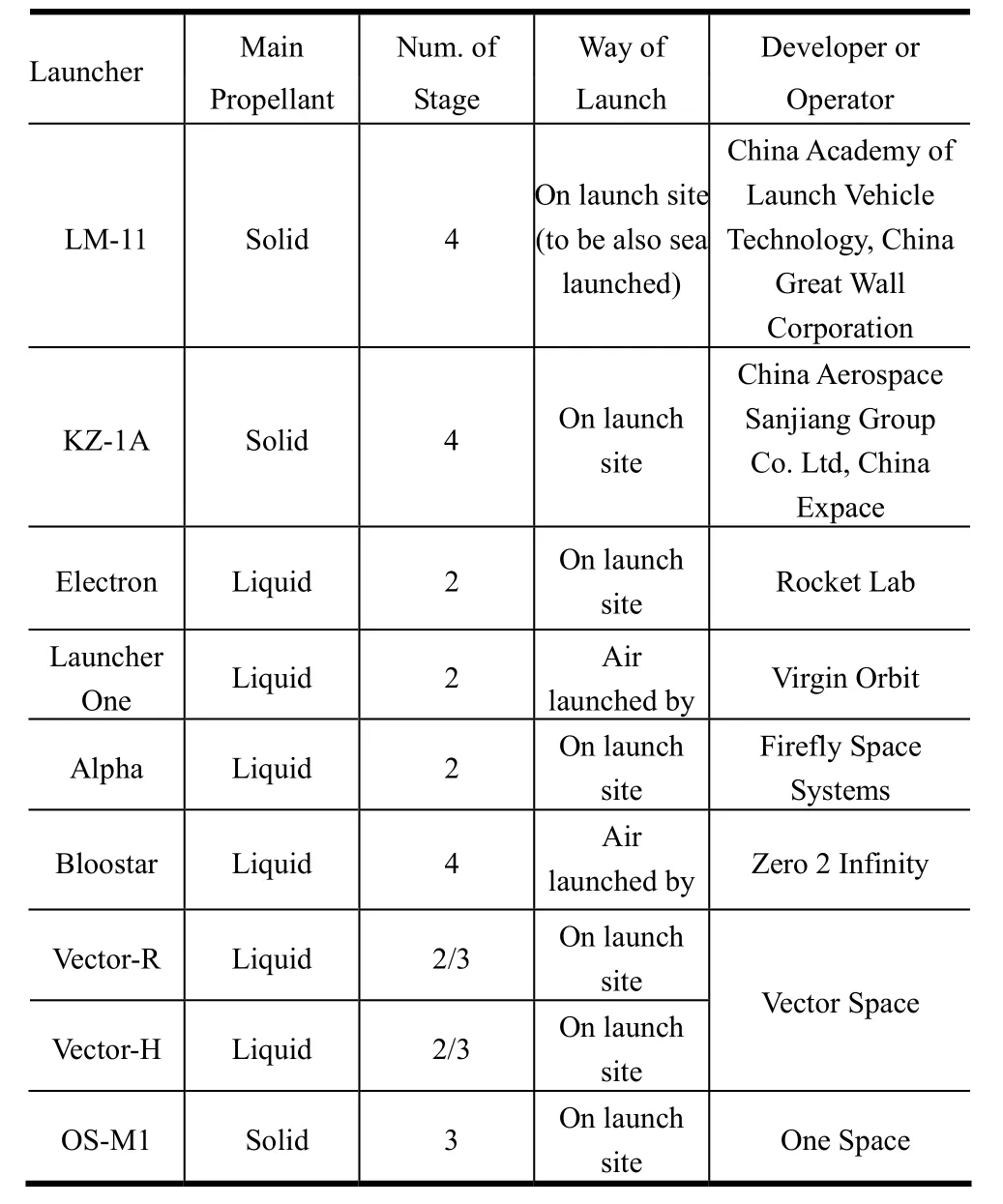
Tab.1 Status of Small-sat Specific Launchers
Besides the above launchers, there are still some other launchers such as Pegasus, Minotaur series and Rockot, which have a lot of launch records for small satellites. They made great contributions to the small satellite industry in its early phases. But for reasons including launch cost, they have few launch missions in recent years, among which most payloads are governmental or military and few from international commercial market. These launchers have little participation in the international commercial launch market, so they are not further discussed below.
2 Launch Capacity and Price Comparison
Launch capacity is conventionally the main factor for pricing a launch service in the market, and it is the standard for evaluating the ability and market position of a launch vehicle. The launch capacity needed by a small satellite (i.e. the launch mass) is the basis of its launch price. The price is normally the most sensitive factor for launch service users, which is a character of commercial space industry, so the price is the primary factor for evaluating a market launch service.
Referring to the small-sat piggyback launchers, the total launch capacity for small satellites is depended on surplus capacity of the main payload of that mission. The price is determined by bilateral negotiation according to the urgency on launch date scheduling, the launch mass of the satellites and the margin capacity of the launcher,as well as the rareness of the mission target orbit and etc.According to the experience of our marketing, the pricing in international commercial market is usually basing on that of Dnepr or PSLV, to a range of 25~35 thousand dollars per kilogram (kdol/kg).
For the small-sat specific launchers, the total launch capacity that is available for small satellites is depended on the launch capacity of the launcher. In order to prevent a loss from business operation, the sum of the prices of all the satellites launched in this mission must not less than the price of the launcher. According to the market information, choosing the representative price for 500km SSO as the comparison factor, the prices and the launch capacities of the small-sat specific launchers are listed in Tab.2.
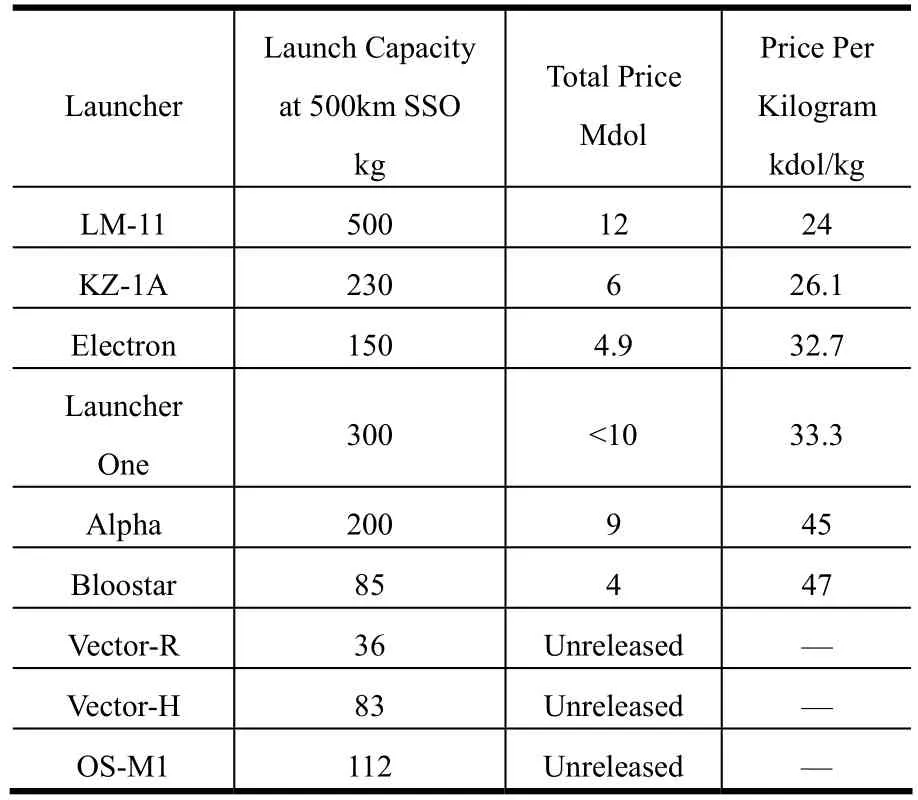
Tab.2 Prices and Launch Capacities of Small-sate Specific Launchers
The launch capacity of the LM-11, KZ-1A, Electron,Launcher One and Alpha is among the range of 150~500kg,their average value is 270kg, mostly they are close to the integral multiples of 50kg.
Besides the technical and operational limitations of their belonged enterprises, it is indicated that there are two reasons for the positioning of the launch capacity.
One is the practical situation of small satellite market. Currently by the ranges of launch mass, the small satellites in the market can be divided into different classes. a) The ones on 5~10kg, including the conventionally called Picosats and Nanosats, usually 1U,2U or 3U Cubesat for academic research or technical evaluation, due to the inadequate total mass for a dedicated launch, they are conventionally launched by piggyback; b) The ones on 10~50kg, conventionally called Minisat, mainly from constellations with tens of to hundreds of satellites, are the most-seen kind of small satellite in the market, they are in forms such as 6U or 8U Cubesat, and usually dozens of them are sent to one orbit plane by a cluster launch mission; c) The ones on 50~500kg, someone also call them Minisat and Microsat, are usually single satellite launched, while sometimes two~three of them are launched in one mission. The major launch requirements are from the class b and c,while the launch service operations of small-sat specific launchers are mainly depended on them.
Another one is the mutual constrains between launch capacity, economical efficiency and mission applicability.If the launch capacity of a launcher is too low, the economical efficiency cannot be guaranteed. While if the launch capacity is too high, it will be hard to be fully occupied by launch requirements. These makes the mission applicability declined and the risk and ratio of vacancy increased, and as a result, the economical efficiency declined.
The prices per kilogram in Tab.2 are calculated according to launch capacities and prices. It is inferred that the prices per kilogram of these launchers is on 25~45 thousand dollars except that of Alpha and Bloostar.
3 Launch Envelop Comparison
Satellites to be launched are conventionally installed in the fairings of launch vehicle, so the available space for satellite launched is determined by its fairing envelop.During the marketing, it is also observed that some satellites with conventional launch mass are hard to find a launch chance only because of their exceeding volume which take too much space of fairing envelop or even go beyond it. So, the shape and available volume of faring envelop, is an important factor to evaluate the service ability of a launch vehicle.
For a small-sat piggyback launcher, the available volume for small satellites is determined by surplus volume left between main payload of the mission and the fairing envelop. The loop space around the payload adapter for main payload is usually utilized for small satellites, while sometimes a bracket structure is utilized to gain space for small satellites in the length direction of the fairings.
For the small-sat specific launchers, the available space for small satellites is determined by design of payload fairing envelop. Four dimensions of the fairing envelop, which are including cylinder diameter, cylinder length, cone length and cone tip diameter (See Fig.1), are chosen to make comparison analyses to these fairings(See Tab.3).
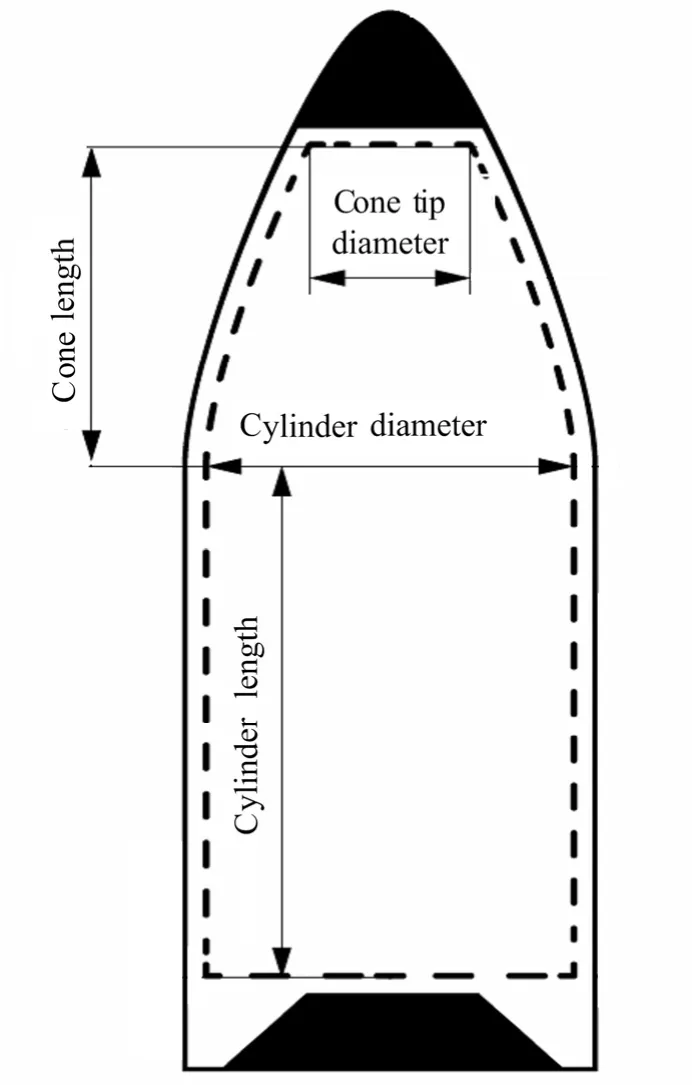
Fig.1 Key Dimensions of Fairing Envelop
According to the dimensions from Tab.3, parameters are calculated and listed (see Tab.4), in which the launch volume is the sum of cylinder volume and cone effective volume of the fairing envelop. Because the conventional low utilization rate of the cone volume, the effective volume of the cone is put forward here and defined as the 3/4 of cone volume. The launch density of a launcher is also put forward to evaluate the spaciousness where the satellites are serviced, which is defined by a ratio of the launch capacity to the launch volume. Besides, in order to compare the shapes of fairings, the total length-diameter ratios are calculated.
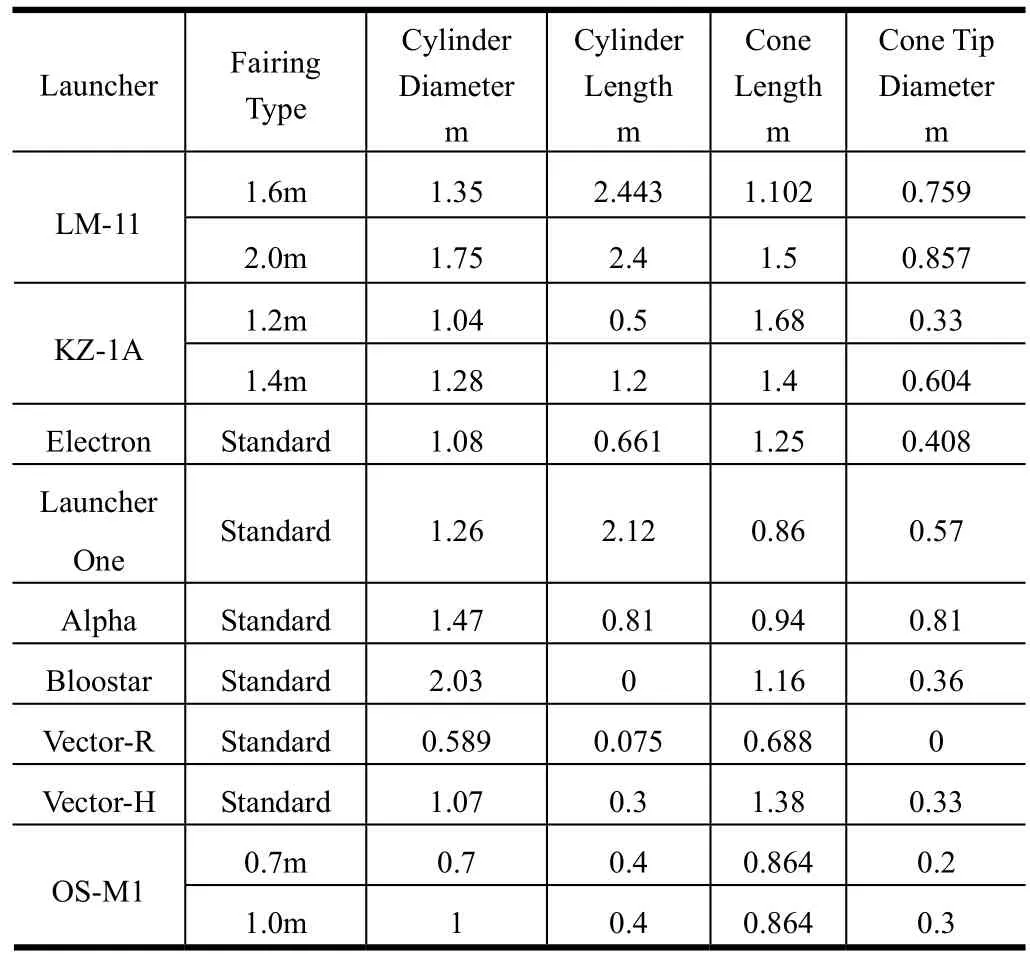
Tab.3 Fairing Dimensions of Small-sat Specific Launchers
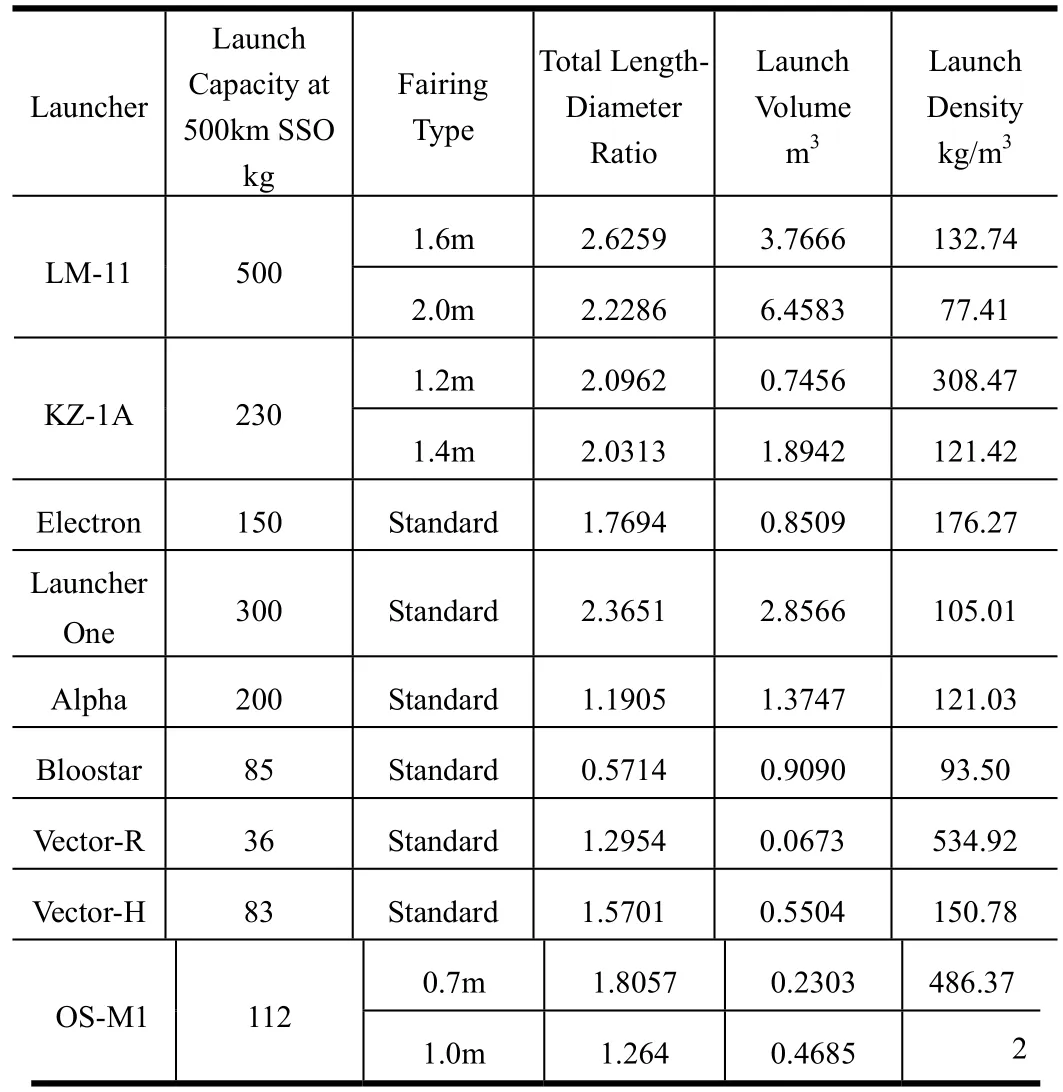
Tab.4 Launch Volumes and Launch Densities of Small-sat Specific Launchers
It can be seen from Tab.4 that the total length-diameter ratios converge to the ranges near 2.5, 2,1.5 and 1. When the shape of a satellite trends towards sphere, it has the maximum ratio of its body volume to its surface area, which benefits heat control, radiation protection and so on. Considering this and also for convenient of their manufacture and assembly, many satellites have shapes close to cube, cylinder with a height equal to diameter or regular polyhedron. By taking the satellite with this kind of shape as reference, the following result is analyzed. a) When the total length-diameter ratios close to 1.5 and 1, it is compatible to Launch One big satellite as main passenger or to have multiple small satellites launched by parallel mounting.This type of fairing shape is comparative more efficient in structure because it needs less surface area to have same volume; b) Due to the limitations from stage diameters and air dynamics of the launch vehicle, the diameter of the fairings should not be too large. In order to make compatible the launch capacity and the launch volume of the launch vehicle, the fairings are lengthened, so the total length-diameter ratios close to 2.5 and 2. Under this scenario, two main satellites with similar size are mounted tandem or many smaller satellites are mounted in parallel to different layers that are tandem mounted.The tandem mounting needs bracket for the upper layers,which causes some loss of launch capacity. The fairing of bloostar launcher has special oblate shape for it is launched in high altitude with special aerodynamic environment, which is for a tray type parallel mounting of multiple small satellites.
It can be also seen from Tab.4 that the launch density distributes on the ranges 80~180kg/m3and with a median of 130kg/m3, which meets the status quo of small satellite industry. For the satellites with same launch mass,more mounting space will benefit the accommodation of spacecraft payloads, solar panels and so on, which reduced the design difficulty and facilitate the satellite design. Lower launch density makes the fairing more spacey, enhances the compatibility to the launch vehicle and facilitates multiple satellites launching, while it has the cost of larger mass of the fairings and loss of launch capacity. In contract, if the launch density is too big, the space limitation of the fairing will reduce the compatibility and make the business operation harder.Most launch densities of the launch vehicles are around 130kg/m3, the LM-11 with 2.0m fairings and Bloostar have obvious advantages in launch density, the KZ-1A with 1.2m fairings, OS-M1 and Vector-R have the highest launch densities.
4 Flight Environment Comparison
The parameters of environment met by satellites during the flight, including load, vibration and shock and so on, determine the comfort level of the flight, and they are also limitations to the availability of satellites serviced.Besides, the axial accelerations during flight are determined by propulsion system and flight sequence,which are the inherent properties of a launch vehicle.With the maximum axial acceleration during flight phases utilized as the key factor, the small satellite available launchers including both small-sat specific launchers and small-sat piggyback launchers are compared in Tab.5.
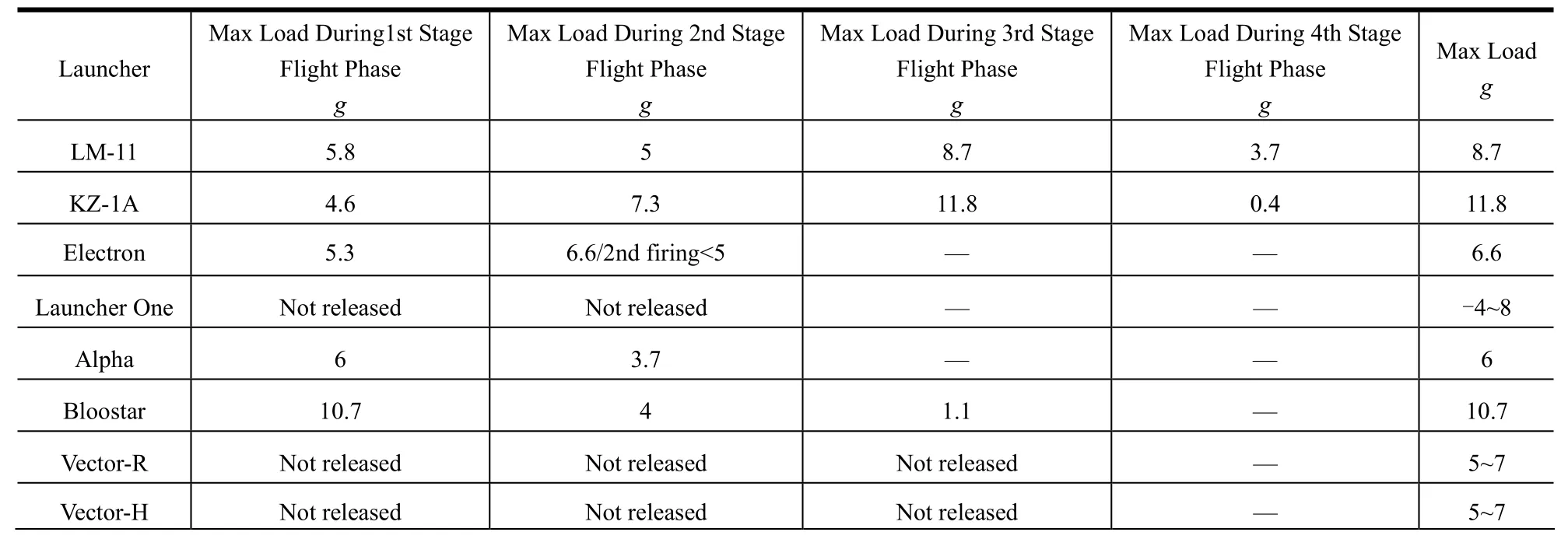
Tab.5 Flight Loads of Small Satellite Available Launchers for International Market
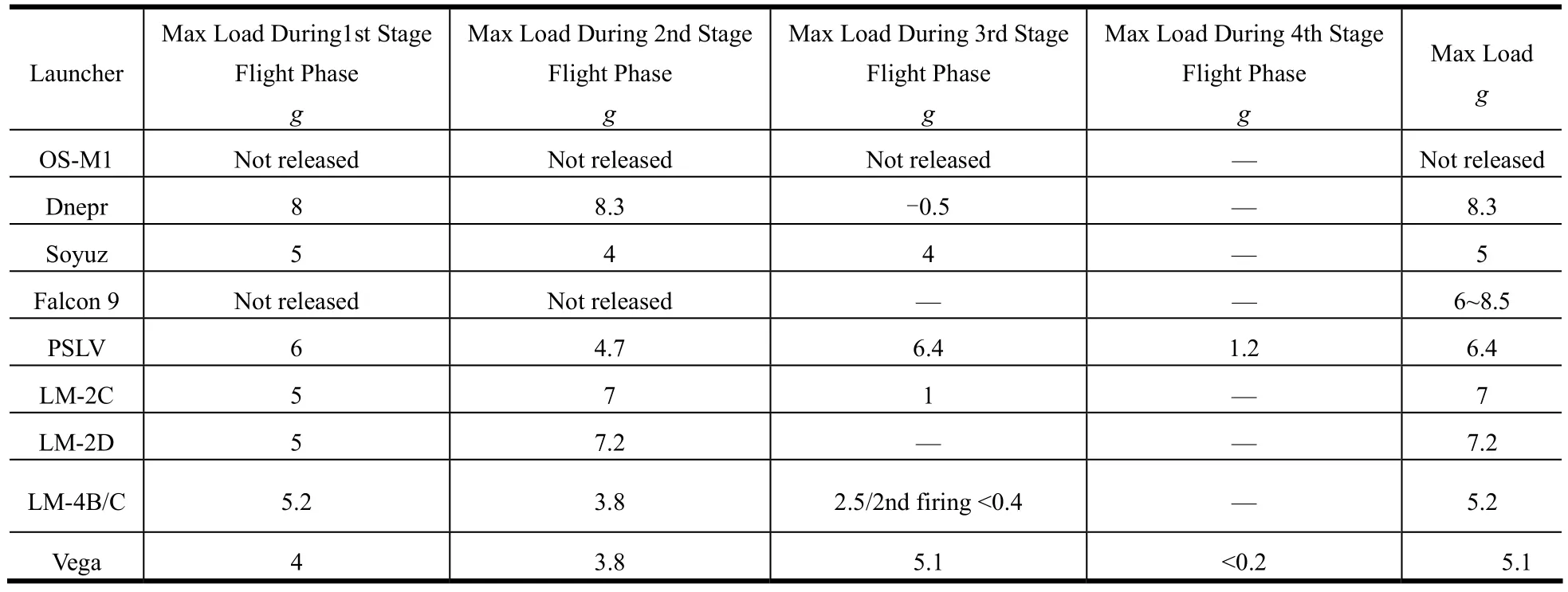
Continuation Tab.5
It can be seen from the table that the flight loads of small type launchers are normally higher than that of the middle and large types. For the launchers with same launch ability, solid propellant launchers have greater flight loads than liquid launchers. For the solid propellant launchers (including the PSLV with third stage solid motor), the maximum acceleration happens during third stage flight phase. The loads of flown launchers concentrate on 5~9g, with average of 7.98g. Except the KZ-1A which has apparently higher maximum flight axial acceleration, the small satellite available launchers have an average maximum flight overload of 7.6g.
The high flight load is a challenge to satellites,which may results higher structure mass or even a disruption to system design for the ones with precision payloads. So the high load will cause more costs of manufacture and launch, as well as a decline of compatibility of launch vehicle, a harder business promotion and less market share.
5 Comprehensive Analyses and Evaluation
Price per kilogram, maximum load and launch density are respectively the factors of a small-sat specific launcher for economical efficiency, spaciousness and environmental comfort. We put together the above factors,set the prices at 30~40 thousand dollars, maximum loads at 6~8g and launch density at 100~150kg/m3as level of middle, while the lower ones as level of low and higher ones as level of high. The values far away from population values are set as extremely high or extremely low. Accordingly, the data of different launch vehicles are evaluated and conclusions are drawn, as shown in Tab.6 and Tab.7.
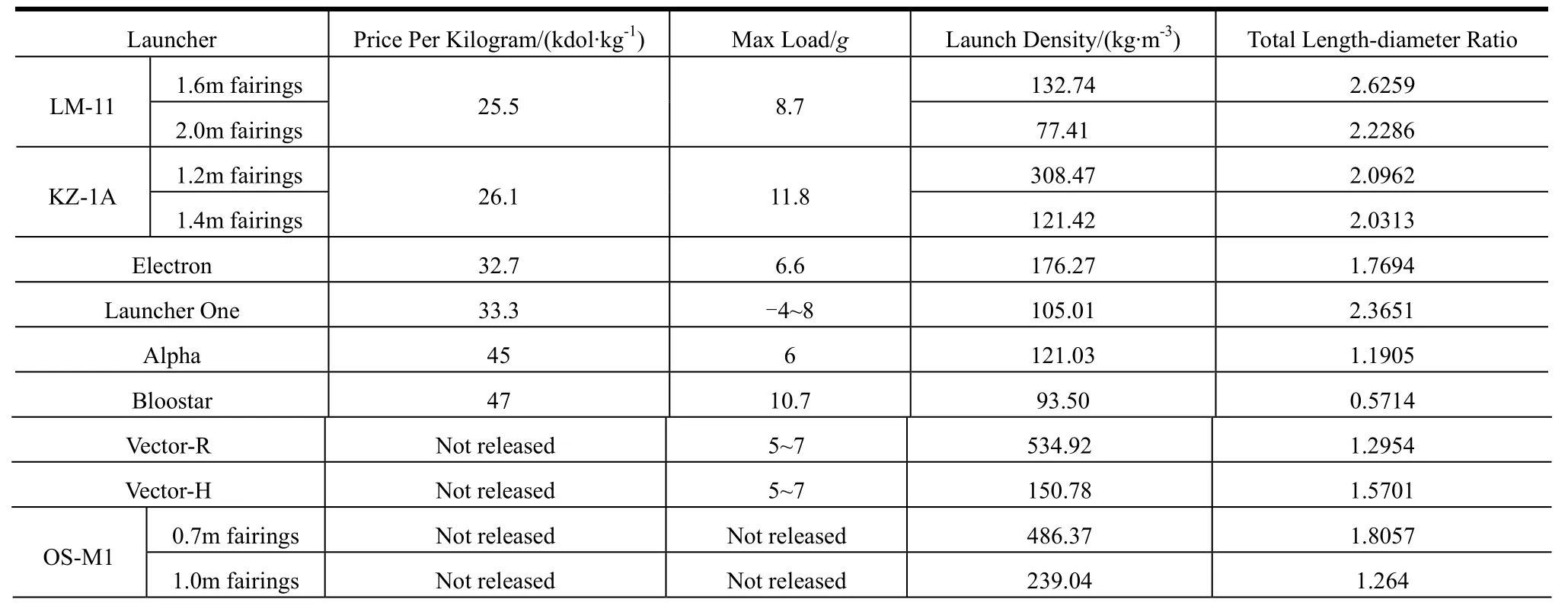
Tab.6 Key Parameters for Performances and Pricing of Small Satellite Available Launchers for International Market

Continuation Tab.6
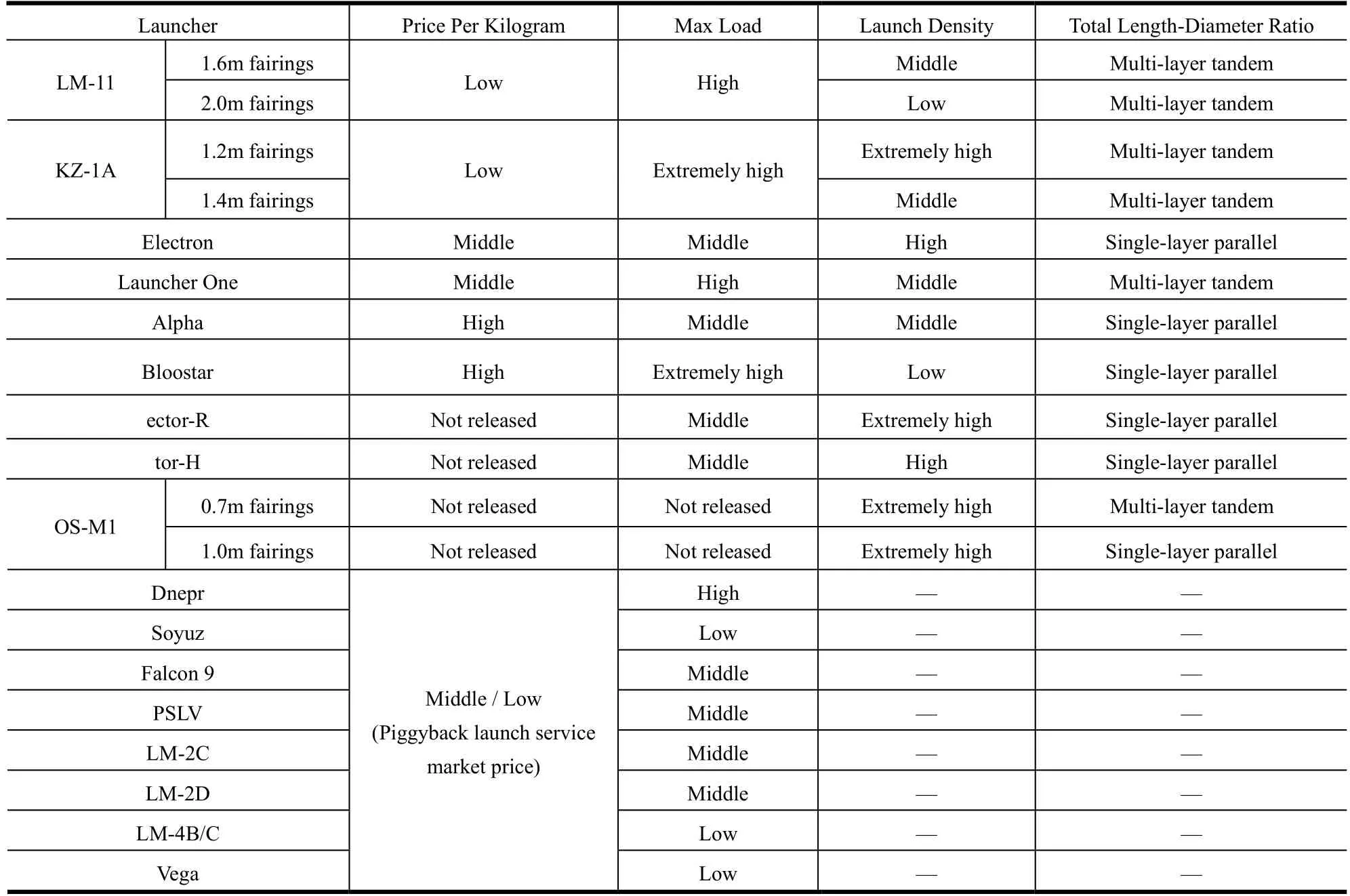
Tab.7 Performances and Pricing Evaluation Results of Small Satellite Available Launchers for International Market
For the 8 types of the first 6 small-sat specific launchers, which have all key factors of market positioning, in order to make comparison, we set scores of -1, 0, 1, 2, 3 and 4 respectively according to the levels of extremely high, high, middle, low and extremely low.Then, the scores of factors of each type of launcher are same weight added (otherwise, if there are emphasizes,different weights can be used), the total scores and the total ranks are shown in Tab.8.
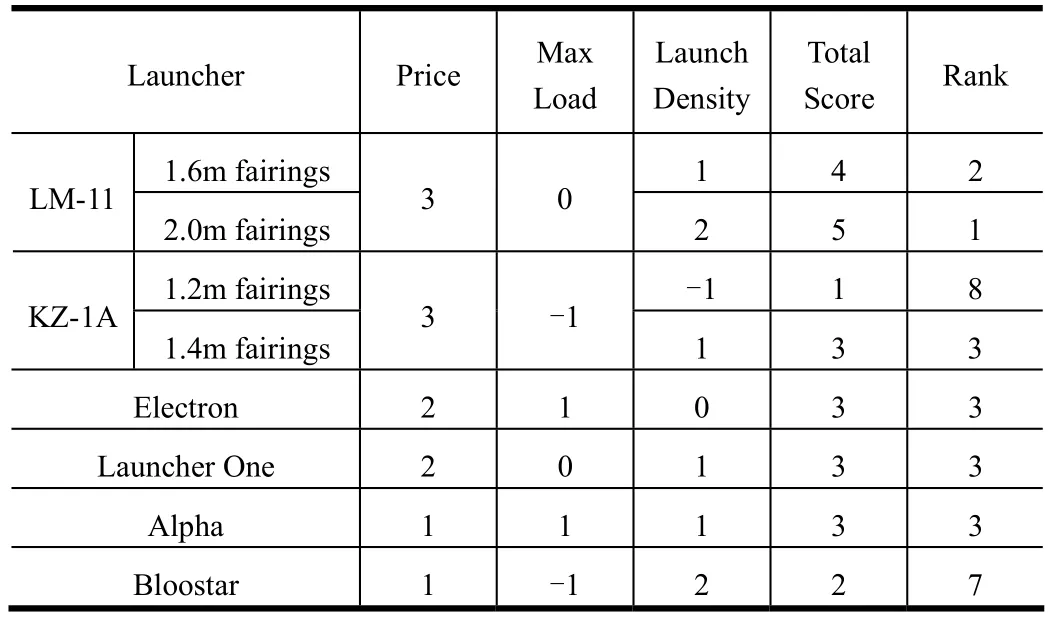
Tab.8 Scores and Ranks of 6 Small-sat Specific Launchers
6 Conclusion
According to the market positioning and performance analysis on small satellite launch services of international commercial market, it is concluded that:
a) The market price of the piggy-back launch service of a small satellite is conventionally located at the range of 25~35 thousand dollars per kilogram. Referring to the launchers being or to be operated in the market, the launch service prices are located around the range of 25~45 thousand dollars per kilogram, the launch capacities are around 150~450kg, with an average launch capacity of 270kg.
b) In order to analyze the launch volume of small-sat specific launchers, the total length-diameter ratio of fairings and the launch density are analyzed. The total length-diameter ratios concentrate on 2.5, 2, 1.5 and 1.The first two and the last two are corresponding to the satellite layouts of multi-layer tandem and the single-layer parallel respectively. The launch densities concentrate in range of 80~180kg/m2, with an average launch density of 130kg/m2.
c) In order to analyze the flight environment of the small-sat specific launchers, the axial loads of the flown launchers during flight are analyzed. It is found that the small type launchers have larger flight load than those of large and middle type, while solid propellant launchers have larger flight loads than those of liquid propellant launcher. The flight axial loads of the launchers concentrate in the range of 5~9g, with an average flight load of 7.6g.
d) The key factors of small satellite available launchers are summarized and compared, while the 8 types of 6 small-sat specific launchers are compared according to their key factors for price, flight environment and space. The LM-11s with 2m and 1.6m fairings are ranked 1st and 2nd. The KZ-1A with 1.2m fairings ranks 8th and Bloostar ranks 7th. Electron,Launcher One and KZ-1A with 1.4m fairings rank 3rd simultaneously, at the middle place.
The above analysis results have key significances and reference value for analyzing market competition situation of small satellite launch service and corresponding strategy, product locating and planning during development process, selecting of small satellite launch service, making pricing strategy of launch service and so on.
[1] 尚輝. 長征-11首次亮相國際小衛星商業發射服務市場[J]. 國際太空2016(8), 34-37.
Shang H. CZ-11 made its debut in international commercial launch service market for small satellites[J]. Space International, 2016(8), 34-37.
[2] Expace. KZ-1A solid launch vehicle[EB/OL]. (2017-12-01)[2017-12-01].http://expace.com.cn.
[3] Rocket Lab. Electron[EB/OL]. (2017-11-20)[2017-11-20]. http://rocketlabusa.com/index.html.
[4] Virgin orbit. Virgin orbit launcher one service guide[EB/OL].(2017-08-07)[2017-11-22]. http://virginorbit.com/s/180117_service-guide_reference.pdf.
[5] Firefly alpha. Firefly alpha payload guide[EB/OL]. (2015-07-01)[2017-09-20]. http://www.fireflyspace.com/documents/FireflyAlpha-Payload Guide.pdf.
[6] Kieran H, Jose M L. Small satellite launch vehicle from a balloon platform[C]. Oxford: 13thReinventing Space Conference, 2015.
[7] Vector space. Vector-R launch user’s guide[EB/OL]. (2017-8-10)[2017-11-20]. http://static1.squarespace.com/VSS-2016-011-V1.5Vector-R Launch Uer’s Guide.pdf.
[8] Vector space. Vector-H launch user’s guide[EB/OL]. (2017-8-10)[2017-11-20]. http://static1.squarespace.com/VSS-2016-023-V1.1Vector-H Launch User’s Guide.pdf.
[9] 零 壹 空 間 . OS-M1[EB/OL]. (2018-01-10)[2018-01-10]. http://www.onespacechina. com/os-m1-2/index.html.
One space. OS-M1[EB/OL]. (2018-01-10)[2018-01-10]. http://www.onespacechina. com/os-m1-2/index.html..
猜你喜歡
杭州金融研修學院學報(2022年5期)2022-06-15 11:41:48
今日農業(2019年14期)2019-09-18 01:21:54
今日農業(2019年12期)2019-08-15 00:56:32
今日農業(2019年11期)2019-08-13 00:49:08
今日農業(2019年13期)2019-08-12 07:59:04
今日農業(2019年10期)2019-01-04 04:28:15
今日農業(2019年15期)2019-01-03 12:11:33
今日農業(2019年16期)2019-01-03 11:39:20
銅仁學院學報(2018年4期)2018-06-13 03:21:34
商周刊(2017年9期)2017-08-22 02:57:56
