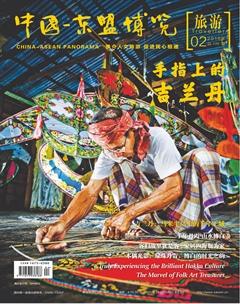
The Marvel of Folk Art Treasures
2018-05-14 12:55:10ByMoTingting
中國-東盟博覽(旅游版) 2018年2期
By Mo Tingting

Generally speaking, Bobai, compared with Shanghai or Beijing, is not a large modern city in China. However, being embraced by green hills and clear waters, this charming county is endowed with deep cultural connotations in its long grand history that other modern counties cannot match. Bobais bamboo weaving is very popular in China for its great varieties, delicate appearance and exquisite workmanship. This beautiful and natural craft can represent traditional Chinese culture and still survives after refining. In addition, Bobais acrobatics, a kind of superb folk skill, enjoys a great fame all over the world.
A gem of handicraft
China is home to about one-third of the worlds bamboo. For centuries, bamboo is a common theme in Chinese literature and a favored subject of painters. Along with the evergreen pine and plum, bamboo is a part of the traditional Three Friends of Winter, representing steadfastness, perseverance and resilience. People weaved bamboo as early as some 5,000 years ago. Bamboos tough, pliable stalks have been deftly woven into a wide variety of objects combining utility with remarkable artistic expression. As a decorative culture, it occupies an important position among the treasures of Chinese traditional arts and crafts, and represents the wisdom of Chinese people.
Bobai County has a long history of weaving bamboo. In primitive society, people already mastered the skills of basketry by using grass, bamboo, straw, etc. Bamboo weaving is connected to dustpans and basket carriers in many peoples eyes, but if they visit the bamboo art center in Bobai, they would find that bamboo items are common around the county. Local craftsmen use bamboo filaments to weave animals, birds, flowers, human and other patterns. Exquisite and durable utensils made of thin strips of bamboo include baskets, dustpans, plaques, couches, barrels and mats. All these are very useful and enjoy high value. Visitors interested in bamboo weaving are able to observe the masterful skill and even buy some items as souvenirs.
Local skilled craftsmen are good at weaving with bamboo strips and vines. Weavers gather and carefully choose bamboo materials in accordance to bamboos maturity, length between nodes, calibers of both ends and colors. Once gathered, the materials will be cleaned and prepared via various techniques, including cutting, splitting, scraping, dividing, weaving, dyeing and lacquering. Then craftsmen strip the bamboo to useful sizes. This is almost the most difficult step. The thinnest bamboo strip can be only a quarter of millimeter in diameter — almost as thin as human hair. After the bamboo stalks are cut down and transported to the workshop, they are boiled in a long metal container to remove
the waxlike skin and other substances to make the material more pleasant to be touched and seen. Sometimes, craftspeople boil the bamboo in dyes before or after weaving to cater to modern peoples taste. After ten complicated procedures, bamboo comes out to be gorgeous and delicate artworks.
While some bamboo-weaving works can be completed in several weeks, others take many months, and exhibition pieces often require longer, sometimes one year or two. Due to its complexity and reliance on skilled labor, the art of bamboo weaving once was in steep decline in the region. With a view to promoting the inheritance and preservation of traditional handicraft, local people have tried to innovate and integrate modern elements into bamboo weaving works.
Bamboo articles from Bobai County are known for its close texture which is solid and durable. Today, many bamboo basketry products are exported to various countries and regions. And exquisite weaving technology, excellent material properties, deep cultural connotations and brilliant achievements prove to be the basis for the development of Bobais bamboo-weaving. Smart Bobai people creatively use bamboo and display their good taste in weaving bamboo, thus to enhance bamboo weavings artistic value.
Ten years of practice off the stage makes perfect
Acrobatics is one of the art forms most popular among Bobai County. In recent years, China was internationally recognized as the No.1 Country of Acrobatics and Bobais acrobats won prizes in many international competitions. Acrobatics has a long and rich heritage in China for more than two thousand years.
As early as the Warring States Period (475 BC-221 BC), the rudiments of acrobatics existed. By the time of the Han Dynasty (221 BC-220 AD), the acrobatic art further developed both in content and variety. In the Tang Dynasty (618-907), acrobatics was prevalent in the imperial court and among ordinary people as well. In the Song Dynasty (960-1279), acrobatics moved from the imperial court to ordinary people, and the performing form and program contents witnessed profound changes. In the Ming (1368-1644) and Qing (1644-1912) dynasties, acrobatics was still a way of living for some people.
Bobais acrobatics ranks among the best in the world thanks to its long history, rich repertory and distinctive artistic characteristics. The artistic characteristics can be summarized as follows:
First, Bobais acrobatics has long stressed the basic training of the waist and legs, and has attached great importance to the skill of standing on the head and hands. Second, Bobais acrobatics is characterized by feats of strength and daring performed cleverly, precisely and accurately, and the ability of retaining balance in motion. The ability of Bobais acrobats to perform rope-dancing stunts on a stack of benches placed on a plank and building pyramids on a free-standing ladder shows their superb skills at stabilizing themselves and retaining their balance in motion — skills that require years of hard training and reflect mans spirit of braving hardships and danger. Third, Bobais acrobats can juggle both light and heavy objects with dexterity, particularly with their feet. The artists manipulate a variety of objects ranging from wine buckets, porcelain jars, tables, ladders, poles, planks, drums and gongs to silk umbrellas and people weighing more than 100 pounds. Fourth, local acrobatics features the combination of great physical strength and nimble somersaults. A local acrobat can show great strength by using his hands and feet to lift four stone barbells and eight people weighing over 1,000 pounds. Fifth, Bobais acrobatics is noted for its flexibility in terms of the size of performance venues and the number of performers. Performances can be staged in squares and theaters, on the streets and even in small living rooms. The great flexibility of Chinese acrobatics has enabled the art form to mature and develop a fine tradition through the ages. Finally, Bobais acrobatics has maintained a strict master-apprentice system and has been closely related to other forms of performing arts. Chinese acrobatics is an art that was handed down from one generation of a family to another, as well as from master to apprentice.