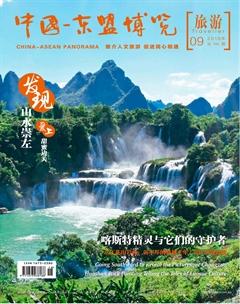
Exploring the Brilliant Zhuang Cultures
2018-05-14 14:42:58WuSheng
中國-東盟博覽(旅游版) 2018年9期
Wu Sheng
Culture is the soul of a nation. The splendid Chinese culture is comprised of different ones of Chinas 56 ethnic groups, each with its unique charm and distinctive features. Among them, the hard-working and talented people of Zhuang ethnic group, mainly inhabited in south Chinas Guangxi Zhuang Autonomous Region, have created many brilliant cultures in the long course of their development, including their own traditional festivals and folk activities. These colorful cultures not only represent the crystallizations and treasures of Zhuang peoples wisdom, but also serve as important tourism resources of the region to attract visitors. Now follow us to take a close look at Longzhou, a typical Zhuang county in Chongzuo, Guangxi, and have a vivid experience of the splendid Zhuang cultures.
Tianqin, a testimony to the wisdom and culture of Zhuang ethnic group
Longzhou County, located in the west of Chongzuo and bordering Vietnams Cao Bang Province to the northwest, is home to a vast group of Zhuang people. Originated in Chongzuo, the Luoyue culture has been well preserved in this beautiful land, among which Longzhous Tianqin is an integral part of this magnificent culture.
Tianqin, a unique folk stringed instrument of Zhuang ethnic group with a history of more than 1,000 years, was originally used as a ritual instrument. There exist varied versions of stories about Tianqin, but now it is rather difficult to identify the exact one behind its origin. Yet, one thing is for sure: Tianqin was created during a time when the ancestors of Zhuang people still dwelled in the caves in Guangxi, and stemmed from their strong belief in supernatural powers. According to historical records, the ancient Luoyue people once resided individually or in small tribes in the caves scattering in the dense forests by the Zuojiang River, a river that flows through both Guangxi and Vietnam. At that time, these cavemen led a harsh life where they struggled for survival by hunting for food with simple stone implements. Later, as northern Chinese cultures permeated into this “wild” land, Luoyue people began to expand their scope of production activities, and managed to learn to grow rice, gradually transforming from a hunting nation to an agricultural one. Even so, they were incapable of defending against foreign invasion or combating natural disasters on account of their living in separation from others and low production capacity. As a result, the ancestors of Zhuang people had no choice but to turn to nature for help, desiring mercies of the God of Heaven and praying for its blessing by holding sacrificial ceremonies. This particular living environment was conducive to the creation of Tianqin to be played at the rites.
The design of Tianqins body integrates the carvings of many Zhuang cultural elements such as dragons and silk balls, giving it high value of appreciation and collection. The performing forms of Tianqin can be categorized into “Tantian”, “Changtian”, and “Tiaotian”. “Tantian” is solo playing that follows a set of certain tunes and rhythms; “Changtian” refers to the use of Tianqin as an accompaniment to the folk songs of Zhuang ethnic group; and “Tiaotian” means performers playing the instrument while dancing and singing at the same time. All of these may provide a joyful and relaxing feeling to hearers in a warm atmosphere.
As one of the oldest Zhuang musical instruments, Tianqin acts as a vivid testimony to the wisdom and respect for nature of the early Luoyue people. It has now turned into a cultural symbol of Zhuang ethnic group that stands for health, auspiciousness and happiness, as well as a cultural brand that enjoys great renown both at home and abroad. As early as 2007, Longzhous Tianqin art was listed as an intangible cultural heritage of Guangxi; Longzhou, the cradle of Tianqin, was therefore honored as the “Home of Chinese Tianqin Art” by the China Federation of Literary and Art Circles and the Chinese Folk Literature and Art Association in December 2007.
Whats more, Tianqin also made its presence at Guangxis most important event — the annually-held China-ASEAN Expo (CAEXPO). At the 7th CAEXPO in 2010, Tianqin was designated as a gift for state leaders and distinguished guests, which not only carried great political and diplomatic significance and historical value, but also played a crucial role in promoting the profound Guangxi and even Chinese traditional culture.
Dalang Dance, best wishes for plentiful harvest, good future and well-being
For Zhuang people, who are renowned for their skills in singing and dancing, dance is much more than a form of performing art that displays the beauty of body; it also implies rich cultural connotations behind this versatile ethnic group.
The Dalang Dance in Tiandeng is typical of the various Zhuang dances. Tiandeng is a county that lies in the north of Chongzuo with concentrations of groups of Zhuang people. Boasting a time-honored history of more than 1,300 years, the Dalang Dance is a valuable cultural heritage created by the Zhuang ancestors in this place, and well carried forward to the present day. Listed as an intangible cultural heritage of Guangxi in 2010, the Dalang Dance has become a lasting emblem of Tiandeng.
“Lang” (mortar) and “Chu” (pestle) are two commonly used tools in the Dalang Dance. “Lang” refers to a hard boat-shaped object in which Zhuang people in the past could remove the husks from substances such as grain, seeds and nuts; and “Chu” is a small heavy tool about one-meter long with a round end used for that purpose. These two things may have suggested that the Dalang Dance was derived from the scene of agricultural work that involves the use of “Lang” and “Chu”, and that it produces an archetypal display of traditional farming culture of Zhuang ethnic group. In the dance, “Chu” is used to strike the different parts of “Lang” to create varied sounds. During the Tang (618-907) and Northern Song (960-1127) Dynasties, the Dalang Dance evolved into a folk grand event for Zhuang people to offer their best wishes for favorable weather that could bring plentiful harvests, good future and well-being of the people.
Due to the employment of such heavy tools, the Dalang Dance requires some strength to perform it, and the dance movements is fairly complex as they involve arms and legs at the same time, and entail flexible alterations of a variety of dance steps. In the Dalang Dance performance, both dances and spectators will immerse themselves in the ear-splitting but pleasant sound as well as the warm atmosphere. Reflecting the distinctive characteristics of Zhuang culture, the dance, with increasing popularity among people, has already extended its influence beyond Guangxi to other parts of China and even Southeast Asia.
Longyuan Festival, an ocean of joy
It is universally acknowledged that people from different cultures have their own unique perspective and approach to think and behave. Just as some ethnic groups in southwest China and Southeast Asia celebrate the Water-Splashing Festival, with a belief that sprinkling water to others could wash away misfortune and hardship, people in Longzhou also created their own festival — the Longyuan Festival, one that features many special local customs.
The name of the festival indicates its close association with the dragon (“Long” in “Longyuan” means dragon in Chinese). The Longyuan Festival falls on the second day of the second lunar month, a day as described in a Chinese folk saying “On February 2, the dragon raises its head”. It is believed by locals that the dragon was the king of all insects, and they would keep themselves hidden in the presence of the dragon, which were conducive to peoples well-being and agricultural production. Consequently, on every February 2 or the Dragon Heads-raising Day, Longzhou people will hold activities to mark the Longyuan Festival, in the hope of waking the dragon up to ward off the plague of insects, and ushering in a bumper year for agriculture.
The Longyuan Festival has injected great glamour to this century-old county. During the festival, people from different towns and villages take part in a wide range of activities. For example, in a grand parade, the dragon-led procession joined by the enthusiastic people that stretches for several meters snakes its way through the well-decorated streets of the county. The lion dance is another highlight of the festival that attracts tens of hundreds of viewers. Amid the sound of gongs and drums, the dancers dressed in resplendent lion costumes constantly vary their dancing movements, and sometimes do some stunts like high jump in mid-air, presenting spectacular beauty of different images of the dragon. The lion dance should be performed by skilled teams to bring the motionless creature to life. The correct combination and proper timing of different parts of the lion are very important to make a successful dance. So to be very successful in the dance, the performers must be able to coordinate with the body movement to match the timing of the musical instruments. Other interesting activities including Tianqin performance and folk songs singing are also held, making the festival an ocean of joy.
Food represents an indispensable part of a traditional festival. Ciba, or glutinous rice cake, deserves a special mention in the Longyuan Festival. The handmade Ciba is made of glutinous rice with sesame or peanuts as the fillings, and some may be wrapped up in banana leaves. In addition to Ciba, five-color glutinous rice is also served during the Longyuan Festival.