
Phase Locked Loop Based Cancellation of ECG Power Line Interference
2018-04-27 02:51:49LITaihaoZHOUJiansheLIUShupengSHIJinshengandRENFuji
ZTE Communications 2018年1期
LI Taihao,ZHOU Jianshe,LIU Shupeng,SHI Jinsheng,and REN Fuji
(1.Beijing Advanced Innovation Center for Imaging Technology,Capital Normal University,Beijing 100048,China;2.Flatley Discovery Lab,Boston 02129,USA;3.School of Communication and Information Engineering,Shanghai University,Shanghai 200072,China;4.Department of Information Science and Intelligent Systems,University of Tokushima,Tokushima 7708506,Japan)
1 Introduction
Electrocardiography(ECG)is extensively used for detecting heart disease by recording the electrical activity generated by cardiac muscles.In ECG measurement,the cable linking the subjects to the ECG monitor is susceptible to the 50 Hz powerline(PL)interference[1],which results in inaccurate reading because the interference frequency is located very close to the high frequency component of the true ECG signal[2].Studies showed that,to achieve high quality for ECG,the amplitude of the PL interference must be kept at less than 0.5%of the peak to peak amplitude of the QRS waves[3].Therefore,removing or can celling the PL interference is a critical challenge in ECG signal processing.In the last several decades many methods have been proposed to cancel the PL interference and they can be generally categorized into nonadaptive and adaptive filtering.Nonadaptive filters such as notch filter have the advantage of featuring a simple structure and fixed coefficients,however,they cannot target PL interference when its frequency deviates from 50 Hz[4][6].From this perspective,adaptive filtering,because of its ability to track the frequency of PL interference,may yield more robust performance in practice[7][11].In implementation,adaptive filtering relies on the stochastic characteristics of a reference signal to track the PL interference.In this work,we propose a method to first use phase locked loop(PLL)to generate the reference signal that can be used to track the frequency and phase of PL interference accurately.We then use a least mean squares(LMS)filter to cancel the PL interference from ECG signal for a better result.We use the ECG data from the MITBIH database to testour method and found that it performed superior to the existing techniques.
2 Methodology
The model of our ECG signal and the structure of the adaptive filter is shown in Fig.1,where s is the original uncontaminated ECG signal.The PL interference at50 Hz is represented by d.However,as the PL interference will deviate from 50 Hz in frequency and phase in practice,we model this process as a noise path filter f such that u=f(d).Hence,our received signal is r=s+u.The adaptive filter g takes d as one of its inputs to mimic the process of f to generate an output v such that the difference between u and v is minimized,and therefore the final output e is the best estimator of s in terms of mean square error(MSE).
In our work,the adaptive filter in Fig.1 has the form of PLL.Its detailed structure is shown in Fig.2,where d1and d2are the 50 Hz reference sine waves that have a phase difference of 90°.The coefficient vector is composed of w1and w2,which are updated by the adaptive filter.The adaptively estimated 50 Hz reference signal is y.Given a noisy observation r,we can obtain an estimation s?of the true signal in the form of a LMS filter as below:
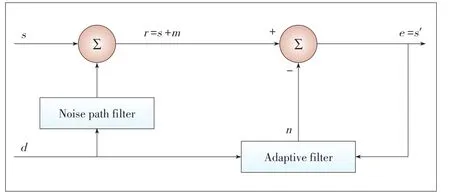
▲Figure1.Principle of adaptive noise cancellation.
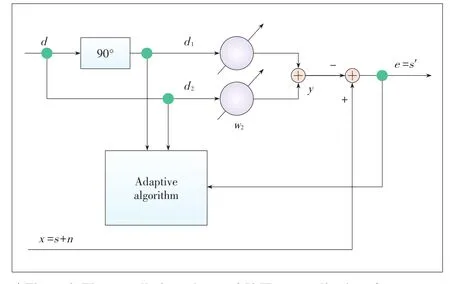
▲Figure2.The cancellation scheme of50Hz powerline interference.
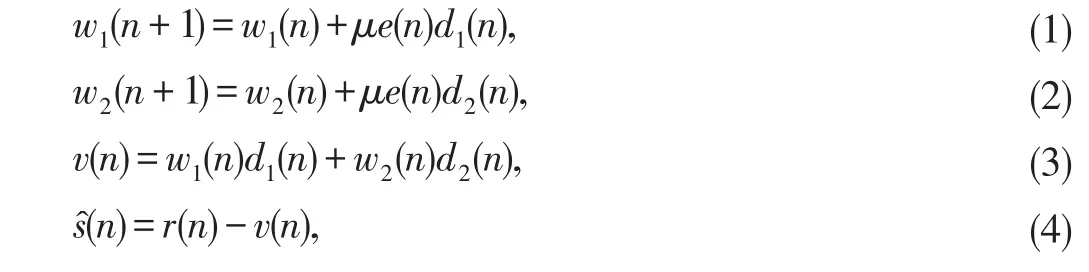
whereμis the step size of LMS process.
3 Proposed Method
It has been shown by Widrow and Glover[10]that once the parameter estimates have converged and are fixed,an adaptive powerline interference(PLI)canceller is approximately equivalent to a notch filter.However,in practice the PL frequency is not stable or not accurately known a priori,and a mismatch between the reference signal frequency and the PLI frequency might lead to inadequate reduction of the PLI.In this paper we propose a new method to solve the problem and take the concept of PLL in communication theory.The PLL tracks the PLI frequency and outputs a reference signal whose frequency is perfectly equivalent to that of the PLI[11].
The proposed model is shown in Fig.3.
In Fig.3,the noisy ECG signal s+n is filtered by a bandpass filter centered to 50 Hz in order to suppress signals outside PLI band,the filter out put contains PLI and noise.According to PLL theory,once the input signal frequency is in the PLL hold in range,the PLL can acquire the frequency of input signal and keep an output signal synchronizing with the input signal in frequency as well as in phase[12].The natural frequency of PLL is 50 Hz,and the PLL will track the PLI in frequency and phase.When the acquisition succeeds,the misadjustment between the parameter estimates and the actual parameters is small enough and the PLL gives a perfect reference signal whose frequency is always the same as PLI within the PLL track range.
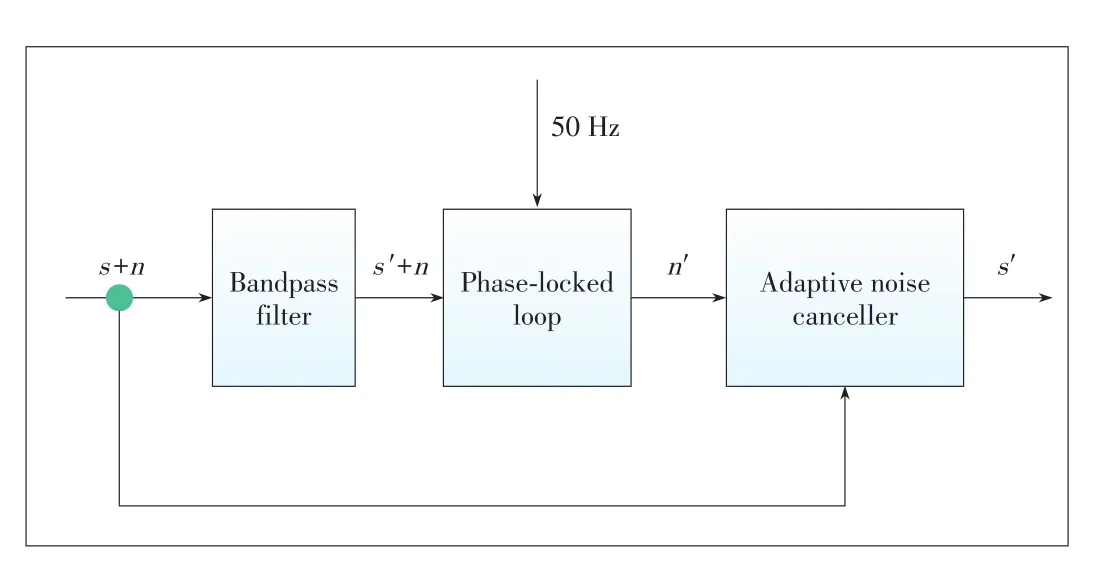
▲Figure3.The proposed model.
The most popularly used PLL in practice is second order,and its closed loop transfer function may be written as follows.

whereωnis the natural frequency andξis the loop damping ratio.Theξusually takes the value 0.7.According the PLL theory,the lock in range of a second order PLL is

The PLL can acquire the input signal immediately as long as the input signal frequency is in the lock in range of PLL.
4 Experimental Results and Analysis
We used the MITBIH ECG data to test our method and compared it with an existing technique.The database consists of 48 half hour excerpts of two channel ambulatory ECG recordings that are digitized at360 samples per second per channel.The data have an 11bit resolution over a 10 mV range and they have been amplified with gain of200[13].
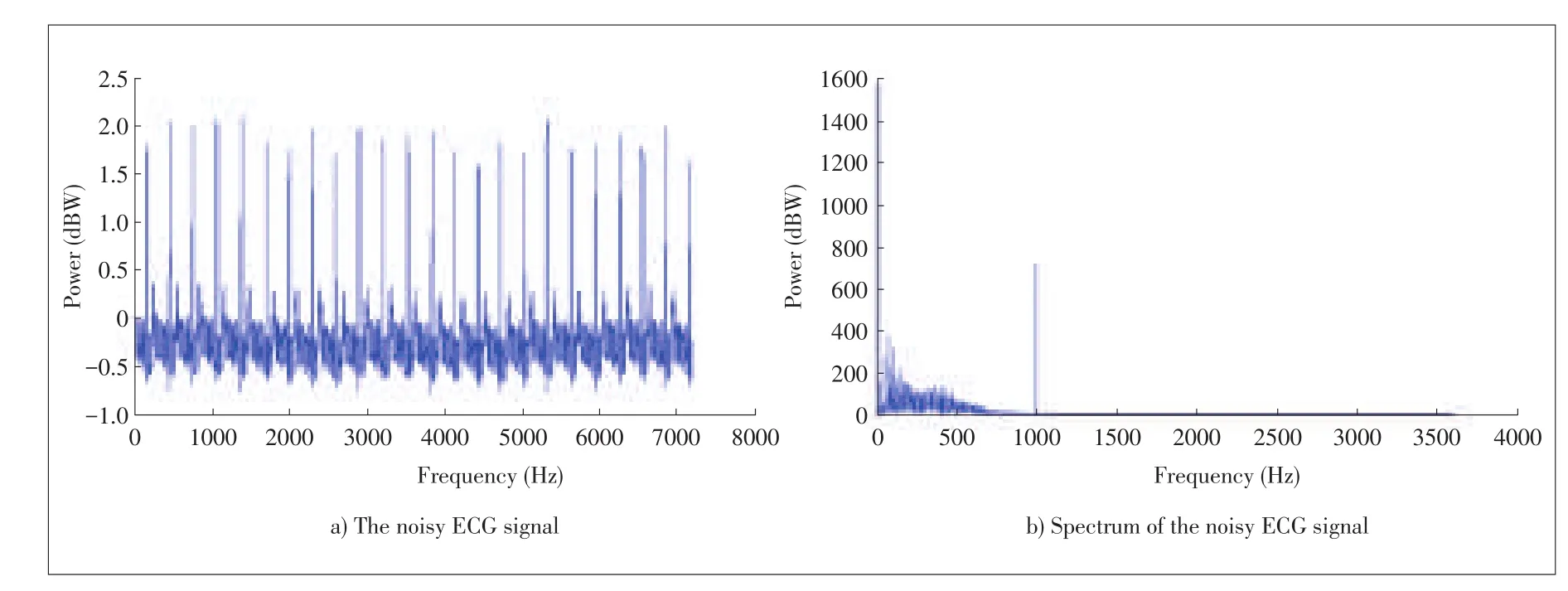
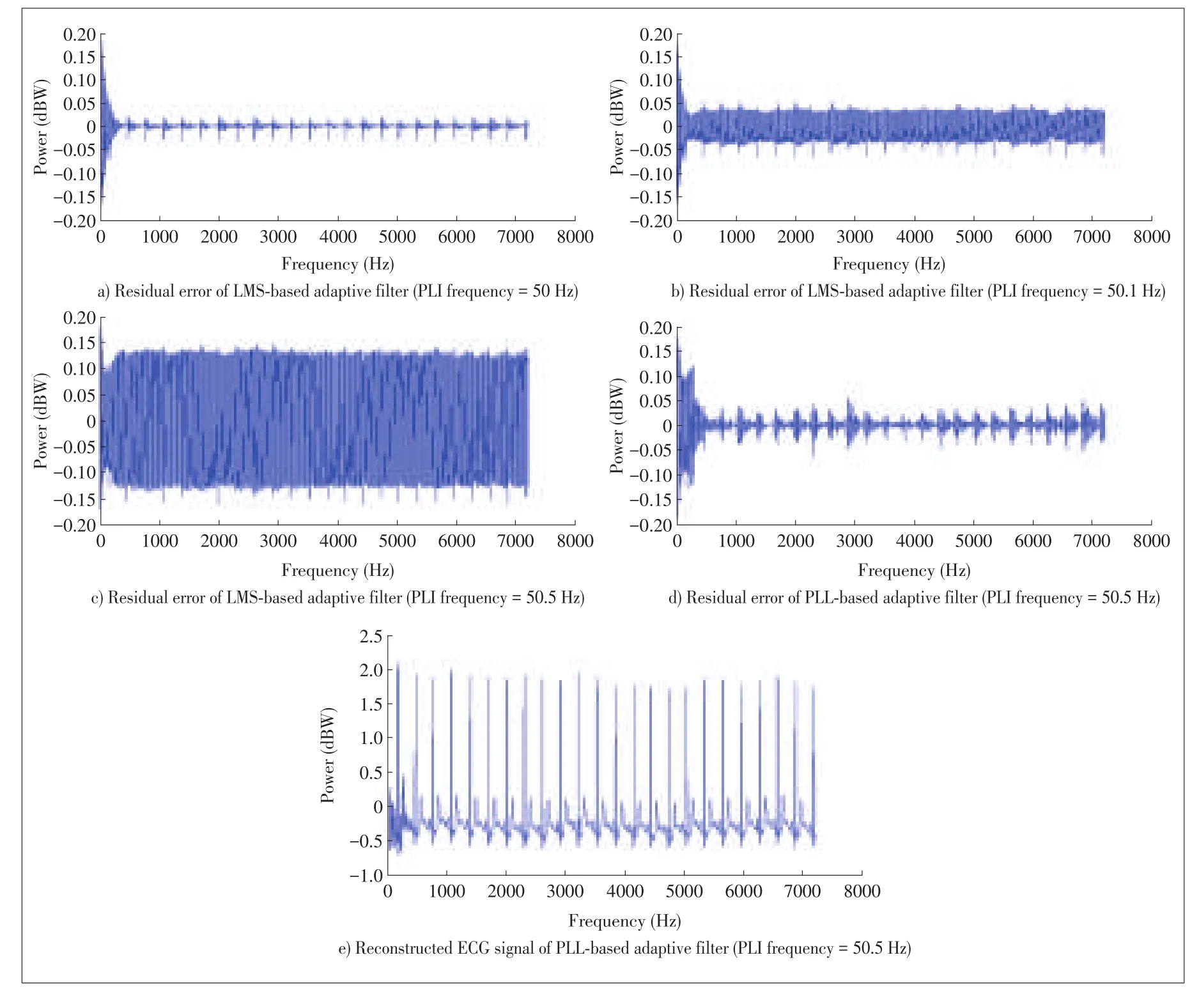
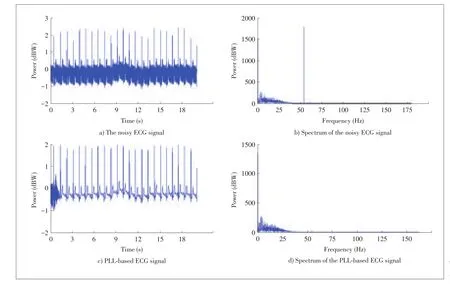
Fig.4 shows a noisy ECG signal(the sum of record 103 and 50 Hz PL interference,Signal Noise Ratio=0 dB)and its spectrum.The recording began at 50 second after the ECG started.The waveform of the ECG was completed submerged under the PL interference(Fig.4a).The spectrum of the PL interference can be clearly observed in Fig.4b.Fig.5 compares the performance of LMS filter and our proposed method in can celling PL interference at different frequency deviations.Fig.5a shows the MSE of an LMS filter to cancel PL interference at 50 Hz.Because there was no frequency deviation,the LMS filter was able to achieve satisfactory performance.When the frequency of PL interference deviated to 50.1 Hz,the performance of the LMS filter decreased as it generated more errors(Fig.5b).When the frequency of PL interference was further deviated to 50.5 Hz,the LMS filter created much larger MSE(Fig.5c).For the same scenario,our method was able to achieve very good performance to maintain a small MSE(Fig.5d).The reconstructed ECG signal of our method in this case was plotted in Fig.5e),from which we can easily observe the true ECG components.Fig.6 shows that the proposed PLL based canceller can track and lock the frequency deviation in about1 second and suppress the PL interference completely.
?Figure4.The noisy ECG signal.
?Figure5.The proposed method.
For quantitative comparison,we simulated different SIRs as the input to the noise cancellation techniques where SIRinis defined as the ratio between the power of true ECG signal s and the amplitude of the PL interference.We then calculated the SIRoutat the output of the LMS filter and our method.For an accurate quantification of the cancellation performance,the SIR at the input and output of the canceller must be known.Table 1 compares the performance of the two methods for a fixed PL interference frequency at different SIRin。
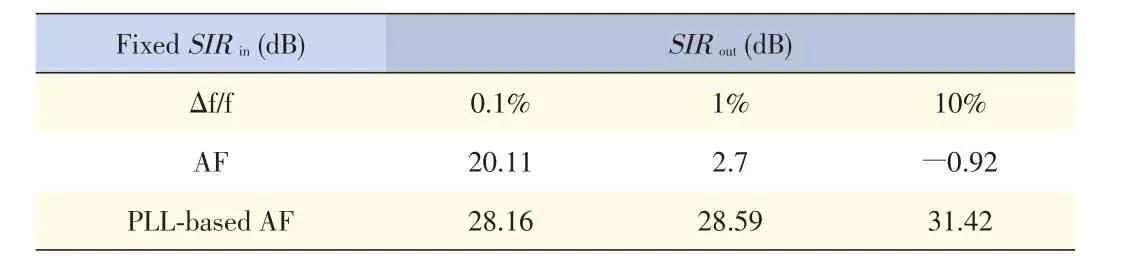
Table 2 compares the two methods at a fixed SIRinbut for different degrees of frequency deviations of the PL interference.It can be seen that the PLL based canceller is robust to frequency deviation,and the SIRoutis about30 dB regardless of frequency deviation.
?Figure6.Tracking performance(Δf/f=8%).

▼Table1.Performance comparison at different SIR in
▼Table2.Performance comparison at different frequencies(SIR in=0 dB)
5 Conclusions
This paper proposes a PLL based adaptive canceller for the suppression of the PL interference in ECG recordings.The canceller comprises a second order PLL,so except amplitude and phase,the frequency deviation can be tracked.Our experiment results showed that the proposed canceller could track PL interference even when its frequency deviated 10%from 50 Hz and lock the tracking in one second.Therefore,our method can obtain a high performance ECG output with the SIR of about30 dB,and it is robust to frequency deviation.As a conclusion,the proposed method is superior to the common adaptive noise canceller.As a PL interference cancellation technique,our method is also applicable to neural recording such as electroencephalography[14]and wearable biomedical instruments[15].
[1]Y.Sun,and X.B.Yu,“Capacitive biopotential measurement for electrophysiological signal acquisition:a review,”IEEE Sensors Journal,vol.16,no.9,pp.28322853,May 2016.doi:10.1109/JSEN.2016.2519392.
[2]M.F.Chimene and R.Pallas Areny,”A comprehensive model for powerline interference in biopotential measurements,”IEEE Transactions on Instrumentation and Measurement,vol.49,no.3,pp.535540,Jun.2000.doi:10.1109/19.850390.
[3]A.C.Metting van Rijn,A.Peper,and C.A.Grimbergen,“High quality recording of bioelectric events.Part 1.interference reduction,theory and practice,”Medical and Biological Engineering Computing,vol.28,no.5,pp.389397.Sept.1990.
[4]M.Kaurand B.Singh,“Power line interference reduction in ECG using combination of MA method and IIR notch filter,”International Journal of Recent Trends in Engineering,vol.2,no.6,pp.125129,Jun.2009.
[5]S.C.Peiand C.C.Tseng,“Elimination of AC interference in electrocardiogram using IIR notch filter with transient suppression,”IEEE Transactions on Biomedical Engineering,vol.42,no.11,pp.11281132,Nov.1995.doi:10.1109/10.469385.
[6]J.A.Van Alste and T.S.Schilder,“Removal of baseline wander and powerline interference from the ECG by an efficient FIR filter with a reduced number of taps,”IEEE Transactions on Biomedical Engineering,vol.32,no.12,pp.10521060,Dec.1985.doi:10.1109/TBME.1985.325514.
[7]J.M.Leskiand N.Henzel,“ECG baseline wander and powerline interference reduction using nonlinear filter bank,”Signal Processing,vol.85,no.4,pp.781793,Apr.2005.doi:10.1016/j.sigpro.2004.12.001.
[8]C.Levkov,G.Mihov,R.Ivanov,et al.,“Removal of powerline interference from the ECG:a review of the subtraction procedure,”Biomedical Engineering Online,vol.4,2005.doi:10.1186/1475925X450.
[9]A.K.Ziarani and A.Konrad,“A nonlinear adaptive method of elimination of powerline interference in ECG signals,”IEEE Transactions on Biomedical Engineering,vol.49,no.6,pp.540547,Jun.2002.doi: 10.1109/TBME.2002.1001968.
[10]S.M.Martens,M.Mischi,S.G.Oei,and J.W.Bergmans,“An improved adaptive powerline interference canceller for electrocardiography,”IEEE Transactions on Biomedical Engineering,vol.53,no.11,pp.22202231,Nov.2006.doi:10.1109/TBME.2006.883631.
[11]M.Ferdjallah and R.E.Barr,“Adaptive digital notch filter design on the unit circle for the removal of powerline noise from biomedical signals,”IEEE Transactions on Biomedical Engineering,vol.41,no.6,pp.529536,Jun.1994.doi:10.1109/10.293240.
[12]G.C.Hsieh and J.C.Hung,“Phaselocked loop techniques—a survey,”IEEE Transactions on Industrial Electronics,vol.43,no.6,pp.609615,Dec.1996.doi:10.1109/41.544547.
[13]G.B.Moody and R.G.Mark,“The impact of the MITBIH arrhythmia database,”IEEE Engineering in Medicine and Biology Magazine,vol.20,no.3,pp.4550,MayJun.2001.doi:10.1109/51.932724.
[14]M.R.Keshtkaran and Z.Yang,“A fast,robustalgorithm for powerline interference cancellation in neural recording,”Journal of Neural Engineering,vol.11,no.2,article.026017,Apr.2014.doi:10.1088/17412560/11/2/026017.
[15]M.Tomasini,S.Benatti,B.Milosevic,E.Farella,and L.Benini,“Power line interference removal for highquality continuous biosignalmonitoring with low-power wearable devices,”IEEE Sensors Journal,vol.16,no.10,pp.38873895,May 2016.doi:10.1109/JSEN.2016.2536363.

- ZTE Communications的其它文章
- ZTE Communications Guidelines for Authors
- Wireless Data and Energy Integrated Communication Networks
- Overview of Co-Design Approach to RF Filter and Antenna
- Behavior Targeting Based on Hierarchical Taxonomy Aggregation for Heterogeneous Online Shopping Applications
- Secure Beamforming Design for SWIPT in MISO Full-Duplex Systems
- Recent Advances of Simultaneous Wireless Information and Power Transfer in Cellular Networks