Comparing longhand and laptop note—taking methods on task performance
2018-04-17 12:10:09陳葉伊格
留學(xué) 2018年16期
關(guān)鍵詞:實(shí)驗(yàn)
陳葉伊格
Abstract
In colleges, professors usually teach classes by giving lectures. Therefore, students take notes to record the contents. Students usually employ one of these two methods for note-taking: longhand and typing on a laptop. There are many studies that have been done to discover which of the two methods is more beneficial for students to acquire certain knowledges. One of them is an experiment from Mueller and Oppenheimer in 2014. Since there may be selection effect by replicating the experiment and assigning students into two groups, this study employs repeated measures as a within-groups design to ask each participant to take notes twice. By comparing the scores the same group of students get on a list of questions after hearing two lectures, this study shows a similar result as Mueller and Oppenheimers study. There is also a difference between students performance on factual and conceptual questions. However, the results may simply be due to group difference because of the within-group design rather than the actual influence of the different modes of note-taking.
Keywords: Note-taking, Lecture learning, Longhand, Laptop, Task performance.
Introduction
In todays classrooms, over two thirds of instruction involves some type of lecturing. Note-taking is then employed by most students as a way of learning that both enhances their reflection and helps them develop analytical skills. In addition, students can refer to the information for later study and comprehension of the materials (Boyle, 2010). However, researches found that students dont take notes efficiently for they only get approximately 25% of the lecture material (Boyle, 2010).
Note-taking has been demonstrated to have several benefits on students. Students who use different methods of note-taking also generate different types of notes. For example, researchers found that students who produce more non-linear notes, represent information in a more connected and meaningful way than traditional note-takers. They also show a deeper understanding of the materials and more integrated knowledge management (Makany et. al 2009).
In “The Pen Is Mightier Than the Keyboard: Advantages of Longhand Over Laptop Note Taking” (Mueller, 2014), Mueller and Oppenheimer did a study to compare the different effects of longhand and laptop note-taking methods on task performance by giving students TED talks and then complete certain tests. However, this experiment was done on different groups of students, so there may be the problem of selection effects.
Given the background and benefits of note-taking, the purpose of this study is to modify the study of Muller and Oppenheimer in 2014 and see whether within-group design could fix some potential problems that the previous study hasnt thought about and come up with better and more reliable results. By comparing the data, this study would show which of the methods is more beneficial as a means of note-taking. Then, students can refer to this study and take notes accordingly to improve their learning.
Experiment Design
I.Participants
Participants were 8 students (4 male, 4 female) from the Introduction of Psychology course in Special A Shanghai subject pool. One of the experimenters also participated in the experiment as a student, while the other two served as the instructors in each room.
II.Materials
We selected two of the five TED talks (https://www.ted.com/talks) for length (slightly over 15 min) and to cover topics that would be interesting but not common knowledge from the supplementary materials that the original study provided.
III.Procedures
8 Students were divided into two groups, and each group had two girls and two boys. One of the group remained in the original classroom while the other group was taken to another classroom. Lectures were projected onto a screen at the front of the room. Participants were given a sheet of paper that listed all the instructions for them to follow. There were also one instructor in each room to read the instructions out loud and answer any questions. The students were instructed to use their normal classroom note-taking strategy, because experimenters were interested in how information was actually recorded in class lectures.
After hearing the lectures and taking notes, students were instructed to take an online IAT test. Then, all the students responded to both factual and conceptual questions on the sheet of paper that the instructor distributed.
Then the same instructions were given for the students to take notes using a different method.
All three experimenters scored the questions based on the scale of the original study, and the final scores were recorded according to their discussions.
Discussion
In this study, repeated method was used in a within-group study to account for the problem that it may be the contents of the videos that are actually affecting students performance. However, the results showed more of a group difference and the results are quite similar to Mueller and Oppenheimers. Therefore, thats maybe why they didnt bother to do the study on the same group of students.
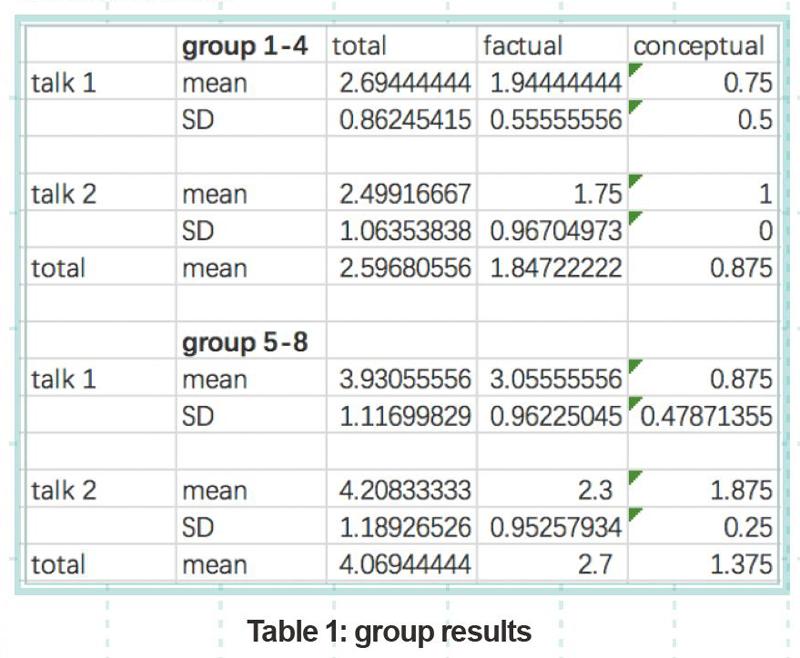
Group 1-4 and 5-8 are different two groups that each listened to both of the talks. The group mean suggests that group 5-8 did better overall than group 1-4, which means there could be difference between the students.
For the factual questions, we are not confident to say that mode of note-taking makes a difference (d=0.49). For conceptual, it seems that writing by hand outperforms laptop (d=1.3). But for group 1-4, it went the other way. Therefore, the difference may be more because of the group difference.
Overall, we seem to get similar results as Mueller and Oppenheimers, even though we used a different mode of testing. As a result, Mueller didnt bother to use different lectures, the different scores may just account for the contents of the lectures.
To resolve some potential problems that occurred, we can use a larger number of subject pool next time. Second, instead of randomly choose students to be in the two groups, we can use matched groups method to assign students to be in different groups. Third, we can show a controlled video where everyone uses the same mode before the study, to see if the two groups are substantially different.
Note:
All materials used in this study are from the original study of Mueller and Oppenheimer in 2014 “The Pen Is Mightier Than the Keyboard: Advantages of Longhand Over Laptop Note Taking”.
Reference:
Boyle, J. R. (2010). Note-taking skills of middle school students with and without learning disabilities: 4/13. Journal of learning disabilities. 43(6), 330-340.
Boyle, J. R. (2010). Strategic note-taking for middle-school students with learning disabilities in science classes. Learning Disability Quarterly. 33, 93109.
Makany, T., Kemp, J., & Dror, I. E. (2009). Optimising the use of note-taking as an external cognitive aid for increasing learning. British Journal of Educational Technology, 40, 619635.
Mueller, P. A., & Oppenheimer, D. M. (2014). The Pen Is Mightier Than the Keyboard: Advantages of Longhand Over Laptop Note Taking: 5/22. Psychological Science.
陳葉伊格
18歲 費(fèi)城
Friends Central School,開(kāi)學(xué)十二年級(jí),目標(biāo)專業(yè):心理學(xué)
在這個(gè)暑假,我參加了心理學(xué)的暑校項(xiàng)目以及與其相關(guān)的行為的生物性研究。在課上,我不僅僅學(xué)到了很多基本的生物知識(shí),比如大腦的構(gòu)造,還學(xué)到了更多更為復(fù)雜,關(guān)于人們一些的行為的機(jī)理原因。我發(fā)現(xiàn)心理學(xué)是一門很有趣,知識(shí)面也很豐富的學(xué)科。因此,在跟著教授的研究課程中,我們從理論知識(shí)開(kāi)始,一步步的講如何設(shè)計(jì)實(shí)驗(yàn),需要注意的方面,關(guān)于數(shù)據(jù)的處理,SPSS的運(yùn)用,等等。最后我們?cè)诒景嗤瑢W(xué)不知情的情況下進(jìn)行了一次實(shí)驗(yàn),我以實(shí)驗(yàn)者的身份也參與了其中。雖然這次實(shí)驗(yàn)比較簡(jiǎn)單,但是在這次實(shí)驗(yàn)中,我體會(huì)到了真正的實(shí)驗(yàn)步驟是什么樣子的,以及其嚴(yán)謹(jǐn)科學(xué)性。之后,在和教練的討論中,我們把獲得的數(shù)據(jù)進(jìn)行計(jì)算分析,看到了我們的實(shí)驗(yàn)結(jié)果,最后我也是寫出了這份實(shí)驗(yàn)報(bào)告。經(jīng)過(guò)這將近一個(gè)月的時(shí)間,我對(duì)于心理學(xué)有了基本的了解,也產(chǎn)生了更強(qiáng)的興趣,如果以后大學(xué)專業(yè)選擇了心理學(xué),我相信我會(huì)更加努力地學(xué)好更多的知識(shí)。
猜你喜歡
作文·小學(xué)低年級(jí)(2025年2期)2025-02-13 00:00:00
小雪花·小學(xué)生快樂(lè)作文(2024年11期)2024-12-31 00:00:00
作文·小學(xué)低年級(jí)(2024年2期)2024-04-29 00:00:00
作文·小學(xué)低年級(jí)(2023年3期)2023-04-29 00:00:00
小獼猴智力畫(huà)刊(2022年9期)2022-11-04 02:31:42
小主人報(bào)(2022年4期)2022-08-09 08:52:06
中學(xué)生數(shù)理化·中考版(2022年11期)2022-02-16 07:01:20
小哥白尼(趣味科學(xué))(2019年6期)2019-10-10 01:01:50
發(fā)明與創(chuàng)新(2016年38期)2016-08-22 03:02:52
太空探索(2016年5期)2016-07-12 15:17:55