
滴灌栽培楊樹人工林細根空間分布特征
2018-01-03 00:51:56秘洪雷蘭再平孫尚偉傅建平彭晶晶
林業科學研究 2017年6期
關鍵詞:方向
秘洪雷,蘭再平*,孫尚偉,傅建平,彭晶晶,馬 鑫
(1.中國林業科學研究院世界銀行項目辦公室,北京 100091; 2.大興區林場,北京 102602)
滴灌栽培楊樹人工林細根空間分布特征
秘洪雷1,蘭再平1*,孫尚偉1,傅建平2,彭晶晶1,馬 鑫
(1.中國林業科學研究院世界銀行項目辦公室,北京 100091; 2.大興區林場,北京 102602)

地面滴灌;楊樹人工林;細根;空間分布
1 試驗區概況
2 試驗材料與方法
3 試驗方法
3.1 取樣
于2015年11月上旬在林分內設置3個面積為30 m×20 m標準地,每個標準地內有樣木40株,在標準地內進行每木檢尺,然后各選取1株樹高、胸徑、冠幅接近平均值的標準木作為研究對象。采用根鉆(根鉆內徑10 cm,高10 cm)法取樣,根據1/4樣圓法[25](圖1),即在每株樣木的不同方位劃分出 1/4 營養區作為取樣區,結合滴灌條件下根系分布[24],以樣木樹干為中心,分別選取株間、行間和對角3個方向作為取樣區,然后在距樹干0.2、0.5、1.0、1.5 m處鉆取土芯,取樣深度為60 cm,每10 cm為1個土層。把取出的每個土樣分別裝入標號的塑封袋內,共計216個土樣帶回實驗室分析。
3.2 測定
土樣在清水中浸泡后用流水沖洗,過孔徑為 0.8 mm 篩,使根系與土樣中絕大部分的土壤及其他雜質分離 ,然后在清水中用鑷子小心撿取所有活根系。本研究按照傳統的根系分類標準[20],以直徑≤2 mm作為劃分細根和粗根的閾值。應用 Epson Twain Pro 根系掃描系統和 WinRhizo 根系圖像分析系統對根系進行細根根長測定。待全部根樣掃描完成后,將細根在80℃烘箱中烘干至恒質量(24 h), 用電子天平稱質量(精確到0.001 g) ,測定各根樣的生物量。
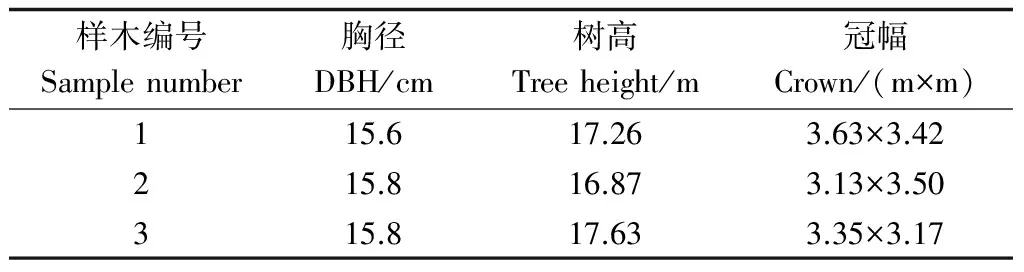
表1 標準木基本特征
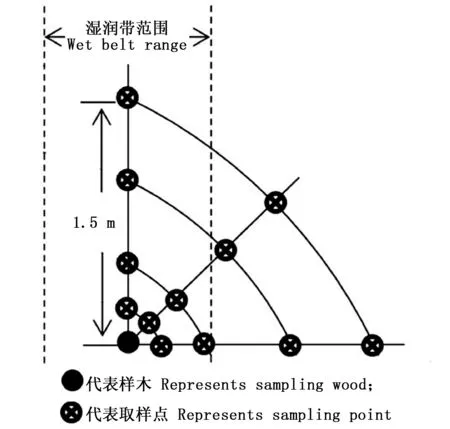
圖1 根系取樣示意圖Fig.1 Root sampling diagram
3.3 數據統計分析
利用Excel軟件對試驗數據進行整理和統計,以 Origin Pro 8.0 軟件作圖,采用SPSS19.0軟件進行樹干距離和土層深度的雙因素方差分析,研究各因素及其交互作用對細根分布的影響,然后對數據進行單因素方差分析以探究細根的水平和垂直分布特征。
4 結果與分析
4.1 細根生物量和根長的總體分布規律
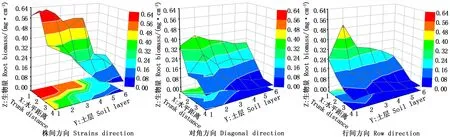
X軸1、2、3、4分別表示距樹干0.2、0.5、1.0、1.5 m的水平距離(下同),Y軸1、2、3、4、5、6分別表示010、1020、2030、3040、4050、5060 cm土層(下同),Z軸表示單位土體內的細根生物量(mg·cm-3)。X-axis 1, 2, 3, 4 represents the horizontal distance of 0.2,0.5,1.0,1.5 m from the trunk respectively(same as follows), Y-axis 1, 2, 3, 4, 5, 6 represents the soil layer of 010, 1020, 2030, 3040, 4050, 5060 cm (same as follows), The Z axis represents the fine root biomass (mg·cm-3) in the unit soil.圖2 細根生物量的空間分布Fig.2 Spatial distribution of fine root biomass
Z軸表示單位土體內的細根長(cm·cm-3)。The Z axis represents the fine root length (cm·cm-3) in the unit soil.圖3 細根長的空間分布Fig.3 Spatial distribution of fine root length
通過樹干距離、土層2個因素對滴灌條件下楊樹人工林細根指標參數進行方差分析,結果(表2)表明:樹干距離、土層深度及其交互作用均對細根生物量和根長分布影響顯著(P<0.05),說明滴灌條件下細根有明顯的空間分布格局。由表2可知:對角和行間方向細根生物量受樹干距離的影響大于株間方向,而株間方向受土層的影響較大;行間方向細根長受樹干距離、土層及其交互作用的影響較株間和對角方向更大,說明行間方向的細根分布有更明顯的空間異質性,這可能是受滴灌后形成的濕潤帶造成不同樹干距離及土層土壤水分條件不同的影響。
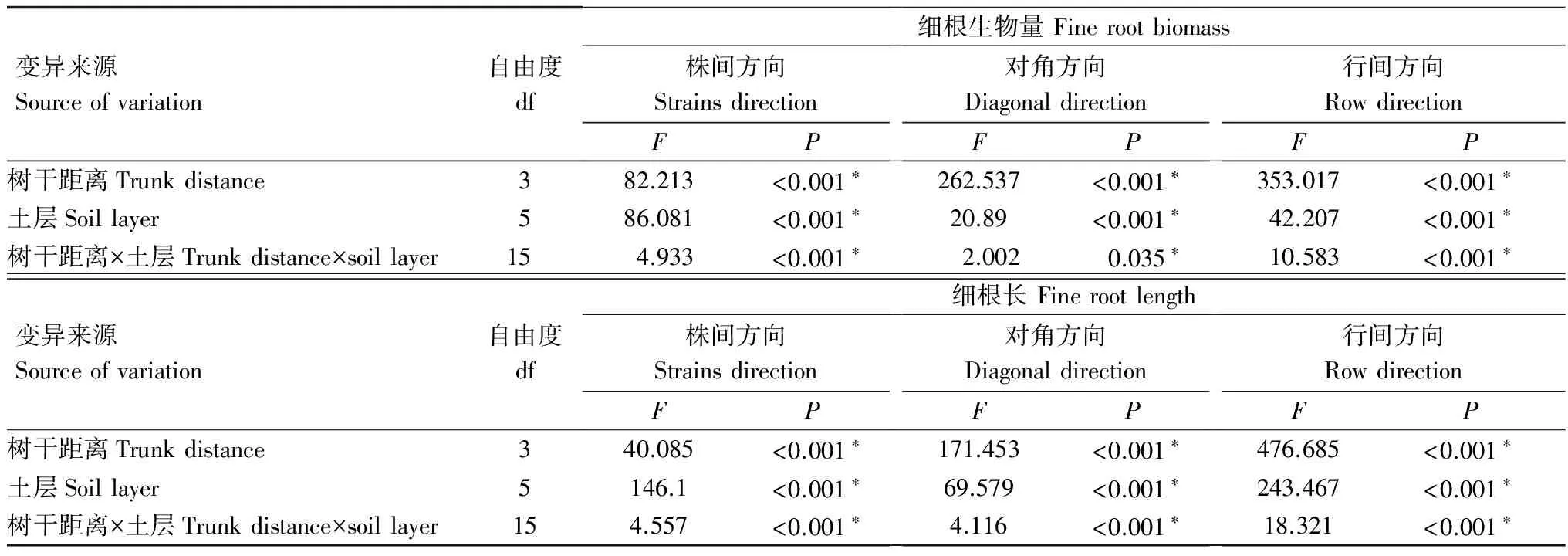
表2 樹干距離、土層及其交互作用對細根生物量和根長的影響
注:“*”表示影響顯著 (P<0.05)。Note: “*”indicate significant differences (P<0.05).
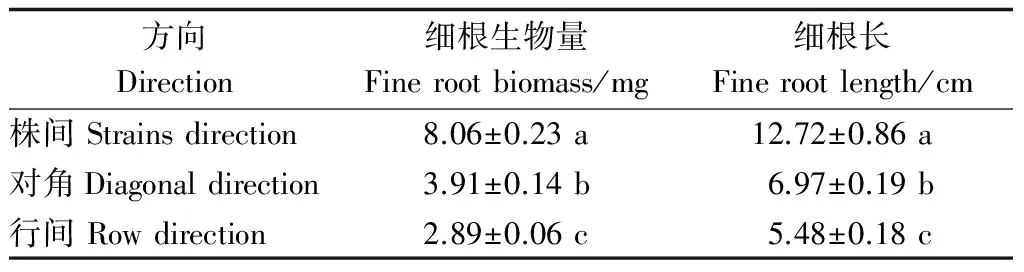
表3 不同方向細根生物量和根長的分布特征
注:表中不同小寫字母表示影響顯著 (P<0.05)。
Note: Different lowercase letters indicate significant differences (P<0.05).
由表3可知:不同方向細根生物量差異顯著(P<0.05),不同取樣點細根生物量總和為14.86 mg,其中,株間方向占細根總生物量的54.2%,分別是對角和行間方向生物量的2.06倍和2.79倍。不同方向的細根長差異顯著(P<0.05),株間方向占細根總長的50.5%,分別是對角和行間方向的1.82倍和2.32倍。滴灌條件下,細根主要分布在株間方向,不同方向細根的分布表現為株間>對角>行間,這是由于細根生長具有向水性,而滴灌管沿樹行鋪設,滴灌后能在株間方向形成連續的濕潤帶,利于細根生長;對角和行間方向受濕潤帶影響有限,細根分布減少,但對角方向受濕潤帶影響范圍大于行間方向(圖1),濕潤帶內土壤水分的增加有利于根系的生長,所以對角方向比行間方向有更多的細根。
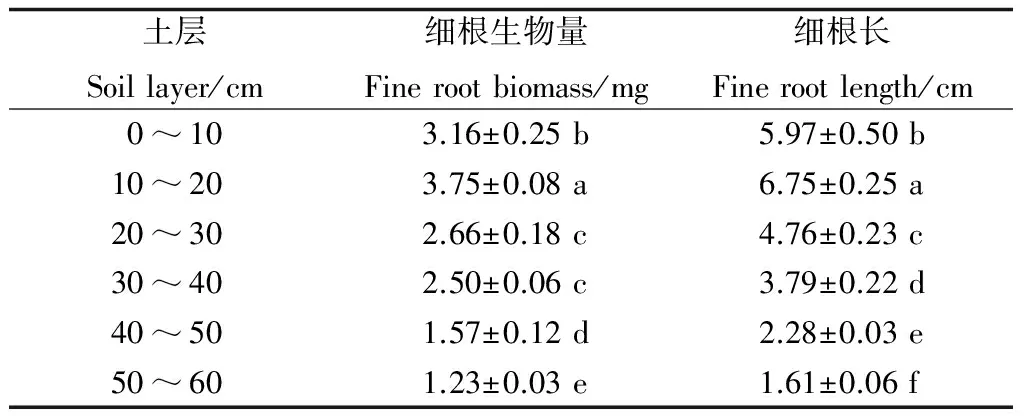
表4 不同土層細根生物量和根長的分布特征
注:表中不同小寫字母表示影響顯著 (P<0.05)。
Note: Different lowercase letters indicate significant differences (P<0.05).
4.2 細根長的水平分布特征
由不同方向細根長的水平分布情況(圖4)可知:滴灌條件下,楊樹人工林細根的水平分布在不同方向差異顯著。株間方向細根長的水平分布表現為先增加后減小的分布規律,根長在距樹干0.5 m處最大,為4.2 cm,占該方向細根總長的33.1%,與距樹干0.2、1.0、1.5 m處的根長均差異顯著(P<0.05)。由于滴灌后在株間方向形成連續濕潤帶,水分條件充足,細根生長不受水分條件制約,細根先增加后減小的水平分布特征應該是樹木細根自身生長調控的結果。
對角方向的細根長表現出隨樹干距離變遠不斷減小的分布特征,根長在距樹干0.2 m處最大,為2.7 cm,占該方向細根總長的38.1%,與距樹干0.5 m處的根長差異不顯著(P>0.05);距樹干0.2、0.5 m處的細根長與距樹干1.0 、1.5 m處均差異顯著(P<0.05)。
行間方向細根長的水平分布與對角方向類似,其水平分布表現為隨距樹干距離的增加而減小,距樹干0.2、0.5、1.0、1.5 m處的細根長差異顯著(P<0.05),其中,距樹干0.2 m處的根長為2.3 cm,占該方向細根總長的41.8%。由于對角方向距樹干0.5 m處仍在滴灌形成的濕潤帶范圍內,土壤水分條件較好,其細根長與距樹干0.2 m處相近;行間方向距樹干0.5 m處已處于濕潤帶邊緣,水分條件較差,影響了細根的生長和積累,顯著小于距樹干0.2 m處的細根長(圖1)。通過以上分析可知,株間方向距樹干0.2、0.5、1.0、1.5 m處以及對角和行間方向距樹干0.2、0.5 m處均在濕潤帶內,其細根長的和占所有位點細根總長的86.4%。
4.3 細根長的垂直分布特征
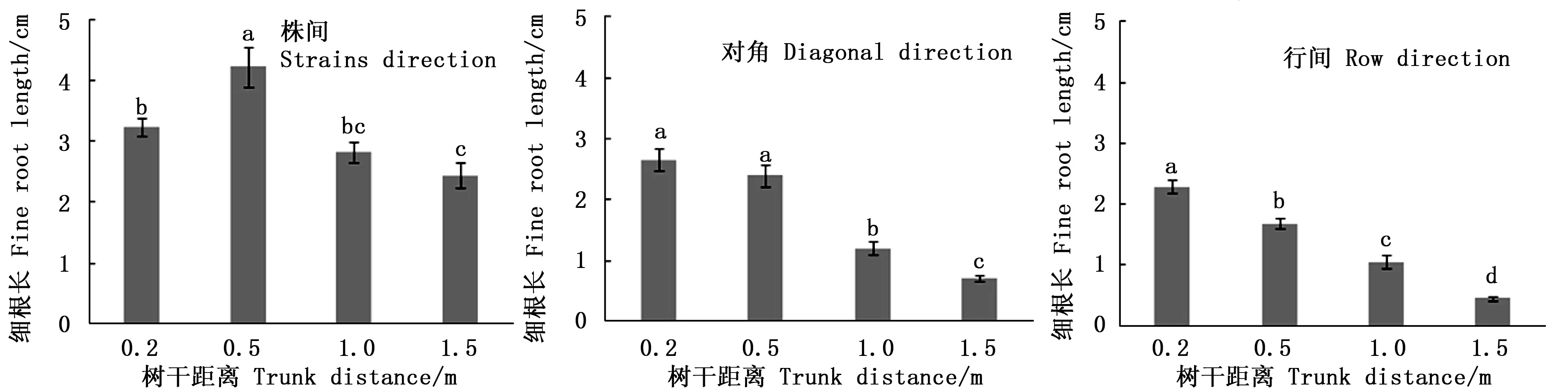
圖中不同小寫字母表示在同一方向的不同樹干距離處的差異顯著(P<0.05)。Different lowercase letters indicate significant differences at different trunk distances in the same direction (P<0.05).圖4 不同方向細根長水平分布特征Fig.4 Horizontal distribution of fine root length in different directions

圖中不同小寫字母表示在同一方向的不同土壤深度顯著差異(P<0.05)。Different lowercase letters indicate significant differences at different soil layers in the same direction (P<0.05).圖5 不同方向細根長垂直分布特征Fig.5 Vertical distribution of fine root length in different directions
5 討論
楊樹人工林細根生物量和根長是評價根系吸收養分和水分能力的重要指標。本研究表明,在不同方向的不同水平距離和土壤深度,細根生物量和根長表現出相似的分布特征,這與李盼盼等[26]有關細根生物量和根長密度等分布特征的研究結果一致。為了簡化分析且完整揭示細根的空間分布規律,在以后的研究中可任選其中之一作為研究細根空間分布規律的指標。
土壤水分、養分等資源的差異是影響細根分布的重要原因,閆小莉等[22]關于水肥耦合條件下細根形態及分布特征的研究表明,細根生長具有一定的向水性和趨肥性。由于本研究試驗地為沙地,土壤貧瘠,N、P、K元素含量極低[27],土壤條件的差異主要受滴灌后形成的濕潤帶在不同方向和不同土壤深度導致的水分條件不同所影響。滴灌條件下,細根長的分布受樹干距離、土層及其交互作用的顯著影響,這是由于滴灌后形成的濕潤帶在不同方向和不同土壤深度導致的水分條件不同所致(圖1)。
距樹干不同距離處的土壤條件等因素顯著影響細根分布[28-29]。滴灌條件下,楊樹人工林細根的水平分布在距樹干不同距離處表現為,株間方向細根長在距樹干0.5 m處最大,而對角和行間方向細根長在距樹干0.2 m處最大,這是由于株間方向水分充足,細根的分布主要受樹木細根自身生長調控的影響[30],而對角和行間方向隨樹干距離變遠,受濕潤帶影響不斷減少,土壤水分條件不斷變差。距樹干由遠到近細根長的變化幅度為株間方向<對角方向<行間方向,這與土壤水分條件在株間方向、對角方向及行間方向的分布格局一致。
滴灌栽培楊樹人工林的灌溉量根據不同年份楊樹速生豐產林的蒸散量確定,本研究對象為北京河流故道沙地上滴灌栽培的5年生楊樹人工林,其年灌溉量僅為2 422 m3·hm-2,比常規灌溉減少50%以上,但其蓄積量卻是常規灌溉人工林的1.5倍,這說明滴灌條件下楊樹人工林形成的上述空間分布格局和數量為楊樹人工林的生長發育奠定了基礎,使其達到了速生豐產的目標。
由于本試驗僅研究了滴灌栽培條件下楊樹人工林細根的空間分布,在常規灌溉條件下細根的空間分布情況未做說明,今后尚需對常規灌溉條件下細根的空間分布進行對比研究,從而全面揭示滴灌栽培條件下林分的速生豐產機制。另外,根系對水分的響應是一個復雜的生理生態過程,本研究僅從細根的形態和生物量指標來探究滴灌栽培條件下細根的分布特征,在今后研究中應該對細根生長發育機制及動態變化進行深入研究,以全面揭示滴灌栽培楊樹人工林細根的生理生態特性。
6 結論
[1] 張小全,吳可紅.森林細根生產和周轉研究[J].林業科學,2001,37(3):126-138.
[2] Vogt K A, Vogt D, Palkiotto P Aetal. Review of root dynamics in forest ecosystems grouped by climate, climatic forest type and species[J].Plant Soil,1996,187:159-219.
[3] Hendrick R L, Pregitzer K S. Spatial variation in root distribution and growth associated with minirhizotrons[J].Plant and Soil,1992,143:283-288.
[4] Gale M R, Grigal D F, Harding R B. Soil productivity index: predictions of site quality for white spruce plantations[J]. Soil Science Society of America Journal,1991,55(6):1701-1708.
[5] 袁渭陽,李賢偉,張 健,等.不同年齡巨桉人工林枯落物和細根碳儲量研究[J].林業科學研究, 2009,22(3):385-389。
[6] 李凌浩,林 鵬,邢雪榮.武夷山甜櫧林細根生物量和生長量研究[J].應用生態學報,1998,9(4):337-340.
[7] Vogt K A, Grier C C, Vogt D J. Production, turnover and nutrient dynamics of above and belowground detritus of world forests[J]. Advances in Ecological Research,1986,15:303-378.
[8] 楊秀云,韓有志,張蕓香.距樹干不同距離處華北落葉松人工林細根生物量分布特征及季節變化[J].植物生態學報,2008,32(6):1277-1284.
[9] 張 犇,金光澤.擇伐對闊葉紅松林細根生物量及其時空分布的影響[J].林業科學研究,2014,27(2):240-245.
[10] Thind H S, Buttar G S, Aujla M S,etal. Yield and water use efficiency of hybrid Bt cotton as affected by methods of sowing and rates of nitrogen under surface drip irrigation[J].Archives of Agronomy and Soil Science,2012,58(2):199-211.
[11] Ramazan T, Sinan S, Bilal A. Effect of different drip irrigation regimes on sugar beet(BetavulgarisL.) yield, quality and water use efficiency in Middle Anatolian, Turkey[J].Irrig Sci,2011, 29:79-89.
[12] 孫丹丹,張忠學.滴灌大豆不同灌水量的產量與水分效應分析[J].東北農業大學學報,2012,43(5):100-104.
[13] 傅建平,蘭再平,孫尚偉,等.滴灌條件下楊樹人工林土壤水分運移[J].林業科學,2013,49(6):25-29.
[14] 傅建平,蘭再平,孫尚偉,等.滴灌條件下楊樹人工林土壤水分變化規律研究[J].北京林業大學學報,2013,35(6):61-66.
[15] 韋艷葵.地下滴灌下沙地楊樹速生豐產機制與灌溉制度研究[D].北京:北京林業大學,2003.
[16] O’Neill M K,Shock C C,Lombard K A,etal.Hybrid poplar(Populusssp.)selections for arid and semi-arid intermountain regions of the western united states[J].Agroforestry System,2010,79(3):409-418.
[17] 張龍寧,向地奎,席本野,等.三倍體毛白楊人工林淺層土壤細根對地下滴灌不同水分處理的響應[J].東北林業大學學報,2013,41(7): 40-44.
[18] 燕 輝,劉廣全,李紅生.青楊人工林根系生物量、表面積和根長密度變化[J].應用生態學報,2010,21(11):2763-2768.
[19] 張小全.環境因子對樹木細根生物量、生產與周轉的影響[J].林業科學研究,2001,14(5):566-573.
[20] Block R M A, Van Rees K C J, Knight J D.A review of fine root dynamics inPopulusplantations[J].Agroforestry Systems,2006,67(1):73—84.
[21] 閆小莉,戴騰飛,賈黎明,等.歐美108楊細根形態及垂直分布對水氮耦合措施的響應[J].植物生態學報, 2015,39(8):825-837.
[22] 閆小莉,戴騰飛,邢長山,等.水肥耦合對歐美 108 楊幼林表土層細根形態及分布的影響[J].生態學報,2015,35(11):3692-3701.
[23] 劉曉麗,馬理輝,汪有科.滴灌密植棗林細根及土壤水分分布特征[J].農業工程學報,2013,29(17):63-71.
[24] 傅建平,蘭再平,孫尚偉,等.地面滴灌對 107 楊人工林根系分布的影響[J].林業科學研究,2013,26(6):766-772.
[25] 趙 忠,李 鵬,王乃江.渭北黃土高原主要造林樹種根系分布特征的研究[J].應用生態學報,2000,11(1):37-39.
[26] 李盼盼,王延平,王華田,等.黃河沖積平原楊樹人工林細根空間分布特征[J].山東農業大學學報:自然科學版,2013,44 (1):61-65.
[27] 賀 勇,蘭再平,孫尚偉,等.滴灌施肥條件下107楊幼林N、P、K 養分吸收量與施肥量研究[J].林業科學研究,2015,28(3):426-430.
[28] Jackson R B, Canadell J R, Mooney H A,etal. A global analysis of root distribution for terrestrial biomass[J].Oecologia,1996,108(3):389- 411.
[29] 程云環,韓有志,王慶成,等.落葉松人工林細根動態與土壤資源有效性的研究[J].植物生態學報,2005,29(3):403-410.
[30] 朱秋美,馬長明,翟明普,等.河北石質山區花椒細根分布特征[J].林業科學,2009,45(2):131-135.
[31] 仲啟鋮,杜 欽,張 超,等.濱岸不同植物配置模式的根系空間分布特征[J].生態學報,2010,30(22):6135-6145.
[32] 閆美芳,張新時,周廣勝,等.不同樹齡楊樹人工林的根系呼吸季節動態[J].生態學報 ,2010,30(13):3449-3456.
SpatialDistributionofFineRootinthePoplarPlantationunderDripIrrigation
BIHong-lei1,LANZai-ping1,SUNShang-wei1,FUJian-ping2,PENGJing-jing1,MAXin1
(1.World Bank Loan Project Office, Chinese Academy of Forestry, Beijing 100091, China; 2.Forest Farm of Daxing District,Beijing 102602, China)
ObjectiveAiming at studying the spatial distribution of fine root under surface drip irrigation, 5-year-old 107 poplar clone (Populus×euramericanacv.‘74/76 ) plantation cultivated with surface drip irrigation in the forest farm of Daxing district was taken as the research object.MethodBy drilling sampling, the samples from different directions at different horizontal distances (0.2, 0.5, 1.0 and 1.5 m) from the trunk were collected. The depths of soil cores were 60 cm, 10 cm each as a soil layer.ResultThe distribution characteristics of fine root were analyzed under the condition of drip irrigation. Under different trunk distance and soil layer, the fine root biomass and root length showed similar distribution characteristics and its distribution was significantly affected by the trunk distance, soil layer and their interaction (P<0.05). The total length of fine roots in the strains direction was 12.7 cm, which was 1.82 times and 2.32 times that of the diagonal direction and row direction. The total root length of the three sampling points was 25.2 cm, of which 86.4% were in the range of wetted belt formed by drip irrigation. In the soil depth of 0—60 cm, 84.5% of the total root length was in the 0—40 cm soil layer. The horizontal distribution of fine root in different directions was different. In the strains direction, the maximum root length was at the trunk distance of 0.5 m, which was 4.2 cm and showed significant difference with other trunk distances (P<0.05). In the diagonal and row direction, the maximum root length, 0.2 m from the trunk, were 2.7 cm and 2.3 cm respectively and accounting for 38.1% and 41.8% of the total length in their respective directions. The vertical distribution of fine root in different directions was different. At different soil layers, the fine root length in the strains direction showed that the fine root length of 0—10 cm soil layer was larger than others, and accounting for 29.1% of the total length, the difference with other soil layers was significant (P<0.05). In the diagonal and row direction, the maximum root length were at 10—20 cm soil layer, 2.0 cm and 1.7 cm respectively, and accounting for 27.9% and 31.0% of the total length in their respective directions, the differences with other soil layers were also significant (P<0.05).ConclusionThe spatial distribution characteristics of fine root in poplar plantations under drip irrigation can be expressed by either fine root biomass or fine root length. The difference of soil moisture condition caused by continuous wet belt range after drip irrigation makes the difference of horizontal and vertical distributions of fine root in different directions, the fine root length is expressed as strains direction>diagonal direction> row direction. Fine roots are mainly distributed in the range of wet belt and relatively concentrated in the 0—40 cm soil layer. According to the horizontal and vertical distribution of fine root of poplar plantation, the water should penetrate to at least 50 cm away from the trunk after each drip irrigation, and the depth of infiltration should reach at least 40 cm to meet the water demand of normal growth of poplar plantation. The results and conclusions of this study provide a theoretical basis for determining the precise single effective irrigation amount, so as to achieve the dual goal of saving water and ensuring the normal growth of trees.
surface drip irrigation; poplar plantation; fine root; spatial distribution
10.13275/j.cnki.lykxyj.2017.06.009
2017-02-22
國家重點研發計劃課題“歐美楊工業資源材高效培育技術研究”(2016YFD0600401)
秘洪雷(1990—)男,在讀碩士.主要研究方向:森林培育.E-mail:bihonglei1990@126.com
* 通訊作者:蘭再平,男,研究員,碩士生導師,主要從事森林培育與森林生態學研究.E-mail:zplan@139.com
S792.11
A
1001-1498(2017)06-0946-08
徐玉秀)
猜你喜歡
計算機應用(2023年1期)2023-02-03 03:09:28
音樂天地(音樂創作版)(2022年10期)2023-01-13 05:47:42
湘潮(上半月)(2022年5期)2022-12-06 03:02:28
計算機應用(2022年2期)2022-03-01 12:33:42
計算機應用(2022年1期)2022-02-26 06:57:42
計算機應用(2021年4期)2021-04-20 14:06:36
數學小靈通(1-2年級)(2021年3期)2021-04-13 01:01:58
計算機應用(2021年3期)2021-03-18 13:44:48
計算機應用(2021年1期)2021-01-21 03:22:38
數學小靈通·3-4年級(2017年11期)2017-11-29 01:35:50
