雙向對沖流灌水器水力性能和消能機理模擬與驗證
2017-11-24 06:06:58王新端
農業工程學報 2017年14期
關鍵詞:模型
郭 霖 ,白 丹 ※,王新端 ,何 靖 ,周 文 ,程 鵬
(1. 西安理工大學水利水電學院,西安 710048;2. 華北水利水電大學水利學院,鄭州 450011)
·農業水土工程·
雙向對沖流灌水器水力性能和消能機理模擬與驗證
郭 霖1,白 丹1※,王新端1,何 靖1,周 文2,程 鵬2
(1. 西安理工大學水利水電學院,西安 710048;2. 華北水利水電大學水利學院,鄭州 450011)
為研究雙向對沖流灌水器的水力性能和消能機理,安排25組試驗方案,開展流量測試與模擬計算,選取模擬精度較高的湍流模型計算不同壓力區間的流態指數、正反向水流流量比,分析正反向水流分布情況。結果表明,RNGk-ε模型的流量計算值與實測值的相對誤差為1.656%~3.151%,與其他模型相比,RNGk-ε模型的相對誤差較小;灌水器的流態指數為0.414~0.483,水力性能良好,尤其在低壓區間,流態指數為0.414~0.456,正反向水流流量比趨近于1,水力性能更加突出;隨壓力的增大,反向水流的流量增幅較快,流量比減小,水力性能降低;正反向水流在擋水裝置的齒尖形成對沖與混摻是消能的核心,而水流分布不均會影響灌水器的消能效果;在灌水器邊壁增加多個改變流向的擋水裝置,可優化雙向水流配比,提高水力性能,從而驗證不同壓力區間、不同流量比與水力性能的內在關系。研究可對灌水器結構優化、水力性能提高提供參考。
消能;數值分析;流量;灌水器;水力性能
0 引 言
灌水器通過流道結構和形式的變化起到調節壓力和穩定流量的目的,并可將射流狀水流變為滴水狀[1]。流道內流量對壓力變化的敏感程度以及灌水器出流的均勻性,統稱為灌水器的水力性能[2-3],是衡量灌水器性能優劣的重要指標[4-5],其中灌水器的結構[6]和流道的消能形式[7]對調壓穩流性能影響很大。因此,灌水器結構設計、消能機理分析是灌水器研究的重點。
灌水器水力性能和消能機理的分析方法主要有試驗測試[8-9]和基于Fluent軟件的數值模擬[10-11],前者主要測試不同壓力下的流量值[12];后者多用于分析流場特性,探究消能和流動機理[13-14],一定程度上彌補了試驗測試的不足。國內外很多學者以 Fluent模擬軟件為基礎,對傳統迷宮流道灌水器進行了深入分析,常瑩華等[15]采用Fluent軟件分析齒形迷宮流道的齒寬、齒底距、齒高對水力性能的影響,通過參數調整提高其水力性能;喻黎明等[16-17]基于流體單向流模型和歐拉-拉格朗日液固多相湍流模型分析流道流體運動以及固體顆粒軌跡、速度分布,優化流道結構以提高工作性能;Wei等[18-19]提出通過改善流道斷面形式、優化流道拐角可提高灌水器性能;王文娥等[20]應用VOF多相流模型和標準k-ε模型得到內鑲齒形片狀流道內速度呈周期性變化;Celik等[21-22]提出結構的細微變化對灌水器性能的影響很大。同時,一些學者在傳統流道結構基礎上提出了新的灌水器結構類型,Li等[23-24]以 Mandelbrot[25]的分形理論為基礎,設計了分形流道灌水器,優化速度滯留區的流道邊界,改善其水力性能;Zhang等[26]設計了新型流量調節器,指出彈性膜片的厚度與彈性模數影響壓力補償能力;此外,繞流式灌水器[27]、渦流式灌水器[28]、雙向流流道灌水器[29]的設計為灌水器類型的多樣性提供參考。
依據灌水器流道結構形式和消能方式,常用灌水器主要分為紊流迷宮式和壓力補償式[30-32]。前者結構較為簡單、使用壽命長,但消能方式比較單一[7,33],后者雖調壓穩流效果明顯,但結構較復雜,內部彈性膜片易變形,降低調壓穩流性能,且膜片變形度難以精確控制[34-36];同時,大量研究都是針對灌水器結構參數與性能之間的關系,鮮少從消能機理角度出發,研究灌水器性能。近年來,筆者及所在研究團隊研制了一種雙向對沖流灌水器[37],已開展了流量測試和流道局部損失計算,初步分析了流道幾何參數對水力性能的影響。本文對灌水器流道進行 Fluent數值模擬,分析不同壓力區間和雙向水流不同流量比對水力性能的影響,從宏觀和微觀 2個角度闡明灌水器的消能機理和水力性能影響因素,以期為灌水器設計、流道優化以及提高水力性能等方面提供依據。
1 數值模擬方法與灌水器樣機設計
1.1 基本控制方程
灌水器流道內的水流可視為黏性不可壓縮流體運動。連續性方程為

動量方程為
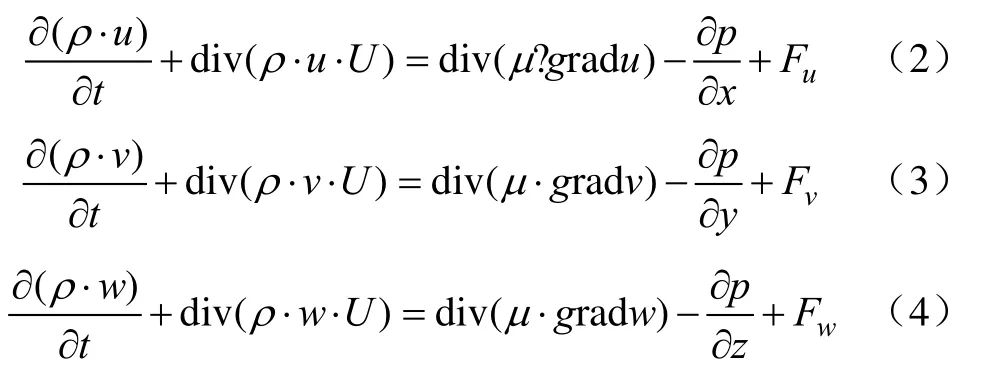
式中U為流體速度,m/s;u、v、w分別為流速在x、y、z坐標軸上的分量,m/s;ρ為水的密度,kg/m3;μ為動力黏度系數,N·s/m2;p為流體的壓力,Pa;div為散度;grad為梯度;Fu、Fv、Fw為微元體在x、y、z坐標軸上的體力,N/m3,當體力只有重力,且z軸豎直向上,則Fu=0,Fv=0,Fw=-ρg。
1.2 Fluent軟件基本模擬方法設置
1.2.1 計算方法設置
利用Gambit軟件可構建灌水器三維模型,并對灌水器流道內部進行網格劃分,流道網格單元選擇0.1 mm的非結構化四面體混合型網格[38]。數值計算采用定常的非耦合隱式算法,灌水器的進口邊界設置為壓力進口(pressure inlet),在Fluent軟件的選項Boundary conditions中選擇pressure inlet,并按照壓力范圍50~250 kPa,每隔20 kPa壓力計算一次流量,逐次設置灌水器的進口壓力,灌水器的出口邊界設置為壓力出口(pressure outlet)。模型計算通常設置為second order upwind格式,為使迭代計算盡可能減小誤差,殘差一般為10-5,并采用精度較高的Simple方式計算,模型主要參數設置如表1所示。

表1 模型主要參數Table 1 Main parameters of model
1.2.2 湍流模型選擇
Fluent軟件常用湍流模型為k-ε和k-ω系列,主要包括 5類湍流模型,由于各模型適應的流動問題與應用工況側重點不同,需要選擇適宜模擬該種灌水器的模型。
1.3 灌水器流道結構與幾何參數設計
雙向對沖流灌水器流道三維模型如圖 1所示。灌水器關鍵幾何參數如圖 2所示,其參數選取以及對各參數的定義可參照文獻[37]。灌水器關鍵幾何參數尺寸取值范圍如下:S為0.6~1.0 mm,T為0.6~1.0 mm,W為0.6~1.0 mm,Z為1.0~1.4 mm,每隔0.1 mm取值,每個參數各取5組值,d為0~1.2 mm,每隔0.3 mm取值,取5組值;灌水器的深度為固定值(0.8 mm)。

圖1 流道三維模型Fig.1 Three dimensional model of flow channel

圖2 灌水器關鍵幾何參數Fig.2 Key geometry parameters of emitter
2 灌水器試驗
2.1 試驗組合與系統布置
對該類灌水器每個幾何參數取 5個水平,按照正交試驗設計表 L25(56)安排灌水器流道幾何參數組合方案,具體組合方案詳見文獻[37]。根據灌水器組合方案及測試規范[4]布置試驗系統,如圖3所示。試驗系統主要設備的參數包括:水源為自來水,通過500 L的不銹鋼水箱供水;2臺型號為15WG0.8-20的水泵,額定流量720 L/h;過濾器規格為200目篩網式過濾器;壓力表型號為YB-150,精度等級為0.25級,允許誤差值為0.4 kPa;量筒精度為0.001 L;電子稱型號為JT1201N,精度為0.1 g。

圖3 試驗系統Fig.3 Experimental system
2.2 灌水器測試
灌水器的測試壓力通過進口壓力表前端控制閥進行調節,測試壓力與數值模擬的壓力范圍和測試間隔相同,每個間隔壓力測試3次,每次5 min,流量取3次測試的平均值,采用量筒容積法測量不同壓力的灌水器流量,電子稱校核。
2.3 計算方法
灌水器壓力和流量的關系為

式中q為流量,L/h;Kd為流量系數;H為灌水器進口壓力,kPa;x′為流態指數。
將式(5)取對數得到下式

流態指數可表示為

3 結果與分析
3.1 湍流模型確定
采用不同湍流模型計算25組灌水器方案的流量值,并與實測值進行誤差對比,結果表明,各模型的模擬值與實測值最大相對誤差為 4.192%,最小相對誤差為1.656%。當采用標準k-ε模型計算時,與實測值相對誤差2.055%~3.986%;采用RNGk-ε模型計算時,相對誤差1.656%~3.151%;采用Realizablek-ε模型計算時,相對誤差2.297%~4.192%;采用標準k-ω模型計算時,相對誤差1.760%~3.462%;采用SSTk-ω模型計算時,相對誤差1.917%~3.882%。對比5種模型流量計算的相對誤差,RNGk-ε模型相對誤差最小。以相對誤差較小(方案18)和相對誤差較大(方案10)的2組試驗方案為例(圖4),RNGk-ε模型與實測值決定系數為0.998,尤其當壓力為50~150 kPa時,相對誤差為1.28%~1.89%,與實測值吻合度更高,因此,選用RNGk-ε模型對灌水器性能進行深入研究。

圖4 不同湍流模型的流量Fig.4 Flow rate of different turbulence model
3.2 灌水器水力性能分析
3.2.1 不同壓力區間與水力性能的關系
在灌水器性能研究中,流態指數反映了流量對壓力變化的敏感程度,其值越小說明灌水器的水力性能越好[39-41]。流態指數的計算通過壓力與流量的多元回歸擬合得到,不同壓力區間對應的值有所不同[39,42-43],因此,對灌水器在不同壓力區間的水力性能應進行深入分析。
對灌水器進行流量數值模擬,并計算不同壓力區間的流態指數,其結果如表 2所示。雙向對沖流灌水器的流態指數為0.414~0.483,相比迷宮式流道灌水器的流態指數較小[29,42-43],在水力性能方面有明顯提高。而同類型灌水器在不同壓力區間內的流態指數有所差異,低壓和中壓區間的流態指數相對較小,在低壓區間,流態指數為0.414~0.456。雙向對沖流灌水器在低壓和中壓區間的水力性能優于高壓區間的水力性能,對于節能、降低滴灌管壁厚度、減少工程投資方面有一定的優勢。

表2 灌水器不同壓力區間的流態指數Table 2 Flow index of emitter in different pressure range
3.2.2 雙向水流不同流量比與水力性能的關系
灌水器的水流分區如圖 5所示。本文定義:灌水器總流量為q,正向水流流量為Q1,反向水流流量為Q2,其中q=Q1+Q2,正向水流與反向水流的流量比為Q1/Q2。流量q、Q1、Q2通過Fluent軟件中的Report數據讀取功能計算不同截面的流量值。計算得到50~250 kPa范圍內的正向水流與反向水流的流量比Q1/Q2,其結果如表3所示。依據表 3的計算結果,在低壓區間,雙向水流流量比Q1/Q2較大,而在高壓區間,流量比Q1/Q2較小。對比表2和表3的結果,Q1/Q2的數值越趨近于1,即正向水流流量與反向水流流量占灌水器流量的比例越近似,混摻效果越強,流態指數越小,水力性能越好;反之,正向水流流量與反向水流流量相差越大,流態指數越大,水力性能越差。

圖5 雙向對沖流分區Fig.5 Division of two-ways mixed flow

表3 灌水器不同壓力區間的流量比Table 3 Flow ratio of emitter in different pressure range
以流態指數較小和較大的 4種灌水器方案為例,對雙向水流流量比和水力性能進一步分析。圖6為4種灌水器方案的雙向水流流量比與水力性能的關系,隨壓力的增大,正向水流的流量增幅較慢,而反向水流的流量增幅較快,雙向水流流量比Q1/Q2逐漸減小;隨著流態指數的減小,Q1/Q2的曲線變化越平緩,Q1/Q2比值越趨近于1。

圖6 不同壓力流量比與水力性能關系Fig.6 Relationship between flow ratio and hydraulic performance in different pressure
3.3 灌水器流場分布與消能機理分析
不同灌水器方案的流場速度分布和消能機理類似,因此為使流場分析具有代表性,選擇水力性能居中的灌水器方案22對流場速度分布與消能機理進行分析。圖7為灌水器方案22不同壓力的流場速度分布圖,從整體流速分布看,流體進入灌水器后受到流道的分流作用被分成正向水流和反向水流,其中正向水流沿灌水器邊壁與分水裝置之間的過水通道流出,由于擋水裝置的阻隔和流道的收縮作用,反向水流改變原有的流動方向,并加快流動速度,與正向水流混摻,在混摻區域由于流速大、混摻劇烈,形成較大的能量損失,使得流體均勻和穩定出流,是該類型灌水器消能穩流的核心內容。

圖7 試驗方案22不同壓力下流場速度分布Fig.7 Flow velocity distribution in different pressure for experimental scheme 22
對速度分布進行局部對比(圖7),通過Fluent軟件中的速度場計算以及Tecplot速度提取功能可得到灌水器不同截面的正向水流和反向水流的平均流速,當壓力為50 kPa時,正向水流平均流速為0.8 m/s,反向水流為1.4 m/s,由于正向水流區域的橫截面大于反向水流區域的橫截面,即正向水流和反向水流的流量相差較小;當壓力增大到250 kPa時,正向水流平均流速為1.7 m/s,反向水流為4.1 m/s,反向水流的流速增幅明顯大于正向水流的流速增幅,使正向水流和反向水流的流量相差越大。由于正反 2股水流的對沖混摻是消能穩流的核心,在對流道設計時,適度增加正向水流的流量,使 2股水流的流量在數值上接近時,能更好地達到雙向水流能量充分抵消的效果,提高灌水器水力性能。灌水器流道的流場速度分布從微觀角度進一步分析了不同壓力區間、不同流量比與水力性能之間的關系。
3.4 基于消能機理的雙向水流配比優化
文中著重從宏觀和微觀 2方面對雙向對沖流灌水器的不同壓力區間、不同流量比與水力性能之間的關系做了深入分析,揭示了消能機理,研究發現,正向水流和反向水流的流量在數值上相同時,可達到雙向流充分混摻的效果,流態指數降低,水力性能提高。因此,在不改變流道幾何參數的前提下,僅從灌水器的消能機理角度考慮,適當增加正向水流的流量,對雙向水流配比進行優化,可在每個灌水器流道單元之間增加 1個改變流向的邊壁擋水裝置。三角形高0.1~0.3 mm、底0.3~0.6 mm,經多次模擬嘗試,最終確定使正反向水流流量近似的邊壁擋水裝置的尺寸大小,如圖8所示。

圖8 灌水器優化Fig.8 Optimization of emitter
為進一步說明增加正向水流的流量,使正反向水流流量近似,可提高水力性能的結論,僅以灌水器方案 22為例,在其邊壁增加擋水裝置,其150 kPa工作壓力的流場速度分布如圖9所示。

圖9 優化后試驗方案22 在150 kPa壓力下的流場速度分布Fig.9 Flow velocity distribution at 150 kPa for experimental scheme 22 after optimization
邊壁增加擋水裝置后,正向水流的流速加快,平均流速為2.4 m/s,而反向水流為2.7 m/s,正向水流和反向水流的流量基本相同;對灌水器的流量模擬計算,在低壓、中壓、高壓3個壓力區間的流態指數分別為0.422、0.431和0.445,相比表2流態指數明顯減小,水力性能有很大的提高。通過雙向水流的配比優化,一方面驗證了研究結論的可靠性,為灌水器水力性能的研究提供參考,另一方面可對后期灌水器水力性能的提高從消能機理角度提供一種新的分析思路。
4 結論與建議
1)本文以雙向對沖流灌水器為研究對象,計算得到Fluent軟件中RNGk-ε模型的模擬精度較高,與實測值相對誤差為1.656%~3.151%,能準確反映灌水器的真實流量,為水力性能和消能機理研究提供準確的理論依據。
2)采用正交試驗獲得灌水器的流態指數為 0.414~0.483,水力性能良好,尤其在低壓區間水力性能更突出;正向與反向水流的流量比越趨近1,則流態指數越小,水力性能越好;壓力增大,反向水流增幅較快,流量比減小,水力性能降低。
3)流道形成正向和反向水流的對沖混摻,是消能的本質;在灌水器邊壁設置改變流向的擋水裝置,可加快正向水流流速,增加正向水流流量,優化雙向水流配比,提高水力性能;正反雙向水流混摻越充分,消能效果越好,水力性能更優越,從微觀角度揭示了流道的消能機理。
本文主要從消能機理角度對灌水器水力性能進行了深入分析,初步探明適度增加正向水流的流量,達到雙向流能量充分抵消的效果,可減小流態指數,提高水力性能,對其水力性能和消能機理的研究有一定的參考價值,有深入研究的必要。但由于研究角度的不同,還可從流道結構角度出發進行幾何參數優化,建議后期應結合 2種分析思路,并借助粒子圖像測速技術綜合研究不同幾何參數、不同壓力區間、不同流量比對水力性能和抗堵性能的影響,更加全面和系統的分析灌水器結構、消能機理以及性能三者的關系,彌補灌水器性能研究的不足,以增強在農業生產中的應用。
[1] 微灌工程技術規范:GB/T 50485-2009[S].
[2] Zhang Lin, Merkley G P. Relationships between common irrigation application uniformity indicators[J]. Irrigation Science, 2012, 30(2): 83-88.
[3] 張林,吳普特,朱德蘭,等. 基于制造偏差的滴灌系統綜合流量偏差率[J]. 農業機械學報,2013,44(12):135-139.Zhang Lin, Wu Pute, Zhu Delan, et al. Integrated flow deviation rate of drip irrigation system based on manufacturing variation[J]. Transactions of the Chinese Society for Agricultural Machinery, 2013, 44(12): 135-139.(in Chinese with English abstract)
[4] 農業灌溉設備滴頭和滴灌管技術規范和試驗方法:GB/T 17187-2009[S]. 北京:中國標準出版社,2010.
[5] Madramootoo C A, Morrison J. Advances and challenges with micro-irrigation[J]. Irrigation and Drainage, 2013, 62(3):255-261.
[6] Gilaad Y, Krystal L, Zanker K. Hydraulic and mechanical properties of drippers[C]//Proceedings of the 2nd International Drip Irrigation Congress. Riverside, USA: University of California, 1974.
[7] 苑偉靜,魏正英,楚華麗,等. 分流式灌水器結構優化設計與試驗[J]. 農業工程學報,2014,30(17):117-124.Yuan Weijing, Wei Zhengying, Chu Huali, et al. Optimal design and experiment for divided-flow emitter in drip irrigation[J]. Transactions of the Chinese Society of Agricultural Engineering (Transactions of the CSAE), 2014,30(17): 117-124. (in Chinese with English abstract)
[8] 蔡耀輝,吳普特,朱德蘭,等. 硅藻土微孔陶瓷灌水器制備工藝優化[J]. 農業工程學報,2015,31(22):70-76.Cai Yaohui, Wu Pute, Zhu Delan, et al. Preparation technology optimization of diatomite porous ceramic irrigation emitter[J]. Transactions of the Chinese Society of Agricultural Engineering (Transactions of the CSAE), 2015,31(22): 70-76. (in Chinese with English abstract)
[9] 劉春景,唐敦兵,王雷,等. 滴灌梯形迷宮滴頭水力性能多目標優化[J]. 干旱區地理,2016,39(3):600-606.Liu Chunjing, Tang Dunbing, Wang Lei, et al. Multi output optimization of the hydraulic performance for drip irrigation trapezoidal labyrinth channel of emitter[J]. Arid Land Geography, 2016, 39(3): 600-606. (in Chinese with English abstract)
[10] Glatzel T, Litterst C, Cupelli C, et al. Computational fluid dynamics (CFD) software tools for microfluidic applications-A case study[J]. Computers & Fluids, 2008, 37(3): 218-235.[11] Philipova N, Nikolov N, Pichurov G, et al. Numerical simulation and a mathematical model of pressure losses depending on geometric parameters of drip emitter labyrinth channel[J]. Comptes rendus de I’Acad é mie bulgare des Sciences, 2009, 62(7): 891-898.
[12] 馮俊杰,費良軍,鄧忠,等. 自適應滴灌灌水器的水力性能試驗[J]. 農業工程學報,2013,29(4):87-94.Feng Junjie, Fei Liangjun, Deng Zhong, et al. Hydraulic performance experiment of an adaptive drip irrigation emitter[J]. Transactions of the Chinese Society of Agricultural Engineering (Transactions of the CSAE), 2013,29(4): 87-94. (in Chinese with English abstract)
[13] 王福軍,王文娥. 滴頭流道CFD分析的研究進展與問題[J].農業工程學報,2006,22(7):188-192.Wang Fujun, Wang Wen’e. Research progress in analysis of flow passage in irrigation emitters using Computational Fluid Dynamics techniques[J]. Transactions of the Chinese Society of Agricultural Engineering (Transactions of the CSAE),2006, 22(7): 188-192. (in Chinese with English abstract)
[14] Al-Muhammad J, Tomas S, Anselmet F. Modeling a weak turbulent flow in a narrow and wavy channel: Case of micro-irrigation[J]. Irrigation Science, 2016, 34(5): 361-377.
[15] 常瑩華,牛文全,王維娟. 滴灌灌水器迷宮流道的內部流體數值模擬與流動分析[J]. 西北農林科技大學學報:自然科學版,2009,37(2):203-208.Chang Yinghua, Niu Wenquan, Wang Weijuan. Numerical simulation and flow analysis of labyrinth path of drip irrigation emitters[J]. Journal of Northwest A&F University:Natural Science Edition, 2009, 37(2): 203-208. (in Chinese with English abstract)
[16] 喻黎明,鄒小艷,譚弘,等. 基于CFD-DEM耦合的水力旋流器水沙運動三維數值模擬[J]. 農業機械學報,2016,47(1):126-132.Yu Liming, Zou Xiaoyan, Tan Hong, et al. 3D numerical simulation of water and sediment flow in hydrocyclone based on coupled CFD-DEM[J]. Transactions of the Chinese Society for Agricultural Machinery, 2016, 47(1): 126-132.(in Chinese with English abstract)
[17] 喻黎明,吳普特,牛文全. 迷宮流道偏差量對灌水器水力性能及抗堵塞性能的影響[J]. 農業機械學報,2011,42(9):64-68.Yu Liming, Wu Pute, Niu Wenquan. Influence of the offset of labyrinth channels of drip emitters on hydraulic and anti-clogging performance[J]. Transactions of the Chinese Society for Agricultural Machinery, 2011, 42(9): 64-68. (in Chinese with English abstract)
[18] Wei Zhengying, Cao Meng, Liu Xia, et al. Flow behaviour analysis and experimental investigation for emitter microchannels[J]. Chinese Journal of Mechanical Engineering,2012, 25(4): 729-737.
[19] 周興,魏正英,苑偉靜,等. 壓力補償灌水器流固耦合計算方法[J]. 農業工程學報,2013,29(2):30-36.Zhou Xing, Wei Zhengying, Yuan Weijing, et al. Fluidstructure interaction analysis method for pressure compensating emitter[J]. Transactions of the Chinese Society of Agricultural Engineering (Transactions of the CSAE),2013, 29(2): 30-36. (in Chinese with English abstract)
[20] 王文娥,王福軍. 迷宮滴頭水力特性非定常數值模擬研究[J]. 水利學報,2010,41(3):332-337.Wang Wen’e, Wang Fujun. Numerical simulation of unsteady flow in labyrinth emitters of drip irrigation system[J]. Journal of Hydraulic Engineering, 2010, 41(3):332-337. (in Chinese with English abstract)
[21] Celik H K, Karayel D, Caglayan N, et al. Rapid prototyping and fl ow simulation applications in design of agricultural irrigation equipment: Case study for a sample in-line drip emitter[J]. Virtual and Physical Prototyping, 2011, 6(1): 47-56.
[22] Patil S S, Nimbalkar P T, Joshi A. Hydraulic study, design &analysis of different geometries of drip irrigation emitter labyrinth[J]. International Journal of Engineering and Advanced Technology, 2013, 2(5): 455-462.
[23] Li Yunkai, Liu Haisheng, Yang Peiling, et al. Analysis of tracing ability of different sized particles in drip irrigation emitters with computational fluid dynamics[J]. Irrigation and Drainage, 2013, 62(3): 340-351.
[24] Wu Dan, Li Yunkai, Liu Haisheng, et al. Simulation of the flow characteristics of a drip irrigation emitter with large eddy methods[J]. Mathematical and Computer Modelling,2013, 58(3/4): 497-506.
[25] Mandelbort B B. The Fractal Geometry of Nature[M]. New York: Freeman W H and Company, 1982.
[26] Zhangzhong Lili, Yang Peiling, Ren Shumei, et al. Numerical simulation and optimization of micro-irrigation flow regulators based on FSI[J]. Irrigation and Drainage, 2013,62(5): 624-639.
[27] 魏青松,史玉升,蘆剛,等. 內鑲式滴灌帶繞流流道水力性能研究[J]. 農業工程學報,2006,22(10):83-87.Wei Qingsong, Shi Yusheng, Lu Gang, et al. Hydraulic performances of the round-flow channel in an in-line drip-tape[J]. Transactions of the Chinese Society of Agricultural Engineering (Transactions of the CSAE), 2006,22(10): 83-87. (in Chinese with English abstract)
[28] Wei Qingsong, Lu Gang, Liu Jie, et al. Evaluations of emitter clogging in drip irrigation by two-phase flow simulations and laboratory experiments[J]. Computers and Electronics in Agriculture, 2008, 63(2): 294-303.
[29] 田濟揚,白丹,于福亮,等. 基于Fluent軟件的滴灌雙向流流道灌水器水力性能數值模擬[J]. 農業工程學報,2014,30(20):65-71.Tian Jiyang, Bai Dan, Yu Fuliang, et al. Numerical simulation of hydraulic performance on bidirectional flow channel of drip irrigation emitter using Fluent[J].Transactions of the Chinese Society of Agricultural Engineering (Transactions of the CSAE), 2014, 30(20): 65-71. (in Chinese with English abstract)
[30] 劉楊,仵峰,彭貴芳,等. 齒形迷宮流道滴頭消能過程的試驗研究[J]. 灌溉排水學報,2008,27(2):39-42.Liu Yang, Wu Feng, Peng Guifang, et al. Experimental research on dissipating process in the interior of labyrinth emitter[J]. Journal of Irrigation and Drainage, 2008, 27(2):39-42. (in Chinese with English abstract)
[31] 王立朋,魏正英,鄧濤,等. 壓力補償灌水器分步式計算流體動力學設計方法[J]. 農業工程學報,2012,28(11):86-92.Wang Lipeng, Wei Zhengying, Deng Tao, et al. Step-by-step CFD design method of pressure compensating emitter[J].Transactions of the Chinese Society of Agricultural Engineering (Transactions of the CSAE), 2012, 28(11): 86-92. (in Chinese with English abstract)
[32] 田濟揚,白丹,任長江,等. 滴灌雙向流流道灌水器水力特性分析[J]. 農業工程學報,2013,29(20):89-94.Tian Jiyang, Bai Dan, Ren Changjiang, et al. Analysis on hydraulic performance of bidirectional flow channel of drip irrigation emitter[J]. Transactions of the Chinese Society of Agricultural Engineering (Transactions of the CSAE), 2013,29(20): 89-94. (in Chinese with English abstract)
[33] 李治勤,馬靜. 迷宮灌水器水流流態試驗[J]. 農業工程學報,2012,28(1):82-86.Li Zhiqin, Ma Jing. Experiment on flow pattern in labyrinth emitter[J]. Transactions of the Chinese Society of Agricultural Engineering (Transactions of the CSAE), 2012,28(1): 82-86. (in Chinese with English abstract)
[34] 魏正英,苑偉靜,周興,等. 我國壓力補償灌水器的研究進展[J]. 農業機械學報,2014,45(1):94-101.Wei Zhengying, Yuan Weijing, Zhou Xing, et al. Research progress of pressure compensating emitters in microirrigation systems in china[J]. Transactions of the Chinese Society for Agricultural Machinery, 2014, 45(1): 94-101.(in Chinese with English abstract)
[35] 黨思思,朱德蘭,牛文鵬,等. 彈性膜片硬度和厚度對調壓裝置水力性能的影響[J]. 灌溉排水學報,2013,32(2):15-18.Dang Sisi, Zhu Delan, Niu Wenpeng, et al. Impact of elastic diaphragm parameters on hydraulic performance of pressure regulators[J]. Journal of Irrigation and Drainage, 2013, 32(2):15-18. (in Chinese with English abstract)
[36] 何靜,李光永,劉志烽. 典型壓力補償滴頭結構分析[J]. 節水灌溉,2006(5):29-31.He Jing, Li Guangyong, Liu Zhifeng. Analysis on the structure of typical pressure compensating emitters[J]. Water Saving Irrigation, 2006(5): 29-31. (in Chinese with English abstract)
[37] 郭霖,白丹,王新端,等. 雙向對沖流滴灌灌水器水力性能與消能效果[J]. 農業工程學報,2016,32(17):77-82.Guo Lin, Bai Dan, Wang Xinduan, et al. Hydraulic performance and energy dissipation effect of two-ways mixed flow emitter in drip irrigation[J]. Transactions of the Chinese Society of Agricultural Engineering (Transactions of the CSAE), 2016, 32(17): 77-82. (in Chinese with English abstract)
[38] 張琛,李光永. 灌溉系統直動式壓力調節器動力學模型與數值模擬[J]. 農業工程學報,2015,31(20):80-87.Zhang Chen, Li Guangyong. Dynamic model and numerical simulation of direct-acting pressure regulator for irrigation system[J]. Transactions of the Chinese Society of Agricultural Engineering (Transactions of the CSAE), 2015,31(20): 80-87. (in Chinese with English abstract)
[39] 杜少卿,曾文杰,施澤,等. 工作壓力對滴灌管迷宮流道灌水器水力性能的影響[J]. 農業工程學報,2011,27(增刊2):55-60.Du Shaoqing, Zeng Wenjie, Shi Ze, et al. Effects of working pressure on hydraulic performances of labyrinth path emitters[J]. Transactions of the Chinese Society of Agricultural Engineering (Transactions of the CSAE), 2011,27(Supp.2): 55-60. (in Chinese with English abstract)
[40] Vekariya P B, Subbaiah R, Mashru H H. Hydraulics of microtube emitters: a dimensional analysis approach[J].Irrigation Science, 2011, 29(4): 341-350.
[41] 鄭耀泉,李光永,黨平,等. 噴灌與微灌設備[M]. 北京:中國水利水電出版社,1998.
[42] 李云開,楊培嶺,任樹梅,等. 滴灌灌水器迷宮式流道內部流體流動特性分析與試驗研究[J]. 水利學報,2005,36(7):886-890.Li Yunkai, Yang Peiling, Ren Shumei, et al. Experimental study on flow characteristics in labyrinth path emitters[J].Journal of Hydraulic Engineering, 2005, 36(7): 886-890. (in Chinese with English abstract)
[43] 馬曉鵬,龔時宏,王建東,等. 常壓灌水器在低壓條件下水力性能試驗研究[J]. 灌溉排水學報,2009,28(5):7-9.Ma Xiaopeng, Gong Shihong, Wang Jiandong, et al.Hydraulic performance of emitters under low operating pressure[J]. Journal of Irrigation and Drainage, 2009, 28(5):7-9. (in Chinese with English abstract)
Numerical simulation and verification of hydraulic performance and energy dissipation mechanism of two-ways mixed flow emitter
Guo Lin1, Bai Dan1※, Wang Xinduan1, He Jing1, Zhou Wen2, Cheng Peng2
(1.Institute of Water Resources and Hydroelectric Engineering,Xi’an University of Technology,Xi’an710048,China;2.School of Water Conservancy,North China University of Water Resources and Electric Power,Zhengzhou450011,China)
The two-ways mixed flow emitter is a new kind of drip irrigation emitter. The main working principle is forming the mixed phenomenon of forward and backward flow to increase more local head loss and eliminate extra inlet pressure.Computational Fluid Dynamics (Fluent software) plays an important role in analyzing hydraulic performance, flow field characteristic and energy dissipation mechanism of drip irrigation emitter. In order to study the hydraulic performance and the energy dissipation mechanism, we chose 5 key geometric parameters as factors and designed 25 sets of experimental schemes according to the orthogonal experimental design method. The flow rate and flow index under different pressures were determined by testing and simulating. Laboratory experiments were carried out in State key laboratory Base of Eco-hydraulic Engineering in Arid Area, Xi’an University of Technology. In this paper, 5 turbulence models including standardk-εmodel,RNGk-εmodel, realizablek-εmodel, standardk-ωmodel and SSTk-ωmodel were chosen and compared, respectively. Based on the flow rate of each experimental scheme within the range of 50-250 kPa, the relative errors of the experimental and simulated flow rate of these 5 models were compared, respectively. The more precision turbulence model was chosen. The flow index, the flow ratio of the forward flow to the backward flow, and the flow field distribution in different pressure were calculated and analyzed, and the relationship between them was explored. The results showed that the simulated results of RNGk-εmodel were better than that of the other 4 models. The relative error between the test value and the simulated value of RNGk-εmodel was from 1.656% to 3.151%, which was the minimum error among these 5 models. Especially, when the pressure was in the range of 50-150 kPa, the simulated values were much closer to the test values with the determination coefficient of 0.998 and the relative error of 1.28%-1.89% in the pressure of 50-150 kPa, which could accurately reflect the flow rate of the emitter. So RNGk-εmodel could be used to accurately simulate the flow rate and flow mechanism of two-ways mixed flow emitter. In addition, the simulated flow index ranged from 0.414 to 0.483 under different pressures,indicating excellent hydraulic performance. In the low pressure range, the flow index was from 0.414 to 0.456, the flow ratio of the forward flow to the backward flow tended to 1, and the hydraulic performance was more prominent. However, for the two-ways mixed flow emitter, the high pressure could lead to the fast increase amplitude of the backward flow, resulting in the less flow ratio and the poor hydraulic performance. The flow velocity distribution showed the forward flow and the backward flow joined together and strongly mixed near blocking water device tooth, meanwhile, produced large local head loss and eliminate more fluid energy. In the high pressure range, the greatly uneven distribution of the forward flow and the backward flow would reduce the effect of energy dissipation. Therefore, the appropriate increase of the forward flow would help to speed up the flow mixing, enhance effect of energy dissipation, and improve irrigation quality. In order to change flow direction,setting up a number of blocking water device in the flow channel side wall of emitter could increase forward flow rate,optimize the flow ratio of the forward flow to the backward flow, and improve hydraulic performance. Flow field analysis revealed that after increasing blocking water device of side wall, the forward and backward flow rate were similar and the flow index under high, medium and low pressures was 0.445, 0.431 and 0.422, respectively. It verified the optimum of emitter based on mechanism of energy dissipation was reliable. These conclusions can provide the method guidance for structure optimization and hydraulic performance improvement.
energy dissipation; numerical analysis; flow rate; emitter; hydraulic performance
10.11975/j.issn.1002-6819.2017.14.014
S275.6
A
1002-6819(2017)-14-0100-08
郭 霖,白 丹,王新端,何 靖,周 文,程 鵬. 雙向對沖流灌水器水力性能和消能機理模擬與驗證[J]. 農業工程學報,2017,33(14):100-107.
10.11975/j.issn.1002-6819.2017.14.014 http://www.tcsae.org
Guo Lin, Bai Dan, Wang Xinduan, He Jing, Zhou Wen, Cheng Peng. Numerical simulation and verification of hydraulic performance and energy dissipation mechanism of two-ways mixed flow emitter[J]. Transactions of the Chinese Society of Agricultural Engineering (Transactions of the CSAE), 2017, 33(14): 100-107. (in Chinese with English abstract)
doi:10.11975/j.issn.1002-6819.2017.14.014 http://www.tcsae.org
2017-03-19
2017-07-10
國家自然科學基金資助項目(51279156、41571222);高等學校博士學科點專項科研基金聯合資助課題(20116118110010)
郭 霖,男,甘肅天水人,博士生,主要從事節水灌溉技術研究。西安 西安理工大學水利水電學院,710048。Email:guolinedu@126.com※通信作者:白 丹,男,重慶開縣人,教授,博士生導師,主要從事節水灌溉理論與技術研究。西安 西安理工大學水利水電學院,710048。
Email:baidan@xaut.edu.cn
猜你喜歡
童話王國·奇妙邏輯推理(2024年5期)2024-06-19 16:03:38
網絡安全與數據管理(2022年1期)2022-08-29 03:15:20
導航定位學報(2022年4期)2022-08-15 08:27:00
中學生數理化·中考版(2022年8期)2022-06-14 06:55:24
新世紀智能(數學備考)(2021年9期)2021-11-24 01:14:36
成都醫學院學報(2021年2期)2021-07-19 08:35:14
新世紀智能(數學備考)(2020年9期)2021-01-04 00:25:14
中學生數理化·七年級數學人教版(2020年10期)2020-11-26 08:24:50
數學物理學報(2020年2期)2020-06-02 11:29:24
光學精密工程(2016年6期)2016-11-07 09:07:19