
云南綠春縣天然次生林和4種人工林樹冠層螞蟻群落多樣性
2017-10-10 03:40:21趙婧文盧志興陳又清
林業科學研究 2017年5期
關鍵詞:物種
趙婧文,盧志興,陳又清
(中國林業科學研究院資源昆蟲研究所,云南 昆明 650224)
云南綠春縣天然次生林和4種人工林樹冠層螞蟻群落多樣性
趙婧文,盧志興,陳又清*
(中國林業科學研究院資源昆蟲研究所,云南 昆明 650224)

天然次生林;人工林;樹種選擇;樹冠層螞蟻;群落多樣性
Abstract:[Objective]To explore the effect of secondary natural forest and plantations on the diversity of canopy foraging ant communities and the influence of tree selections in plantations on the diversity of canopy foraging ant communities.[Method]Investigations of ant communities in secondary natural forest and four plantations were conducted by trap at Lüchun County, Yunnan Province. Meanwhile, the plant diversity and foliage density were investigated. [Result](1) 17998 ant individuals were collected, which belonging to 68 species, 29 genera, and 6 subfamilies of Formicidae. (2) Ant abundance ranked as lac insect-corn agroforests > lac insect plantations > eucalyptus plantations > rubber plantations > secondary natural forests. (3) Ant richness ranked as lac insect-corn agroforests > lac insect plantations > secondary natural forests > eucalyptus plantations > rubber plantations. (4) ACE index ranked as lac insect-corn agroforests > lac insect plantations > secondary natural forests > eucalyptus plantations >rubber plantations. (5) Significantly negative relationship was found between canopy foraging ant abundance, species richness and litter coverage, foliage density of the zone above 300 cm, and the tree crown density, but positive relationship was found between the ant abundance, species richness and herbage coverage. Meanwhile, there were significantly negative relations between ACE index and litter coverage, herbage coverage, and tree crown density, but a positive correlation between ACE index and foliage density of the zone from 175 cm to 199.9 cm. [Conclusion]Plantation has a certain positive role to the ant diversity conversation, especially has a significantly effect by choosing native tree. Reasonable management of plantation is conducive to the conservation of biological diversity.
Keywords: secondary natural forest; plantation; tree species selection; canopy foraging ant; community diversity
人工林由于其經濟價值日益成為全球森林的重要組分[1]。中國人工林面積居世界首位,面積達6 933萬hm2,云南省綠春縣人工林主要包括桉樹林、橡膠林和紫膠林等。人工林的大面積種植使人們開始關注其對生物多樣性的保護是否有利。有研究表明,人工林會降低生物多樣性[2-3]。人工林中的物種豐富度和多度均減少,甚至當地種、特有種和被保護的稀有物種缺失,同時常見種的多度增加,使少量常見、分布廣泛的物種占據優勢地位[4-5]。除此之外,人工林的樹種選擇是影響生物多樣性的因素之一,選擇非鄉土樹種使本地物種無法適應這些外來樹種及其所營造的環境[6-7],但目前國內針對人工林樹種選擇對生物多樣性影響的研究,多是針對林內植物多樣性,而對節肢動物的研究很少。
螞蟻是地球上分布最廣泛的昆蟲,以其良好的分類知識庫和對環境變化的敏感性經常被用來作為環境的指示生物[8]。研究發現,樹冠層節肢動物群落中90%以上的個體為螞蟻[9],而且樹冠層螞蟻的捕食壓力,能夠顯著影響樹冠節肢動物群落的多樣性、群落結構和動態[10-11],進而對生態系統服務產生影響。樹冠層螞蟻多樣性受到植被結構[12]、植物多樣性[13]、棲息地干擾[14]和食物資源分布[15]等多種因素的影響。樹冠層螞蟻多數來自地表,但目前對于環境因子變化對樹冠層螞蟻群落的影響研究很少[16],特別是相關研究還未探討地表環境特征與人工林垂直結構特征與樹棲螞蟻群落多樣性之間的關系。
本研究對云南省綠春縣桉樹林、紫膠玉米混農林、天然次生林、橡膠林和紫膠林5種類型樣地中樹冠層螞蟻群落多樣性、植物多樣性及地表棲境特征進行調查,通過比較分析人工林與天然林的螞蟻群落多樣性和植物群落多樣性的差異及二者的相關性,進而分析天然林和人工林對螞蟻群落多樣性的影響及人工林樹種的差異對螞蟻群落多樣性保護作用,以期為人工林的經營管理和生物多樣性的保護提供依據。
1 材料與方法
1.1研究地概況
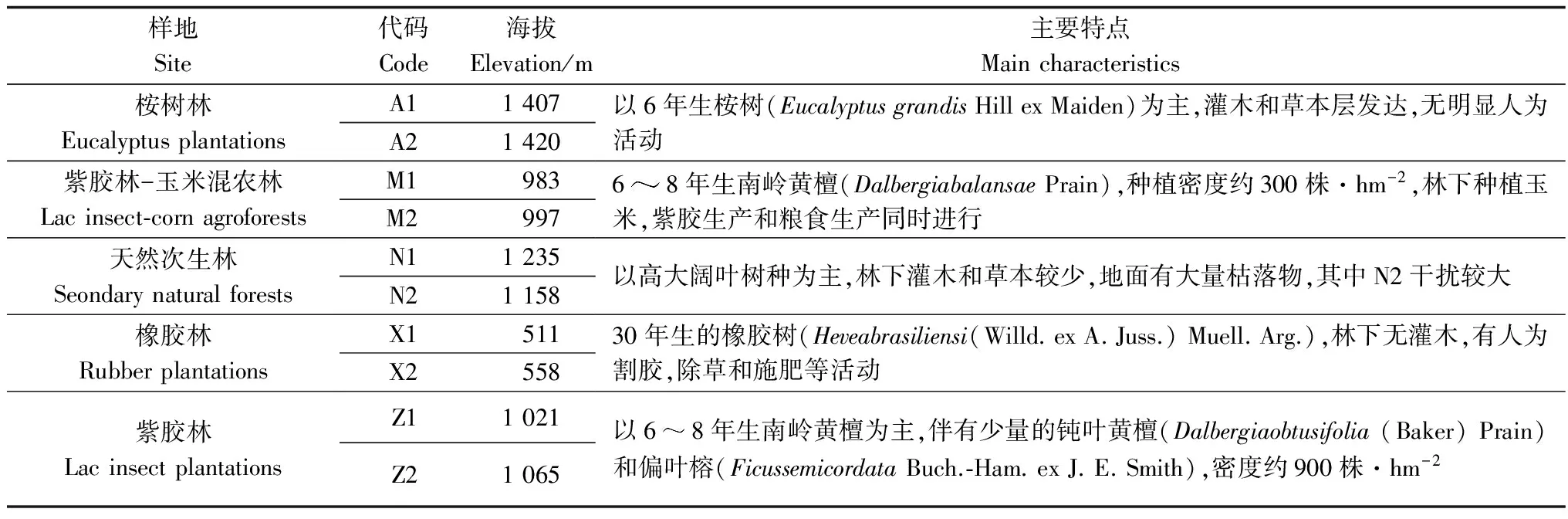
表1 不同樣地概況
1.2調查方法
1.2.1樹冠層螞蟻群落調查 于2012年10月份(雨季)和2013年4月份(旱季),調查5種類型樣地內的樹冠層螞蟻群落,具體方法為:每個樣地設置3條100m長的樣帶,樣帶間距大于50m,在每條樣帶上選擇5株喬木,至少間距10m,保證樣本獨立性,共計15株喬木,所選擇的喬木胸徑在10cm以上,對所選喬木進行編號。將樹棲螞蟻誘集陷阱固定在樹干上距離地面1.5m處,以濃度為50%的乙二醇作為陷阱溶液。在陷阱中使用支架設置誘餌提高誘集效果,支架下端浸沒在陷阱溶液中,螞蟻不能接觸到誘餌,誘餌為金槍魚和蜂蜜的混合物。設置48h后收集陷阱中的所有螞蟻,置于含有70%酒精溶液的離心管中,帶回實驗室進行鑒定并統計數量,無法鑒定到種的以形態種對待[17],根據種類鑒定結果整理出物種組成名錄。
1.2.2植物群落調查 喬灌木群落調查:每塊樣地選擇3個10m×10m的大樣方,調查并記錄喬木和灌木的植物種類、數量、胸徑、樹高和郁閉度。
草本植物群落調查:在放置樹棲陷阱的喬木附近設置1個1m×1m的小樣方,調查草本植物的種類、數量和蓋度,同時估計小樣方內的枯落物蓋度并用5點法測量枯落物厚度并計算其平均值作為該樣方的枯落物厚度值。
植物垂直密度變化:使用利維桿(長3m,直徑1cm的鐵桿)方法。以地表陷阱位置為參考,使用時將利維桿立于距陷阱水平距離1m的位置,垂直于地面,以每25cm作為一個區段,共12個區段,統計該位置每個區段內植物與鐵桿接觸點的數量(不考慮植物與鐵桿的接觸面積),對于超過300cm高度的植物密度,只統計有無,有植物覆蓋記為1,無則記為0[18]。
1.3分析方法
1.3.1抽樣充分性判斷 使用R語言中的iNEXT軟件包進行基于個體數的物種稀疏和預測曲線的繪制,根據曲線特征進行抽樣充分性的判斷[19]。
1.3.2多樣性比較 在比較樹冠層螞蟻群落多樣性時,以設置的樣帶為重復,即按編號以5個陷阱為一組,每塊樣地有3個重復。統計螞蟻物種豐富度和多度,并使用軟件Estimate S計算ACE估計值。數據分析時,滿足單因素方差分析條件時使用單因素方差分析(One-way ANOVA)中LSD 多重比較方法,不滿足時,進行Krushkal-wallis H 檢驗,比較樣地間樹冠層螞蟻群落多樣性的差異。
1.3.3群落結構相似性 對不同物種的多度數據進行有/無轉換,重點關注不同類型植被樹冠層螞蟻群落在物種組成上的差異,使用PRIMER v7中的非度量多維尺度分析(Non-metric Multi-Dimensional Scaling,nMDS)分析不同類型樣地樹冠層螞蟻群落結構差異;使用群落結構相似性比較不同類型樣地間群落結構差異的顯著性[20];對不同類型樣地螞蟻群落進行層次聚類分析(Hierarchical Cluster analysis),選取40%相似性水平將結果以圓圈的方式疊加到nMDS結果圖中。
1.3.4指示物種分析 使用R語言中的indicspecies軟件包對不同類型樣地進行指示物種分析,分析時使用的分組基于nMDS群落結構分析結果,即相似螞蟻群落結構的樣地為同一類型,計算不同物種的特異度和保真度,同時計算IndVal值,以IndVal指示值大于0.7并與樣地顯著相關(P<0.05)的物種作為指示物種[21]。
1.3.5相關性分析 使用SPSS18.0軟件中的相關性分析對樹冠層螞蟻多樣性和植物多樣性進行分析,其中,樹冠層螞蟻多樣性包括螞蟻多度和物種豐富度;植物多樣性包括草本植物的多度、物種豐富度和蓋度,喬灌木植物的多度、物種豐富度和蓋度,枯落物的蓋度和厚度以及植物垂直密度。
2 結果分析
2.1物種組成及抽樣充分性
5種類型樣地共采集螞蟻17998頭,隸屬于6亞科29屬68種,其中,桉樹林共采集到螞蟻3606頭,隸屬于4亞科13屬23種;紫膠林-玉米混農林共采集到螞蟻5421頭,隸屬于5亞科17屬37種;天然次生林共采集到螞蟻1850頭,隸屬于5亞科19屬36種;橡膠林共采集到螞蟻2472頭,隸屬于5亞科15屬24種;紫膠林共采集到螞蟻4649頭,隸屬于5亞科20屬37種。5種類型樣地的樹冠層螞蟻群落基于個體數的物種稀疏和預測曲線(圖1)表明:圖中實線部分為實際曲線,虛線部分為預測曲線,5條曲線預測部分都趨于平緩,說明這5種類型的樣地物種數隨個體數增加基本不再變化,表明抽樣比較充分。
2.2樹冠層螞蟻群落多樣性
表2表明:5種類型樣地樹冠層螞蟻群落物種多度之間差異顯著(χ2=13.178,P<0.05),紫膠林-玉米混農林>紫膠林>桉樹林>橡膠林>天然次生林,紫膠林-玉米混農林顯著高于天然次生林和橡膠林,紫膠林顯著高于天然次生林,其他樣地間差異不顯著;5種類型樣地樹冠層螞蟻群落物種豐富度差異極顯著(F4,25=18.129,P<0.001),紫膠林-玉米混農林>紫膠林>天然次生林>橡膠林>桉樹林,紫膠林-玉米混農林顯著高于其他4種類型樣地,天然次生林和紫膠林顯著高于桉樹林和橡膠林,其他樣地間差異不顯著;5種類型樣地樹冠層螞蟻ACE估計值差異極顯著(χ2=17.702,P<0.01),紫膠林-玉米混農林>紫膠林>天然次生林>桉樹林>橡膠林,紫膠林-玉米混農林顯著高于其他4種類型樣地,紫膠林顯著高于桉樹林和橡膠林,天然次生林顯著高于橡膠林,其他樣地間差異不顯著。
2.3樹冠層螞蟻群落結構比較
5種類型樣地的樹冠層螞蟻群落結構差異極顯著(ANOSIM GlobalR=0.577,P<0.01),其中,紫膠林的樹冠層螞蟻群落結構與紫膠林-玉米混農林相似;天然次生林的2個重復樣地的樹冠層螞蟻群落結構不相似;桉樹林的樹冠層螞蟻群落結構與其余類型樣地較不相似;橡膠林的樹冠層螞蟻群落結構與其余樣地明顯不相似(圖2)。
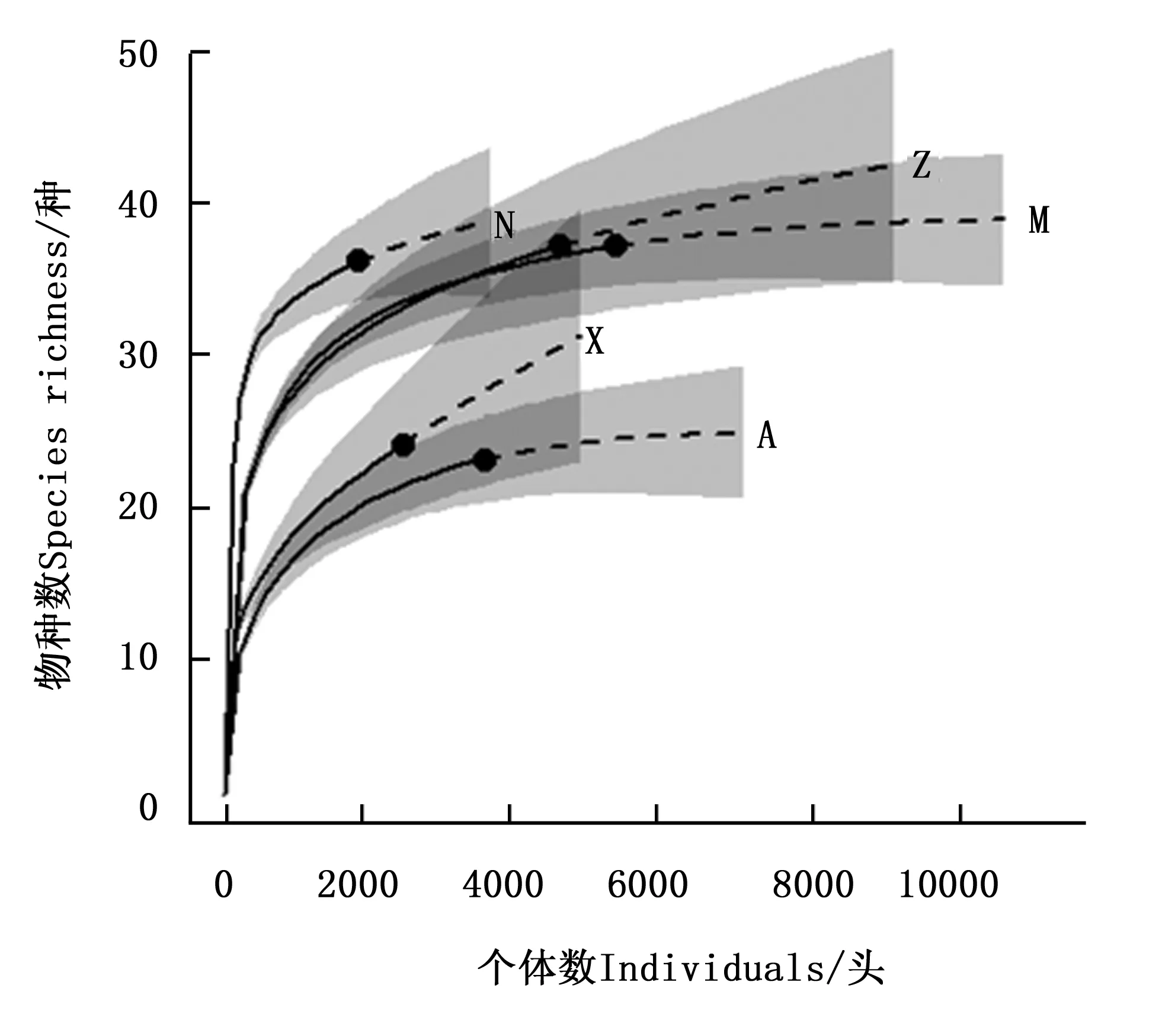
A、M、N、X和Z分別代表桉樹林、紫膠林-玉米混農民、天然次生林、橡膠林和紫膠林。A, M, N, X and Z represented Eucalyptus plantations, Lac insect-corn agroforests, Seondary natural forests, Rubber plantations and Lac insect plantations respectively.圖1 不同樣地樹冠層螞蟻群落基于個體數的物種稀疏和預測曲線Fig.1 Rare species number and extrapolation curves of canopy foraging ant communities in different sites based on individuals

樣地Site多度Abundance物種豐富度SpeciesrichnessACE估計值ACEestimatedvalue桉樹林Eucalyptusplantations601.00±148.39abc8.17±1.22c10.53±2.50cd紫膠林-玉米混農林Lacinsect?cornagroforests903.50±88.46a19.83±1.14a30.44±7.79a天然次生林Seondarynaturalforests308.33±35.17c13.50±1.09b16.03±2.08bc橡膠林Rubberplantations412.00±81.96bc8.50±0.72c10.50±1.38d紫膠林Lacinsectplantations774.83±175.2ab16.17±1.56b18.17±1.30b
注:表中數值為均值±標準誤。同列不同字母表示在0.05水平的差異顯著。ACE估計值是對樣地中實際物種數的估計。
Note: Data in the table as mean ±standard error. The different letters within the same column mean significant difference (P<0.05). ACE index was an estimate of the actual number of species in the sample plot.
2.4指示物種
紫膠林和紫膠林-玉米混農林的指示物種為平和弓背蟻、網紋刺結蟻、紅頭弓背蟻和羅氏心結蟻;橡膠林的指示物種為黑細長蟻和黃猄蟻(表3);其他樣地無指示物種。
2.5螞蟻群落與環境因子相關性分析
3 討論
有研究表明,鄉土樹種人工林對螞蟻多樣性有一定的保護作用[22-23],外來樹種人工林使螞蟻物種豐富度降低[24],或者雖然能夠保持和天然次生林相近的螞蟻豐富度,但組成明顯有差異[25],甚至使少數常見的物種多度增加,占據優勢地位[5]。本研究中,在天然林和4種人工林的比較中,外來人工桉樹林和橡膠林與天然次生林相比,樹冠層螞蟻物種豐富度和ACE估計值降低,但少數常見種多度增加,并且與天然次生林群落結構差異顯著,與前人研究一致[4-5],說明2種外來人工林能夠維持一定的螞蟻群落,但保護作用不及天然次生林;而鄉土樹種人工紫膠林和紫膠林一玉米混農林樹冠層螞蟻多度、物種豐富度和ACE估計值均增加,并且2種人工林群落結構相似,對螞蟻群落的保護作用顯著優于外來人工林。
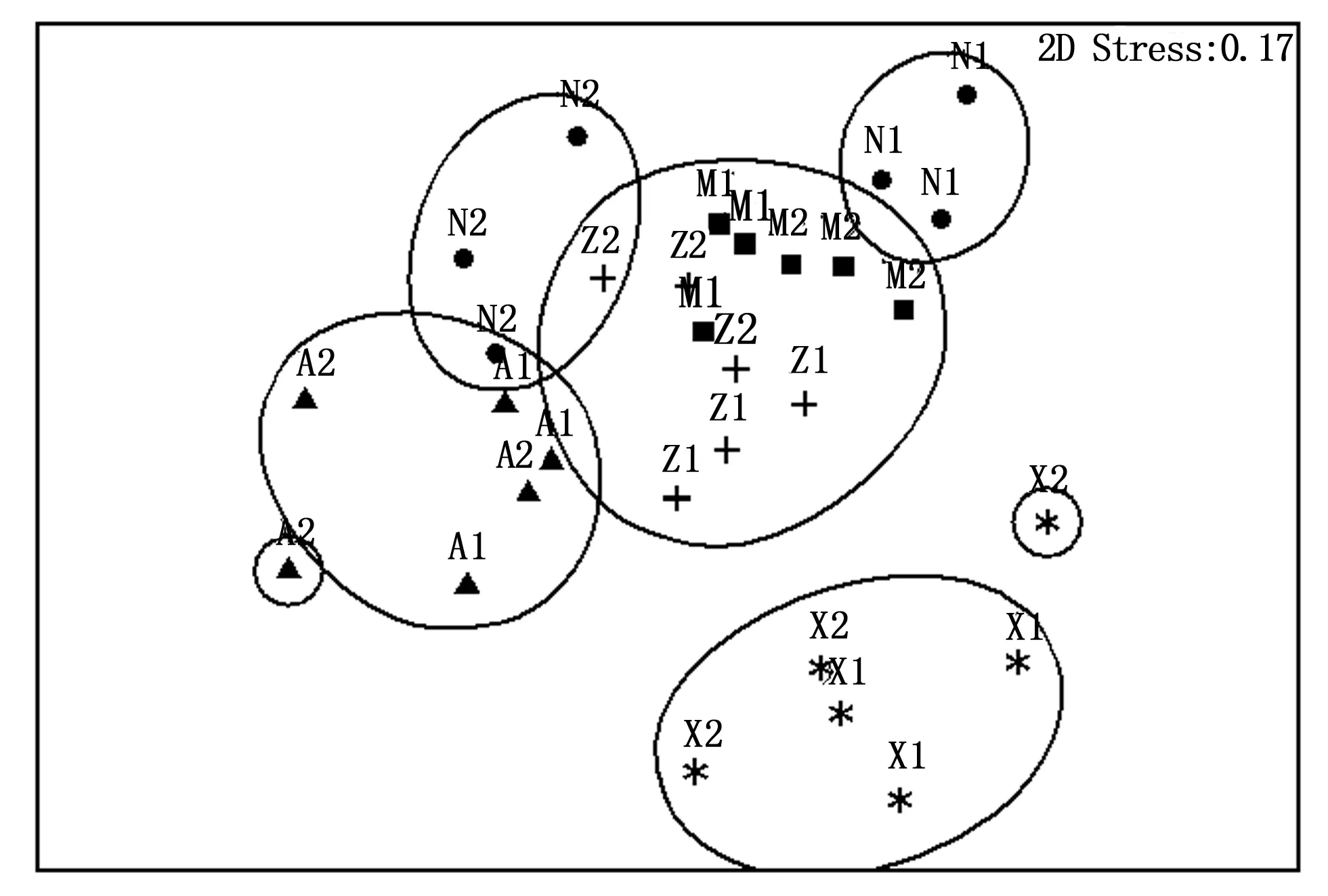
圖中黑圈表示40%相似性水平。A、M、N、X和Z分別代表桉樹林、紫膠林-玉米混農民、天然次生林、橡膠林和紫膠林。The dark circles represented similarity level of forty percent.A, M, N, X and Z represented Eucalyptus plantations, Lac insect-corn agroforests, Seondary natural forests Rubber plantations and Lac insect plantations respectively.圖2 不同類型樣地樹冠層螞蟻群落結構相似性Fig.2 The similarity of structures of canopy foraging ant communities in different sites

樣地Site物種Species特異性Specificity保真度Fidelity指示值IndValP紫膠林+紫膠林-玉米混農林Lacinsectplantations+Lacinsect?cornagroforests橡膠林Rubberplantations平和弓背蟻(Camponotusmitis(Smith))0.8721.0000.9340.002網紋刺結蟻(LepisiotareticulateXu)0.9090.7500.8260.005紅頭弓背蟻(CamponotussingularisSmith)1.0000.5000.7070.015羅氏心結蟻(Cardiocondylawroughtonii(Forel))1.0000.5000.7070.013黑細長蟻(Tetraponeranigra(Jerdon))0.9661.0000.9830.001黃猄蟻(Oecophyllasmaragdina(Fabricius))0.7480.8330.7900.002
注:特異性是該物種在各樣地中出現的概率,保真度為該物種在分組中出現的概率。
Note: Specificity mean the proportion of the species appeared in different sites. Fidelity mean the proportion of the species appeared in groups.

表4樹冠層螞蟻群落多樣性與環境因子相關性分析
注:*代表在0.05水平上的顯著相關,**代表0.01水平的顯著相關。
Note:One asterisk mean significant correlation (P<0.05). Two asterisks mean significant correlation (P< 0.01)
螞蟻作為指示生物能較好指示環境變化[31]。平和弓背蟻和紅頭弓背蟻同屬于弓背蟻屬,廣泛分布于各種棲境中,能夠利用的食物資源非常廣泛[32];羅氏心結蟻個體較小,喜歡潮濕地區或者沼澤[33],這3種螞蟻為紫膠林和紫膠林-玉米混農林的指示物種,說明這2種鄉土樹種人工林能夠提供一個棲境異質性較高的環境,使得多種螞蟻共存。黃猄蟻多發生在有干擾的地區[34],該螞蟻的出現,證明橡膠林受到了干擾。
4 結論
本研究結果顯示,人工林對螞蟻多樣性有一定的保護作用,特別是鄉土樹種人工林較外來人工林對螞蟻多樣性有更好的保護作用,但如何對人工林進行合理的管護,才能既滿足經濟發展又保護生物多樣性,值得進一步研究。
[1] FAO,State of the world’s forests[J]. Food and Agriculture Organization of the United Nations, 2011, 54(2):165-166.
[2] Cicuzza D, Kessler M, Clough Y,etal. Conservation value of cacao agroforestry systems for terrestrial herbaceous species in central Sulawesi, Indonesia[J]. Biotropica, 2011, 43(6): 755-762.
[3] Gibson L, Lee T M, Gibson L,etal. Primary forests are irreplaceable for sustaining tropical biodiversity[J]. Nature, 2011, 478(7369): 378-381.
[4] Beukema H, Danielsen F, Vincent G,etal. Plant and bird diversity in rubber agroforests in the lowlands of Sumatra, Indonesia[J]. Agroforestry Systems, 2007, 70(3): 217- 242.
[5] Steffan-Dewenter I, Kessler M, Barkmann J,etal. Tradeoffs between income, biodiversity, and ecosystem functioning during tropical rainforest conversion and agroforestry intensification[J]. Proceedings of the National Academy of Sciences, 2007, 104(12): 4973-4978.
[6] 任 海, 王 俊. 試論人工林下鄉土樹種定居限制問題[J]. 應用生態學報, 2007, 18(8): 1855-1860.
[7] Djègo J, Sinsin B. Effect of introduced exotic trees on the species diversity of the plant communities of their undergrowth[J]. Systematics & Geography of Plants, 2006, 76(2): 191-209.
[8] Dejean A, Corbara B, Orivel J,etal. Rainforest canopy ants: the implications of territoriality and predatory behavior[J]. Functional Ecosystems and Communities, 2007, 1(2): 105-120.
[9] Davidson D W, Cook S C, Snelling R R,etal. Explaining the abundance of ants in lowland tropical rainforest canopies[J]. Science, 2003, 300(5621): 969-972.
[10] Floren A, Biun A, Linsenmair E K. Arboreal ants as key predators in tropical lowland rainforest trees[J]. Oecologia, 2002, 131(1): 137-144.
[11] Philpott S M, Perfecto I, Vandermeer J. Effects of Management Intensity and Season on Arboreal Ant Diversity and Abundance in Coffee Agroecosystems[J]. Biodiversity & Conservation, 2006, 15(1): 139-155.
[12] Klimes P, Idigel C, Rimandai M,etal. Why are there more arboreal ant species in primary than in secondary tropical forests?[J]. Journal of Animal Ecology, 2012, 81(5): 1103-1112.
[13] Basset Y, Cizek L, Cuénoud P,etal. Arthropod diversity in a tropical forest[J]. Science, 2012, 338(6113): 1481-1484.
[14] Schonberg L A, Longino J T, Nadkarni N M,etal. Arboreal ant species richness in primary forest, secondary forest, and pasture habitats of a tropical montane landscape[J]. Biotropica, 2004, 36(3): 402-409.
[15] Blüthgen N, Stork N E. Ant mosaics in a tropical rainforest in Australia and elsewhere: a critical review[J]. Austral Ecology, 2007, 32(1): 93-104.
[16] Yusah K M, Foster W A. Tree size and habitat complexity affect ant communities (Hymenoptera: Formicidae) in the high canopy of Bornean rain forest[J]. Myrmecological News, 2016, 23: 15-23.
[17] 徐正會. 西雙版納自然保護區蟻科昆蟲生物多樣性研究[M]. 昆明:云南科技出版社, 2002.
[18] Gunawardene N, Majer J, Edirisinghe J. Correlates of ant (Hymenoptera: Formicidae) and tree species diversity in Sri Lanka[J]. Myrmecological News, 2012, 17(17): 81-90.
[19] Chao A, Gotelli N J, Hsieh T C,etal. Rarefaction and extrapolation with Hill numbers: a framework for sampling and estimation in species diversity studies[J]. Ecological Monographs, 2014, 84(1): 45-67.
[20] Clarke K R, Gorley R N. PRIMER version6: user manual/tutorial[M]. Plymouth, UK:PRIMER-E,2006.
[21] Cáceres M D, Legendre P. Associations between species and groups of sites: indices and statistical inference[J]. Ecology, 2009, 90(12): 3566-3574.
[22] 盧志興, 李可力, 張念念, 等. 巨桉林和天然次生林枯落物層螞蟻多樣性及指示種[J]. 林業科學研究, 2016, 29(4): 576-580.
[23] Delabie J H C, Jahyny B, Nascimento I C D,etal. Contribution of cocoa plantations to the conservation of native ants (Insecta: Hymenoptera: Formicidae) with a special emphasis on the Atlantic Forest fauna of southern Bahia, Brazil[J]. Biodiversity and Conservation, 2007, 16(8): 2359-2384.
[24] Hashim N R, Wan F A W J, Nasir M N S M. Ant diversity in a Peninsular Malaysian mangrove forest and oil palm plantation[J]. Asian Myrmecology, 2010, 3(1): 5-8.
[25] Denmead L H. Ant diversity, function and services across tropical land-use systems in Indonesia[D]. G?ttingen:Georg-August Universit?t, 2016.
[26] Queiroz A C M, Ribas C R. Canopy cover negatively affects arboreal ant species richness in a tropical open habitat[J]. Brazilian Journal of Biology, 2016, 76(4): 864-870.
[27] Klimes P, Fibich P, Idigel C,etal.Disentangling the diversity of arboreal ant communities in tropical forest trees[J]. Plos One, 2015, 10(2): e0117853.
[28] Floren A, Wetzel W, Staab M. The contribution of canopy species to overall ant diversity (Hymenoptera: Formicidae) in temperate and tropical ecosystems[J]. Myrmecological News, 2014, 19(1): 65-74.
[29] 張念念, 陳又清, 盧志興,等. 云南橡膠林和天然次生林枯落物層螞蟻物種多樣性、群落結構差異及指示種[J]. 昆蟲學報, 2013, 56(11):1314-1323.
[30] 武子文, 畢興丹, 盧志興,等. 干熱河谷地區不同恢復期火燒跡地地表螞蟻群落比較[J]. 云南大學學報:自然科學版, 2017(1):130-136.
[31] Hoffmann B D, James C D. Using ants to manage sustainable grazing: Dynamics of ant faunas along sheep grazing gradients conform to four global patterns[J]. Austral Ecology, 2011, 36(6): 698-708.
[32] Garcia F H, Wiesel E, Fischer G. The Ants of Kenya (Hymenoptera: Formicidae)—Faunal Overview, First Species Checklist, Bibliography, Accounts for All Genera, and Discussion on Taxonomy and Zoogeography[J]. Journal of East African Natural History, 2007, 101(101): 127-222.
[33] Deyrup M, Davis L, Cover S. Exotic ants in Florida[J]. Transactions of the American Entomological Society, 2000, 126(3): 293-326.
[34] Torchote P, Sitthicharoenchai D, Chaisuekul C. Ant Species Diversity and Community Composition in Three Different Habitats: Mixed Deciduous Forest, Teak Plantation and Fruit Orchard[J]. Tropical Natural History,2010, 10(1): 37-51.

附表 不同樣地螞蟻名錄及多度
續附表
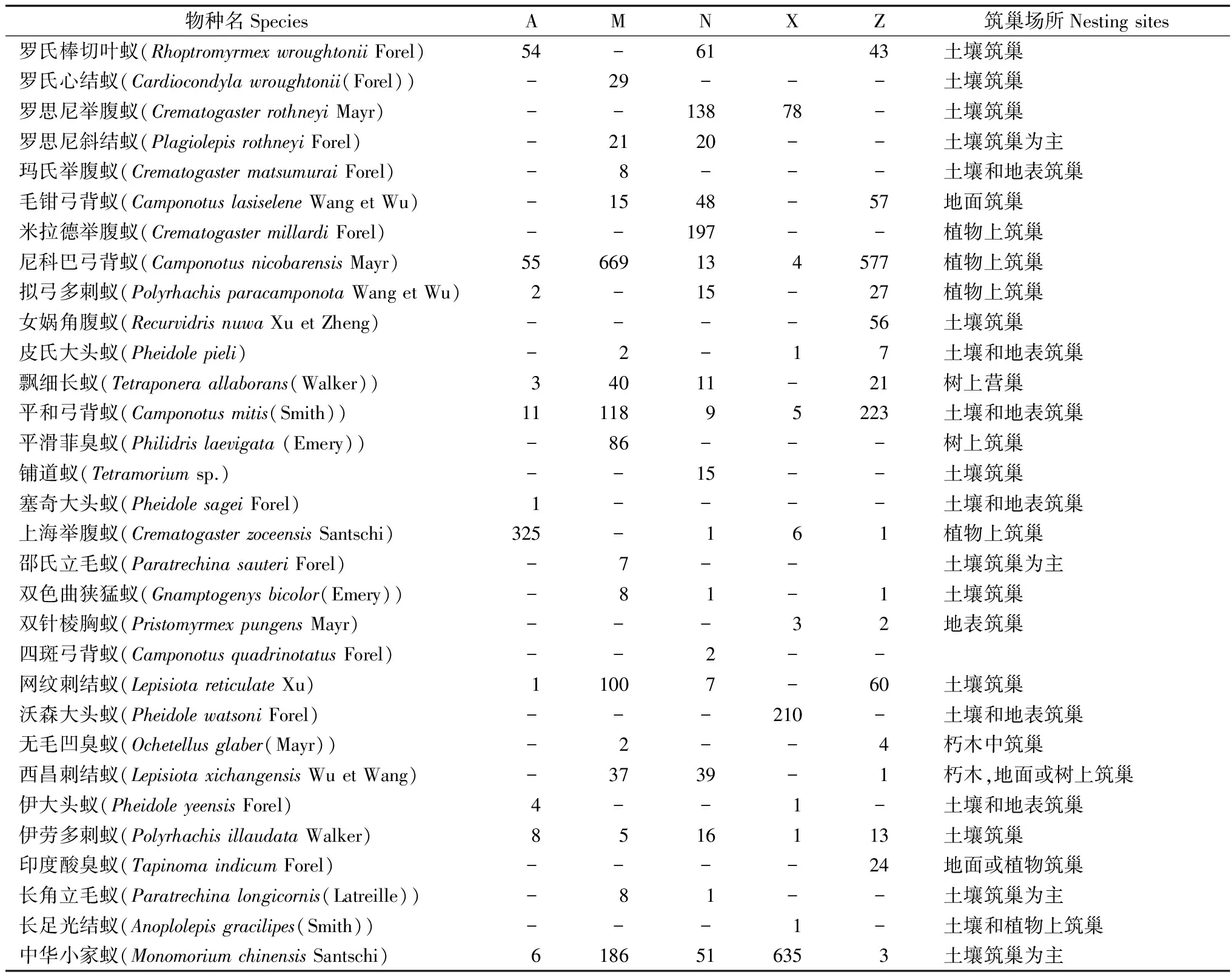
不同樣地螞蟻名錄及多度
(責任編輯:張 玲)
DiversityofCanopyForagingAntCommunitiesinSecondaryNaturalForestandPlantationsinLüchun,Yunnan
ZHAOJing-wen,LUZhi-xing,CHENYou-qing
(Research Institute of Resources Insects, Chinese Academy of Forestry, Kunming 650224, Yunnan, China)
S718.55
A
1001-1498(2017)05-0823-08
10.13275/j.cnki.lykxyj.2017.05.016
2017-04-15
國家自然科學基金項目(31470493和31270561)。
趙婧文(1991—),女,河北保定人,昆蟲生態學碩士研究生.E-mail:zhaojingwen115@163.com.
* 通訊作者.
猜你喜歡
課堂內外·初中版(科學少年)(2025年1期)2025-02-28 00:00:00
課堂內外·初中版(科學少年)(2025年2期)2025-02-28 00:00:00
課堂內外·初中版(科學少年)(2024年12期)2024-12-02 00:00:00
英語世界(2023年10期)2023-11-17 09:18:18
中學生博覽(2022年7期)2022-06-21 21:48:14
大科技·百科新說(2021年8期)2021-11-03 10:55:16
學苑創造·A版(2021年5期)2021-06-28 19:51:42
少兒美術(快樂歷史地理)(2020年9期)2020-03-19 05:10:56
科學大眾(中學)(2019年3期)2019-05-17 10:04:30
汽車觀察(2018年10期)2018-11-06 07:05:26
