草甘膦與氰氟草酯對隆線溞的急性毒性研究
2017-09-26 02:40:16李佳袁玲
草業學報 2017年9期
李佳,袁玲
(西南大學資源環境學院,重慶 400716)
草甘膦與氰氟草酯對隆線溞的急性毒性研究
李佳,袁玲*
(西南大學資源環境學院,重慶 400716)
在水生食物鏈中,水溞是連結植物、微生物和動物的關鍵成員。草甘膦與氰氟草酯被廣泛用于防除水生和稻田雜草,研究它們對水溞的毒性,有益于人們關注使用除草劑對水體生態系統的影響。試驗以標準水體監測生物——隆線溞(Daphniacarinata)單克隆為材料,研究草甘膦和氰氟草酯對其泳動能力、存活率和趨光性的影響。結果表明,兩種除草劑對隆線溞均有明顯毒性,草甘膦對隆線溞24, 48和96 h的半致死濃度(LC50)分別為66.58, 29.60和12.33 mg/L,為田間常規用藥量的0.15%~0.81%;氰氟草酯對隆線溞24, 48和96 h的LC50依次是63.15, 51.91和34.41 mg/L,為田間常規用藥量的17.21%~31.58%。兩種除草劑顯著影響隆線溞的泳動能力和趨光指數。隆線溞接觸草甘膦和氰氟草酯3 h后,導致其趨光指數顯著改變的濃度分別是4.59和14.20 mg/L,分別為常規用藥量的0.06%和7.10%。因此,草甘膦和氰氟草酯對水溞的毒性大,對水生食物鏈的影響不可忽視。利用水溞趨光性可快速、靈敏地監測除草劑使用后的水體生物毒性。
草甘膦; 氰氟草酯; 隆線溞; 急性毒性
除草劑是現代農業廣泛使用、高效防除雜草的化學試劑,其用量大于殺蟲劑、殺菌劑和殺螨劑三者之和,占目前農藥生產總量的55%左右[1]。我國除草劑用量大,環境負荷重。在20世紀90年代中期,我國化學除草劑使用面積達4000萬hm2,占播種面積的1/4[2]。到2014年我國除草劑原藥產量達180.35萬t,其中出口80.60萬t,國內使用量約100萬t[3]。由此可見,我國除草劑用量極大,其主要用于農地、森林和水域(如魚塘、河道及湖泊等)[4]。
在水體生態系統中,魚類以浮游動物——水溞(Daphnia)為食,而水溞以水藻和微生物為食,故水溞是水生食物鏈的關鍵成員。環境中的除草劑影響動物和微生物新陳代謝和生長發育。研究發現,氯嘧磺隆減低土壤微生物數量,影響土壤微生物的結構和多樣性[5];丁草胺嚴重影響蝌蚪的生長發育,產生遺傳毒性[6];阿特拉津對家蠶的生長發育速度、眠蠶體重有顯著影響,且在蠶體內有一定積累作用[7]。丁草胺和丁芐混劑對淡水螺、福壽螺、坑螺這3種水生動物的呼吸作用有顯著的抑制作用,嚴重影響其存活率[8]。乙草胺能夠引起雄性小鼠睪丸組織病理損傷、精子畸形率增高、睪丸細胞酶LDH、SDH活性下降、睪丸細胞周期紊亂和細胞凋亡率升高,具有生殖毒性[9]。草甘膦和精喹禾靈對蚯蚓用濾紙法染毒48 h后,其LC50值分別為546.4和638.7 μg/cm2[10]。但是,關于除草劑對水溞生長發育、運動能力和趨光性的影響尚待研究。
除草劑大量用于水體除草,施入土壤的除草劑也通過降雨、徑流和淋溶進入水體[11]。但除草劑對水體生態系統的影響知之甚少,開展除草劑對水體生物的影響研究,對科學使用除草劑具有重要的現實意義。草甘膦廣泛用于控制一年和多年生的各種雜草,是當前生產和使用量最大的農藥品種之一[12-14],也是河岸、濕地等水體防除如空心蓮子草(Alternantheraphiloxeroides)、水葫蘆(Eichhorniacrassipes)等惡性雜草使用最廣泛的除草劑[15-16]。氰氟草酯(R-2-[4(4-氰基-2-氟苯氧基)苯氧基]-丙酸丁酯)是稻田廣泛使用的一種內吸傳導性除草劑,用于殺滅稗草(Echinochloacrusgalli)、千金子(Leptochloachinensis)等雜草[17]。水溞不僅是水生食物鏈的關鍵成員,而且也是國際公認的標準試驗生物,廣泛用于監測水體中的有害物質,評價水體生態系統的健康質量[18]。本研究選擇常用的草甘膦和氰氟草酯為試驗材料,以我國長江流域的常見水溞——隆線溞(D.carinata)為試驗生物,研究這兩種代表性的除草劑對水溞的生物毒性,為除草劑的科學使用提供理論依據。
1 材料與方法
1.1試驗時間
2015年12月15日至2016年2月20日,逐代培養并篩選出生長良好且趨光性強的優良隆線溞;2016年2月21日至2016年4月10日,進行多次預備試驗而確定試驗處理的草甘膦和氰氟草酯濃度;2016年4月11日至2016年4月15日,準備試驗用品及調試試驗裝備;2016年4月16日至2016年4月23日,進行正式試驗。
1.2試驗材料
1.2.1除草劑 除草劑分別為41%草甘膦異丙胺鹽水劑和10%氰氟草酯水乳劑,均購于中國農業科學院植物保護研究所,保存于4~10 ℃的冰箱中。
1.2.2水溞 選取自主選育的、趨光性強的隆線溞為試驗材料。原種采集于重慶三峽庫區的自然水體,經多代孤雌生殖、純化,獲得單克隆生物株,保存于西南大學資源環境學院水溞實驗室。
在光強1200 lx、光周期12 h/d、溫度(20±0.5) ℃的條件下,用充分充氧曝氣脫氯的自來水培養隆線溞,每日清晨8:00投喂新鮮的斜生柵藻,培養至4 d齡期備用。
1.2.3試驗用水 標準毒物的稀釋水為ISO6341-1989人工標準水(以下簡稱標準水)[19],其組成為:0.294 g/L CaCl2·H2O,0.123 g/L MgSO4·7H2O,0.065 g/L NaHCO3,0.006 g/L KCl, 用預先充氧至飽和的去離子水(20 ℃)配制,用1 mol/L HCl或NaOH調節pH至7.80,靜置24 h后使用。
1.3試驗設計及過程描述
1.3.1除草劑對隆線溞存活率及活動能力的影響 采用單因子隨機設計,在多次預備試驗的基礎上(參照兩種除草劑說明書的用藥濃度,草甘膦8.2 g/L,氰氟草酯0.2 g/L),根據改良寇氏法[20],每種除草劑按等比設置處理濃度梯度,組間比值為1.6,設置6個試驗處理:草甘膦濃度設置為0(CK),12.30,19.68,31.57,50.43,80.77 mg/L,氰氟草酯濃度設置為0(CK), 15.0, 24.0, 38.4, 61.4, 98.3 mg/L。每處理重復6次,每個重復隨機選取10只健康水溞,即每個處理共有60只水溞參與試驗。
試驗在光強1200 lx 、光周期12 h/d、溫度(20±0.5) ℃的條件下進行。將試驗用的水溞于200 mL ISO標準水中潤洗3次,每次5 min,再置于100 mL不同濃度的除草劑溶液中,在12, 24, 36, 48, 72和96 h 觀察隆線溞存活及活動情況。在觀察期間的條件設置同常規培養。
隆線溞活動受抑制標準為:輕微擾動溶液15 s,觸角可活動,但個體不能泳動;死亡判斷標準為:溞體沉入水底,輕輕轉動容器無任何反應[21]。
1.3.2除草劑對隆線溞趨光性的影響 隆線溞培養、試驗條件和除草劑濃度設置(表1)、處理數、重復數,以及每次重復所用的水溞數均與1.2.1相同。每次重復即隨機選取10只隆線溞,置于100 mL不同濃度的除草劑溶液中,1200 lx光照培養3 h。然后將隆線溞轉入水溞趨光測定裝置[22-23],暗適應5 min后,在1200 lx光照下,刺激10 min,從第6 min開始,每1 min記錄各光區內的隆線溞數目[23]。
1.4測定指標及其計算方法
用改良寇氏法[20]計算隆線溞半抑制濃度(EC50)和半致死濃度(LC50);水溞趨光指數(phototaxical index,Ip) 的計算公式如下[21,24]:
Ip=(U-L)/(U+M1+M2+L)
式中:U、M1、M2、L分別代表觀察裝置[17]上、中上、中下和下部的水溞數。
1.5數據處理
用Excel 2013對試驗數據進行基本計算以及圖表的制作;用SigmaPlot 12.5軟件進行毒性方程的擬合;用SPSS 17.0軟件進行方差分析,多重比較采用Duncan法,顯著水平設為P<0.05。
2 結果與分析
2.1除草劑對隆線溞的致死作用
由表1可知,草甘膦和氰氟草酯均與隆線溞致死率存在著明顯的劑量-效應關系,可用y=a/{1+exp[-(x-c)/b]}方程表示。草甘膦對隆線溞24, 36, 48, 72和96 h的LC50分別為66.58, 58.13, 29.60, 18.83和12.33 mg/L,LC50(24 h)分別是LC50(48 h)和LC50(96 h)的2.3和5.4倍,即草甘膦的LC50隨著時間推移而降低。氰氟草酯對隆線溞24, 36, 48, 72和96 h的LC50依次是63.15, 56.37, 51.91, 40.88和34.41 mg/L,LC50(24 h)分別比LC50(48 h)和LC50(96 h)高21.7%和83.5%。在36 h及以后的時段,草甘膦的LC50顯著低于氰氟草酯。
2.2除草劑對隆線溞活動能力的抑制作用
由表2可知,草甘膦和氰氟草酯處理可顯著降低隆線溞的活動能力,也存在著明顯的劑量-效應關系,可用y=a/{1+exp[-(x-c)/b]}方程表示。前者對隆線溞24, 36, 48, 72和96 h的EC50分別為45.24, 42.49, 26.53, 17.14和11.58 mg/L,即隨著時間推移,草甘膦的EC50顯著降低;后者對隆線溞的EC50依次是47.07~52.94 mg/L(24~48 h), 39.00 mg/L (72 h)和30.84 mg/L(96 h),即24~48 h無顯著變化,隨后顯著降低。此外,在各個時段,草甘膦的EC50均小于氰氟草酯。
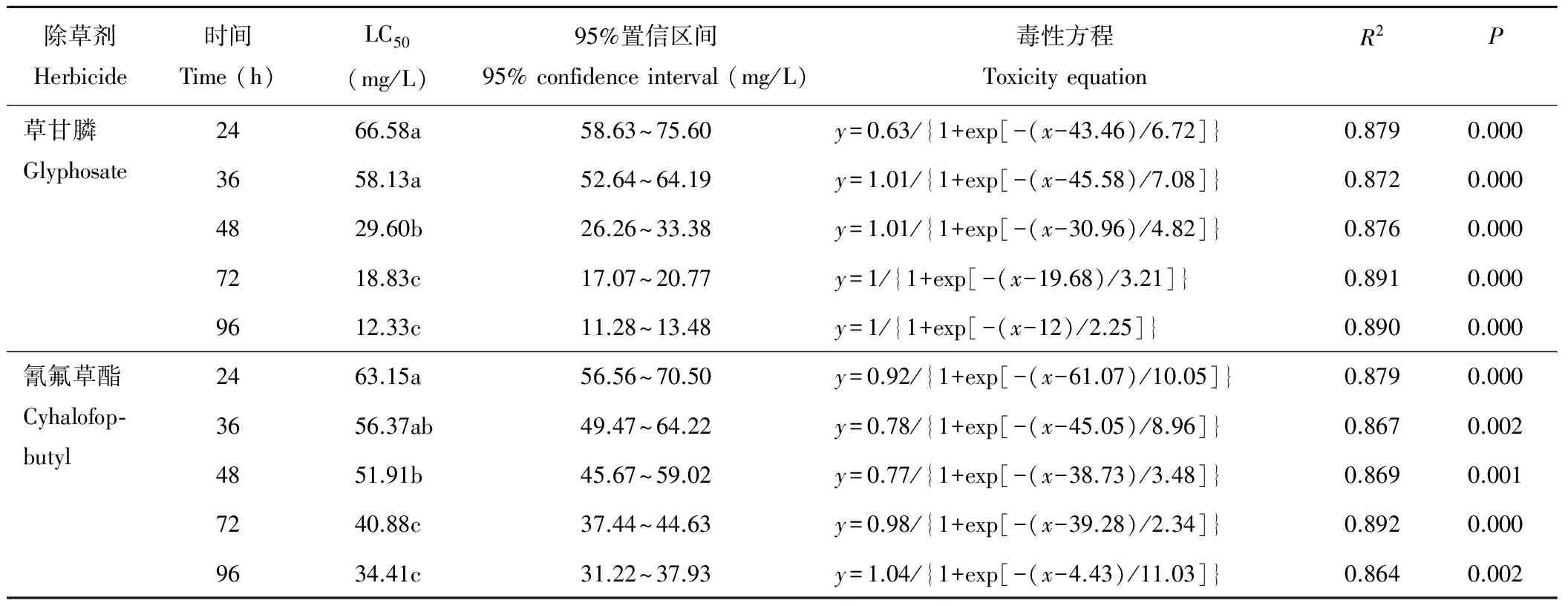
表1 草甘膦和氰氟草酯對隆線溞致死率的影響Table 1 Effect of glyphosate and cyhalofop-butyl on the death rate of D. carinata
注:LC50值由改良寇氏法[20]計算,y表示累計致死率(%),x表示除草劑濃度(mg/L)。同列不同字母表示差異顯著(P<0.05)。
Note:LC50is calculated by modified Karber’s method[20],yrepresents the cumulative lethality (%), andxrepresents the concentration of herbicides (mg/L). Different letters in the same column indicate significant difference (P<0.05).
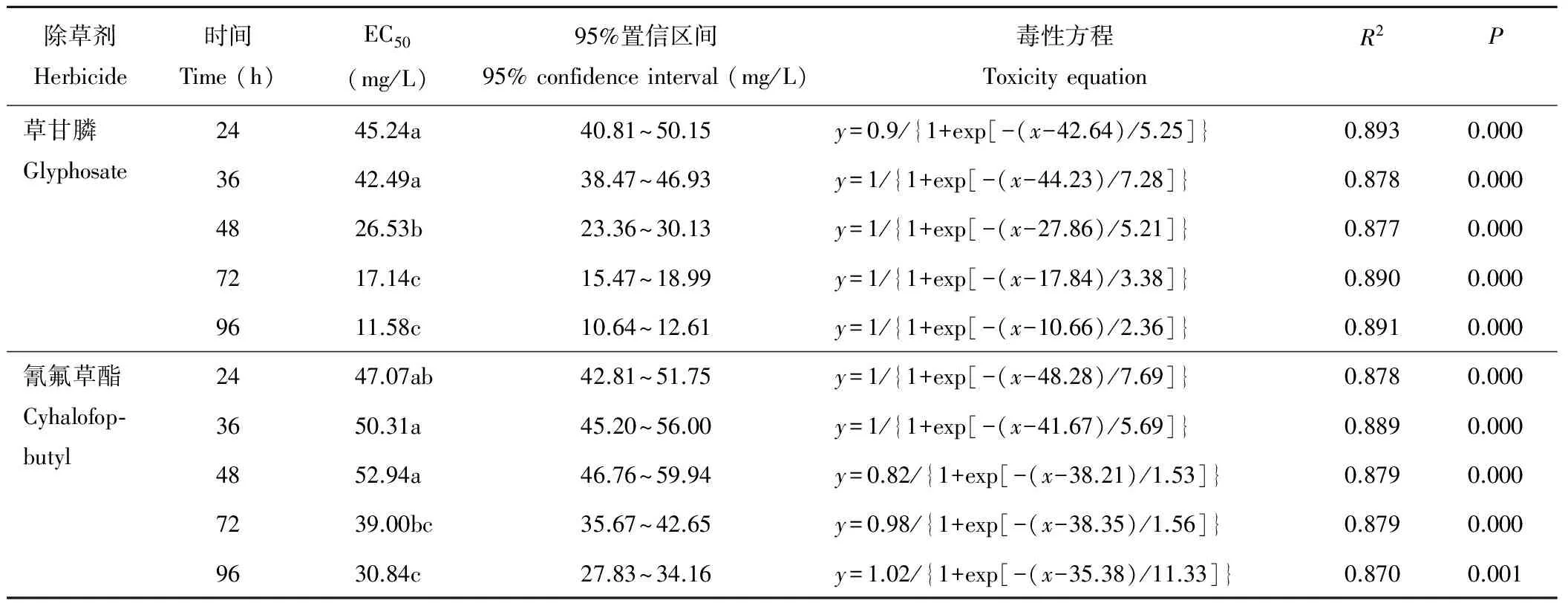
表2 草甘膦和氰氟草酯對隆線溞活動能力的影響Table 2 Effect of glyphosate and cyhalofop-butyl on the movement of D. carinata
注:EC50值由改良寇氏法[20]計算,y表示累計抑制率(%),x表示除草劑濃度(mg/L)。同列不同字母表示差異顯著(P<0.05)。
Note:EC50is calculated by modified Karber’s method[20],yrepresents the cumulative inhibition ratio (%), andxrepresents the concentration of herbicides (mg/L). Different letters in the same column indicate significant difference (P<0.05).
2.3除草劑對隆線溞趨光性的影響
2.3.1草甘膦 由圖1可知,隆線溞趨光指數Ip隨著草甘膦濃度增大而顯著降低。在無草甘膦的對照中,Ip為0.3,加入草甘膦之后,隆線溞趨光指數Ip和草甘膦濃度之間的關系可由方程y=10-4x2-0.023x+0.355,R2=0.973(y表示Ip;x表示除草劑濃度, mg/L)表示,由此可計算出當草甘膦濃度為4.59 mg/L(施用濃度的1/1787)時,Ip顯著降低;當草甘膦濃度從19.68 mg/L增加至31.57 mg/L時,Ip由正變負;當草甘膦濃度為80.77 mg/L時,隆線溞的趨光性極弱,Ip僅為-0.858,相對于對照組減少了1.158個Ip單位。
2.3.2氰氟草酯 由圖2可知,隆線溞趨光指數Ip也隨著氰氟草酯濃度增大而顯著降低。在無氰氟草酯的對照中,Ip為0.3,加入氰氟草酯之后,隆線溞趨光指數Ip和氰氟草酯濃度之間的關系可由方程y=10-4x2-0.023x+0.308,R2=0.990(y表示Ip;x表示除草劑濃度, mg/L)表示,由此可計算出當氰氟草酯濃度為14.2 mg/L(為施用濃度的1/14)時,Ip顯著降低;當氰氟草酯濃度增加至24.0 mg/L時,Ip由正變負,降至-0.2;當氰氟草酯濃度為98.3 mg/L時,隆線溞趨光性很弱,Ip為-0.65,相對于對照組降低了0.95個Ip單位。
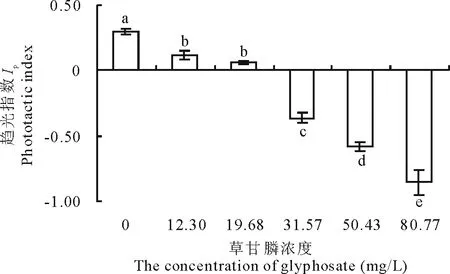
圖1 草甘膦對隆線溞趨光性的影響Fig.1 Effect of glyphosate on the phototaxis of D. carinata
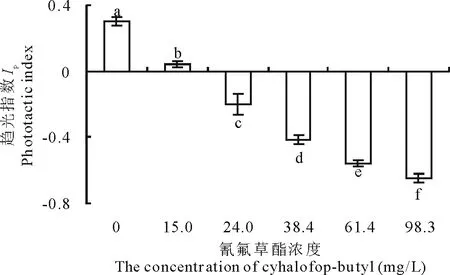
圖2 氰氟草酯對隆線溞趨光性的影響Fig.2 Effect of cyhalofop-butyl on the phototaxis of D. carinata
不同字母代表差異顯著(P<0.05)。下同。Different letters mean significant difference atP<0.05. The same below.
3 討論
在除草劑登記品種中,草甘膦占總用量的60.37%[25],不僅用于農田、果園、綠地,而且也大量用于防治魚塘、河道及湖泊中的水生空心蓮子草、水葫蘆等,施用劑量高于推薦用藥量3~4倍[26],施用后在水體中含量極高。氰氟草酯主要用于稻田,防除稗草、千金子、牛筋草(Eleusineindica)等惡性禾本科雜草,并可有效防除對二氯喹啉酸、磺酰脲類和酰胺類除草劑產生抗性的雜草[27]。在2006-2011年,氰氟草酯的市場銷售量年增長10.80%;2011-2013年的增長率高達23.55%[28]。因此,草甘膦和氰氟草酯劑是目前使用廣、用量大、遞增快,也是用于水域環境最具代表性的除草劑[29],研究它們對水溞的影響有重要意義。
試驗以隆線溞作為監測生物,設置不同濃度的草甘膦和氰氟草酯處理,研究了隆線溞的生理反應,包括24,36,48,72和96 h的LC50和EC50,以及3 h的趨光行為[22,30-32]。結果表明,在不同時段,二者對隆線溞的存活和泳動能力存在著明顯的劑量-效應關系,草甘膦對隆線溞的LC50(48 h)為29.60 mg/L,氰氟草酯的LC50(48 h)是51.91 mg/L,說明兩種除草劑對隆線溞均有較強毒性,施用濃度越高毒性愈強,草甘膦的毒性大于氰氟草酯,類似對魚、蝦、蛙類等水生和兩棲動物的危害。吳長興等[33](2011)研究發現,氰氟草酯對澤蛙蝌蚪高毒。Modesto等[34](2010)發現,5 mg/L 草甘膦制劑能使魚類血液中的血球容積增大,紅細胞和白細胞數量增加,體內的抗氧化酶活性改變,產生毒害作用。徐怡等[35](2010)的研究表明,10%草甘膦水劑對克氏原螯幼蝦產生毒害作用。Relyea[36](2008)及Lajmanovich等[37](2011)報道,3.80 mg/L草甘膦可使蝌蚪大量死亡,1.85 mg/L草甘膦制劑在施藥48 h后降低青蛙體內乙酰膽堿酯酶和谷胱甘肽酶活性。說明草甘膦使用濃度在1.85~5.00 mg/L范圍對水生動物魚、蝦、青蛙、蝌蚪等產生毒害。劉曉偉等[38](2012)也研究表明,低濃度的草甘膦對多刺裸腹溞具有毒性[LC50(48 h)=26.29 mg/L]。值得注意的是,草甘膦對隆線溞的LC50(96 h)僅為常規使用濃度(8.2 g/L)的0.15%,氰氟草酯的LC50(96 h)是常規使用濃度(0.2 g/L)的17.21%,說明在水體使用除草劑對水溞產生較大危害,威脅其生存。在水體生態系統中,水溞不僅是水生食物鏈的關鍵成員,而且還與水體生產力密切相關。因此,除草劑的使用對水生態系統的影響不可忽視。
隆線溞食物廣,適應性強,易于培養,繁殖生長快,短時間內可獲大量群體,且對毒物反應靈敏,故在水質監測中,水溞是國際上公認的標準試驗生物[39]。因此,吳永貴等[40]、楊靜等[41]和郭曉燕[42]利用隆線溞Ip檢測水體中的銅、鎘、汞、五氯酚鈉、擬除蟲菊酯,判斷其對隆線溞的生物毒性。在本研究中,水溞EC50(24 h)和LC50(24 h)分別為45.24~66.58 mg/L(草甘膦)和47.07~63.15 mg/L(氰氟草酯),而在3 h時,使Ip發生顯著改變的濃度僅為4.59 mg/L(草甘膦)和14.20 mg/L(氰氟草酯),分別為常規用藥量的0.06%和7.10%,說明測定Ip不僅耗時短,而且靈敏度高。此外,水溞趨光性易于觀察,若將可視技術與電子計算機結合可儀器化測定Ip,在線監測除草劑使用后的水體生物毒性。
4 結論
草甘膦和氰氟草酯對隆線溞的運動抑制和致死率存在著明顯的劑量-效應關系,二者的常規使用濃度極顯著高于LC50,對隆線溞有較強毒性,且草甘膦的毒性顯著大于氰氟草酯。
草甘膦和氰氟草酯使隆線溞的趨光指數(3 h)顯著改變的濃度顯著低于EC50和LC50(24 h),利用水溞趨光性可快速、靈敏地監測水體中的除草劑。
References:
[1] Zhu J. Studies on Photodegradation of Emamectin Benzoate and its Effect on the Insecticidal Activity[D]. Nanjing: Nanjing Agricultural University, 2010. 朱軍. 甲氨基阿維菌素苯甲酸鹽的光解及對殺蟲活性影響的研究[D]. 南京: 南京農業大學, 2010.
[2] Feng C C, Ma H. Application status and challenges of herbicides. Jiangsu Agricultural Sciences, 2014, 42(8): 111-113. 馮程程, 馬紅. 除草劑應用現狀及挑戰. 江蘇農業科學, 2014, 42(8): 111-113.
[3] Yang Y J. Where will Chinese pesticide industry go under the new normal. Marketing: Means of Agricultural Production and Market, 2015, (8): 74-76. 楊益軍. 新常態下我國農藥行業會往哪走. 營銷界: 農資與市場, 2015, (8): 74-76.
[4] Lu X, Zhao B Z, Zhang J B,etal. Summary of nature and environmental behavior of the herbicide glyphosate. Chinese Journal of Soil Science, 2005, 36(5): 785-790. 盧信, 趙炳梓, 張佳寶, 等. 除草劑草甘膦的性質及環境行為綜述. 土壤通報, 2005, 36(5): 785-790.
[5] Sheng Y. Effects of Long-term Residual Herbicide Chlorimuron-ethyl on Soil Microbial Ecology[D]. Harbin: Northeast Agricultural University, 2011. 盛宇. 長殘留除草劑氯嘧磺隆對土壤微生物生態的影響[D]. 哈爾濱: 東北農業大學, 2011.
[6] Lin L. Study of Butachlor on Tadpoles of Three Anuran Species Toxic Effects[D]. Fuzhou: Fujian Normal University, 2010. 林玲. 丁草胺對三種無尾兩棲類蝌蚪毒理學效應的研究[D]. 福州: 福建師范大學, 2010.
[7] Chen J Q, Dai X Y, Xu S Q. Effects of environmental herbicide atrazine hormone on the growth and development of silkworm. China Sericulture, 2007, 28(4): 13-17. 陳劍秋, 戴璇穎, 徐世清. 環境激素除草劑阿特拉津對家蠶生長發育的影響. 中國蠶業, 2007, 28(4): 13-17.
[8] Zhao L, Luo S M, Li H S,etal. Eco-toxicological effects of four herbicides on typical aquatic snail pomacea canaliculata and crown conchs. Acta Ecologica Sinica, 2011, 31(19): 5720-5727. 趙蘭, 駱世明, 黎華壽, 等. 不同濃度下四種除草劑對福壽螺和坑螺的生態毒理效應. 生態學報, 2011, 31(19): 5720-5727.
[9] Hu W J. The Study on Reproductive Toxicity of Herbicide Acetochlor in Male Mice[D]. Changchun: Jilin University, 2010. 胡偉軍. 除草劑乙草胺對雄性小鼠生殖毒性的研究[D]. 長春: 吉林大學, 2010.
[10] Wang F F, Zheng M M, Liu S H,etal. Acute toxicity and oxidative stress of two herbicides on earthworm eisenia fetida. Asian Journal of Ecotoxicology, 2014, 9(6): 1210-1218. 王飛菲, 鄭夢夢, 劉樹海, 等. 兩種除草劑對蚯蚓的急性毒性及氧化脅迫效應. 生態毒理學報, 2014, 9(6): 1210-1218.
[11] Ni Y. Toxic Effects and Mechanism of Mesotrione onMicrocystissp. andScenedesmusquadricauda[D]. Nanchang: Nanchang University, 2014. 倪妍. 硝磺草酮對微囊藻和四尾柵藻的毒性效應及致毒機理研究[D]. 南昌: 南昌大學, 2014.
[12] Hua N Z. Progress in research and application of nonselective herbicide glyphosate varieties, dosage forms and additives. Pesticide Market News, 2014, (27): 20-23. 華乃震. 非選擇性除草劑草甘膦品種、劑型及助劑研究應用進展. 農藥市場信息, 2014, (27): 20-23.
[13] Tu Y Q, Yuan H Z. Scientific use of pesticides on the basis of pesticide application technology. Journal of Plant Protection, 1996, 23(3): 275-280. 屠予欽, 袁會珠. 農藥的科學使用問題與農藥應用工藝學. 植物保護學報, 1996, 23(3): 275-280.
[14] Klevorn T B, Wyse D L. Effect of soil temperature and moisture on glyphosate and photoassimilate distribution in quackgrass (Agropyronrepens). Weed Science, 1984, 32(3): 402-407.
[15] Wang C. Test of glyphosate inAlternantheraphiloxeroides. Anhui Forestry Science and Technology, 2006, (5): 40. 王超. 草甘膦防除空心蓮子草試驗. 安徽林業科技, 2006, (5): 40.
[16] You Y, Wang C F, Wang J,etal. Glyphosate isopropylamine control of water hyacinth and the chemical residue in water. Fujian Journal of Agricultural Sciences, 2007, 22(2): 167-171. 游泳, 王長方, 王俊, 等. 草甘膦異丙胺鹽水劑防除水葫蘆效果及其在水中的殘留. 福建農業學報, 2007, 22(2): 167-171.
[17] Nie Z J, Gu X J, Cai S,etal. Isolation of a cyhalofop-butyl-degrading bacterium and its degradation characteristics. Chinese Journal of Applied and Environmental Biology, 2011, 17(6): 869-875. 聶志娟, 顧謝軍, 蔡舒, 等. 一株除草劑氰氟草酯降解菌的分離鑒定與降解特性. 應用與環境生物學報, 2011, 17(6): 869-875.
[18] Hermens J, Broekhuyzen E, Canton H,etal. Quantitative structure activity relationships and mixture toxicity studies of alcohols and chlorohydrocarbons: effects on growth of daphnia magna. Aquatic Toxicology, 1985, 6(3): 209-217.
[19] Wu Y, Hong R, Fu T. Use inhibition rate of vertical movement ability of daphnia carinata as an indicator of chromium acute bio-toxicity. Energy Procedia, 2012, 16(16): 383-390.
[20] Li C P, Wu M Y, Wang H Y. LC50calculated by Kochi, Probit analysis and linear regression methods. Progress in Veterinary Medicine, 2012, 33(9): 89-92. 李翠萍, 吳民耀, 王宏元. 3種半數致死濃度計算方法之比較. 動物醫學進展, 2012, 33(9): 89-92.
[21] Wu Y G, Lin C X, Yuan L. Characteristics of six cladocerans in relation to ecotoxicity testing. Ecological Indicators, 2007, 7(4): 768-775.
[22] Wu Y G. Biomonitoring Toxicity of Nitrogen,Phosphorus and Heavy Metals in Water and Soil by the Phototactic Behavior of Daphnia[D]. Chongqing: Southwest Agricultural University, 2004. 吳永貴. 利用水溞趨光行為監測水體及土壤中氮磷與重金屬的生物毒性[D]. 重慶: 西南農業大學, 2004.
[23] Chen Y N, Yuan L. Acute toxicity of coptis chinensis rhizome extracts toDaphniacarinata. Environmental Science, 2015, 36(10): 3892-3895. 陳亞楠, 袁玲. 黃連根莖浸提物對隆線溞的急性毒性作用. 環境科學, 2015, 36(10): 3892-3895.
[24] Meester L D. Genotype, fish-mediated chemical, and phototactic behavior in daphnia magna. Ecology, 1993, 74(5): 1467-1474.
[25] Tian Z H, Shen G H. Status of non-crop herbicide registration in China. Weed Science, 2015, (1): 61-64. 田志慧, 沈國輝. 我國非農用除草劑產品登記現狀概述. 雜草科學, 2015, (1): 61-64.
[26] Zhu G N, Lou Z Y, Sun J H. Study on toxicity and environmental safety of glyphosate to aquatic organisms. Journal of Zhejiang University: Agriculture & Life Sciences, 2000, 26(3): 309-312. 朱國念, 樓正云, 孫錦荷. 草甘膦對水生生物的毒性效應及環境安全性研究. 浙江大學學報: 農業與生命科學版, 2000, 26(3): 309-312.
[27] Zhang W N. The demand of cyhalofop-butyl in rice herbicide market is on the rise. Shandong Pesticide Information, 2014, (5): 35. 張為農. 氰氟草酯在水稻除草劑市場需求呈上升趨勢. 山東農藥信息, 2014, (5): 35.
[28] Bai Y L. General situation of world pesticide market and new product development. Journal of China Agrochemicals, 2012, (1): 5-22. 柏亞羅. 世界農藥市場概況及新產品研發. 中國農藥, 2012, (1): 5-22.
[29] Li F. Development and export dynamics of glyphosate industry in China[C]//Report of China Formaldehyde Industry Association Annual Conference and Domestic and International Technology Exchange in 2009. Suzhou: 2009. 李峰. 我國草甘膦工業的發展與出口動態[C]//2009年中國甲醛行業協會年會暨國內外技術交流會報告集. 蘇州: 2009.
[30] Sarma S S S, Nandini S, Flores J L G. Effect of methyl parathion on the population growth of the rotiferBrachionuspatulus, (O. F. Müller) under different algal food (Chlorellavulgaris) densities. Ecotoxicology & Environmental Safety, 2001, 48(2): 190-195.
[31] Mangas-Ramírez E, Sarma S S, Nandini S. Combined effects of algal (Chlorellavulgaris) density and ammonia concentration on the population dynamics ofCeriodaphniadubiaandMoinamacrocopa(Cladocera). Ecotoxicology and Environmental Safety, 2002, 51(3): 216-222.
[32] Gama-Flores J L, Sarma S S S, Nandini S. Acute and chronic toxicity of the pesticide methyl parathion to the rotiferBrachionusangularis, (Rotifera) at different algal (Chlorellavulgaris) food densities. Aquatic Ecology, 2004, 38(1): 27-36.
[33] Wu C X, Zhao X P, Wu S G,etal. Toxicity and risk of herbicide cyhalofop-butyl onRanalimnocharis. Acta Agriculturae Zhejiangensis, 2011, 23(4): 771-775. 吳長興, 趙學平, 吳聲敢, 等. 氰氟草酯對澤蛙蝌蚪毒性及風險. 浙江農業學報, 2011, 23(4): 771-775.
[34] Modesto K A, Martinez C B R. Effects of roundup transorb on fish: hematology, antioxidant defenses and acetylcholinesterase activity. Chemosphere, 2010, 81(6): 781-787.
[35] Xu Y, Liu Q G, Hu Z J,etal. Acute toxicity of ten pesticides to larval red swamp crayfish procambarus clarkia. Asian Journal of Ecotoxicology, 2010, 5(1): 50-56. 徐怡, 劉其根, 胡忠軍, 等. 10種農藥對克氏原螯蝦幼蝦的急性毒性. 生態毒理學報, 2010, 5(1): 50-56.
[36] Relyea R A. The lethal impact of roundup on aquatic and terrestrial amphibians. Ecological Applications, 2008, 15(4): 1118-1124.
[37] Lajmanovich R C, Attademo A M, Peltzer P M,etal. Toxicity of four herbicide formulations with glyphosate on rhinella arenarum (anura: bufonidae) tadpoles: B-esterases and glutathione S-transferase inhibitors. Archives of Environmental Contamination & Toxicology, 2011, 60(4): 681-689.
[38] Liu X W, Xi Y L. Toxicological effect of paraquat and glyphosate on cladoceranMoinamacrocopa. Chinese Journal of Ecology, 2012, 31(8): 1984-1989. 劉曉偉, 席貽龍. 百草枯和草甘膦對多刺裸腹溞的毒性效應. 生態學雜志, 2012, 31(8): 1984-1989.
[39] Shao L, Huang J G, Yuan L. The effect of cadmium on reproductive ability of three species of daphnia. Journal of Southwest University: Natural Science Edition, 2010, 32(5): 102-106. 邵蕾, 黃建國, 袁玲. 重金屬鎘對三種水溞繁殖能力的影響. 西南大學學報: 自然科學版, 2010, 32(5): 102-106.
[40] Wu Y G, Xiong Y, Lin C X. Evaluating the biotoxicity effect of copper by the phototactic behaviour ofDaphniacarinataand LC50. Journal of Yunnan Agricultural University: Natural Science Edition, 2006, 21(5): 657-662. 吳永貴, 熊焱, 林初夏. 銅對隆線溞趨光行為的抑制作用及其致死效應. 云南農業大學學報: 自然科學版, 2006, 21(5): 657-662.
[41] Yang J, Yuan L, Tang Y. Monitoring sodium pentachlorophenate and cadmium in aquatic solutions by phototactic behavior ofDaphniacarinataclone. Acta Scientiae Circumstantiae, 2006, 26(6): 1011-1015. 楊靜, 袁玲, 唐毅. 利用隆線溞趨光行為檢測水體中五氯酚鈉和鎘的研究. 環境科學學報, 2006, 26(6): 1011-1015.
[42] Guo X Y. Monitoring Pyrethroids and Hg2+in Water by Phototaxis ofDaphnia[D]. Chongqing: Southwest University, 2007. 郭曉燕. 利用水溞趨光性監測水中的擬除蟲菊酯類農藥和汞[D].重慶: 西南大學, 2007.
Acutetoxicitystudyofglyphosateandcyhalofop-butyltoDaphniacarinata
LI Jia, YUAN Ling*
CollegeofResourcesandEnvironment,SouthwestUniversity,Chongqing400716,China
Daphnia is a key organism in the food chains of plants, microbes, and animals in aquatic ecosystems. Glyphosate is widely applied to crop fields, orchards, green land, and water, and accounts for about 60% of registered herbicides in China. Cyhalofop-butyl is widely used to controlEchinochloacrusgalliin paddy fields. The use of these two herbicides has increased markedly in recent years in China. Therefore, it is important to investigate the toxicity of glyphosate and cyhalofop-butyl to zooplankton to understand their effects on aquatic ecosystems. In this study,Daphniacarinata, a standard bio-monitor of water quality, was cultivated in dechlorinated tap water and fed withScenedesmusobliquusat (20±0.5) ℃ under light at 1200 lx supplied by fluorescent lamps. Four-day-oldD.carinatawere incubated in solutions containing glyphosate or cyhalofop-butyl at different concentrations. The acute toxicity of these two herbicides to the movement, survival, and phototaxis ofD.carinatawas evaluated. Both herbicides were toxic toD.carinata. The semi-lethal concentration (LC50) of glyphosate in 24 h, 48 h, and 96 h was 66.58, 29.60, and 12.33 mg/L, respectively, and that of cyhalofop-butyl was 63.15, 51.91, and 34.41 mg/L, respectively. These dosages represented only 0.15%-0.81% (glyphosate) and 17.21%-31.58% (cyhalofop-butyl) of those applied in the field. Both glyphosate and cyhalofop-butyl had significant adverse effects on the swimming ability and phototaxis index ofD.carinata. The concentrations causing significant changes in the phototaxis index at 3 h were 4.59 mg/L for glyphosate and 14.20 mg/L for cyhalofop-butyl; these concentrations corresponded to 0.06% and 7.10% of the field dosage, respectively. These results showed that glyphosate and cyhalofop-butyl are very toxic to daphnia. Therefore, their effects on the aquatic food chain should not be ignored. Changes in the phototaxis ofD.carinatain response to herbicides at low concentrations may serve as an index of herbicide bio-toxicity in fresh water.
glyphosate; cyhalofop-butyl;Daphniacarinata; acute toxicity
10.11686/cyxb2016474
http://cyxb.lzu.edu.cn
李佳, 袁玲. 草甘膦與氰氟草酯對隆線溞的急性毒性研究. 草業學報, 2017, 26(9): 148-155.
LI Jia, YUAN Ling. Acute toxicity study of glyphosate and cyhalofop-butyl toDaphniacarinata. Acta Prataculturae Sinica, 2017, 26(9): 148-155.
2016-12-10;改回日期:2017-03-15
科技部973課題(2013CB127405)資助。
李佳(1992-),女,四川閬中人,在讀碩士。E-mail:459319608@qq.com*通信作者Corresponding author. E-mail:lingyuanh@aliyun.com
猜你喜歡
作物雜志(2022年4期)2022-09-13 07:41:08
上海農業科技(2019年5期)2019-10-24 12:03:22
今日農業(2019年15期)2019-01-03 12:11:33
現代園藝(2017年19期)2018-01-19 02:50:21
植物保護(2017年5期)2017-10-09 00:52:46
現代農業(2016年5期)2016-02-28 18:42:36
大麥與谷類科學(2015年2期)2015-10-10 05:43:20
營銷界(2015年23期)2015-02-28 22:06:18
雜草學報(2014年1期)2014-08-13 08:41:42
安徽農學通報(2014年11期)2014-07-28 10:30:43