適宜鉀濃度降低小麥蚜蟲密度的生理代謝機理
2017-09-03 09:34:50付延磊王祎王宜倫姜瑛李培培閆鳳鳴譚金芳韓燕來
植物營養與肥料學報 2017年4期
關鍵詞:水平
付延磊,王祎,2,王宜倫,2,姜瑛,李培培,閆鳳鳴,譚金芳,2,韓燕來,2*
(1河南農業大學資源與環境學院,河南鄭州450002;2河南省糧食作物協同創新中心,河南鄭州450002;3河南農業大學植物保護學院,河南鄭州450002)
適宜鉀濃度降低小麥蚜蟲密度的生理代謝機理
付延磊1,王祎1,2,王宜倫1,2,姜瑛1,李培培1,閆鳳鳴2,3,譚金芳1,2,韓燕來1,2*
(1河南農業大學資源與環境學院,河南鄭州450002;2河南省糧食作物協同創新中心,河南鄭州450002;3河南農業大學植物保護學院,河南鄭州450002)
【目的】從對植物基礎代謝影響的角度,研究施鉀降低麥株蚜蟲密度的作用機理,為田間小麥蚜蟲的生態調控提供科學依據。【方法】采用水培試驗,設置5個鉀水平(KCl0.005、0.05、0.5、2、10mmol/L),每個鉀水平均進行蚜蟲侵染和不侵染處理,每個處理重復3次,并于麥株五葉一心時進行蚜蟲侵染,將蟲齡大小一致的成年無翅蚜蟲接種在小麥的最新完全展開葉上,每株小麥用5頭蚜蟲侵染。然后,分別于蚜蟲侵染4天和8天兩個時間節點調查麥株蚜蟲密度并取樣,分析鉀水平和蚜蟲取食對小麥葉片游離氨基酸、可溶性蛋白和可溶性糖含量的影響。【結果】鉀水平在0.005~0.5mmol/L范圍內,蚜蟲侵染后第4天,單位干物質重的蚜蟲密度隨著鉀水平的提高顯著降低,進一步提高鉀水平,蚜蟲的群體密度差異并不顯著;而在蚜蟲侵染后第8天,蚜蟲的群體密度隨著鉀水平的升高而顯著降低。隨著鉀水平提高,未被蚜蟲侵染的小麥植株其游離氨基酸含量呈降低趨勢,而可溶性蛋白和可溶性糖含量則呈先升高后降低趨勢;被蚜蟲侵染的小麥植株其游離氨基酸和可溶性蛋白含量的變化趨勢不變,而可溶性糖含量則呈持續增加趨勢。同一測定時間與不接蟲處理相比,接蟲處理隨著鉀水平的提高,蚜蟲侵染誘導的游離氨基酸和可溶性蛋白含量降低,而可溶性糖含量增加。兩個時間節點相比,隨時間推移,不接蟲處理游離氨基酸、可溶性蛋白、可溶性糖含量的平均增幅分別為2.6%、18.1%、2.0%,而接蟲處理上述指標平均增幅分別為67.3%、20.9%、22.9%,與不接蟲處理相比,接蟲處理麥株游離氨基酸和可溶性糖含量增幅較大。此外,蚜蟲侵染誘導的游離氨基酸、可溶性蛋白和可溶性糖含量的增加量,都與相應時間節點的蚜蟲群體密度顯著或極顯著相關,其中,接蟲4天和接蟲8天的相關系數分別為0.948、0.920、–0.908和0.944、0.985、–0.991。而組成型的可溶性蛋白和可溶性糖含量與相應時間節點蚜蟲群體密度間相關性不顯著,游離氨基酸含量卻與之呈極顯著正相關,接蟲4和8天的相關系數分別為0.995和0.944。【結論】提高鉀水平可能通過降低小麥組成型游離氨基酸的含量,降低蚜蟲取食誘導型游離氨基酸和可溶性蛋白積累,提高誘導型可溶性糖的積累,共同降低麥長管蚜密度。
冬小麥;鉀;麥長管蚜;蚜蟲取食;游離氨基酸;可溶性蛋白;可溶性糖
小麥是世界上第三大糧食作物,蚜蟲是影響小麥生產的主要害蟲。據全國農技推廣中心歷年公布的數據,我國麥蚜常年發生面積約為0.1~0.17億公頃,造成小麥減產10%左右[1],其中麥長管蚜(Sitobion avenae F.)是我國黃淮麥區的優勢種[2],不僅直接吸食麥株汁液,同時通過傳播病毒,對小麥產量造成極大的影響。
提高作物抗蟲性是降低蟲害發生、對蟲害進行綜合防治的重要技術途徑,也是農業領域中極具挑戰性的研究課題[3]。研究表明,施肥等農藝措施對作物抗蟲性具有重要影響[4–5],其中施用鉀肥在降低作物蟲害發生方面效果突出。Waring等[6]通過綜述前人研究結果指出,有50%和40%試驗中高鉀供應與蚜蟲或刺吸性蟲害發生呈正相關;Perrenouds[7]對國際鉀肥研究所2000多項鉀肥試驗結果進行總結后發現,63%的施用鉀肥試驗能夠降低蟲害的發生率;鉀缺乏延長大麥蚜蟲生命歷期和增加繁殖能力[8];土壤或葉片鉀含量較低時大豆蚜蟲群體密度、蚜蟲凈增值率和內稟增長率較高[9–11]。
碳水化合物是植物和植食性昆蟲共同的能量來源,而氨基酸作為植物主要的氮素形態,不僅是制約植食性昆蟲生長的食物,也是重要的防御性物質的前體物質[12],而可溶性蛋白作為植物另一類含氮化合物,不僅可以酶的形式參加植物的各種代謝活動和作為滲透調節物[13],而且也是植食性昆蟲的營養物質[14]。因而,對上述物質進行調控對控制植食性昆蟲的發生具有重要意義。
研究表明,供鉀水平對植株碳氮代謝有重要影響。例如Van Emden等[15]發現,施鉀可降低甘藍可溶性氮的含量;Hu等[16]研究認為,缺鉀的棉花植株游離氨基酸含量較高;低鉀脅迫條件下,玉米可溶性蛋白含量降低,而可溶性糖含量增加[13]。植食性昆蟲取食亦可誘導植物基本代謝物質尤其是碳水化合物和氨基酸的變化。蚜蟲取食可誘導小麥韌皮部必需氨基酸含量的升高[17–18];蚜蟲取食日本花楸后植株游離氨基酸含量比未取食植株高約4倍[19],但關于蚜蟲取食條件下供鉀水平對植株碳氮代謝相關物質積累的影響研究較少,尤其是將上述變化與蚜蟲發生相聯系的研究還鮮見報道。
本研究通過對不同鉀水平下小麥植株分別進行不接蟲和接蟲處理,探討了供鉀水平和蚜蟲取食對麥株游離氨基酸、可溶性蛋白質和可溶性糖影響的主效及其交互效應,在此基礎上分析了供鉀水平對蚜蟲取食過程中上述物質變化的影響及其與蚜蟲密度的關系,為田間麥蚜的生態調控提供科學依據。
1 材料與方法
1.1 試驗設計
本試驗采用水培試驗,在光照培養室中進行,采用鉀水平和蚜蟲侵染水平5×2設計,其中5個供鉀(K+)水平分別為0.005、0.05、0.5、2、10 mmol/L;蚜蟲侵染分為不接蟲和接蟲兩個水平。植物所需要的鉀用氯化鉀提供(其中鉀水平低于2mmol/L處理中Cl–用NaCl補充)。營養液配方采用楊振明營養液:Ca(NO3)2·4H2O0.6mmol/L,NH4NO30.8 mmol/L,CaCl22.6mmol/L,MgSO4·7H2O0.3mmol/L, (NH4)2HPO40.28mmol/L,NH4H2PO40.64mmol/L, CuSO4·5H2O0.001mmol/L,ZnSO4·7H2O0.001 mmol/L,H3BO30.033mmol/L,MnSO40.01mmol/L, (NH4)6Mo7O2·4H2O0.0002mmol/L。螯合鐵:EDTAFe2+0.02mmol/L。培養過程中每2天更換1次營養液。小麥五葉一心開始接種蚜蟲(5頭/株),蚜蟲選用蟲齡一致的健壯成蟲,每個處理15株為一個重復,共設3個重復。為防止蚜蟲從接蟲植株上遷出,用上端開口的玻璃紙罩將植株罩住,開口處再蓋上用80目(á0.178mm)的尼龍網做成的蓋子。所用麥長管蚜的飼養設定溫度為20℃,相對濕度為70%,光照(LED燈)每日為L(light)∶D(dark)=14h∶10h。小麥品種為黃淮地區的主栽品種‘矮抗58’。
1.2 小麥植株蚜蟲群體密度的測定
于接種蚜蟲后的第4天和第8天取樣之前先調查蚜蟲數量,然后稱取對應小麥植株的地上部干重,計算單位干物質重的蚜蟲數目。
1.3 游離氨基酸、可溶性糖和可溶性蛋白質含量的測定
于接種蚜蟲后的第4天和第8天取樣,各處理接蟲植株取接蟲部位葉片,不接蟲植株取同葉位葉片。游離氨基酸測定采用水合茚三酮法,可溶性糖測定采用蒽酮法,可溶性蛋白質測定采用考馬斯亮藍法。
1.4 數據處理
數據處理采用Excel2010和SPSS statistics19.0進行數據計算與統計分析;相關性采用雙變量相關性分析。
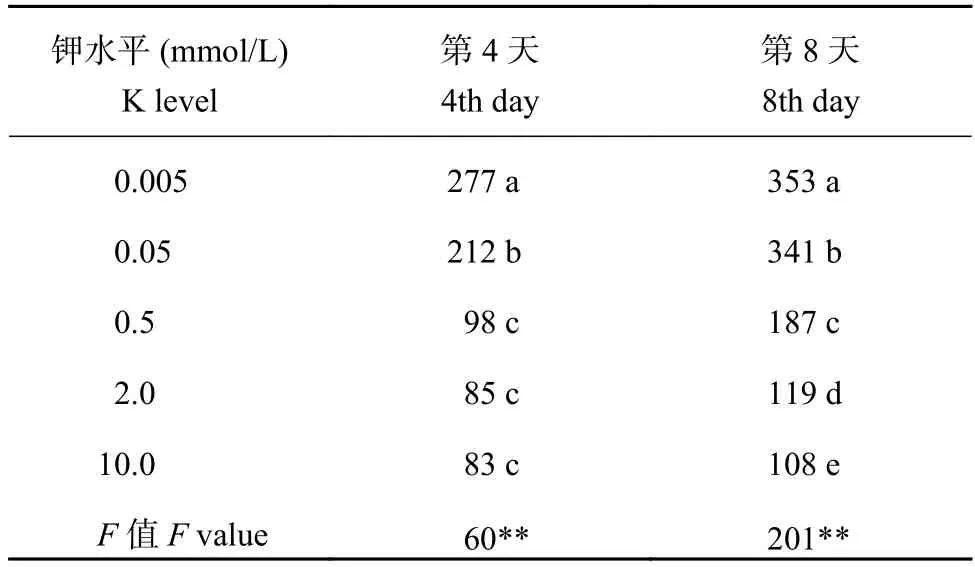
表1 處理 4 天、8 天后麥株蚜蟲數量 (No./g, DW)Table 1 Number of aphids in wheat under different K treatments on the 4th and 8th day after the infestation
2 結果與分析
2.1 不同供鉀水平對麥株蚜蟲數量的影響
隨著時間的推移,各施鉀水平蚜蟲數量均呈增加趨勢;隨著鉀水平的提高,麥株上蚜蟲數量整體呈降低趨勢(表1)。接蟲后第4天,蚜蟲數量在K 0.005~0.5mmol/L范圍內顯著下降,繼續提高鉀水平蚜蟲數量無顯著變化;接蟲后第8天,蚜蟲數量在K0.005~10mmol/L范圍內顯著下降。由此可以看出,隨著蚜蟲侵染時間的延長,降低蚜蟲數量所需的供鉀水平隨之增加。
2.2 鉀水平和蚜蟲取食對小麥葉片游離氨基酸含量的影響
在兩個時間節點上,鉀水平和接蟲水平對小麥游離氨基酸影響的主效應及其交互效應均達顯著水平(表2)。同一接蟲水平下,葉片游離氨基酸含量均隨著鉀水平的提高呈先降低后趨于穩定的趨勢,其轉折點在K0.5水平。鉀水平相同時,與不接蟲處理相比,接蟲植株葉片游離氨基酸含量均呈增加趨勢,但接蟲植株與不接蟲植株兩者差值隨鉀水平的增加而縮小,其中在接蟲后第4天K0.005、0.05 mmol/L水平下,接蟲與不接蟲植株葉片游離氨基酸含量差異達顯著水平;而在接蟲后第8天,各供鉀水平下接蟲與不接蟲植株葉片游離氨基酸含量差異均達顯著水平。兩個時間點相比,隨時間推移,不接蟲處理植株游離氨基酸的增加幅度較小,為–4.8%~10.8%,平均增幅為2.6%;而接蟲處理不同鉀水平下植株游離氨基酸含量增加幅度較大,為40.2%~100.0%,平均增幅為67.3%。
2.3 鉀對蚜蟲取食過程中小麥葉片可溶性蛋白質含量的影響
在兩個時間節點上,鉀水平對小麥可溶性蛋白質含量的影響的主效應達顯著水平,接蟲水平對小麥可溶性蛋白質影響的主效應未達顯著水平,但鉀水平和接蟲水平對小麥可溶性蛋白質影響的交互效應達顯著水平(表3)。接蟲水平相同時,葉片可溶性蛋白質含量均隨著鉀水平的提高呈先增加后減少的趨勢,其中在K2水平下葉片可溶性蛋白質含量達最高。同一鉀水平下,與不接蟲處理相比,接蟲后植株葉片可溶性蛋白含量均呈增加趨勢,但接蟲植株與不接蟲植株葉片可溶性蛋白含量的差值隨鉀水平的提高而縮小,在接蟲后第4天K0.005mmol/L水平下、在第8天K0.005和0.05mmol/L水平下,接蟲與不接蟲植株葉片可溶性蛋白含量差異均達顯著水平。兩個時間點下相同處理間葉片可溶性蛋白質含量均隨時間推移呈增加趨勢。其中,不接蟲處理間植株可溶性蛋白含量增加7.6%~31.3%,平均增幅為18.1%;接蟲處理間植株可溶性蛋白含量增加9.7%~33.7%,平均增幅為20.7%。
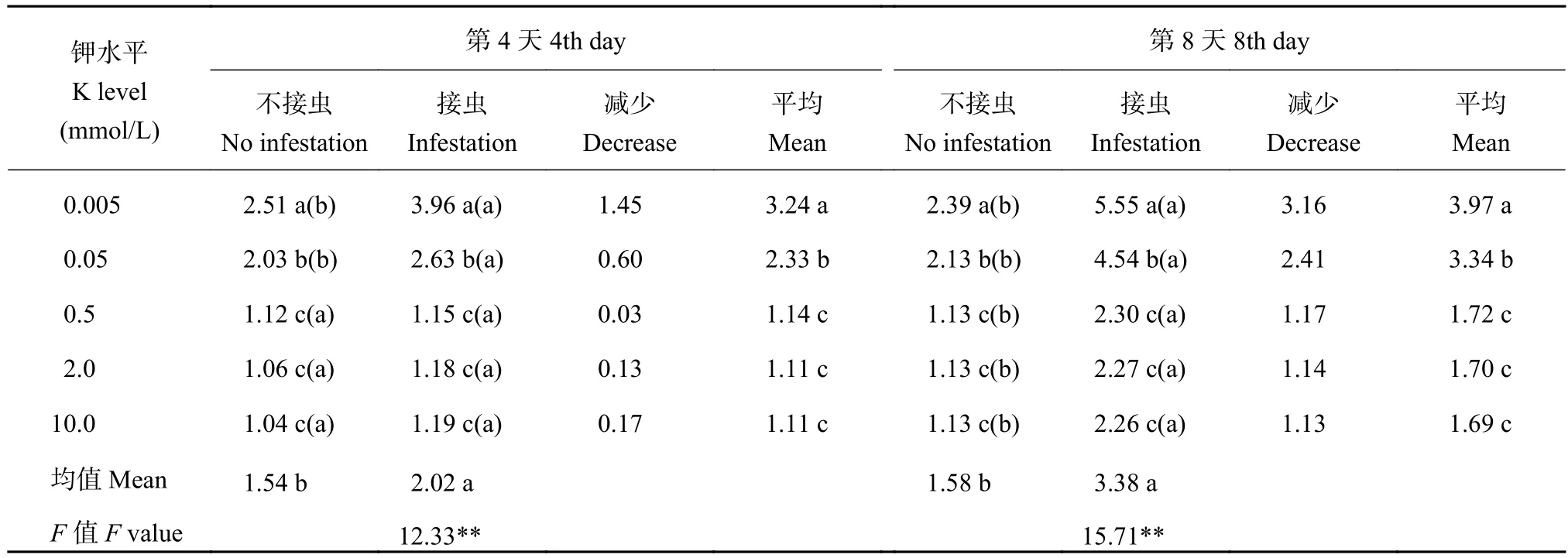
表2 接蟲后第 4 天和第 8 天不同鉀水平處理小麥游離氨基酸含量 (mg/g)Table 2 Free amino acids content of wheat after the aphids infestation under different K levels on the 4th and the 8th day
2.4 鉀水平和蚜蟲取食對小麥葉片可溶性總糖含量的影響
在兩個時間節點上,鉀水平和接蟲水平對小麥可溶性總糖含量的影響的主效應及其交互效應均達顯著水平(表4)。不接蟲時,小麥葉片可溶性總糖含量均隨著鉀水平的提高呈先增加后趨于穩定的變化規律,其轉折點為K0.05mmol/L,進一步提高鉀水平可溶性糖含量變化不顯著。接蟲時,在第4天小麥葉片可溶性總糖含量隨著鉀水平的變化規律與不接蟲相同,但轉折點鉀水平提高到K0.5mmol/L。在第8天小麥葉片可溶性總糖含量隨著鉀水平的提高而升高。供鉀水平相同時,與不接蟲相比,接蟲后小麥葉片可溶性總糖增加量隨鉀水平增加而提高,其中在第4天的K2和10mmol/L水平下,在第8天的各供鉀水平下,可溶性總糖的增加量均達顯著水平。兩個時間點相比,不接蟲處理葉片可溶性總糖含量隨時間推移增加較少,增加幅度為–3.7%~4.4%,平均增幅為2.0%;接蟲處理葉片可溶性總糖含量隨時間推移增加較多,增加幅度為17.8%~29.9%,平均增幅為22.9%。
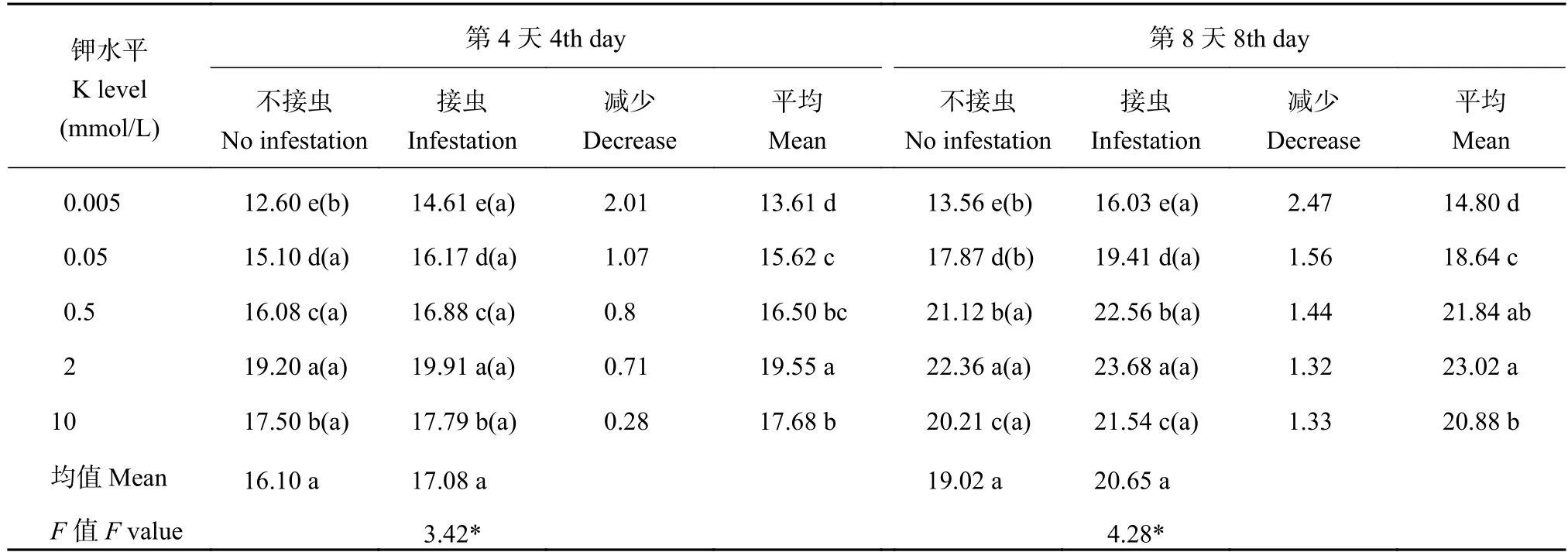
表3 接蟲后第 4 天和第 8 天不同鉀水平處理小麥可溶性蛋白質含量 (mg/g)Table 3 Effect of K levels on total soluble protein content of wheat under different K treatment levels on the 4th and the 8th day after the aphids infestation

表4 接蟲第 4 天和第 8 天不同鉀水平處理小麥可溶性總糖含量 (mg/g)Table 4 Total soluble sugar content of wheat affected by the K treatment levels on the 4th and the 8th day after the aphids infestation
2.5 不同生化指標與蚜蟲密度的相關性分析
表5表明,在接蟲后第4天和第8天,隨著鉀水平的增加,小麥蚜蟲密度與不接蟲小麥葉片游離氨基酸含量呈極顯著正相關關系,與可溶性蛋白和可溶性糖含量相關性不顯著;與蚜蟲取食誘導的游離氨基酸積累量、可溶性蛋白積累量呈顯著的負相關關系,而與蚜蟲取食誘導的可溶性糖的增加量呈顯著的正相關關系。
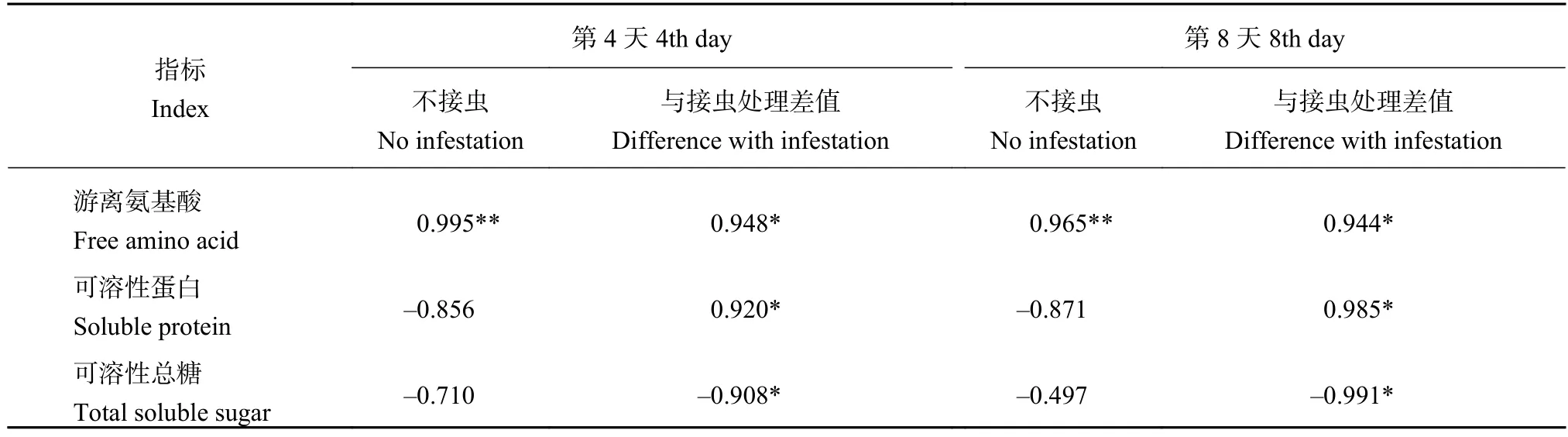
表5 接蟲后第 4 天和第 8 天各測定指標與蚜蟲密度的相關性分析Table 5 Correlation analysis of the measured items and aphid population density on the 4th and 8th day after the aphids infestation
3 討論和結論
植物的抗性,既涉及到植物本身的組成抗性,也包括遭受植食性昆蟲進攻后所表現出來的誘導抗性[20]。植物的抗蟲性外在表現為昆蟲種群降低和為害減少,其內在機理既與植物基礎代謝相關,也與其次生代謝有關。本研究涉及的施鉀可以增強小麥抗蚜水平的可能的生理機制,就是從植物基礎代謝的角度開展的研究。
本試驗結果表明,在接蟲后8天內,兩個時間節點小麥植株單位干重的蚜蟲群體密度均受供鉀水平的影響,且在一定供鉀濃度范圍內隨供鉀水平的提高呈降低趨勢,這與前人在大豆、甘藍等作物上發現的土壤或葉片鉀含量較低時植株蚜蟲群體密度、蚜蟲凈增值率和內稟增長率繁殖率較高的研究結果相一致[9–11,14]。進一步證明提高供鉀水平可降低蚜蟲密度,同時研究也發現,隨著時間的推移,有效降低蚜蟲密度所需要的鉀水平增加。
前人關于供鉀水平對植株游離氨基酸、可溶性蛋白和可溶性糖含量的影響已進行過較多研究。多數研究結果均表明缺鉀增加植株游離氨基酸水平,這在大豆、棉花、甘藍等作物上均得到證明[11,14-15],本研究結果與前人結論基本一致,且進一步發現,供鉀水平在0.5mmol/L以下植株游離氨基酸含量顯著降低,而鉀水平高于0.5mmol/L,進一步增加供鉀水平植株游離氨基酸含量變化較小。前人關于供鉀水平對植株可溶性蛋白質、可溶性糖含量的影響的研究結果不盡一致,有的結果甚至相反。如閆洪奎等[16]和Mengel等[21]發現低鉀脅迫使植物可溶性蛋白含量降低,而Rashid等[22]則發現,增施鉀肥可以使水稻組織內可溶性蛋白含量降低。而本研究發現,供鉀水平過低和過高對小麥可溶性蛋白質含量均有不利影響。Marschner等[23]認為,供鉀不足會引起植物體內可溶性糖含量的升高,Rashid等[22]的研究也表明,提高水稻組織中的含鉀量會降低可溶性糖含量。但是,柳洪鵑等[24]研究表明,鉀肥可以促進植物組織中淀粉水解,從而提高組織可溶性糖含量。本研究結果表明,小麥可溶性蛋白隨供鉀水平的增加呈先上升后降低的趨勢;在鉀水平低至0.005mmol/L時,小麥可溶性糖含量雖顯著降低,但在該水平以上,進一步提高鉀水平,可溶性糖含量變化不顯著。與前人研究不盡一致。筆者認為,植株可溶性蛋白和可溶性糖含量對鉀水平的響應可能受作物類型和品種、外部環境條件等多種因素的影響,而本試驗條件與其它研究可能有所差異。
相關分析表明,未接蟲時,僅植株游離氨基酸的含量與相應時間節點蚜蟲密度呈顯著的正相關關系,而可溶性蛋白質和可溶性糖的含量與相應時間節點蚜蟲密度均未達到顯著水平,似乎說明植株中后兩種物質積累的多少不是限制蚜蟲生長的主要因子。但這一結果似乎難以解釋前人的研究,人們發現,抗蚜品種西瓜幼苗的可溶性蛋白含量明顯低于感蚜材料[25];小麥抗蚜性與可溶性蛋白含量呈負相關[26]。棉株體內可溶性糖含量與其抗蚜性呈正相關[27];冬小麥體內平均可溶性糖含量越高,麥蚜密度或生殖力越低[26]。朱永峰等[28]對燕麥的研究發現,高抗蚜品種受到蚜蟲危害后體內可溶性糖含量的增加顯著高于感蚜品種。Karley等[29]和Pompon等[30]研究認為,植物韌皮部可溶性糖濃度足夠高時會導致蚜蟲的取食液和血淋巴滲透勢升高,從而引起蚜蟲脫水和死亡。蔗糖的濃度顯著影響蚜蟲的進食,當蔗糖的濃度超過20%以后,蚜蟲的進食嚴重減弱[31]。
筆者分析發現,供鉀水平和蚜蟲取食對植株游離氨基酸、可溶性蛋白質含量和可溶性糖含量影響的交互效應亦達顯著水平,也就是說,寄主植物中受蚜蟲取食所誘導的上述物質積累因供鉀水平不同而異。其中隨著供鉀水平的增加,蚜蟲取食誘導的游離氨基酸和可溶性蛋白含量顯著降低,而蚜蟲取食誘導的可溶性糖含量顯著增加。相關分析表明,隨著鉀水平的提高,寄主蚜蟲取食誘導的氨基酸、可溶性蛋白質的增加量與蚜蟲密度呈顯著的正相關關系,而可溶性糖的增加量與蚜蟲密度呈顯著的負相關關系。該結果與前人研究所得的氨基酸、可溶性蛋白以及可溶性糖與蚜蟲密度的關系基本吻合,所以我們推測,供鉀水平對蚜蟲密度的影響一方面是降低了植株體內組成型和誘導型游離氨基酸的含量,另一方面降低了誘導型可溶性蛋白含量和增加了誘導型可溶性糖的含量,共同降低麥長管蚜密度。
關于施鉀增強植株抗蟲性的機理,前人從鉀對植物基礎代謝的影響角度雖進行過闡述,例如Van Emden提出,施鉀降低甘藍蚜蟲繁殖力機理與降低了植株游離氨基酸含量有關[15];Walter等[11]提出,施鉀降低大豆蚜蟲發生與降低了植株韌皮部中的天冬氨酸含量有關,但上述研究主要基于施鉀對未感蟲植株的生理代謝的影響進行分析,因而未涉及施鉀對蟲害誘導植物抗蚜性的影響。而本研究通過對不同鉀水平下小麥植株分別進行不接蟲和接蟲處理,在探討供鉀水平和蚜蟲取食對麥株游離氨基酸、可溶性蛋白質和可溶性糖影響的主效及其交互效應基礎上,分析了供鉀水平對蚜蟲取食過程中麥株上述物質變化的影響及其與蚜蟲密度的關系,既探討了施鉀對植株組成型抗性的影響,也探討了施鉀對蚜蟲取食誘導抗性的影響,更為深入地闡述供鉀水平—植株基礎代謝—蚜蟲發生的關系。
目前認為,蟲害的早期信號傳到細胞內后,植物將通過三種主要的激素茉莉酸(JA)、水楊酸(SA)、乙烯(ET)等信號物質介導的信號通路,啟動一系列防御反應[32]。因此需要進一步深入分析鉀水平對上述過程的調控機理,以揭示施鉀如何通過影響植物基礎代謝而影響植物的防御反應。另外,本試驗是在室內水培條件下嚴格控制蚜蟲遷移的前提下開展的,且只應用了一個小麥品種,因此,該試驗僅反映了無翅蚜蟲在不同鉀水平的矮抗58小麥幼苗上的生長發育與植株體內碳氮代謝相關物質含量的關系,其結果有待在更多的品種、土壤培育小麥和田間進一步驗證。
總之,從植物基礎代謝角度分析,提高鉀水平可能通過降低小麥組成型游離氨基酸的含量,降低蚜蟲取食誘導型游離氨基酸和可溶性蛋白積累,提高誘導型可溶性糖的積累,共同降低小麥苗期麥長管蚜密度。
[1]胡想順,趙惠燕.我國小麥抗蚜機理研究進展[J].應用昆蟲學報, 2014,51(6):1459–1469. Hu XS,Zhao HY.The reviews of wheat resistant mechanism to cereal aphid in China[J].Chinese Journal of Applied Entomology, 2014,51(6):1459–1469.
[2]王美芳,原國輝,陳巨蓮,等.麥蚜發生危害特點及小麥抗蚜性鑒定的研究[J].河南農業科學,2006,(7):58–60. Wang MF,Yuan GH,Chen JL,et al.Research advances of occurrence pattern,damage characteristics of wheat aphid and resistance identification of wheat[J].Journal of Henan Agricural sciences,2006(7):58–60.
[3]Dogimont C,Bendahmane A,Chovelon V,et al.Host plant resistance to aphids in cultivated crops:Genetic and molecular bases, and interactions with aphid populations[J].Comptes Rendus Biologies,2010,333:566–573.
[4]Altieri MA,Nicholls CI.Soil fertility management and insect pests: harmonizing soil and plant health in agroecosystems[J].Soil& Tillage Research,2003,72:203–211.
[5]龐淑婷,董元華.土壤施肥與植食性害蟲發生為害的關系[J].土壤, 2012,44(5):719–726. Pang ST,Dong YH.Effects of soil fertilization on herbivores infestation[J].Soils,2012,44(5):719–726.
[6]Waring GL,Cobb NS.The impact of plant stress on herbivore population dynamics[J].Insect-plant Interactions,1992,4:167–226.
[7]Perrenoud S.Potassium and plant health[M].Bern,Switzerland: International Potash Institute,1990.
[8]Havlickova H,Smetankova M.Effect of potassium and magnesium fertilization on barley preference by the bird cherry-oat aphid (Rhopalosiphum padi)[J].Rostlinna Vyroba,1998,44(8):379–383.
[9]Myers SW,Gratton C,Wolkowski RP,et al.Effect of soil potassium availability on soybean aphid(Hemiptera: Aphididae) population dynamics and soybean yield[J].Journal of Economic Entomology,2005,98(1):113–120.
[10]Myers SW,Gratton C.Influence of potassium fertility on soybean aphid,aphis glycines matsumura(Hemiptera: Aphididae),population dynamics at afield and regional scale[J].Physiological Ecology, 2006,35(2):219–227.
[11]Walter AJ,Difonzo CD.Soil potassium deficiency affects soybean phloem nitrogen and soybean aphid populations[J].Physiological Ecology,2007,36(1):26–33.
[12]Zhou SQ,Lou YR,Tzin V,Jander G.Alteration of plant primary metabolism in response to insect herbivory[J].Plant Physiology, 2015,169:1488–1498.
[13]閆洪奎,劉祥,王會廣,等.低鉀脅迫下耐低鉀玉米可溶性蛋白、可溶性糖和鉀含量的變化及其關系[J].玉米科學,2012,20(6):81–84.Yan HK,Liu X,Wang HG,et al.Changes and relation of soluble protein,soluble sugar and potassium in low-potassium tolerant maize under low-potassium condition[J].Journal of Maize Sciences,2012, 20(6):81–84.
[14]李田田,姜文芝,谷停停,等.黃瓜葉片營養物質與抗蚜性的關系研究[J].山東農業科學,2016,48(10):44–47. Li TT,Jiang WZ,Gu TT,et al.Relationship between aphid resistance and leaf nutrient content of cucumber[J].Shandong Agricultural Sciences,2016,48(10):44–47.
[15]Van Emden HF.Studies on the relations of insect and host plant.III. A comparison of the reproudution of Brevicoryne Brassicae and Myzus Presicae(Hemiptera Aphididae)on brussels sprout plants supplied with different rates of nitrogen and potassium[J]. Entomologia Experimentalis et Applicata,1966,9(4):444–460.
[16]Hu W,Zhao WQ,Yang JS,et al.Relationship between potassium fertilization and nitrogen metabolism in the leaf subtending the cotton (Gossypium hirsutum L.)boll during the boll development stage[J]. Plant Physiology and Biochemistry,2016,101:113–123.
[17]Dorschner KW,Ryan JD,Johnson RC.Modification of host nitrogen levels by the greenbug(Homoptera:Aphididae):its role in resistance of winter wheat to aphids[J].Environmental Entomology, 1987,16(4):1007–1011.
[18]Sandstr?m J,Telang A,Moran NA.Nutritional enhancement of host plants by aphids—A comparison of three aphid species on grasses[J]. Journal of Insect Physiology,2000,46(1):33–40.
[19]Koyama Y,Yao I,Akimoto SI.Aphid galls accumulate high concentrations of amino acids:a support for the nutrition hypothesis for gall formation[J].Entomologia Experimentalis et Applicata,2004, 113(1):35–44.
[20]婁永根,程家安.植物的誘導抗蟲性[J].昆蟲學報,1997,40(3): 320–330. Lou YG,Cheng JA.Induced plant resistance to phytophagous insects[J].Acta Entomologica Sinica,1997,40(3):320–330.
[21]Mengal K,Kirkby EA,Appel T,et al.Principles of plant nutrition(5th edition)[M].The Netherlands:Dordrecht,2001.
[22]Rashid MM,Jahan M,Islam KS.Impact of nitrogen,phosphorus and potassium on Brown[J].Rice Science,2016,23(3):119–131.
[23]Marschner H.Mineral nutrition of higher plants(2nd edition)[M]. New York:Academic Press,1995.
[24]柳洪鵑,史春余,張立明,等.鉀素對食用型甘薯糖代謝相關酶活性的影響[J].植物營養與肥料學報,2012,18(3):724–732. Liu HJ,Shi CY,Zhang LM,et al.Effect of potassium on related enzyme activities in sugar metabolism of edible sweet potato[J].Plant Nutrition and Fertilizer Science,2012,18(3):724–732.
[25]吳梅梅,楊麗榮,張顯.蚜蟲侵染對西瓜幼苗生理生化指標的影響[J].果樹學報,2015,32(5):943–949. Wu MM,Yang LR,Zhang X.Effect of aphid invasion on physiological and biochemical indexes in watermelon seedling stage[J].Journal of Fruit Science,2015,32(5):943–949.
[26]王祎,張月玲,蘇建偉,等.氮硅配施對冬小麥生育后期蚜蟲密度及抗蟲生化物質含量的影響[J].植物營養與肥料學報,2013,19(4): 832–839. Wang Y,Zhang YL,Su JW,et al.Effect of nitrogen application combined with silicon on density of Sitobion avenae and contents of biochemical materials of winter wheat at the late growth stage[J]. Journal of Plant Nutrition and Fertilizer,2013,19(4):832–839.
[27]劉旭明,楊奇華.棉花抗蚜的生理生化機制及其與棉蚜種群數量消長關系的研究[J].植物保護學報,1993,20(1):25–29. Liu XM,Yang QH.Physiological and biochemical mechanism of cotton aphid resistance and its relationship with the growth and decline of the cotton aphid populations[J].Acta Phytophylacica Sinica,1993,20(1):25–29.
[28]朱永峰,陳明,劉長仲.蚜蟲為害對五個燕麥品種苗期體內幾種物質的影響[J].植物保護,2011,37(2):55–58,66. Zhu YF,Chen M,Liu CZ.Variations of several substances in the seedlings of five oat varieties infested by aphids[J].Plant Protection, 2011,37(2):55–58,66.
[29]Karley AJ,Ashford DA,Minto LM.The significance of gut sucrase activity for osmoregulation in the pea aphid,Acyrthosiphon pisum[J]. Journal of Insect Physiology,2005,51(12):1313–1319.
[30]Pompon J,Quiring D,Joyer C.A phloem-sap feeder mixes phloem and xylem sap to regulate osmotic potential[J].Journal of Insect Physiology,2011,57(9):1317–1322.
[31]Mittler TE.Effect of amino acid and sugar concentrations on the food uptake of the aphid Myzus persicae[J].Entomologia Experimentalis et Applicata,1967,10(1):39–51.
[32]Gao LL,Jonathan PA,Klingler JP,et al.Involvement of the octadecanoid pathway in bluegreen aphid resistance in Medicago truncatula[J].Molecular Plant-microbe Interactions,2007,20(1): 82–93.
Physiological mechanism of potassium application in decreasing density of aphid (Sitobion avenae F.) in wheat
FU Yan-lei1,WANG Yi1,2,WANG Yi-lun1,2,JIANG Ying1,LI Pei-pei1,YAN Feng-ming2,3,TAN Jin-fang1,2,HAN Yan-lai1,2*
(1 College of Resource and Environment, Henan Agricultural University, Zhengzhou 450002, China; 2 Collaborative Innovation Center of Food Crops in Henan, Zhengzhou 450002, China; 3 College of Plant Protection, Henan Agricultural University, Zhengzhou 450002, China)
【Objectives】Based on the view of plant basic metabolism,the experiment revealed the mechanism of reducing aphid(Sitobion avenae F.)population density of wheat by applying potassium,and provided scientific basis for ecological regulation of wheat aphids in the field.【Methods】A solution culture method and fully balancing design with five potassium levels(0.005,0.05,0.5,2and10mmol/L KCl,respectively)and two aphidinfection levels(aphid infection and not infection)were used in this experiment,and three repetitions were arranged for each treatment.When the wheat seedlings had5expanded leaves,5adult wingless aphids in the same size and age were set on the latest fully expanded leaves per wheat plant.Then the density of aphids were surveyed and the wheat samples were collected respectively at the fourth and eighth days after the aphid infection to study effects of potassium level and aphid feeding on free amino acids,soluble protein and the content of soluble sugar of wheat leaves.【Results】The results showed that at the fourth day after the infection of aphids and in the range of K0.005–0.5mmol/L,the aphid density of unit dry weight of wheat decreased significantly as potassium level increased,and if improving the potassium level further,the aphids population density did not increase significantly.At the eighth day after the aphid infection,the aphid population density decreased significantly with the increase of potassium levels in the arranged range.As potassium level increased,the free amino acid contents in the wheat plants uninfected by aphids showed adecreasing trend,while both soluble protein and soluble sugar contents showed increasing trends at first and then showed decreasing trends.In the wheat plants infected by aphids,the free amino acids and soluble protein contents showed the same changing trend as in the former,however,the soluble sugar content showed acontinuously increasing trend.Comparing the treatment infected by aphids with the treatment uninfected by aphids at the same time nodes,as potassium level increased,the free amino acids and soluble protein contents of wheat plant were decreased by aphid infection,while the soluble sugar contents were increased.By comparison of the involved indexes in the two time nodes,as the time prolongation,there were average increments of2.6%,18.1%,2.0%for free amino acid, soluble protein and soluble sugar contents respectively in the uninfected wheat,and of67.3%,20.9%and 22.9%for infected wheat respectively,which showed greater increase for free amino acids and soluble sugar content in infected wheat plants than in uninfected wheat plant.In addition,the contents of induced free amino acid,soluble protein and soluble sugar,had significant or extremely significant correlation with the aphid population density in relevant each time node,and the correlation coefficients were0.948,0.920and–0.908in the fourth day,and0.944,0.985and–0.991in the eighth day respectively.The contents of constitutive soluble protein and soluble sugar had no significant correlation with aphid density,but the content of constitutive free amino acid had extremely significant correlation with aphid density,and the correlation coefficients were0.995 and0.944respectively at the fourth and eighth days after the aphid infection.【Conclusions】Our results showed that increasing potassium supply could significantly reduce aphid population density by significantly reducing constitutive free amino acid content,inhibiting the accumulation of free amino acids and soluble protein and promoting the induced soluble sugar content.
winter wheat;potassium;Sitobion avenae;aphids feeding;free amino acid;soluble protein; soluble sugar
2016–11–28接受日期:2017–04–04
省部共建小麥玉米國家重點實驗室課題(39990037);國家“十二五”科技支撐計劃(2013BAD07B07-2);鄭州市科技創新團隊項目(131PCXTD610)共同資助。
付延磊(1989—),男,河南南陽人,碩士研究生,主要從事植物鉀素營養生理研究。E-mail:15837195361@163.com
*通信作者E-mail:hyanlai@126.com
猜你喜歡
美與時代·美術學刊(2022年3期)2022-04-27 01:18:15
火花(2019年12期)2019-12-26 01:00:28
人大建設(2019年6期)2019-10-08 08:55:48
人大建設(2019年12期)2019-05-21 02:55:32
雜文月刊(2018年21期)2019-01-05 05:55:28
人大建設(2017年6期)2017-09-26 11:50:44
學苑創造·A版(2015年11期)2016-01-14 09:03:27
俄羅斯問題研究(2012年1期)2012-03-25 09:54:45
中國火炬(2010年12期)2010-07-25 13:26:22
中國火炬(2010年8期)2010-07-25 11:34:30