通過血清、唾液可快速診斷肝炎中英聯合啟動研發獲得英國牛頓基金支持的重大項目
2017-07-31 16:27:33胡睿
重慶與世界 2017年6期
□ 文/本刊記者 胡睿
通過血清、唾液可快速診斷肝炎中英聯合啟動研發獲得英國牛頓基金支持的重大項目
□ 文/本刊記者 胡睿
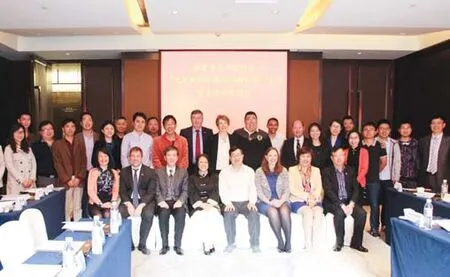
嘉賓合影,英國駐重慶總領事館總領事艾佩詩(前排左四)出席會議。
五方科研團隊聯合申請
4月12日,中英聯合研發項目“一種肝炎診斷檢測集成試劑盒的聯合研發與產業化”國家重點研發計劃重點專項在重慶大學啟動。出席會議的有英國駐重慶總領事館總領事艾佩詩女士,英國Biovici公司、英國斯旺西大學Owen Guy教授團隊、英國國家物理實驗室Olga Kazakova教授團隊,重慶大學副校長王時龍教授、重慶大學科技處副處長劉敢新教授、重慶大學光電工程學院常務副院長郭永彩教授等相關領導,以及重慶大學劉玉菲教授團隊和常州碳維納米科技有限公司等項目科研團隊。作為國家重點研發計劃“政府間國際科技創新合作”重點專項—中英研究與創新橋計劃首個啟動項目,該項目還得到英國牛頓基金支持。項目總投資約為1600萬元人民幣(約186萬英鎊)。
據了解,這個由青年千人計劃專家、重慶大學劉玉菲教授團隊、英國Biovici公司、英國斯旺西大學Owen Guy教授團隊、英國國家物理實驗室Olga Kazakova教授團隊和常州碳維納米科技有限公司等5方組成的科研團隊聯合申請的項目,將開發用于肝炎診斷的新型即時診斷設備,為監控血清、唾液肝炎標志物開發一種具商業用途的快速傳感器,并探索其商業化,為病患提供幫助。該項目為中英研究與創新橋計劃中英聯合資助的15個項目之一。
通過血清、唾液可快速診斷肝炎
在啟動會上,重慶大學光電工程學院教授、該項目高校技術負責人劉玉菲教授介紹:“全球有近20億人感染了病毒性肝炎,其中25%遭受慢性或長期感染,每年有100萬人死于肝硬化和肝癌。以我國為例,大約有1.3億人感染乙型肝炎,4000萬人感染丙型肝炎,病患死亡率高達40%。”他提出,如果能實現早期診斷,就能有效提升患者的診療效果,預防肝炎傳染。
據介紹,五方聯合開發的肝炎診斷檢測集成試劑盒,其技術核心是在一種微流控芯片與特異性檢測上。“根據我們的初步設計,微流控芯片上劃分有甲肝、乙肝、丙肝3個檢測區,每個檢測區有多個檢測單元。”劉玉菲舉例說,比如在乙肝檢測區,如果3個檢測單元都呈陽性或陰性,這是很好得出診斷結果的,如果呈現一個或兩個陽性,那經過進一步數據分析,再得出診斷結果。這也避免了假陽性或陰性的情況,讓肝炎診斷更加精準。微流控芯片上有幾十甚至上百個微流控通道,集成了許多石墨烯傳感器,當血液或唾液樣本進入微流控芯片后,在運輸、混合、篩選之后,石墨烯傳感器就能快速找到血清或唾液肝炎標志物,分析診斷出樣本是否受到肝炎感染。
科研產品預計2019年面市
簡單來說,只需要檢測患者的一滴血清或唾液,便能使用這項科研產品在幾分鐘的時間內快速診斷出是否感染肝炎,“該類產品的年市場需求超過4.25億英鎊,研發的產品預計2019年推向市場。”劉玉菲表示。
此次合作的五方將分別負責石墨烯材料制備、材料表征與測試、傳感器加工與集成、石墨烯表面修飾、檢測電路與分裝,并準備在華設立合資公司,共同推動石墨烯材料及試劑盒產品的全球銷售。另外,在項目啟動會上,重慶大學、英國斯旺西大學、英國國家物理實驗室聯合設立的“智能感知技術協同創新中心”也正式揭牌,未來,三方將在人工智能、智能傳感、腦科學與神經科學等領域展開全方位的合作與探索。
(圖片由重慶大學光電工程學院教授劉玉菲提供)
On April 12, a key project of national key R&D plan—“Joint R&D and industrialization of an integrated kit for hepatitis diagnosis and detection”—which is operated by China and UK, was launched in Chongqing University. Participants included Ms. Cecille El Beleidi,Consul General of British Consulate-General in Chongqing, Biovici Company in British, Professor Owen Guy and his teams from Swansea University, Professor Olga Kazakova and his teams from National Physics Laboratory, Professor Wang Shilong,vice-principal of Chongqing University, Professor Liu Ganxin,deputy director general of department of science and technology,Chongqing University, Professor Liu Yufei and his teams from Chongqing University and Changzhou Tanwei Nanometer Science and Technology Co., Ltd. As a major project of national key R&D plan in the “Intergovernmental cooperation in international scienti fi c and technological innovation”, the fi rst startup project of China-UK Research and Innovation Bridge Program, this project also has gained the support of British Newton Fund. The total investment of the project is about ¥16 million RMB (£1.86 million).
It is understood that this project was jointly applied by fi ve research groups: Professor Liu Yufei, expert of the Recruitment Program of Global Experts, and his teams; Biovici Company; Professor Owen Guy and his teams from Swansea University; Professor Olga Kazakova and his teams from National Physics Laboratory;Chongqing University and Changzhou Tanwei Nanometer Science and Technology Co., Ltd. This research group will develop a new diagnostic device for hepatitis diagnosis and develop a fast sensor for commercial use to monitor serum, saliva and hepatitis markers. After putting this sensor into market, patients can bene fi t from it. This project also represents one of the fifteen projects jointly supported by China and UK in the China-UK Research and Innovation Bridge Program.
Professor Liu Yuqing: Hepatitis can be quickly diagnosed by serum and saliva
As the university technical leader and the professor of school of optical engineering in Chongqing University, Liu Yufei made an introduction on the launching ceremony. He said nearly 2 billion people worldwide are infected with viral hepatitis, among which 25% infected person are subjected to chronic infection. Every year, one million people die from cirrhosis and liver cancer. Taking China as an example, about 130 million people are infected with hepatitis B, 40 million are infected with hepatitis C, and the death rate is as high as 40%. Liu also provided that the diagnosis and treatment effect of infected person can be effectively improved by the realization of early diagnosis to prevent hepatitis infection.
According to the presentation, the technical core of this integrated kit for the purpose of hepatitis diagnosis developed jointly by fi ve parties lies on micro fl uidic chip and its speci fi c detection. According to our preliminary design, there are 3 detection areas of hepatitis A, hepatitis B and hepatitis C on the microfluidic chip and each detection area has a plurality of detection units, explained by Liu. For example, in the area of hepatitis C, if the 3 test units are positive or negative, this will be easy for the diagnosis; if one or two are positive, further data analysis should be done to obtain the diagnosis. It also avoids false positives or negative cases,making hepatitis diagnosis more accurate. Microfluidic chips are equipped with dozens of, or even hundreds of microfluidic channels, integrated with many graphene sensors. When the blood or saliva samples come into the microfluidic chip, after mixing,transportation, filtering, graphene sensors will be able to quickly fi nd the saliva or serum markers of hepatitis to analyze whether the sample is infected with hepatitis or not.
Research products are expected to be available in 2019
In simple terms, with only one drop of serum or saliva from the patient, the research product can be used to quickly diagnose hepatitis infection in a few minutes. The market demand of this kind of products exceeds 425 million pounds, and the products are expected to be put into the market in 2019, said by Professor Liu.Five parties in this cooperation are responsible for the preparation of graphene material, material characterization and testing, sensor processing and integration, the surface modi fi cation of graphene,and detection circuit and packaging respectively. They also prepared to set up joint venture in China to jointly promote the global sales of graphene materials and reagent kits. In addition,“Collaborative Innovation Center of Intelligent Sensing Technology”jointly established by Chongqing University, Swansea University,National Physics Laboratory also was of fi cially inaugurated. In the future, those three parties will carry out all-round cooperation and exploration in the areas of arti fi cial intelligence, intelligent sensing,brain science and neuroscience.
A Major Project Supported by British Newton Fund Was Launched by Both China and UK in Chongqing:Hepatitis can be quickly diagnosed by serum and saliva
□ Article / journalist Hu Rui
猜你喜歡
中學生數理化·七年級數學人教版(2021年6期)2021-11-22 07:50:58
中學生數理化·七年級數學人教版(2021年6期)2021-11-22 07:50:58
中學生數理化·七年級數學人教版(2021年6期)2021-11-22 07:50:58
中老年保健(2021年3期)2021-08-22 06:50:04
瘋狂英語·初中天地(2021年6期)2021-08-06 09:03:24
天津醫科大學學報(2021年2期)2021-03-29 05:31:08
現代臨床醫學(2021年1期)2021-01-26 00:56:02
中國外匯(2019年21期)2019-05-21 03:04:06
少年漫畫(藝術創想)(2018年12期)2018-04-04 05:29:10
海峽科技與產業(2016年3期)2016-05-17 04:32:12