
Closed-form interference alignment with heterogeneous degrees of freedom①
2017-06-27 08:09:23YangXiumei楊秀梅WangJiangWangRuiZhouTing
High Technology Letters 2017年2期
Yang Xiumei (楊秀梅), Wang Jiang, Wang Rui, Zhou Ting
(*Key Laboratory of Wireless Sensor Network & Communication, Shanghai Institute of Microsystem and Information Technology, Chinese Academy of Sciences, Shanghai 200050, P.R.China) (**Shanghai Research Center for Wireless Communications, Shanghai 201210, P.R.China)
Closed-form interference alignment with heterogeneous degrees of freedom①
Yang Xiumei (楊秀梅)②***, Wang Jiang***, Wang Rui**, Zhou Ting***
(*Key Laboratory of Wireless Sensor Network & Communication, Shanghai Institute of Microsystem and Information Technology, Chinese Academy of Sciences, Shanghai 200050, P.R.China) (**Shanghai Research Center for Wireless Communications, Shanghai 201210, P.R.China)
Interference alignment (IA) has been recognized as a promising technique for obtaining the optimal degrees of freedom (DOF) in interference networks. A closed-form interference alignment design is proposed for three-cell uplink transmissions with heterogeneous DOFs. By exploiting the heterogeneity of DOFs from different transmission links, full or partial interference alignment precoders are calculated at each base station (BS). Aided by information exchange among BSs, the precoders can be finally obtained for all transmission links. Comparing to existing IA methods, the proposed scheme has a closed-form expression. Furthermore, there is no need to go through the iterative adaptation or jointly calculate the precoder and the equalizer. Simulation results show that the proposed design is able to achieve the optimal DOF performance with the advantage of perfect alignment capabilities.
interference alignment (IA), heterogeneous DOFs, precoder design
0 Introduction
Interference alignment (IA) has been developed as a promising technique for interference management in wireless networks. By aligning interference signals from different links into a subspace with reduced dimensions, the dimensions of the subspace for the desired signals can be enlarged so as to further improve network capacity[1]. Since IA is able to achieve new breakthroughs on the optimal DOF, a great deal of research activities have been inspired to investigate various aspects of IA from theoretical analysis to practical design[2,3].
Among various design approaches, heterogeneity of network topologies has been utilized to obtain precoders for the wireless transmissions. In Ref.[4], a hierarchical interference alignment scheme was proposed for heterogeneous networks by exploiting different numbers of transmit antennas of picocells and macrocells. In Ref.[5], characteristics of the partial connectivity for downlink multiple-input multiple output (MIMO) heterogeneous networks were investigated. The work in Ref.[6] used the heterogeneous path loss and spatial correlations to design the interference alignment precoders in MIMO interference networks. To further reduce the signaling overhead, work in Ref.[7] proposed a cognitive radio (CR) based interference alignment scheme by treating the macrocell and small cells as the primary system and secondary systems, respectively. Besides the precoder design in interference networks, recently, research work focusing on network performance analysis with co-channel interference modeling and spatial spectrum analysis was presented under random cellular networks[8,9], which provide new insights for the analysis of interference networks.
Differing from the aforementioned work, the heterogeneity of DOFs among different transmission links is exploited to design the IA precoders. The channel propagation for different links can own much disparity, resulting in different ranks of channel matrices[10]. Even for a full rank channel, the transmitter might only support a smaller number of independent data streams in order to effectively avoid crosslink interference. It also differs in transmission rates when further considering the traffic dynamics of interfering users, where each transmission link will support a different number of independent data streams in practical scenarios[11]. From the perspective of interference network capacity, the number of independent data streams or multiplexing gain can be characterized by the degrees of freedom[1]. Therefore, the interference system also inherits heterogeneity property from the perspective of the DOF per link. This work, analyzes subspace relationships induced by the DOF’s heterogeneity to present a closed-form precoder design method for two different DOF cases, which fully utilizes the DOF’s heterogeneity either to reduce signaling overhead or achieve a higher sum rate. Unlike it often does with joint calculations between transmitter and receiver[4]or iterations[12,13], proposed precoders are obtained only by requiring calculations at each BS and limited information exchange among BSs.
The remainder of this paper is organized as follows. Section 1 introduces the system model for three-cell uplink transmission. Section 2 analyzes the relationship of the heterogeneous DOFs and highlights the closed-form IA precoder expressions. Section 3 provides the simulation results and analysis. And the final section concludes this work.
1 System model

(1)
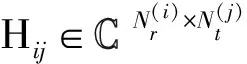
(2)
whereρistheaveragesignal-to-noiseratio(SNR)perlinkwithρ=1/σ2undertheabovenormalizedparameterconfigurations.γikisthepostsignal-to-noise-plus-interferenceratio(SINR)ofthekthdatastreamattheithreceiver.Therefore,thetotalDOFofthesystem,alsoknownasthecapacityper-logorthemultiplexinggain[1],is
d
(3)

2 IAPrecoderdesign
2.1 Heterogeneous DOFs
For heterogeneous DOFs among different transmission links, without loss of generality, it is assumed
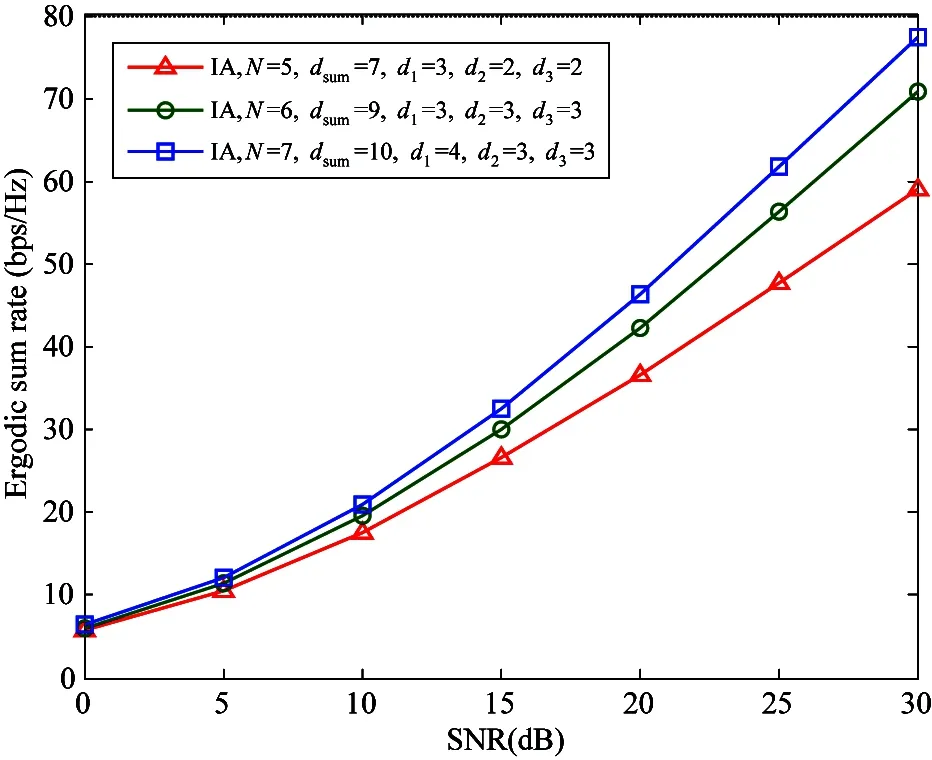
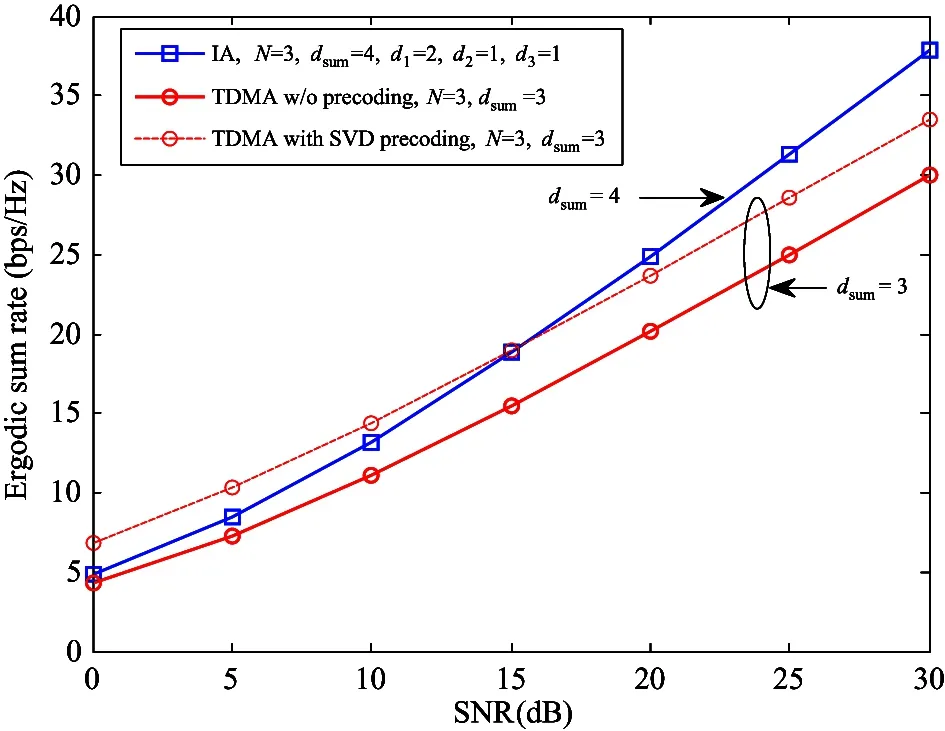
d3≤d2≤d1 (4) ThereafterthemaximalnumberofdimensionsavailableforinterferingsignalsofthreelinksareN-d1,N-d2andN-d3,respectively.Wheninterferencealignmentisintroducedintotheabovethree-linksystem,itisclaimedthattheDOFperlinkshouldfurthersatisfyconstraintinthefollowingproposition.Theproofisstraightforwardandprovidedsimplyinthefollowing. Proposition 1 The DOFs ofd1andd2inthethree-linkinterferencenetwork,undertheassumptionsofd3≤d2≤d1 d1+d2≤N (5) Proof With interference alignment, the number of dimensions occupied by the aligned interference signals should be no larger than the number of dimensions for the null pace of the desired signal at each receiver[1,14]. For instance, at receiver #1, there is max{d2,d3}≤(N-d1).Therefore,theDOFsetinathree-linktransmissionsystemshouldsatisfy (6) CombiningwithEq.(4),thefollowingis (7) Consideringd3≤d2,therelationshipofd1+d2≤Nbecomesamorestrictconstraintcomparedtod1+d3≤N. MotivatedbyProposition1,theachievablesumDOFsoftheaboveinterferencenetworkcanbeobtained.InTable1,severalparametersetsoftheachievableDOFsunderdifferentantennaconfigurationsareillustratedwhenequalmarkbeingguaranteedinEq.(5).TheDOFsetsarefurtherdividedintotwodifferentcases,withCaseB.1 satisfyingd2+d3≤d1andCaseB.2 satisfyingd2+d3>d1.Suchtwocaseswillresultindifferentclosed-formdesignproceduresaswellastherequirementsforthechannelstateinformation(CSI). Table 1 DOF parameters vs. antenna parameters 2.2 Proposed design In this subsection, a closed-form design of the IA precoders for the mentioned two different DOF cases is presented. CaseB.1d2+d3≤d1 IntheDOFregionof{d1,d2d3:d2+d3≤d1},partialorfullprecodersforallthreetransmissionlinkscanbefirstlycalculatedbasedontheestimatedCSIateachownreceiver. Stage 1 Firstly, the full interference signals from UE #3 and the partial interference signals from UE #2 with dimensions ofd3arealignedatthereceiveroflink#1.Thatis, (8) (9) here,Span(·)isthespanningsetofthecolumnsofamatrix.And(·)-1denotestheinversionofasquarematrix.FromEq.(8)toEq.(9),thefullprecoderforUE#3andpartialprecoderforUE#2areobtainedatBS#1.ThenbothprecodersarerespectivelysignaledtoBS#2andBS#3insomemanners,e.g.,throughsignalingbroadcastingorviadedicatedchannels. (10) (11) The interference links at BS #2 will just occupyd1dimensionsofthematrixspacesothatthedesiredsignalcanbeeasilyidentifiedwiththezero-forcing(ZF)detectionsinced2satisfiesd2≤N-d1accordingtoEq.(5).TherestpartofW2with (d2-d3)dimensions,whichisnotcalculatedcanbeflexiblydesigned,e.g.,forbetterdiversitygain. Similarly,anotherpartofW1can be calculated in parallel at BS #3 following the same operations as those at BS #2, (12) Remark 1 All three precoders can be obtained in closed forms after one stage of calculations at BS #1 and the parallel stage of calculations both at BS #2 and BS #3. Therefore the DOF’s heterogeneity contributes to simplify the derivation of the IA precoders. Remark 2 Only local CSI is needed to perform the proposed algorithm at each receiver. The local CSI consists of the channel state information from both the desired link and the interfering links arrived at the same receiver. The CSI from interfering links at the same receiver can be achieved by channel estimation under cooperative transmission systems. Without the need for global and full CSI sharing among all transmission links, the local CSI feature provides one of the most important advantages for the proposed design. CaseB.2d2+d3>d1 WhentheheterogeneousDOFsfallintheregionof{d1,d2d3:d2+d3>d1},however,thedesignisalittlecomplicated.ThisisbecausetheflexibilityremainingforW1is reduced, and it is not able to be achieved by directly combining the partial vectors from the other two receivers as in Case B.1. In such case, all three precoders should satisfy according to the dimension relationships of the subspaces in Eq.(4) and Eq.(5), (13) According to (13), the following is got: (14) and it further obtains (15) It can be solved by the generalized eigen-problem as (16) whereeig(·)meanstheeigenvectorsofamatrix,withthenumberofeigenvectorsbeingd2forsolutions.Furthermore, W1can be obtained as (17) Remark 3 CSI sharing is necessary for the precoder calculations in CaseB.2. And higher sum rate performance can be expected than that in CaseB.1 due to the much stricter CSI requirement. The cooperative transmission improves the network capacity, which is also verified through the capacity analysis in Ref.[8]. Remark 4 In principle, either uplink or downlink transmissions can use the proposed designs. According to current standard specifications, however, it seems more suitable for uplink considering the requirement for information sharing among receivers. The information exchange between BSs has already been supported through X2 interface while it is somewhat challenging for UEs to exchange control information directly[15]. That is also the reason why the uplink transmission is selected as the system model in the above descriptions. The performance of the ergodic sum rate is presented under a three-cell uplink model via Monte Carlo simulations. Three aspects of performance verifications are considered for 1) Case B.1; 2) Case B.2 and 3) comparison with a typical time division multiple access (TDMA) MIMO transmissions. The sum DOF as defined by Eq.(3), which is the slope of the performance curve versus log2(SNR),isalsoillustrated.Tofullyevaluatetheperformanceoftheproposeddesigns,thebiterrorrate(BER)performanceisfurtherprovidedforanalysis. IntwoIAcases,precodersaredesignedaccordingtotheproposedschemeswhileZFdetectorsareusedatreceivers.Notethattheprecodingmatrixisappliedwithnormalization.InTDMAbenchmarks,theantennaconfigurationsarethesameasthoseinIAschemes.However,thevalueoftheDOFperlinkequalstothenumberofantennasandeachlinkoccupiesonetimeslotfortransmissionwhiletheothertwolinkskeepsilent. ThesumrateperformanceforCaseB.1 is shown in Fig.1. For illustration, the number of antennas is configured asN=5,6,7.ItcanbeseenthatthesumrateaswellasthesumDOF(dsum)isincreasedwiththeincreaseofthenumberofantennas.Andtheinterferencesignalsarefinelyalignedandthusremovedfromthereceiver.WithouttheneedofsharingCSIamongBSs,thesignalingoverheadisreducedinthiscase. Fig.1 Ergodic sum rate performance with the number of antennasN∈{5,6,7}andtheDOFsetfallingintheregionof{d1,d2,d3:d2+d3≤d1} In Fig.2, performance of the sum rate under CaseB.2 is provided. Under the same antenna configurations, it can be observed that the sum DOF is a little higher than that in Fig.1 due to the benefit of fully shared CSI. For example, the sum DOF is 7 while it is 6 for the system in CaseB.1 withN=5.Withtheincreaseofthenumberofantennas,theadvantagefromtheperspectiveofthesumDOFbecomesmoreobvious. Fig.2 Ergodic sum rate performance with the number of antennasN∈{5,6,7}andtheDOFsetfallingintheregionof{d1,d2,d3:d2+d3>d1} Theproposedclosed-formIAdesignalsohassuperiorsumDOFperformancethanTDMAschemes,asshownbyFig.3.Inthissimulation,twoMIMOschemesasTDMAbenchmarksareperformed.OneisthespatialmultiplexingTDMAschemewithoutprecoding,whiletheotheroneadoptstheeigenbeam-formingbasedonsingularvaluedecomposition(SVD).SimulationresultsshowthattheproposeddesignisabletoachievehighersumDOFthanbothconventionalMIMOschemes.ItalsoachievesbettersumrateperformancecomparedtotheTDMAschemewithoutprecoding.However,inthelowSNRregion,theproposeddesignisinferiortotheSVDscheme.ThisisduetotheperfectmatchfilteringfortheprecodingandreceivingintheSVDschemewhiletheproposedschemeusestheprecoderandtheZFdetector,stillremainingfurtheroptimizationopportunitiesforbetterdiversitygain. Fig.3 Ergodic sum rate performance comparison between the proposed IA design and the TDMA benchmarks with and without precoding (N=3) To fully evaluate the performance of the IA schemes, the BER performance in Fig.4 is further presented. In this simulation, the number of antennas is set at the transmitter and receiver asN=3,5,7andthecorrespondingDOFsaredsum=4,6,8respectively.Binaryphaseshiftkeying(BPSK)isadoptedasthemodulationschemeandZFdetectorsareusedforinterferencecancellationatthereceivers.Fromthesimulationresults,itshowsthattheinterferencesignalsfromtheco-channellinkscanbeperfectlynulledandtheBERperformanceisimprovedasSNRincreases.Furthermore,fordifferentantennaconfigurations,theBERperformanceslightlydecreasesasthenumberofantennasincreases.However,thesumDOFishigherforcaseswithmoreantennaswhichisconsistentwiththeresultsfromaforementionedsimulationresults. Fig.4 Bit error rate performance of the proposed IA design This work investigates the IA schemes with heterogeneous DOFs for a three-cell uplink transmission system. After analyzing the relationship of the subspace dimensions among the desired and interfering links, the closed-form IA design procedures are described in detail for two different DOF cases, respectively. The features of two specific design methods are further discussed. Based on the feature analysis, the proposed designs have the advantages that either local CSI requirements can reduce the signaling burden or the higher sum DOF contributes to the improvement of the sum rate performance. In essence, the proposed designs can be used in both uplink and downlink transmissions, and in this work the uplink transmission is taken as the implementation example. Although here the three-cell interference model is adopted which is more consistent to the current cellular topology, its extension to a general case with an arbitrary number of links will be more meaningful in theory but will be rather more complicated. [ 1] Cadambe V R, Jafar S A. Interference alignment and degrees of freedom of the K-user interference channel.IEEETransactionsonInformationTheory, 2008, 54(8): 3425-3441 [ 2] Nauryzbayev G, Alsusa E. Interference alignment cancellation in compounded MIMO broadcast channels with general message sets.IEEETransactionsonCommunications, 2015, 63(10): 3702-3712 [ 3] Chen X M, Yuen C. On interference alignment with imperfect CSI: characterizations of outage probability, ergodic rate and SER.IEEETransactionsonVehicularTechnology, 2016, 65(1): 47-58 [ 4] Shin W, Noh W, Jang K, et al. Hierarchical interference alignment for downlink heterogeneous networks.IEEETransactionsonWirelessCommunications, 2012, 11(12): 4549-4559 [ 5] Liu G Q, Sheng M S, Wang X J, et al. Interference alignment for partially connected downlink MIMO heterogeneous networks.IEEETransactionsonCommunications, 2015, 63(2): 551-564 [ 6] Rao X B, Ruan L Z, Lau V. Limited feedback design for interference alignment on MIMO interference networks with heterogeneous path loss and spatial correlations.IEEETransactionsonSignalProcessing, 2013, 61(10): 2598-2607 [ 7] Castanheira D, Silva A, Gameiro A. Set optimization for efficient interference alignment in heterogeneous networks.IEEETransactionsonWirelessCommunications, 2014, 13(10): 5648-5660 [ 8] Ge X H, Huang K, Wang C X, et al. Capacity analysis of a multi-cell multi-antenna cooperative cellular network with co-channel interference.IEEETransactionsonWirelessCommunications, 2011, 10(10): 3298-3309 [ 9] Ge X H, Yang B, Ye J L, et al. Spatial spectrum and energy efficiency of random cellular networks.IEEETransactionsonCommunications, 2015, 63(3): 1019-1030 [10] Wang C X, Hong X M, Ge X H, et al. Cooperative MIMO channel models: a survey.IEEECommunicationsMagazine, 2010, 48(2): 80-87 [11] Zeng Y, Xu X L, Guang Y L, et al. Degrees of freedom of the three-user rank-deficient MIMO interference channel.IEEETransactionsonWirelessCommunications, 2014, 13(8): 4179-4192 [12] Gomadam K, Cadambe V R, Jafar S. A distributed numerical approach to interference alignment and applications to wireless interference networks.IEEETransactionsonInformationTheory, 2011, 57(6): 3309-3322 [13] Guillaud M, Rezaee M, Matz G. Interference alignment via message-passing. In: Proceedings of IEEE International Conference on Communications, Sydney, Australia, 2014. 5752-5757 [14] Yetis C, Gou T G, Jafar S, et al. On feasibility of interference alignment in MIMO interference networks.IEEETransactionsonSignalProcessing, 2010, 58(9): 4771-4782 [15] 3GPP TS 36.300. Evolved universal terrestrial radio access (E-UTRA) and evolved universal terrestrial radio access network (E-UTRAN); overall description, v12.5.0. 2015 Yang Xiumei, born in 1979. She received the Bachelor’s and Master’s degrees in electrical engineering from Shandong University in 2001 and 2004, respectively, and the Ph.D. degree in communications and information systems from the Shanghai Institute of Microsystem and Information Technology (SIMIT), Chinese Academy of Sciences (CAS) in 2011. Her research focuses on interference management, cooperative communications, and heterogeneous wireless networks. 10.3772/j.issn.1006-6748.2017.02.008 ①Supported by the National Natural Science Foundation of China (No. 61271285), the National High Technology Research and Development Programme of China (No. 2015AA01A703), STCSM Project (No. 17ZR1429200), Shanghai Sailing Program (No. 16YF1411200) and the Leadcore-WiCO Cooperative Project. ②To whom correspondence should be addressed. E-mail: xiumei.yang@wico.sh on May 12, 2016 inally, BS #1 combines the received partial precoders and finally obtains full precoder W1. The remaining vectors with (d1-d2-d3)dimensionsofW1can be generated flexibly, similar to W2.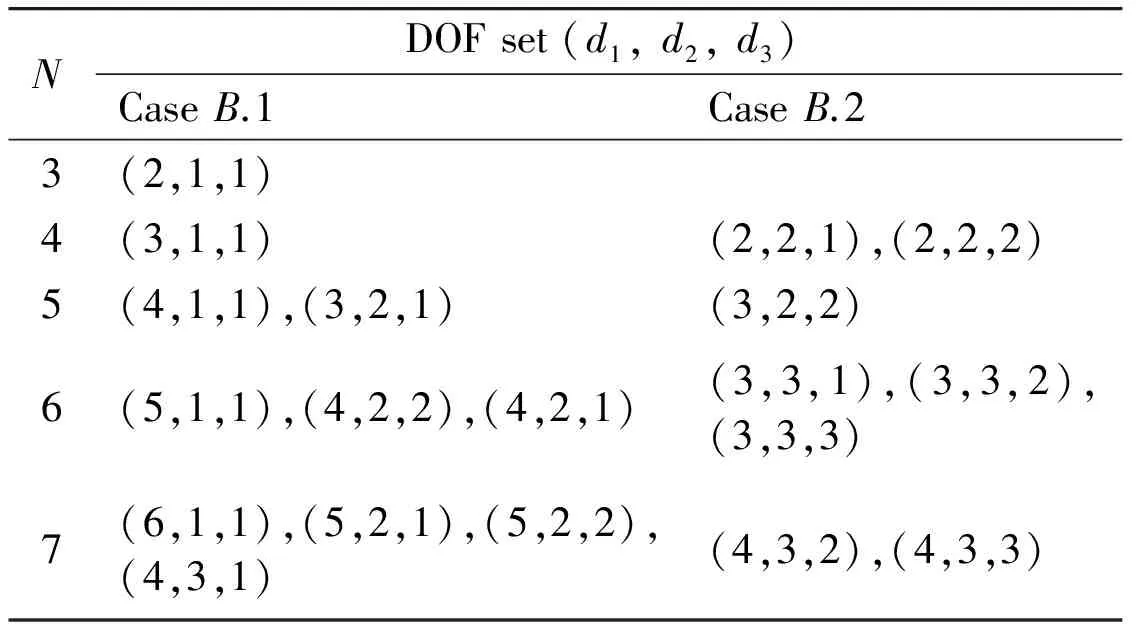


3 Performance results


4 Conclusion
 High Technology Letters2017年2期