
社區(qū)旅游:“打開”柬埔寨旅游的新方式
2017-06-21 15:12:25阿法瑞
中國-東盟博覽(政經(jīng)版) 2017年6期
□ 文/阿法瑞·謝
社區(qū)旅游:“打開”柬埔寨旅游的新方式
□ 文/阿法瑞·謝
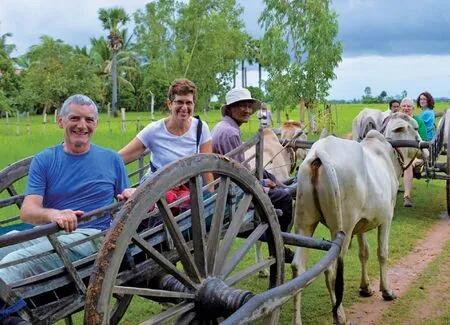
Getting a ride on an ox-cart in Cambodia's local community
In Cambodia, local communities open their homes to visitors as part of community-based tourism.
While most visitors to Cambodia are still struggling to find the perfect spot to capture the sunrise of Angkor Wat among the crowd, some have already heard the call of the local community and found their tranquility there.
Over the past few years, more and more Cambodian communities in the rural areas have become willing to open their homes to visitors, inviting visitors to get a taste of the local culture or to explore the wildlife in the country.
Unlike general tourism, which is mostly organized by private tour operators, meaning the bulk of the profits leave the community, these Community-Based Tourism (CBT) and Community-Based Ecotourism (CBET) projects are managed by local communities themselves or with the local communities strongly involved in the decision-making process. The prof ts thus benefit local communities directly, improving their community development.
“In order to do the CBET and CBT in the right way, in a way that is not exploiting the communities, then you must engage and consult with local communities. These communities need to be empowered in the decision-making process and that’s absolutely essential,” said Alison Curry, marketing technical adviser at Sam Veasna Center (SVC), a non-profit NGO that works with eight local communities to promote bird watching and other ecotourism activities while reducing deforestation and poaching in these protected areas and contributing to community development.
There are currently 66 CBT and CBET projects across Cambodia, according to a recent brochure published by Cambodia’s Ministry of Tourism. These projects offer the visitors a wide range of options to explore the country in many different ways, from visiting f oating villages and taking jungle trekking tours to joining bird and dolphin watching tours.
According to the Tourism Statistics Report published by Cambodia’s Ministry of Tourism, more than 4.7 million international tourists visited Cambodia last year. “Around 10 percent to 20 percent of tourists in Cambodia visit the CBT and CBET sites,” said Ho Vandy, secretary-general of the Cambodia National Tourism Alliance.
The inflow of visitors has improved the livelihood of the locals in Banteay Chhmar, a village located in the northwest of Cambodia that is known for its namesake cultural heritage— an 800-year-old temple built by King Jayavarman VII, the same king who built Bayon.
The locals at Banteay Chhmar started a project called Banteay Chhmar Community-Based Tourism (Banteay Chhmar CBT) in 2007. The project is dedicated to the preservation and protection of the cultural heritage as well as implementing responsible tourism practices in the area. Besides visiting the temple, the local community in charge of the project also welcomes visitors to have a genuine local experience by staying at homestays, taking a village tour, or getting a ride on an ox-cart.
“This CBT project benef ts the local people and I can also help my family by taking part in it,” said 32-year-old Kit Sokuon, who is one of the 11 local tour guides at Banteay Chhmar CBT. Before joining the CBT project in 2011, Sokuon worked in the f eld every day, growing rice and cassava. He didn’t know any English at that time. “It was really hard work. Now , besides being a farmer, I can also bring tourists to visit the beautiful temple, showing them around my childhood playground and share the history of the king with them,” he says. “It is a good job for me.”
Khlout Sopheng, vice president of Banteay Chhmar CBT, said 1,392 visitors visited Banteay Chhmar last year, bringing in revenue of around US$ 45,000. Approximately 19 percent of the income will be collected in the community local fund, which will be used in waste collection services, cleaning the moat, opening a library, and other community developmentrelated activities, Sopheng added.
The responsible tourism project in the village has also educated locals about the importance of the preservation of Banteay Chhmar. “Before we set up the project, many people looted the stones and the sculptures [in the temple] and sold them to outsiders,” said Tath Sophal, general manager at Global Heritage Fund-CBT. Global Heritage Fund is a San Franciscobased non-profit organization that supports the conservation work and Banteay Chhmar CBT. “As more and more local people join our project, they know that only supporting the preservation of the temple can help them earn more money so there is no looting now.”
To make sure that the 76 direct members Banteay Chhmar CBT is working with can all get to participate in the project, all of the tour guides, homestay owners, and cooks will take turns to welcome the visitors. “After seeing the success of the project, there are more and more locals applying for being our direct members, but we have to f nd a balance between the number of visitors and the number of CBT members so we can’t take everyone in,” said Sopheng.
Some 100 kilometers to the southeast lies Prek Toal, a f oating village that has begun a CBET project called Saray Tonle in 2004 with help from Osmose, a non-prof t NGO focusing on conservation through education and ecotourism.
Chim Sopheap, executive director at Osmose, said that before Osmose introduced the concept of ecotourism to Prek Toal, the village was really poor and no visitors would go there. Now , more than 7,000 visitors have discovered the floating village culture in the area, by joining a water hyacinth handicraft workshop or taking a traditional paddle boat tour.
“Prek Toal has become a relatively rich village after the CBET project was started. In the past, Osmose had to support the total cost of the repairing of their floating platform, which costs at least US$ 6,000, but now, the village can afford at least 50 percent of the cost,” said Sopheap.
The success of Saray Tonle’s project was so significant that some locals in Prek Toal have also started their own CBET projects in the area. But Saray Tonle, which works with around 100 families in Prek Toal, is still “the leading CBET project in the area,” Sopheap noted.
However, CBT and CBET projects in Cambodia are still facing some challenges in the communities and there is also a lack of dialogue between the local communities, the Cambodian government, and local tour operators in terms of creating a supportive environment for the implementation of responsible tourism in the communities.
Somborath Dy, operation manager at Cambodian Rural Discovery Tours, which works with four local communities in the provinces of Kratie and Stung Treng, pointed out that when they’re promoting CBT and CBET in local communities, “alack of youth participation, knowledge of tourism, hospitality skills and tourism products” are the biggest challenges for them.
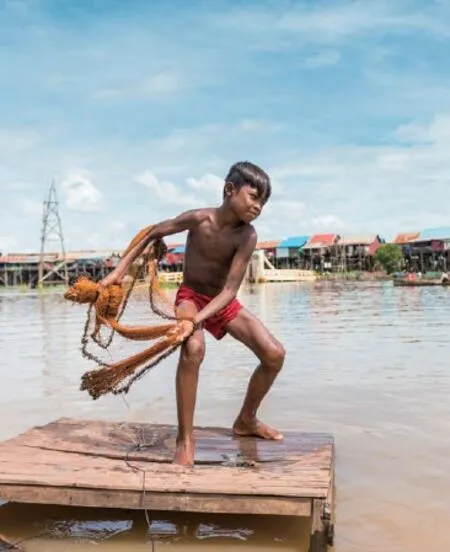
A young kid living in the local floating village of Cambodia was casting a net.
“Not enough education and understanding of tourism can lead to a lack of respect and support for it, in favor of practices with more immediate economic returns,” said Thourn Sinan, chairman of the Cambodia Chapter of the Pacif c Asia Travel Association.
Besides a still low awareness of responsible tourism, too much reliance on NGOs and hard-to-access sites are other factors that hinder the development of CBT and CBET in Cambodia. “Most CBT and CBET that I know of have been set up by NGOs or with significant NGO involvement. The reliance on NGOs for CBT and CBET in Cambodia is much stronger than I’ve seen in many places,” said Amy McLoughlin, awards manager at Wild Asia Responsible Tourism and co-founder of Ayana Journeys, a tour operator that promotes responsible and educational tours in Cambodia.
She adds, “I’ve never seen these sites being over-crowded and one of the reasons to date is probably the access. It takes time to get there. People are put off by the connectivity of locations.”
While more and more local communities are leaving their mark on the tourist map of Cambodia, they’re also calling for the government and tour operators to give them a boost to reach a broader market. “Currently, Cambodia tourist support, in terms of their marketing, is entirely focused on what I call temples and tragedy,” said Curry. “They are not promoting Cambodia to those many tourists who want to come in and to experience local culture and local community or nature and wildlife.”
Dy suggested that the Cambodian government should reduce taxes and support the budget of tour operators actively promoting CBT and CBET. Currently all the CBT and CBET groups in Cambodia don’t need to pay taxes to the government. According to Johnny Orn, former SVC Director, local nonprof t NGOs like SVC, which puts all the prof t it makes back into conservation and community development, only pay taxes on salary and labor and withholding taxes, but other tour operators need to pay full taxes.
The development of tourism can be a double-edged sword: it brings income to the local communities, but it can also cause over-development and have a negative impact on the inheritance of tradition and local culture. And these are the problems that all the parties involved in the CBT and CBET trend in Cambodia might be facing in the long term.
“The Cambodian government should have accurate understanding of the definition of what CBT and CBET is while assisting with marketing,” noted McLoughlin. She added that there is a big difference between having a high volume of visitors go into quite vulnerable communities to observe them and having quality visitors engaging in the projects owned by the communities.
Vandy suggested that the key for these local communities to stay competitive in the travel industry is to keep their identities.“If they don’t keep their tradition, it will be hard for them to attract more people from cities or other destinations.”
As in Banteay Chhmar, to prevent over-development, the CBT has made an agreement with the government that none of the properties in this protected area can be sold to outsiders; neither are outsiders allowed to build guesthouses or hotels in the zone. “We hope we can have a maximum of only 5,000 visitors every year. If the number of visitors grow over this number, there are many things we can’t control,” said Sophal.
Can this remote, tranquil village escape the fate of being disturbed by mass tourism in the future? “To do things right is a challenge, but it is a challenge worth doing,” said Curry.
· Source: http://thediplomat.com
Cambodia’s Experiment with Responsible Tourism
By Afore Hsieh
猜你喜歡
少兒科技(2022年4期)2022-04-14 23:48:10
中國-東盟博覽(政經(jīng)版)(2022年2期)2022-03-14 22:12:32
今日農(nóng)業(yè)(2021年12期)2021-11-28 15:49:26
中國-東盟博覽(政經(jīng)版)(2019年6期)2019-08-27 08:49:09
少兒美術(shù)(快樂歷史地理)(2019年10期)2019-04-20 07:15:50
好孩子畫報(2018年7期)2018-10-11 11:28:06
人民周刊(2017年17期)2017-10-23 11:48:24
今古傳奇·故事版(2016年24期)2017-02-07 04:29:04
數(shù)學(xué)大王·低年級(2014年7期)2014-08-11 16:36:44
海外英語(2013年8期)2013-11-22 09:16:04
