
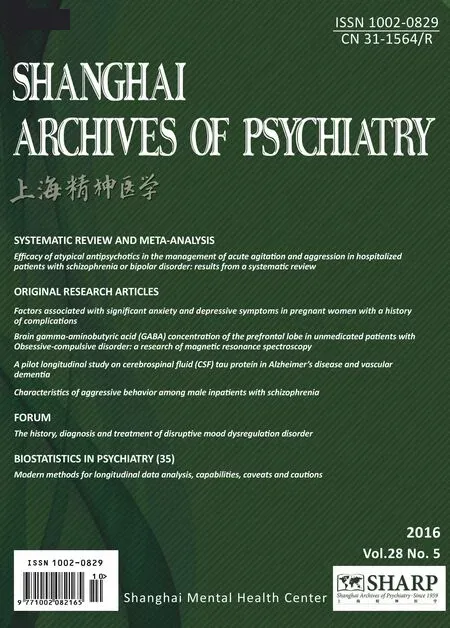
The history, diagnosis and treatment of disruptive mood dysregulation disorder
2016-12-09 09:29:52JunCHENZuoweiWANGYiruFANG
上海精神醫學 2016年5期
關鍵詞:要點
Jun CHEN, Zuowei WANG, Yiru FANG*
?Forum?
The history, diagnosis and treatment of disruptive mood dysregulation disorder
Jun CHEN1, Zuowei WANG2, Yiru FANG1*
Disruptive mood dysregulation disorder; DSM-5
Ever since 1952 when diagnostic and statistical manual of mental disorders (DSM) was published, it has continued in its development for more than 60 years. When DSM-5 was published in 2013, in order to relieve the concern of over-diagnosing bipolar disorder(BD) in children and teenagers, disruptive mood dysregulation disorder (DMDD) was included as a new diagnostic category; and it was put in the depression disorder module. Even though it has been published for over 3 years, the knowledge regarding DMDD in the clinical practice fi eld is still limited. Domestic professor Jinsong Zhang introduced this new diagnostic category of disorder briefly in 2012.[1]Xiaoyan Ke also wrote about it after DSM-5 was officially published; however,there were no corresponding studies about DMDD in China after that.[2]As for the reason underlying this phenomenon, on one hand, it is probably because this new diagnostic category has not been comprehended widely in the clinical field yet; on the other hand, it is also possible that the low morbidity of DMDD results in it lacking attention in clinical practice. Therefore, the present article aims to introduce DMDD’s history, key points in diagnosis, treatment and its impact on clinical practice.
1. The history of DMDD
The results of The Global Burden of Disease study which were published in 2013 indicate that the burden of disease appears during the childhood period (1-10 years old) in individuals with common mental disorders(e.g., depression disorder, bipolar disorder, anxiety disorder), and it reaches a peak during the juvenile period and adulthood period (10-29 years old).[3]Hence,there has been heated debate about the diagnoses of mental disorders within children and teenagers. In 2011, the results of Leibenluft’s study suggested that the ratio of children and teenagers being diagnosed with BD has increased 500% in America during the past 20 years.[4]On the other hand, those who advocate on behalf of children assert that there is a tendency of over-diagnosing children and teenagers with BD.Especially intense within this debate is whether children and teenagers who only show severe irritability without other symptoms (such as manic or hypomanic symptoms) should be diagnosed with BD.
In order to test whether the severe chronic irritability that appears in children is and early indicator of BD, Stringraris and colleagues created a new diagnostic category – severe mood dysregulation (SMD).According to the diagnostic criteria of SMD, the patients’age should be between 7 and 17, the first episode should occur before the age of 12, and the characteristics are chronic negative emotions with irritability and frequent emotional outbursts.[4]Following this research,multiple clinical studies on children have shown that the development of chronic paroxysmal irritability has a clear pattern in which paroxysmal symptoms are closely linked with manic episodes, while chronic symptoms are closely related to depressive or anxiety disorders.[5]The chance of children with paroxysmal elation going on to develop BD is 50 times higher than that of children with chronic irritability.[6]Based on the relevant series of studies on SMD, the DSM-5 task force created a new diagnostic category – DMDD; and it was classif i ed under depression disorder instead of BD when DSM-5 was published in 2013.[7]
2. Key points of DMDD diagnosis
The core characteristic of DMDD is chronic, severe and persistent irritability.
The definition of DMDD is combined with the features of SMD, but it is also different from SMD.DMDD inherited some features of SMD, such as the severe and paroxysmal emotional outbursts which overlies the persistent irritability or anger.However, DMDD does not include the criteria for over activation as seen in SMD (e.g., insomnia, radicalness,distractibility, thought acceleration, increase in speech and invasiveness),[4]because these over activation symptoms are more likely to be seen in manic episodes or attention deficit hyperactivity disorder (ADHD).[8-9]
According to the diagnostic criteria in DSM-5,DMDD has two main symptom criteria: (1) severe and frequent emotional outbursts; (2)chronic and persistent irritability or anger that exists between temper tantrums. Besides these two criteria, there are also specific descriptions about other limiting factors in the diagnostic criteria, including frequency (at least 3 episodes every week), duration (irritability or anger occurs almost everyday for most of the day), course of disease (at least more than 12 months, and the period when the criteria are not met never exceeds 3 months), age (at least more than 6 years old), the age of fi rst onset (before the age of 10), and the settings (it happens in multiple settings).[10]
3. The treatment for DMDD
Even though the DMDD diagnostic category was introduced in DSM-5, as of now, there has not been any summarization of the treatment for DMDD.
Clinically, it is a common belief that unlike BD which is treated with mood stabilizers or atypical antipsychotics as fi rst choices, DMDD should be treated with SSRIs as the first choice. However, many clinical studies on the treatment for children’s aggressivity or chronic irritability symptoms indicate that the range of choosing DMDD’s pharmacological treatment is very wide. A systemic review by Leon Tourian and colleagues has shown that pharmacological treatment for the aggression and chronic irritability in individuals with DMDD includes anti-depressants (SSRIs, SNRIs),mood stabilizers (lithium salts, valproate, lamotrigine,carbamazepine), psychostimulants (methylphenidate),typical antipsychotics (haloperidol), atypical antipsychotics (quetiapine, aripiprazole, risperidone),and other drugs (α-2 agonist, β blocker, trazodone).[11]However, due to the differences between researchers,sample size,ethical factors and other reasons, there are still few randomized and double blind DMDD research studies with large sample sizes and placebo control groups. Besides this, the long-term effects and safety of pharmacological treatment also requires further validation.
Besides pharmacological treatment, other psychological therapies and rehabilitation therapies can also be included in the combined treatment of DMDD. Scott and colleagues has shown that parents’intervention (based on Wesbter-Stratton technique) can help children with emotional irritability; however, its real effect and whether it can be used to treat DMDD specifically still need further validation.[12]Additionally,some research has indicated that behavioral therapies are effective for patients with DMDD, especially in improving their cognitive functioning.[13-14]
4. Conclusions
Even though DMDD was included in the DSM-5 as a new diagnostic category with clear diagnostic criteria and exclusion criteria, what true improvements will this change have on clinical practice?
First of all, DMDD is still considered as a mental disorder with a relatively low morbidity. Three community studies with large sample sizes have been analyzed by William and colleagues, and the results indicate that the three-month prevalence ratios of DMDD diagnosed by psychiatric structured interviews are only 0.8% to 3.3% (preschool children have the highest morbidity). More importantly, the ratios of DMDD’s comorbidity are very high, which are 62%to 92%; and the most common comorbid mental disorders are depressive disorder (odds ratios: 9.9-23.5)and oppositional defiant disorder (odds ratios: 52.9-103.0), which is due to the very low morbidity of “pure”DMDD.[14]
Secondly, the high comorbidity ratio and severe functional impairment of patients with DMDD has not caused enough attention in the clinical fi eld. Pinar Uran and colleagues have done a comparison study on children with DMDD, children with ADHD and healthy controls, and found that the comorbidity of DMDD and other mental disorders is a lot higher than that of ADHD.They also found that maladaptive behavioral patterns and impairments in family functioning were more significant in those with DMDD than those with ADHD.[15]Furthermore, the prospective follow-up study with large sample sizes done by William and colleagues has shown that compared to children with other mental disorders and healthy controls, children with DMDD are not only more prone to develop a depressive or anxiety disorder in their adulthood, but also to have comorbidity with other mental disorders. As well, functional impairments are more common, including poorer physical health condition, poorer economic conditions, lower education levels and higher crime rates.[16]
Thirdly, a greater understanding of the effect that DMDD has on decreasing the overdiagnosis of BD in children and teenagers is needed. In order to test whether the use of a DMDD diagnosis can actually help clinicians lower the rate of over-diagnosing children with BD, Margulies and colleagues evaluated admission and hospital follow-up for 56 children with manic symptoms reported by parents; the results showed that based on the medical histories provided by parents, 45.7% of the children met DMDD’s diagnostic criteria, but only 17.4% of the children could be identified with followup observations in hospital.[17]. In addition, during the discussion surrounding the drafting of ICD-11, some experts asserted that even though the emergence of DMDD changed how this disorder was addressed,it did not solve the problem completely in terms of diagnosis and treatment. There is still a lack of evidence to differentiate DMDD from BD and other mental disorders.[18]Therefore, there is evidence supporting DMDD diagnosis reducing the over-diagnosis of BD, but the impact of this still requires further validation with cohort follow up studies that have larger sample sizes.
Finally, placing DMDD under the depression disorder category still requires further discussion. Even though the over-activation characteristic of SMD was excluded from the onset of DMDD, in terms of severe and frequent emotional outbreaks with at least three episodes a week and irritability or anger occurring mosttime of almost every day, these symptoms indicate that DMDD and BD are related closely and hard to distinguish from each other. It also should be considered that by putting DMDD in the depression disorder category and treating it with antidepressants there is the possibility of patients’ irritability symptoms being further aggravated.Furthermore, while more and more clinical studies have shown that mood stabilizers and antipsychotics can be used to treat DMDD, there is also evidence indicating that classifying DMDD within BD might be more appropriate. In a survey with 375 children of patients with BD done by Garrett and colleagues,it was found that compared with healthy controls,children of patients with BD met DMDD diagnostic criteria significantly more (OR = 8.3, 6.7% v. 0.8%); and family history of BD increased the risk of suffering from DMDD.[19]Ideally the diagnostic classification would depend on a clear biological marker as an objective indicator, so more basic studies are needed to illuminate the pathologic mechanism of DMDD in the future.
Funding
Preparation of this manuscript was funded by the Youth Science Fund Project of the National Natural Science Fund (81201056, 91232719); Major Research Program in National Science Fund (91232719); Excellent Talents Training Project in Shanghai Health System(XYQ2011014); Medical Guidance Project in Shanghai Science Committee (traditional Chinese medical science) (12401906200); Shanghai clinical mental health center (2014); National Key Clinical Disciplines– Shanghai Mental Health Center (The Department of Health Administration 2011 – 873); Ministry of Science and Technology’s “ten two five” National Science and Technology Support Project (2012BAI01B04).
Conflict of interest
The authors declare no conflict of interest related to this manuscript.
Author contributions
Jun Chen – article writing
Zuowei Wang – literature review Yiru Fang – guidance and revision
Reference
1. Zhang JS. [Early diagnosis and prevention of mental disorders in children and adolescents]. Zhongguo Er Tong Bao Jian Za Zhi. 2012; 20(7): 579-581. Chinese
2. Ke XY. [The changes of child psychiatry in the American Diagnostic and Statistical Manual of mental disorders (Fifth Edition)]. Lin Chuang Jing Shen Yi Xue Za Zhi. 2013; 23(5):345-347. Chinese
3. Whiteford HA, Degenhardt L, Rehm J, Baxter AJ, Ferrari AJ, Erskine HE, et al. Global burden of disease attributable to mental and substance use disorders: findings from the Global Burden of Disease Study 2010. Lancet. 2013;382(9904): 1575-1586. doi: http://dx.doi.org/10.1016/S0140-6736(13)61611-6
4. Leibenluft E. Severe mood dysregulation, irritability, and the diagnostic boundaries of bipolar disorder in youths.Am J Psychiatry. 2011; 168(2): 129-142. doi: http://dx.doi.org/10.1176/appi.ajp.2010.10050766
5. Stringaris A, Zavos H, Leibenluft E, Maughan B, Eley TC. Adolescent irritability: phenotypic associations and genetic links with depressed mood. Am J Psychiatry.2012; 169(1): 47-54. doi: http://dx.doi.org/10.1176/appi.ajp.2011.10101549
6. Stringaris A, Baroni A, Haimm C, Brotman M, Lowe CH,Myers F, et al. Pediatric bipolar disorder versus severe mood dysregulation: risk for manic episodes on follow-up.J Am Acad Child Adolesc Psychiatry. 2010; 49(4): 397-405
7. Rao U. DSM-5: disruptive mood dysregulation disorder.Asian J Psychiatr. 2014; 11: 119-123. doi: http://dx.doi.org/10.1016/j.ajp.2014.03.002
8. Faraone SV, Biederman J, Mennin D, Wozniak J, Spencer T. Attention-deficit hyperactivity disorder with bipolar disorder: a familial subtype? J Am Acad Child Adolesc Psychiatry. 1997; 36(10): 1378-1387; discussion 87-90. doi:http://dx.doi.org/10.1097/00004583-199710000-00020
9. Mick E, Spencer T, Wozniak J, Biederman J. Heterogeneity of irritability in attention-deficit/hyperactivity disorder subjects with and without mood disorders. Biol Psychiatry.2005; 58(7): 576-582. doi: http://dx.doi.org/10.1016/j.biopsych.2005.05.037
10. Axelson D. Taking disruptive mood dysregulation disorder out for a test drive. Am J Psychiatry. 2013; 170(2): 136-139.doi: http://dx.doi.org/10.1176/appi.ajp.2012.12111434
11. Tourian L, LeBoeuf A, Breton JJ, Cohen D, Gignac M, Labelle R, et al. Treatment options for the cardinal symptoms of disruptive mood dysregulation disorder. J Can Acad Child Adolesc Psychiatry. 2015; 24(1): 41-54
12. Scott S, O’Connor TG. An experimental test of differential susceptibility to parenting among emotionallydysregulated children in a randomized controlled trial for oppositional behavior. J Child Psychol Psychiatry. 2012;53(11): 1184-1193. doi: http://dx.doi.org/10.1111/j.1469-7610.2012.02586.x
13. Carlson GA. The dramatic rise in neuroleptic use in children: why do we do it and what does it buy us?Theories from inpatient data 1988-2010. J Child Adolesc Psychopharmacol. 2013; 23(3): 144-147. doi: http://dx.doi.org/10.1089/cap.2013.2331
14. Copeland WE, Angold A, Costello EJ, Egger H. Prevalence,comorbidity, and correlates of DSM-5 proposed disruptive mood dysregulation disorder. Am J Psychiatry. 2013;170(2): 173-179. doi: http://dx.doi.org/10.1176/appi.ajp.2012.12010132
15. Uran P, Kilic BG. Family Functioning, comorbidities, and behavioral profiles of children with adhd and disruptive mood dysregulation disorder. J Atten Disord. 2015; doi:http://dx.doi.org/10.1177/1087054715588949
16. Copeland WE, Shanahan L, Egger H, Angold A, Costello EJ. Adult diagnostic and functional outcomes of DSM-5 disruptive mood dysregulation disorder. Am J Psychiatry.2014; 171(6): 668-674. doi: http://dx.doi.org/10.1176/appi.ajp.2014.13091213
17. Margulies DM, Weintraub S, Basile J, Grover PJ, Carlson GA.Will disruptive mood dysregulation disorder reduce false diagnosis of bipolar disorder in children? Bipolar Disord.2012; 14(5): 488-496. doi: http://dx.doi.org/10.1111/j.1399-5618.2012.01029.x
18. Rao P, Moore JK, Stewart R, Hood SD, Runions K, Zepf FD. Diagnostic inexactitude - Reframing and relabelling Disruptive Mood Dysregulation Disorder for ICD-11 does not solve the problem. Med Hypotheses. 2015; 85(6): 1035-1036. doi: http://dx.doi.org/10.1016/j.mehy.2015.10.008
19. Sparks GM, Axelson DA, Yu H, Ha W, Ballester J, Diler RS,et al. Disruptive mood dysregulation disorder and chronic irritability in youth at familial risk for bipolar disorder. J Am Acad Child Adolesc Psychiatry. 2014; 53(4): 408-416. doi:http://dx.doi.org/10.1016/j.jaac.2013.12.026

Dr. Jun Chen graduated from Shanghai Second Medical University (SSMU) with a bachelor’s degree in Medicine in July 2001. He then received a Ph.D. degree in Psychiatry from Shanghai Jiaotong University in April 2009. He has been working at the Shanghai Mental Health Center since 2001. He is currently the director of the office of National Key Clinical Disciplines, associate chief physician and a supervisor for masters students. He is also the Vice Chairman of the Youth Committee of the Chinese Society of Psychiatry, secretary of the Chinese Society of Psychiatry and a committee member of the Chinese Psychiatrist Association. His current research interests are bipolar disorders and treatment-resistant depression.
破壞性心境失調障礙的診斷與治療的思考
陳俊,汪作為,方貽儒
破壞性心境失調障礙,美國精神障礙診斷與統計分冊第5版
Disruptive mood dysregulation disorder was newly included as a diagnostic category in Diagnostic and statistical manual of mental disorders fifth edition (DSM-5), but the knowledge about it in the clinical practice field is still limited. Therefore, the aim of the present article is to introduce this diagnostic category’s history, key points of diagnosis, treatment and its impact on clinical practice for clinical reference.
[Shanghai Arch Psychiatry. 2016; 28(5): 289-292.
http://dx.doi.org/10.11919/j.issn.1002-0829.216071]
1Division of Mood Disorders, Subsidiary Mental Health Centre of Shanghai Jiao Tong University Medical School, Shanghai, China
2Mental Health Centre of Hongkou District, Shanghai, China
*correspondence: Professor Yiru Fang. Mailing Address: Division of Mood Disorders, Subsidiary Mental Health Centre of Shanghai Jiao Tong University Medical School, 600 South Wanping RD, Shanghai, China. Postcode: 200030. E-mail: yirufang@aliyun.com
概述: 美國精神障礙診斷與統計分冊第5版新增一個診斷類別為破壞性心境失調障礙,但是臨床實踐中對此認識仍然較為有限。因此,本文就該診斷類別的由來、診斷要點、治療以及對臨床實踐的啟示作一介紹,供臨床參考。
猜你喜歡
中學生數理化·七年級數學人教版(2023年3期)2023-03-21 00:44:54
今日農業(2022年16期)2022-11-09 23:18:44
保健醫苑(2022年5期)2022-06-10 07:47:26
建材發展導向(2022年1期)2022-03-08 01:53:10
學校教育研究(2020年13期)2020-07-07 09:31:30
學生天地·小學低年級版(2019年11期)2019-12-30 09:41:28
學生天地·小學低年級版(2019年12期)2019-12-30 01:51:01
學生天地·小學低年級版(2019年10期)2019-12-30 01:50:33
學生天地·小學低年級版(2019年9期)2019-11-22 10:43:40
學生天地·小學低年級版(2019年5期)2019-06-05 01:15:11
- 上海精神醫學的其它文章
- Modern methods for longitudinal data analysis, capabilities,caveats and cautions
- Characteristics of aggressive behavior among male inpatients with schizophrenia
- A pilot longitudinal study on cerebrospinal fluid (CSF) tau protein in Alzheimer’s disease and vascular dementia
- Brain gamma-aminobutyric acid (GABA) concentration of the prefrontal lobe in unmedicated patients with Obsessivecompulsive disorder: a research of magnetic resonance spectroscopy
- Factors associated with significant anxiety and depressive symptoms in pregnant women with a history of complications
- Efficacy of atypical antipsychotics in the management of acute agitation and aggression in hospitalized patients with schizophrenia or bipolar disorder: results from a systematic review