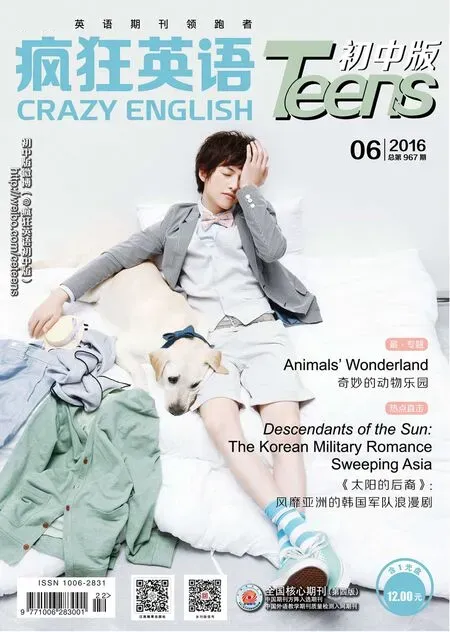
《太陽的后裔》:風靡亞洲的韓國軍隊浪漫劇
2016-11-30 06:05:50byTessaWong
瘋狂英語·初中天地 2016年6期
關鍵詞:軍隊
by Tessa Wong
翻譯:法比仔
《太陽的后裔》:風靡亞洲的韓國軍隊浪漫劇
by Tessa Wong
翻譯:法比仔

要問今年上半年的大熱劇是啥?不用說,必定當屬那主演顏值爆表、畫面唯美的韓劇《太陽的后裔》(Descendants of the Sun)呀!自二月底該劇開播以來,男主角柳時鎮的扮演者宋仲基頓時紅透了半邊天。這個關于特種部隊海外派兵隊隊長柳時鎮和外科醫生姜暮煙(宋慧喬飾)在韓國和派兵地區之間往返相愛的故事牽動著許多劇迷的心。



Korean television dramas have always been popular across Asia, but the region may have hit the highest Korean drama1)fever with2)military3)romance Descendants of the Sun.
◆ Love Is a Battlefield
The 16-episode show began airing on South Korean television in February. It is also being4)simulcast online in China and shown up on other websites.
It has all the familiar5)ingredients of a Korean drama: a6)complicated plot, the best actors and a foreign location—in this case standing in as the7)fictional8)war-torn9)Mediterranean country Uruk.
But one unique10)feature of Descendants of the Sun is its military setting. It is often not fate that11)gets in the way of the main characters’ happiness, but the urgencies of war.
The show is mostly set in Uruk where a12)special forces13)captain played by Song Joong-ki14)woos an15)army surgeon played by Song Hye-kyo. Rather inconveniently, he often has to leave her at important moments to save lives or go on some other mysterious missions.
An16)editorial carried by People’s Daily praised it as “an excellent advertisement for17)conscription” because it shows South Korea’s “national spirit” and “18)communitarian culture,”and suggested China creates a similar soap opera.
1) fever ['fi?v?】 n. 狂熱,興奮
2) military ['mIlIt?rI】 adj. 軍人的,戰爭的
3) romance [r?u'm?ns】 n. 愛情故事
4) simulcast ['sIm?lkɑ?st】 v.(廣播和電視)同時聯播
5) ingredient [In'gri?dI?nt】 n. 成分,要素
6) complicated ['k?mplIkeItId】 adj. 錯綜的,復雜的
7) fictional ['fIk??nl】 adj. 虛構的
8) war-torn 遭受戰爭破壞的
9) Mediterranean [medIt?'reInI?n】 adj. 地中海的
10) feature ['fi?t??】 n. 特征,特色
11) get in the way 妨礙,阻礙
12) special force 特種部隊
13) captain ['k?ptIn】 n. 隊長,軍官
14) woo [wu?】 v.(男人)求愛
15) army surgeon 戰地醫生
16) editorial [edI't??rI?l】 n. 社論
17) conscription [k?n'skrIp??n】 n. 征兵(制度)
18) communitarian [k?,mju?nI'te?rI?n】 adj. 公有社會的


19) viewership ['vju???Ip】 n. 電視觀眾,收視
20) boost [bu?st】 v. 增進,改善
21) investor [In'vest?】 n. 投資者
22) promote [pr?'m?ut】 v. 促進,發揚
23) patriotism ['p?trI?tIz?m】 n. 愛國主義
24) dutiful ['dju?tIful】 adj. 忠實的,順從的
25) marital ['m?rIt?l】 adj. 婚姻的
26) criminal ['krImIn?l】 adj. 犯罪的,刑事的
27) tabloid ['t?bl?Id】 n. 小報
28) obsession [?b'se??n】 n. 迷戀,癡迷
obsessive [?b'sesIv】 adj. 著迷的
29) drunkenly ['dr??k?nlI】 adv. 醉醺醺地
30) chase [t?eIs】 v. 追趕
31) dramatic [dr?'m?tIk】 adj. 戲劇性的
32) slap [sl?p】 v. 摑,拍
33) justify ['d??stIfaI】
v. 證明……是正當的,替……辯護
At home, the drama has broken19)viewership records and won applause from even President Park Geun-hye, who said it could help spread South Korean culture and20)boost tourism.
However, its main fan base lies overseas, particularly China. China has strict rules on broadcasting foreign dramas, but relaxed them for Descendants of the Sun,whose production was reportedly partly funded by Chinese21)investors.
Even Thailand’s Prime Minister Prayuth Chan-ocha—an army general—is a fan of the soap opera. He urged his countrymen to watch it as it22)promotes “23)patriotism,sacrifice, obeying orders and being a24)dutiful citizen.”
The show has been sold to 27 countries including the UK and translated into 32 different languages, according to South Korea’s Yonhap News Agency.
But fandom has its costs. Chinese authorities have warned of the dangers of watching Korean dramas, which it said could lead to25)marital trouble and26)criminal behavior.
Recently, Chinese27)tabloids carried a story of a young man who was so jealous of his wife’s28)obsession with Song Joong-ki that one night he29)drunkenly run into a photography studio and demanded that the shop owner take pictures to “make him look like Song.” The owner eventually called the police.
“When you30)chase male or female stars, do not become too obsessive with them. Because sometimes your casual words could end up hurting those who really care for you,” it said.
It also warned citizens against imitating the more31)dramatic aspects of Korean dramas, such as32)slapping one another during the conflicts.
“Some behavior may seem romantic, but this kind of romance is not acceptable to everyone...it becomes wrong when you33)justify criminal behavior as romance,” it said.
◆ What Fans Are Saying
“The military theme does not appear frequently in TV shows so combined with the romantic theme, this is not like other Korean soap operas.”
“Unlike most Korean dramas which are about a rich guy who falls in love with a poor, golden-hearted girl, the story feels more like the love story of two evenly-matched adults.”

參考譯文
韓國電視劇在亞洲一直很受歡迎,而軍隊主題浪漫劇《太陽的后裔》更是掀起了最高的韓劇熱潮。
◇愛如戰場
這部共16集的電視劇于2月在韓國電視上開播。其也在中國的網站以及其他國家的網站上同步播出。
這部劇集合了韓劇所有常見的元素:復雜的情節、一流的演員,還有海外取景地—而它的背景便設在一個虛構的飽受戰爭蹂躪的地中海國家烏魯克。
但《太陽的后裔》與眾不同的地方在于它的軍隊故事背景。在那樣的背景下,往往不是命運,而是那萬分緊迫的戰爭,阻礙了主人公們的幸福。
該劇將故事地點主要設定在烏魯克。在那里,由宋仲基扮演的特種部隊隊長追求著由宋慧喬扮演的戰地醫生。讓這對情侶十分苦惱的是,他常常不得不在重要時刻離開她,去拯救他人的生命或是去執行其他的一些秘密任務。
《人民日報》的一篇社論稱贊這部劇是“杰出的征兵廣告”,因為它展示了韓國的“民族精神”和“共產主義文化”。社論里還建議中國拍攝類似的肥皂劇。
在韓國,這部劇已經打破了收視紀錄,甚至還贏得了總統樸槿惠的贊賞。她說這部韓劇可以幫助傳播韓國文化及推動旅游事業。
然而,這部韓劇的主要觀眾群在海外,尤其是在中國。中國對于播放外國電視劇一向有著嚴格的規定,而《太陽的后裔》之所以能夠引進中國,是因為據報道稱該劇有一部分是由中國投資者來投資的。
甚至連泰國總理兼陸軍總司令巴育·占奧差也是這部肥皂劇的粉絲。他敦促他的國民們去看看這部劇,因為它宣揚了“愛國主義、犧牲、服從命令,以及做一個盡職的公民”。
據韓國的聯合通訊社報道,這部韓劇已經被包括英國在內的27個國家引進,翻譯成了32種不同的語言。
但狂熱追捧的背后是有代價的。中國有關部門已經警告了人們看韓劇的危害,有些危害可能會引發婚姻問題與犯罪行為。
近來,中國的小報報道了一則新聞。一名年輕男子由于過分嫉妒他的妻子對于宋仲基的癡迷,在一天晚上醉醺醺地跑進了一個照相館,要求老板把他拍得“像宋仲基一樣”。老板最終報了警。
新聞里還評論說:“當你在追逐男明星或女明星時,不要過于沉迷其中。因為有時你隨口的話語最終可能會傷害那些真正關心你的人。”
評論還告誡市民不要模仿韓劇里較為夸張的情節,比如在沖突中賞別人一個耳光。
“有些行為似乎是浪漫的,但并非每個人都可以接受這種浪漫……如果你認為犯罪行為是一種浪漫,就大錯特錯了,”該新聞評論道。
◇粉絲們的一些話
“軍隊主題結合浪漫主題的電視劇并不常常出現在電視上,它區別于韓國的其他肥皂劇。”
“大多數的韓劇都是關于一個富有的男孩愛上了一個貧窮卻心地善良的女孩,與之不同,《太陽的后裔》感覺更像是兩個門當戶對的成年人間的愛情故事。”
Descendants of the Sun:The Korean Military Romance Sweeping Asia
猜你喜歡
故事作文·低年級(2022年3期)2022-03-17 18:30:10
少兒美術(快樂歷史地理)(2019年2期)2019-06-12 08:42:58
環球時報(2018-11-02)2018-11-02 04:10:46
小哥白尼(軍事科學)(2018年4期)2018-06-21 06:25:18
軍營文化天地(2017年12期)2017-03-01 06:52:20
軍事體育學報(2016年2期)2016-06-15 20:28:15
故事作文·低年級(2015年1期)2015-11-11 07:55:06
軍事歷史(2004年2期)2004-11-22 07:12:08
軍事歷史(1995年4期)1995-08-21 02:18:26
軍事歷史(1993年5期)1993-08-21 06:17:26