
以6-甲基-2,3,5-吡啶三酸為配體的過渡金屬配合物的合成、結(jié)構(gòu)與性質(zhì)
2016-11-28 09:36:33宿秀梅姜麗伊勇玲
無機化學學報 2016年2期
宿秀梅 姜麗 伊勇玲
(1天津師范大學化學學院,天津300387) (2天津大學化學系,天津300072)
以6-甲基-2,3,5-吡啶三酸為配體的過渡金屬配合物的合成、結(jié)構(gòu)與性質(zhì)
宿秀梅*,1姜麗2伊勇玲2
(1天津師范大學化學學院,天津300387) (2天津大學化學系,天津300072)
以6-甲基-2,3,5-吡啶三酸為配體和過渡金屬鹽反應,合成出2個新穎的金屬配位聚合物{[Cu(Hmptc)(H2O)]·2H2O}n(1)和{Cd(Hmptc)(H2O)}n(2)(H3mptc=6-甲基-2,3,5-吡啶三酸)。配合物1存在具有四邊形孔道的二維網(wǎng)狀結(jié)構(gòu)。配合物2中的Cd中心通過Hmptc2-配體連接成為類似于籠狀的二維層狀結(jié)構(gòu),進一步由氫鍵相互作用連接成三維超分子結(jié)構(gòu)。配合物2存在藍綠色熒光。
6-甲基-2,3,5-吡啶三酸;配位聚合物;熒光性質(zhì)
The design and synthesis of novel coordination polymers have received significant attention due to their intriguing structures and potential applications in host-guestchemistry,catalysis,chemicalsensors, magnetic and fluorescent materials[1-5].Many metalorganic frameworks,which consist of metal ions and multidentate organic ligands containing O-or N-donors,have been reported during the past several years[6-8].However,it is still a big challenge to predictably prepare the desired networks because many factors such as the coordination geometry of metal ions,the structural characteristics of ligands, the solvent system,and the counter anions,influence the final structures[9-11].To date,the most effective approach for the synthesis of desirable complexes is still to adopt appropriate bridging ligands,becausechanges in substituent group,symmetry,and flexibility of organic ligands can result in materials bearing diverse architectures and functions.
Recently,we have systematically investigated a seriesofcoordinationnetworksconstructedfrom pyridine-2,3,5,6-tetracarboxylaic acid(H4pdtc),which display versatile architectures[12-14].In this context,as the continuance of this research,we choose 6-methyl-2,3,5-pyridinetricarboxylic acid(H3mptc)as organic ligand,which has been prepared via slight change on the synthesis ofH4pdtc[15].Compared toH4pdtc, H3mptc possesses a lower symmetry because 6-methyl group has replaced the corresponding carboxyl group, whichmayresultintheformationofunusual complexes.To our knowledge,only a few lanthanide coordination complexes based on H3mptc have been reportedanditscoordinationchemistryremains largely unexplored[15].
Herein,we have successfully synthesized two new complexes{[Cu(Hmptc)(H2O)]·2H2O}n(1)and{Cd (Hmptc)(H2O)}n(2).It is noteworthy that complexes 1~2 are reported for the first time from transition metal ions and H3mptc and complex 1 presents a twodimensional(2D)rectangle channels.The luminescent properties of complex 2 have also been investigated.
1 Experimental
1.1General
H3mptc was synthesized according to the reported method[15].The other reagents werecommercially availableandusedwithoutfurtherpurification. Elemental analysis(C,H and N)was carried out with a Perkin-Elmer 240 CHN elemental analyzer.IR spectra were obtained with a Bruker TENOR 27 instrument in the range of 4 000~400 cm-1on a KBr pellet.Thermal gravimetric analysis(TGA)curve was obtained from a NETZSCH TG 209 thermal analyzer in a static air atmosphere with a heating rate of 10℃·min-1.Fluorescence spectra were measured on a F-4500 FL fluorescence spectrophotometer.
1.2Synthesis of the complexes
Complex 1:A mixture of CuCl2·2H2O(25.7 mg, 0.15 mmol),H3mptc(33.8 mg,0.15 mmol),H2O(10 mL) was stirred at room temperature for 2 h and then filtered. Blue crystals of 1 were obtained after the filtrate was allowed to stand at room temperature for one week. Yield:0.011 g,32%based on Cu.Anal.Calcd.for C9H11CuNO9(%):C,31.72;H,3.25;N,4.11.Found(%): C,31.75;H,3.19;N,4.07.IR(KBr pellet,cm-1):3491s, 1 719s,1 647s,1 572vs,1 398m,1 278m,1 140m,814w, 675w.
Complex 2:A mixture of Cd(NO3)2·4H2O(46.3 mg,0.15 mmol),H3mptc(22.5 mg,0.1 mmol),H2O(10 mL)was stirred at room temperature for 2 h and then filtered.Colorless crystals of 2 were obtained after the filtrate was allowed to stand at room temperature for four weeks.Yield:0.012 g,34%based on Cd.Anal. Calcd.for C9H7CdNO7(%):C,30.57;H,1.99;N,3.96. Found(%):C,30.60;H,1.92;N,3.95.IR(KBr pellet, cm-1):3 437s,1 700s,1 639vs,1 566m,1 440m, 1 370m,1 286m,1 147m,675w,811w.
1.3X-ray crystallography
ThesinglecrystalX-raydiffractiondata collections for complexes 1~2 were performed with a BRUKER SMART-1000 CCD diffractometer,equipped with graphite-monochromatized Mo Kα radiation with a radiation wavelength of 0.071 073 nm,using ω-φ scan. The structures were solved by direct methods and refined anisotropically with a full-matrix least-squares tec hnique based on F2using the SHELXS-97 and SHELXL-97 programs[16].Anisotropic thermal parameters were assigned to all non-hydrogen atoms.The organic hydrogen atoms were generated geometrically; the hydrogen atoms of the water molecules were located fromdifferentmapsandrefinedwithisotropic temperaturefactors.Thedisorderedfreesolvent molecules are unavoidable,of which the hydrogen atoms cannot be confirmed for the improper electron density around the central atom.Analytical expressions of neutral-atom scattering factors were employed,and anomalous dispersion corrections were incorporated. Crystal data collection and refinement details for complexes 1~2 are summarized in Table 1.Selected bond lengths and angles for complexes 1 and 2 are listed in Table 2.
CCDC:906071,1;906072,2.
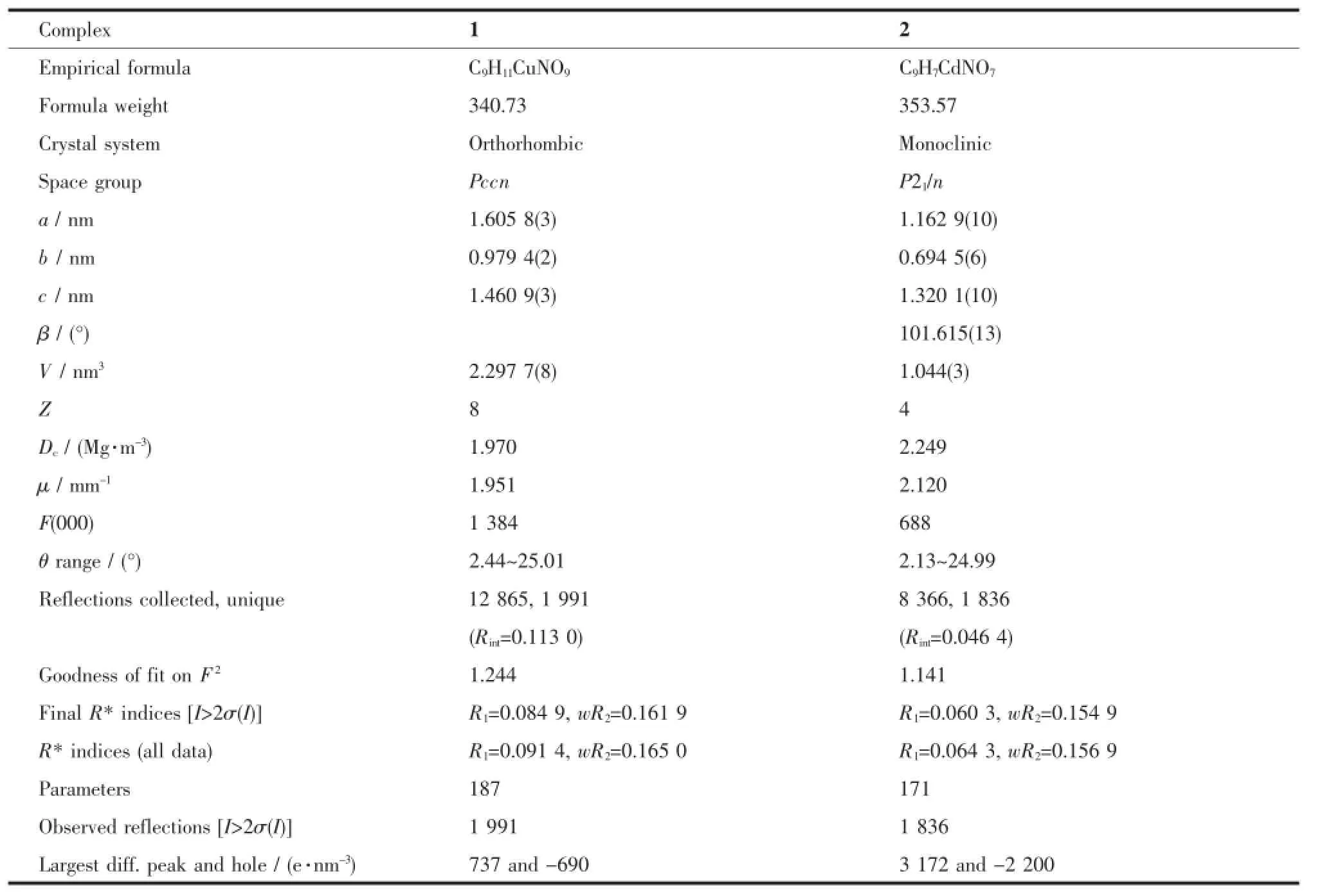
Table 1 Crystal data and structure refinement information for complexes 1~2
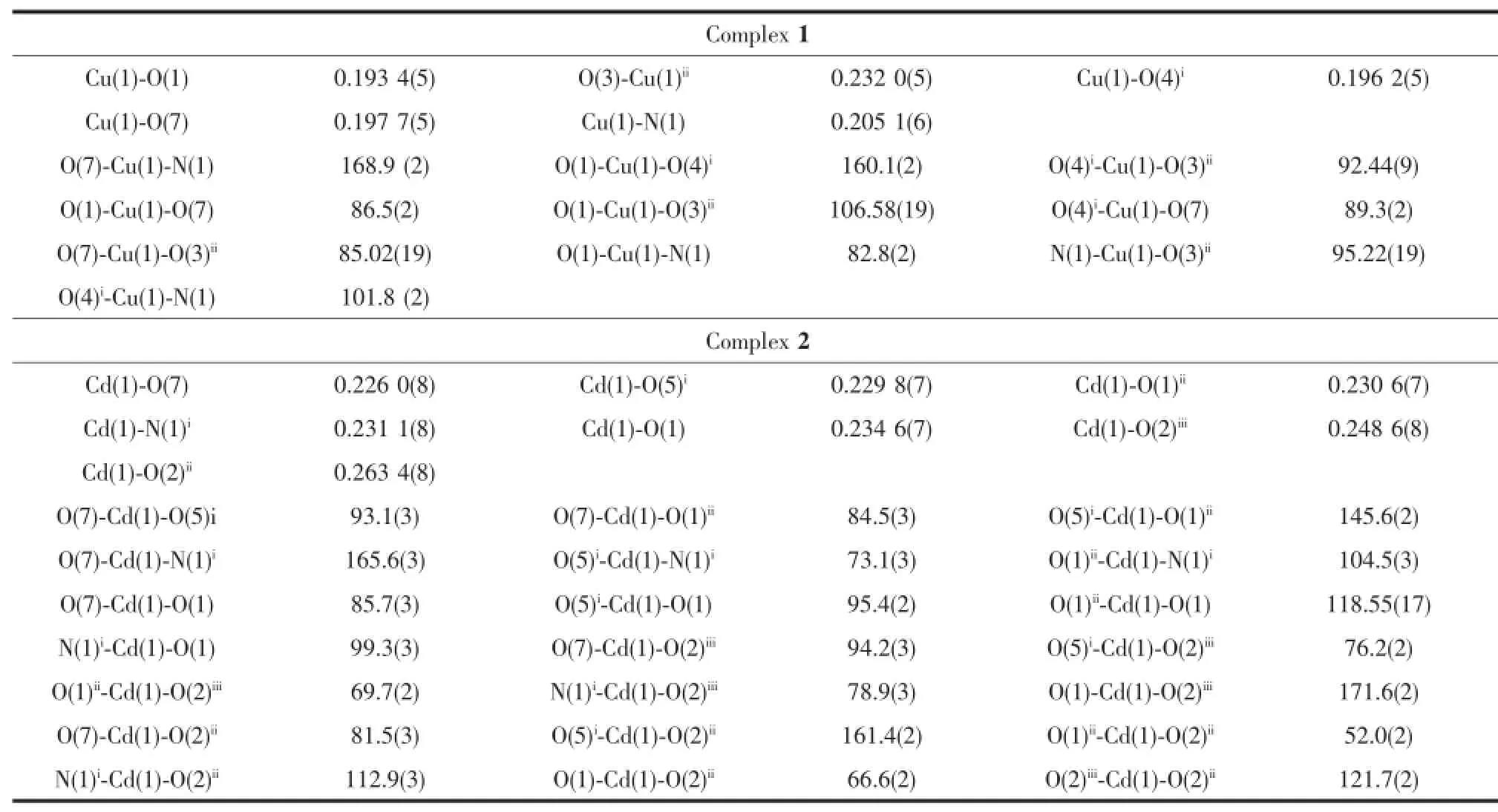
Table 2Selected bond lengths(nm)and angles(°)for complexes 1~2
2 Results and discussion
2.1Structure description
All the complexes,once isolated,are air-stable and can retain their structural integrity at room temperature for a considerable length of time.The single crystal X-ray diffraction analysis reveals the asymmetricalunitof1consistsofone crystallographicallyindependentcopperion,one Hmptc2-ligand and three water molecules,and O8 is from disordered water molecules(Fig.1a).Each Cucenter is surrounded with a tetragonal pyramidal geometry and is coordinated by four oxygen atoms and one nitrogen atom,in which two oxygen atoms(O3A, O4B)are from two different Hmptc2-ligands;one oxygen atom(O7)is from coordinated water molecule; the other two are bidentate chelate O and N atoms. The bond distances and angles involving the metal ions are collected in Table 2.The Cu-O distances are in the range of 0.1 932(1)~0.231 1(1)nm and Cu-N distance is 0.204 8(1)nm,in good agreement with previous studies[17].
For the Hmptc2-ligand,there is one carboxyl group that is not deprotonated.The Hmptc2-ligand bounds to three Cuthrough chelating and bridging modes:one carboxylate group adopts a bidentate bridging coordination mode connecting two Cuions, whereas another carboxylate group and one pyridine nitrogen chelate with one Cuion bidentately. Normally,the carboxyl group coordinated with metal is dehydrogenated.Meanwhile,the C-O distances of the carboxyl group possessing hydrogen atom are significantly different,and hydrogen atom is generally located in the oxygen atom of longer C-O bond length. In complex 1,the C9-O5 and C9-O6 distances are 0.129 7 and 0.123 5 nm,respectively,so H5 is connected to O5.
On the basis of the connection modes,two Cucenters are bridged by two different Hmptc2-ligands to form a dinuclear unit consists of a 12-membered ring.And then O4 from carboxylate groups(O4-C8-O3)acts as nodes to connect the dinuclear units to form the infinite 2D layer structure in the bc plane (Fig.1b).What is interesting is that complex 1 shows an infinite channel along a-axis,the hole is 1.008 24 nm×0.842 65 nm.
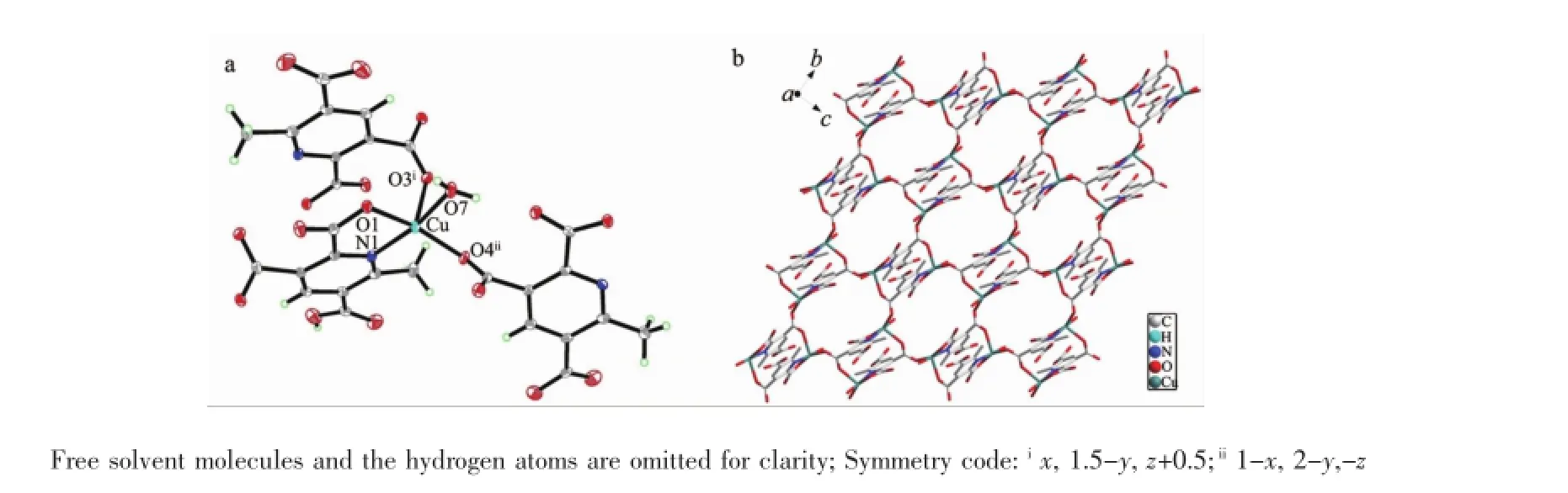
Fig.1 (a)Coordination environment of the Cuion in 1 with 50%thermal ellipsoid probability;(b)2D layer structure of 1
In addition,the 2D layer structures are further assembledintoa3Dsupramolecularframework throughtherichhydrogen-bondinginteractions involving the carboxylate oxygen,the coordinated and uncoordinated water molecules(Fig.2).
Complex 2 exhibits a 2D coordination framework crystallizing in monoclinic space group P21/n and was connectedinto3Dnetworksbysupramolecular interactions.The asymmetrical unit of 2 contains one Cdatom,one Hmptc2-ligand and one coordinated water molecule(Fig.3a).The Cdatom is sevencoordinated and in a distorted pentagonal bipyramidal coordination geometry.Five carboxylate oxygen atoms (O1,O1A,O2A,O2B,O5C)from different Hmptc2-ligands comprise the equatorial plane,while another two atoms(O7 and N1)occupy the axial positions with a trans angle of 165.6(3)°.The Cd-O distances are in the range of 0.226 0(1)~0.263 4(1)nm and Cd-Ndistance is 0.231 1(1)nm.The distance of 0.263 4(1) nmisalittlelong,butitisanonnegligible interaction,which is in good agreement with previous studies[18-19].

Fig.2 3D packing diagram of 1 connected by hydrogen bonds
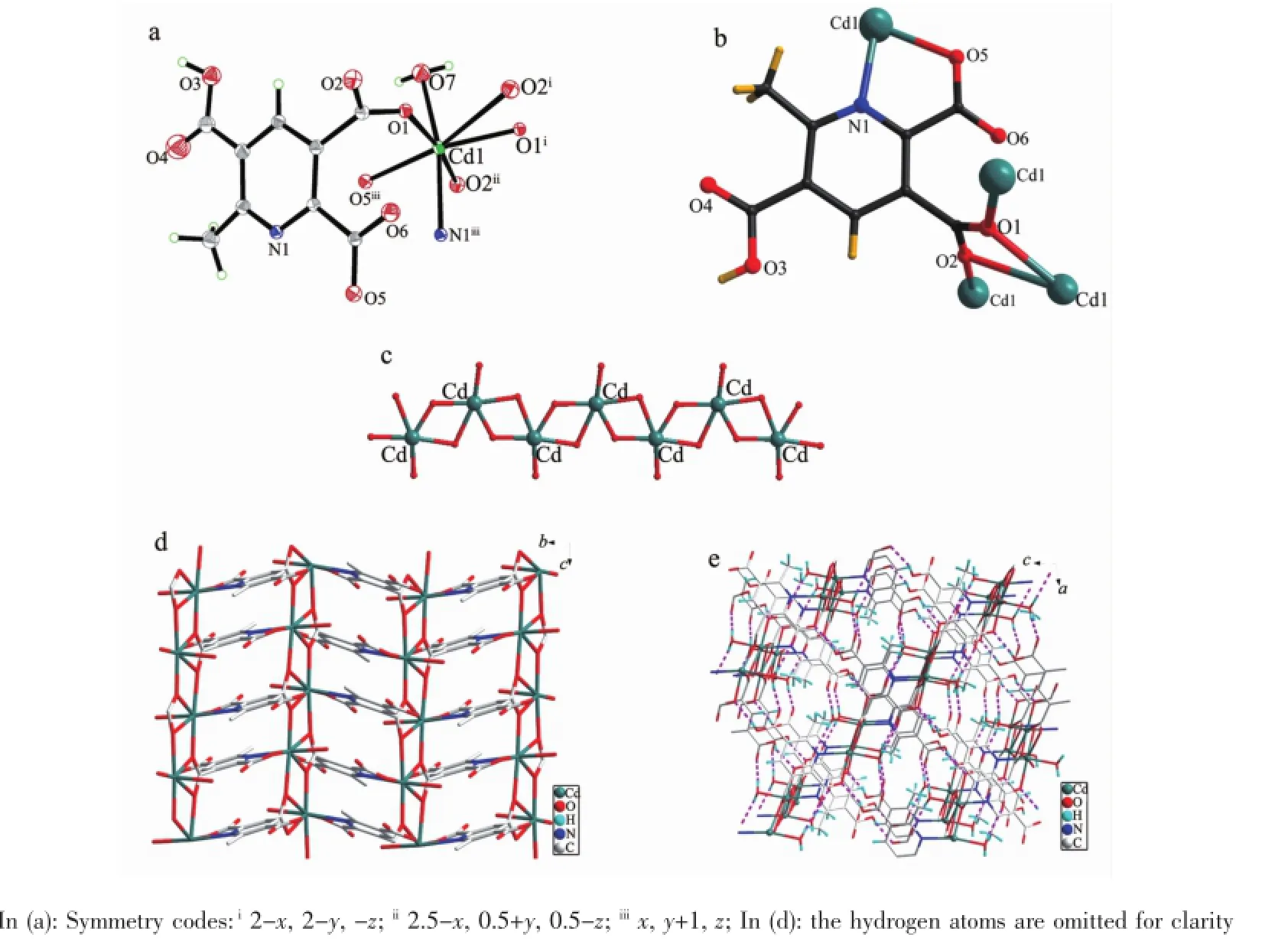
Fig.3 (a)The coordination environment of the Cdion in 2 with 50%thermal ellipsoid probability;(b)The coordination mode of Hmptc2-in 2;(c)View of 1D Cd-O grid chain;(d)2D grid structure of 2;(e)3D packing diagram of 2 connected by hydrogen bonds
The Hmptc2-ligand in complex 2 exhibits a tetradentatechelatingandbridgingcoordination modes:a carboxylate group and a pyridine nitrogen chelate with one Cdion bidentately;another carboxylate group adopts a chelate/bridge tetradentate coordination mode connecting three Cdmetal ion (Fig.3b).In the crystal structure,neighboring Cdcenters are connected to each other by the carboxylate groups to form an infinite one-dimensional Cd-O grid chain that runs along the a-axis with a Cd…Cdseparation of 0.402 78(2)nm(Fig.3c).These onedimensional(1D)chains are parallel to each other and further linked together by Hmptc2-ligands to generate a 0.792 56 nm×0.993 04 nm 2D grid network in the bc plane(Fig.3d).Moreover,O…O hydrogen bonds between carboxylate oxygen atoms and lattice water molecules further extend 2D layered network into a 3D supramolecular framework along the ac plane (Fig.3e).
2.2Thermal gravimetric analysis
To study the thermalstabilitiesofthetwo complexes,thermal gravimetric analysis of complexes 1~2 was performed under the atmosphere of air in the temperature range of 30~800℃.As shown in Fig.4, complex 1 first lost all water molecules below 160℃; the weight loss found of 15.45%was consistent with that calculated(15.86%).After the loss of water molecules,a continuously weight loss occurs in the temperature range of 160~350℃,which is due to the degradation of Hmptc2-ligand.The residue,22.38%,is expected to be the mixture of CuO and Cu2O.The TG curve of 2 indicates the first weight loss is about 4.99%from 30 to ca.225℃,corresponding to the loss of coordinated water molecules,which is in agreement with the calculated value(5.09%).The second weight loss,59.19%,occurs in the temperature range of 225~460℃,which is due to the degradation of Hmptc2-ligand(Calcd.58.59%).The residue, 35.82%,is expected to be CdO,which is in agreement with the calculated value,36.82%.
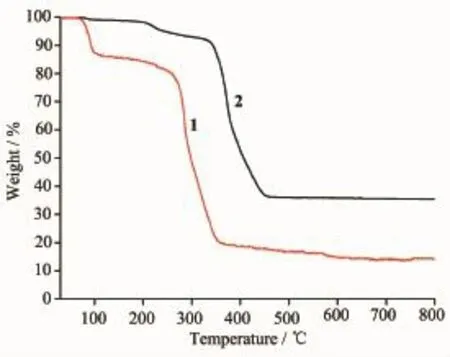
Fig.4 TGA curves for 1 and 2
2.3Fluorescence
Luminescent properties of compounds containing d10metal centers have attracted more interest due to theirpotentialapplicationsinchemicalsensors, photochemistry,electroluminescent display,and so on[20-21].Thus,solid-state emission spectra of the complex 2 have been investigated at room temperature(Fig.7). It can be observed that intense blue/green fluorescent emissions occur at 503 nm(λex=340 nm)for 2.To further analyze the nature of the emission band,the photoluminescent properties of H3mptc have also been exploredinthisresearch.FreeH3mptcligand fluoresces with the emission peaks at 398 nm upon excitation at 320 nm.Obviously,complex 2 exhibits one small red shift compared to the band shown by the free ligand.This may be due to the chelating and/ or bridging effect of the ligand to the metal centers, which effectively increases the rigidity of the ligand and reduces the loss of energy via a radiationless decay[22-23].
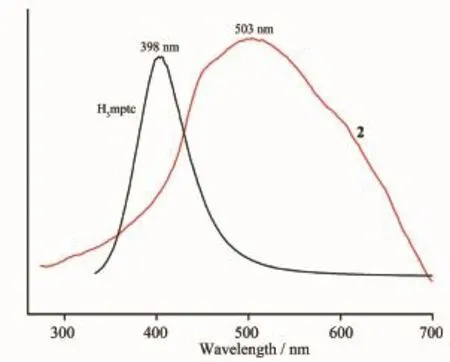
Fig.5Emission spectra of the ligand(H3mptc)and complex 2 at room temperature
According to the literature,the Cdions are difficult to oxidize or reduce because of the d10configuration.As a result,the emission of the complex 2 is neither metal-to-ligand charge transfer(MLCT) norligand-to-metalchargetransfer(LMCT)in nature[24].On the basis of the empirical data,such emission of complex 2 may be owing to the intraligand transition.
3 Conclusions
In summary,we have successfully prepared two new coordination polymers via using H3mptc as theorganic linker.Different structures of complexes 1 and 2 imply that the H3mptc ligand is of the ability to adjust its coordination modes and configuration in differentreactionsystems.Thestructural characteristics of 1 and 2 are unusual compared to other Cu or Cd complexes constructed from the tetracarboxylate or tricarboxylate analogues[25-27].The introduction of 6-methyl group can decrease the symmetry of the organic ligand,which may result in theformationofunusualMOF.Furthermore, complexes 1 and 2 still have a protonated carboxylic acid moiety for the acidic condition,which may make lowdimensionalstructureofcomplexes.Further experiments are in progress aiming at designing new coordination polymers based on H3mptc and other transition metals in order to better understand the nature of luminescence properties in these systems.
References:
[1]Wang F Q,Weng D F,Zheng X J,et al.Inorg.Chim.Acta, 2007,360(6):2029-2038
[2]Yaghi O M,O′Keeffe M,Ockwig N W,et al.Nature,2003, 423(6941):705-714
[3]Halder G J,Kepert C J,Moubaraki B.Science,2002,298: 1762-1765
[4]Pan L,Olson D H,Ciemnolonski L R,et al.Angew.Chem., 2006,118:632-635
[5]Liu Y Y,Ma J F,Yang J,et al.Inorg.Chem.,2007,46:3027-3037
[6]Li J R,Timmons D J,Zhou H C.J.Am.Chem.Soc.,2009, 131:6368-6369
[7]Ke C H,Lin G R,Kuo B C,et al.Cryst.Growth Des.,2012, 12:3758-3765
[8]Kreno L E,Leong K,Farha O K,et al.Chem.Rev.,2012, 112:1105-1125
[9]Forster P M,Stock N,Cheetham A K.Angew.Chem.Int. Ed.,2005,44:7608-7611 [10]Barnett S A,Champness N R.Coord.Chem.Rev.,2003, 246:145-168
[11]Chu Q,Liu G X,Huang Y Q,et al.Dalton Trans.,2007,38: 4302-4311
[12]Yang A H,Zhang H,Yin P,et al.Inorg.Chem.Commun., 2010,13:1304-1308
[13]Yang A H,Zhang H,Gao H L,et al.Cryst.Growth Des., 2008,8:3354-3359
[14]Yan S T,Shi L X,Sun F F,et al.CrystEngComm,2010,12: 3437-3440
[15]Yang A H,Zhao L H,Quan Y P,et al.Cryst.Growth Des., 2010,10:218-223
[16](a)Sheldrick G M.SHELXL-97,Program for the Solution of Crystal Structures,University of G?ttingen,G?ttingen, Germany,1997. (b)Sheldrick G M.SHELXL-97,Program for the Refinement of Crystal Structures,University of G?ttingen,G?ttingen, Germany,1997.
[17]Yordanova S,Temiz H T,Boyaci I H,et al.J.Mol.Struct., 2015,1101:50-56
[18]Chen X L,Zhang B,Hu H M,et al.Cryst.Growth Des., 2008,8:3706-3712
[19]Dai J C,Wu X T,Fu Z Y,et al.Inorg.Chem.,2002,41: 1391-1396
[20]Zheng S L,Yang J H,Yu X L,et al.Inorg.Chem.,2004,43: 830-838
[21]Zheng S L,Zhang J P,Chen X M,et al.Chem.-Eur.J., 2003,9:3888-3896
[22]Yersin H,Vogler A.Photochemistry and Photophysics of Coordination Compounds.Berlin:Springer-Verlag,1987.
[23]ValeurB.MolecularFluorescence:Principlesand Applications.Weinheim:WILEY-VCH Verlag GmbH,2002.
[24]Allendorf M D,Bauer C A,Bhakta R K,et al.Chem.Soc. Rev.,2009,38:1330-1352
[25]Yang A H,Quan Y P,Zhao L H,et al.J.Coord.Chem., 2009,62:3306-3313
[26]Wang L Y,Wang J G,Xie C Z.J.Coord.Chem.,2008,61: 3401-3409
[27]Wang H S,Ma J G,Zhai B,et al.J.Mol.Struct.,2007,829: 1-7
Syntheses,Structures,and Properties of Transition Metal Complexes Constructed from 6-Methyl-2,3,5-pyridinetricarboxylic Acid
SU Xiu-Mei*,1JIANG Li2YI Yong-Ling2
(1College of Chemistry,Tianjin Normal University,Tianjin 300387,China) (2Department of Chemistry,Tianjin University,Tianjin 300072,China)
Two new transition metal coordination polymers,{[Cu(Hmptc)(H2O)]·2H2O}n(1)and{Cd(Hmptc)(H2O)}n(2),were successfully constructed from transition metal salts with 6-methyl-2,3,5-pyridinetricarboxylic acid(H3mptc). Complex 1 exhibits a 2D coordination network,in which rectangle channels are shown to exist.In complex 2,Cdcenters are linked by Hmptc2-ligands into 2D grid-like layers,which are further linked by hydrogen bonding interactions to form a 3D supramolecular network.In addition,complex 2 exhibits blue/green luminescence in the solid state at room temperature.CCDC:906071,1;906072,2.
6-methyl-2,3,5-pyridinetricarboxylic acid;coordination polymers;luminescence properties
O614.121;O614.24+2
A
1001-4861(2016)02-0320-07
10.11862/CJIC.2016.027
2015-08-20。收修改稿日期:2015-11-27。
*通信聯(lián)系人。E-mail:hxxysxm@mail.tjnu.edu.cn
- 無機化學學報的其它文章
- 一個基于N′-(3-溴-5-氯-2-羥基苯亞甲基)-3-羥基-4-甲氧基苯甲酰肼的甲基麥芽酚配位的氧釩配合物:合成、晶體結(jié)構(gòu)及其胰島素增強活性
- 由V-型雙咪唑和芳香羧酸根配體共同構(gòu)筑的Zn配位聚合物的合成,結(jié)構(gòu)與性能
- 多次透射反射紅外光譜法靈敏和準確地測量單晶硅中間隙氧和代位碳的含量
- 基于2-甲基-8-羥基喹啉的鏑單分子磁體的晶體結(jié)構(gòu)及磁性
- 三個喹啉氧基乙酰胺鑭系(Eu、Gd、Er)配合物的合成、結(jié)構(gòu)及Eu配合物的熒光性質(zhì)
- 兩個Schiff堿銅配合物的合成、晶體結(jié)構(gòu)、光譜性質(zhì)及取代基效應