CHINA KEY PHRASES
2016-11-14 22:32:16
CHINA TODAY 2016年11期
CHINA KEY PHRASES
全面建成小康社會(huì)
“小康社會(huì)”是由鄧小平在20世紀(jì)70年代末80年代初在規(guī)劃中國經(jīng)濟(jì)社會(huì)發(fā)展藍(lán)圖時(shí)提出的戰(zhàn)略構(gòu)想。隨著中國特色社會(huì)主義建設(shè)事業(yè)的深入,其內(nèi)涵和意義不斷地得到豐富和發(fā)展。在20世紀(jì)末基本實(shí)現(xiàn)“小康”的情況下,中共十六大報(bào)告明確提出了“全面建設(shè)小康社會(huì)”,中共十七大報(bào)告在此基礎(chǔ)上提出新的更高要求,中共十八大報(bào)告根據(jù)我國經(jīng)濟(jì)社會(huì)發(fā)展實(shí)際和新的階段性特征,在黨的十六大、十七大確立的全面建設(shè)小康社會(huì)目標(biāo)的基礎(chǔ)上,提出了到2020年“全面建成小康社會(huì)”的目標(biāo)。全面建成小康社會(huì)的目標(biāo)主要包括:第一,轉(zhuǎn)變經(jīng)濟(jì)發(fā)展方式取得重大進(jìn)展;第二,實(shí)現(xiàn)兩個(gè)“倍增”,即國內(nèi)生產(chǎn)總值和城鄉(xiāng)居民人均收入比2010年翻一番;第三,通過增強(qiáng)創(chuàng)新驅(qū)動(dòng)發(fā)展新動(dòng)力,進(jìn)入創(chuàng)新型國家行列;第四,工業(yè)化基本實(shí)現(xiàn),信息化水平大幅提升,城鎮(zhèn)化質(zhì)量明顯提高,農(nóng)業(yè)現(xiàn)代化和社會(huì)主義新農(nóng)村建設(shè)成效顯著;第五,區(qū)域協(xié)調(diào)發(fā)展機(jī)制基本形成;第六,對外開放水平進(jìn)一步提高,國際競爭力明顯增強(qiáng)。
Complete the Process of Building a Moderately Well-off Society in All Respects
Deng Xiaoping created the vision of a moderately well-off society in the late 1970s and early 1980s, while the blueprint for China’s economic and social development was being crafted. The concept has since been enriched and deepened in an evolving process of social-economic development with Chinese characteristics.
In consideration of the fact that the goal of a markedly improved life for Chinese people had basically become a reality by the end of the 20th century, the CPC Central Committee called for a continued push to build a moderately well-off society in all respects in its report to the 16th National Congress. New and more ambitious elements were subsequently added to this already expanded concept at the Party’s 17th National Congress (held in 2007). In view of the current status and future characteristics of China’s social-economic development, the CPC Central Committee announced in its report to the 18th National Congress the goal of completing the process of building a moderately well-off society in all respects by the year 2020 on the basis of what had been achieved since the Party’s previous two major gatherings.
Specifically, the goal calls for: (1) making major progress in transforming China’s growth model; (2) doubling China’s 2010 GDP and the per capita income of both urban and rural residents; (3) promoting innovation and pursuing innovation-driven development; (4) basically completing the process of industrialization, markedly expanding access to information technology, achieving better urbanization management, and making notable progress in agricultural modernization and rural development; (5) establishing a mechanism for coordinated development across all regions; and (6) opening up further and notably improving China’s international competitiveness.
精準(zhǔn)扶貧、精準(zhǔn)脫貧
2014年12月11日閉幕的中國中央經(jīng)濟(jì)工作會(huì)議,首次在中央工作層面明確提出了精準(zhǔn)脫貧的概念;2015年6月18日,習(xí)近平在貴州調(diào)研時(shí)強(qiáng)調(diào),扶貧開發(fā)“貴在精準(zhǔn),重在精準(zhǔn),成敗之舉在于精準(zhǔn)”,“精準(zhǔn)扶貧”隨后成為社會(huì)各界熱議的關(guān)鍵詞。2015年11月3日發(fā)布的“十三五規(guī)劃建議”中,進(jìn)一步作出“實(shí)施精準(zhǔn)扶貧、精準(zhǔn)脫貧”的工作部署。精準(zhǔn)脫貧,就是要防止用經(jīng)濟(jì)收入的平均數(shù)掩蓋大多數(shù),更加注重保障基本民生,更加關(guān)注低收入群眾生活。精準(zhǔn)扶貧,則是要做到對貧困人口進(jìn)行精確識別、精確幫扶,對扶貧工作做到精確管理。中央明確提出精準(zhǔn)扶貧、精準(zhǔn)脫貧,是因?yàn)橹袊姆鲐氶_發(fā)工作已進(jìn)入“啃硬骨頭、攻堅(jiān)拔寨”的沖刺期。為了真正實(shí)現(xiàn)“精準(zhǔn)”目標(biāo),習(xí)近平提出了“扶貧對象精準(zhǔn)、措施到戶精準(zhǔn)、項(xiàng)目安排精準(zhǔn)、資金使用精準(zhǔn)、因村派人精準(zhǔn)、脫貧成效精準(zhǔn)”的具體要求。
Targeted Approach to Alleviating Poverty
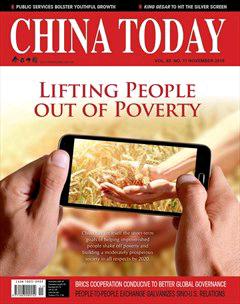
At the conclusion of the Central Economic Work Meeting on December 11, 2014, the central leadership foated the idea of a targeted approach to alleviating poverty. On June 18, 2015, during his visit to Guizhou Province, Xi Jinping once more raised the subject, which he believes is pivotal to the success of the poverty alleviation drive. It has subsequently become a hot topic amongst the general public. In its Proposal for Formulating the 13th Five-Year Plan for National Economic and Social Development, released in November 2015, the 18th CPC Central Committee specifed targeted measures to be taken in the coming fve years.
The targeted efforts are designed to ensure that average income statistics do not mask the actual living conditions of those living in hardship. Such efforts require attention to detail. Greater emphasis will be laid upon identifying low-income groups in need of assistance in order that they may receive due attention and their basic standard of living guaranteed.
The central leadership proposed such a targeted approach at a time when China faces a daunting challenge in its efforts to eliminate the final pockets of poverty across the country. To ensure the effectiveness of poverty reduction efforts, Xi Jinping called for assistance policies and programs that are tailored to the needs of individual families in conjunction with targeted funding and village-specifc expert support, and pursued with a results-oriented focus.
Editor’s note: In this column we present to you the phrases used every day in the media and by Chinese government, so providing a succinct overview of China’s political thinking, its policies and ongoing reforms and transitions.
猜你喜歡
中國核電(2021年3期)2021-08-13 08:56:36
中國外匯(2019年18期)2019-11-25 01:41:56
家庭影院技術(shù)(2018年11期)2019-01-21 02:20:52
電子制作(2018年14期)2018-08-21 01:38:28
華人時(shí)刊(2017年21期)2018-01-31 02:24:01
人大建設(shè)(2017年10期)2018-01-23 03:10:17
民生周刊(2017年19期)2017-10-25 10:29:03
北方交通(2016年12期)2017-01-15 13:52:53
汽車零部件(2014年9期)2014-09-18 09:19:14
中央社會(huì)主義學(xué)院學(xué)報(bào)(2013年1期)2013-03-01 04:17:32