Cooperate via G20 for Shared Prosperity
2016-10-08 01:41:51ByLIGANG
CHINA TODAY 2016年9期
By LI GANG
AS an increasingly significant platform for economic cooperation and global governance, the G20 plays a key role in boosting cooperation and coordination of world economic development. The aggregate size of G20 member countries economies accounts for roughly 85 percent of the world total, and their population for more than 60 percent of the global total. Therefore, achieving G20 development targets and promoting international cooperation under the G20 framework is vital to achieving the UNs Sustainable Development Goals (SDGs).
In September 2015, the 2030 Agenda for Sustainable Development was adopted by all 193 member countries at the UN Sustainable Development Summit. The agenda covers a wide spectrum of issues, represented in the 17 SDGs and their 169 sub-goals. The core aim is to eliminate hunger and poverty throughout the world by 2030. The ambitious agenda outlines the grand blueprint for world development over the next 15 years. Whether or not these goals will be achieved depends on the actions of and collaboration between all countries.
Chinas Contribution
In the three decades since the adoption of the reform and opening-up policy, China has developed astoundingly fast. As the largest developing nation, it has not only contributed to world economic growth, but its unique approach also provides useful lessons to other developing countries.
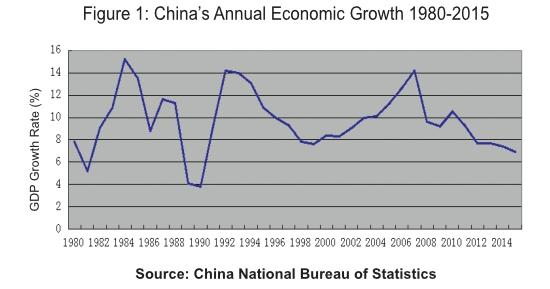
From 1980 to 2010 China maintained an average growth rate of 10.4 percent per annum (See Figure 1). In 2010, Chinas GDP surpassed that of Japan, and in doing so became the worlds second largest economy. Impacted by the global economic slowdown, the Chinese economy also entered a period of comparatively lower growth. It fell to 7.7 percent in 2012, the fi rst time since 2000 that growth dropped below eight percent.
Under the new circumstance, China has upped the pace of industrial restructuring, transforming the economy from one centered on investment and export to one driven by domestic consumption. The growth quality, along with the growth rate, has become a benchmark of this “new normal” stage of the Chinese economy. Though decelerating, the growth rate is still above the global average as well as that of other developing countries. In 2015, Chinas growth declined to 6.9 percent, while the average of developing countries and that of the world was four percent and 3.1 percent respectively.
Brexit has affected market and investor confidence, leading to increasing uncertainty in both the European and world economy. The “Global Economic Outlook”released by the IMF on July 19 downgraded the growth estimates for developed countries and the world as a whole by 0.1 percent, while lifting the estimate of Chinas growth by 0.1 percent. The IMF forecasts that China will continue to contribute one quarter of total world economic growth between 2016 and 2020. And in 2020, China is expected to comprise 20 percent of the world economy, compared with the current 17 percent. China will thus remain a main driver of the global economy.
China has also made remarkable progress in poverty elimination, one of the key indicators of the UN Millennium Development Goals (MDGs). Adopted in September 2000, the historic MDGs had led the world development framework for 15 years as an indicator measuring a countrys development achievement.
China has long highly valued the eradication of poverty and hunger, free compulsory education, gender equality, maternal and childrens health, disease preven- tion and control, and environmental protection. Taking poverty reduction as an example. In 2011, there were 250 million people in China living on a daily expenditure of under US $1.25. This was a precipitous drop compared with the 689 million in 1990, signaling that China had achieved the MDGs target of halving the proportion of the population living in poverty. The number of people suffering malnutrition accounted for 10.6 percent of the countrys total population in 2014, having declined from 23.9 percent in 1992. In 2014 the UN Food and Agriculture Organization awarded China a prize for halving the proportion of the population subject to hunger.
As a responsible developing country, China is also actively engaged in South-South cooperation to help other developing countries, especially least developed lowincome countries. It has assisted reconstruction projects, provided goods and materials, donated to development organizations, provided professional and technical training, dispatched medical teams, wiped out debts, etc.
According to the Report on Chinas Implementation of the Millennium Development Goals 2000-2015, jointly released by Chinas Foreign Ministry and the United Nations System in China, China has provided about RMB 400 billion in assistance to 166 countries and international organizations, and trained more than 12 million professionals and technicians since the founding of the Peoples Republic of China in 1949.
Improve Equilibrium and Democracy in Global Governance
The G20 encompasses 11 emerging economies and developing countries, namely, Argentina, Brazil, China, India, Indonesia, Mexico, South Korea, Russia, Saudi Arabia, South Africa, and Turkey. The 11 countries combined account for about 30 percent of the worlds total economy, and half of the total population. Against the backdrop of weak economic, trade, and investment growth worldwide, the developing countries have maintained a relatively higher growth rate. In addition to their huge market demand, they have become major drivers of the world economy. The IMF forecasts that emerging economies and developing countries will grow at a rate of 4.1 percent and 4.6 percent, respectively, from 2016 to 2017, well above the predicted global average of 3.1 percent and 3.4 percent.
A main flaw in the existing global economic governance system is that of developing countries lacking representation and say in international economic organizations such as the IMF and World Bank. The current global economic system and its rules, formed half a century ago, are still dominated by developed countries who can no longer solve major global issues without the participation of emerging economies.
World economic growth necessitates accelerating global financial governance reform. According to 2015 IMF data, the U.S. economy accounts for 15.81 percent of the world total. Its quota and voting power in the IMF are 17.51 percent and 16.58 percent, almost in line with its economic status. In comparison, China accounts for 17.08 percent of the world economy, while its quota and voting power stand at merely 6.43 percent and 6.11 percent in the IMF. Similarly, India and Brazil enjoy rights in the IMF incompatible with their economic size. Reforming the existing global economic governance system under the G20 framework is conducive to enhancing the representation and say of developing countries, so effectively offsetting the deficiencies of the current global economic governance system.
Chinas Initiatives at the G20
The G20 Summit in Hangzhou is themed “Toward an Innovative, Invigorated, Interconnected and Inclusive World Economy.” The forum seeks consensus in four areas – innovated growth patterns, improved global economic and financial governance, accelerated international trade and investment, and promotion of inclusive and coordinated development.
China proposes a series of initiatives under the G20 framework. First, it advocates innovative growth patterns to narrow the industrialization gap between developing and developed countries. Against the backdrop of the global economic downturn, it is hard to revive the macro economy and achieve steady growth solely via fiscal stimulus and loose monetary policy. Only by reinforcing technological innovation and economic restructuring can developing countries strengthen their competitiveness and growth potential in the mid to long term. Therefore, China proposes to formulate a G20 roadmap for innovative growth that helps developed countries to enhance R&D capacities and industrialization, and adds new impetus to world economic growth.
Second, China calls for accelerating global financial governance reform to enhance the representation and say of developing countries in international financial organizations. It is a common demand of developing countries to push forward IMF and World Bank reforms, to promote diversification of the monetary system, and end the dominance of the U.S. dollar. Chinas initiative in this regard represents the common interests of developing countries, and is in the interest of the health of the world economy.
Last but not least, China advocates reform of the world trade and investment system, so as to promote developing countries trade and increase their attraction of foreign capital. As a member of the WTO and a big trading country, China is a steadfast advocator of free trade, and against any form of trade protectionism. In the context of increasing economic integration, transnational investment is becoming more commonplace. In this regard, formulating a global investment governance framework and strengthening policy coordination are expected to effectively protect investors interests. With regard to the lack of funds and foreign investment of some developing countries, China proposes initiatives that promote both investment and the investing environment in these countries, so to help them escape their low-income plight.