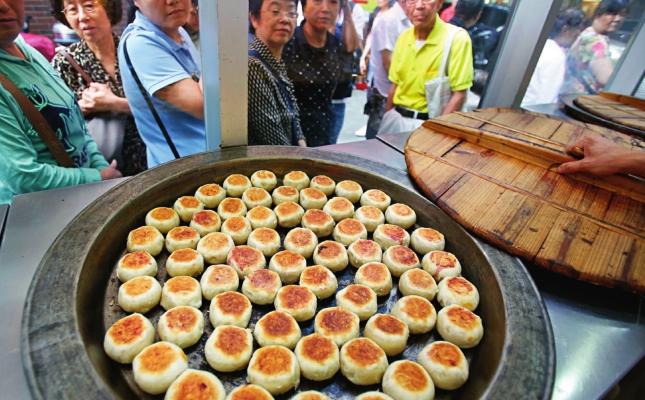
Customs around the Mid-Autumn festival
2016-10-08 01:41:51
CHINA TODAY 2016年9期
THE traditional Mid-Autumn Festival enjoys great popularity in China where it is second only to the Spring Festival, or Chinese New Year, and in some of its neighboring countries.
The Mid-Autumn Festival falls on the 15th day of the eighth lunar month. Since ancient times, people have celebrated it by worshipping and admiring the glorious full moon, and enjoying osmanthus flowers and fermented-osmanthus wine. The Chinese believe that the full moon represents family reunions. Therefore, Mid-Autumn Festival is also a day for families to get together and for those far away from home to think of their loved ones.
Influenced by Chinese culture, certain other countries in East and Southeast Asia also celebrate the Mid-Autumn Festival. In 2006, the holiday was added to the list of Chinas first batch of national intangible cultural heritages.
Origins
Mid-Autumn Day, as the name suggests, usually falls in late September. As the full moon implies family reunions, it is also called the “reunion festival.”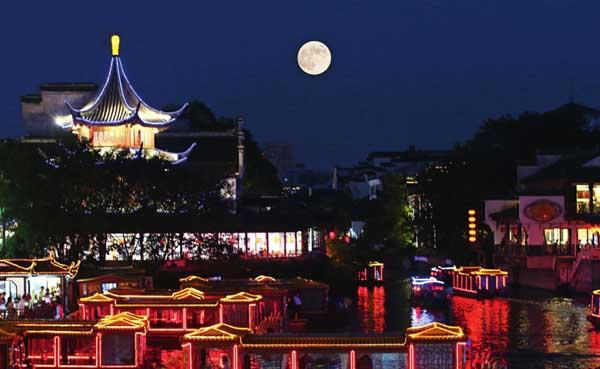
The Chinese peoples tradition of worshiping the moon and offering sacrifices to it can be traced back more than 2,000 years. The Mid-Autumn Festival also happens to be a harvest season. To show their gratitude to Heaven for a good harvest, Chinese ancients held celebratory activities around this day. At this time of year, its cool, but not yet cold. Clear skies and crisp air make it a good time to enjoy the beauty of the full moon. Hence, later, celebrations of the festival laid greater emphasis on enjoying the moon rather than making sacrifices, as new connotations became attached to it.
Ancient customs, rites, myths, legends and other factors of traditional Chinese culture have combined to imbue the Mid-Autumn Festival with rich content and cultural connotations in its evolution. The most famous legends told around the festival are fairy tales about the Moon Palace, relating to such figures as the Moon Goddess, and Tang Dynasty Emperor Li Longji (685-762) and his concubine Yang Yuhuan.
In the seventh century, the Mid-Autumn became an established festival as related celebrations of a bright full moon and feasting became prevalent. In the 10th century, the mooncake, a special dessert for the day, made an appearance, and the festival became even more popular as the accompanying celebrations evolved. By the 14th century, its importance was second only to that of the Spring Festival.
At Mid-Autumn Festival, a memorial tablet to the Moon Goddess is set up in each household with fruits, melons and mooncakes placed in front of it as a sacrifice. The cake must be round and melons and fruits cut into lotus-petal-shaped pieces. Some people also buy joss paper with images of the Goddess and patterns like the Jade Rabbit making heavenly medicine printed on it. After the moonworshipping ceremony, people burn the joss paper and family members share the fruits and moon cakes. At the festival of family reunion, people give each other mooncakes as gifts to express their good wishes.
Apart from the common traditions, different regions also have their unique customs and celebrations on this day. For people in East Chinas Zhejiang Province, tidal bore watching is an important event on this day when the Earth is at its almost closest position to the Sun, when the most spectacular tides are formed in the Qiantang River. Its turbulent waves can sometimes reach several meters in height, overwhelming everything in their way, like herds of stampeding horses.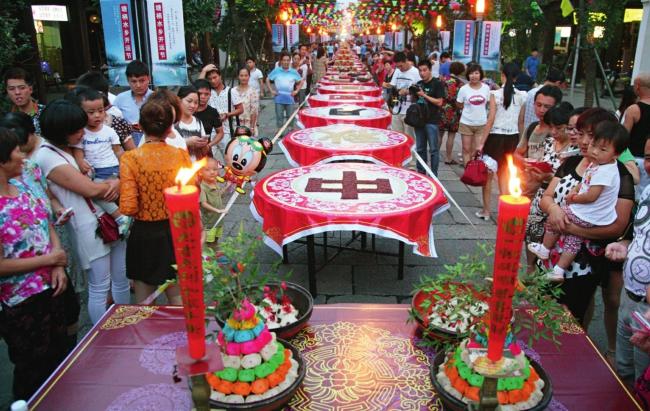
One particular Chinese folk tale relates how in the Moon Palace there was a huge osmanthus tree, more than 1,000 meters tall. Due to his violation of Taoist rules, Wu Gang was banished to the Moon Palace to cut down the tree as punishment. However, the sacred tree could self-heal the cuts Wu made on its trunk. Although hundreds of years passed by, the magic tree still thrived even though Wu chopped it diligently every day. Wu was allowed to rest only on the Mid-Autumn Day.
The eighth month of the lunar calendar is also a season of osmanthus blossom fragrance. Blossoms can be used to make various delicacies. It has therefore become traditional for people to drink fermented wine made from osmanthus flowers on that day, while eating other osmanthus-flavored delicacies.
In Guangzhou, on Mid-Autumn night, kids fix different shaped lanterns on short sticks that are then positioned vertically one by one on a high pole. These splendidly glittering lights, add a new beauty to the festival. Kids enjoy racing to be the first to erect the highest pole hung with the most exquisite and largest number of lamps. In Nanning, Guangxi Zhuang Autonomous Region, people also have a tradition of making lamps with bamboo strips that are hung in front of a moon-worshipping table. Kids also play with these lamps. In addition, lamps made from grapefruit, orange peel and pumpkin are also popular during this festival.