
Trumping a New Foreign Policy
2016-08-30 02:42:54CliffordA.Kiracofe
Beijing Review 2016年32期
?
Trumping a New Foreign Policy
A Donald Trump presidency would shake-up the current system By Clifford A. Kiracofe

The author is an educator and former SeniorProfessional Staff Member of the U.S. Senate Foreign Relations Committee
With the conclusion of both party conventions, the turbulent 2016 election process in the United States now enters its final phase. The situation at home and abroad lends to this election a sense of deep dissatisfaction and trepidation among voters. Whatever the result in November, many see the event as an existential turning point for the nation.
Both the Republican and Democratic parties have significant internal factional divisions, with Donald Trump and Bernie Sanders bringing these internal contradictions to a head in their respective parties this year.
The election mosaic
These contradictions reflect a fundamental political split between factions supported by the financiers of “Wall Street” and “Main Street,”which represents the working class groups opposed to the corporate power behind the political scene.
On the Republican side, Trump advocates a political line rooted in nationalism and populism, encapsulated by his slogan, “make America great again.” Thus, he opposes the Wall Street-backed establishment and is reasonably popular among Main Street cadres composed of the middle class and small business owners. Like Ronald Reagan, he also appeals to the bluecollar working class.
On the Democratic side, Sanders favors progressive policies and is opposed to vested interests. His strongest support comes from young idealistic voters as well as more generally from among liberals and progressives. Despite espousing a very different type of politics to Trump, Sanders is also highly critical of the Wall Street-backed establishment.
However, Sanders, to the dismay of some of his most ardent supporters, finally endorsed Hilary Clinton, who many consider to be a creature of Wall Street. While many Americans are well aware of Wall Street and its machinations, this may not be so apparent to international observers who rely on U.S. mainstream media. The hostile media coverage toward Trump and Sanders may therefore surprise them.
This can be explained by the following: Major corporate media in the United States is financed by Wall Street and has been dominated by such interests for over a century. With each passing decade there has been a higher concentration in ownership in print and electronic media and more uniformity in news management from a reporting and editorial standpoint. Thus, Trump and Sanders are targeted as the only main party candidates that oppose Wall Street.
A leading example of the deep division at the domestic level is the debate over imposing regulations on the U.S. banking system to promote financial stability. The key piece of Congressional legislation today harkens back to 1932, when the Glass-Steagall Act separated investment and commercial banking, helping to stabilize the economy in the aftermath of the 1929 stock market crash and subsequent Depression.
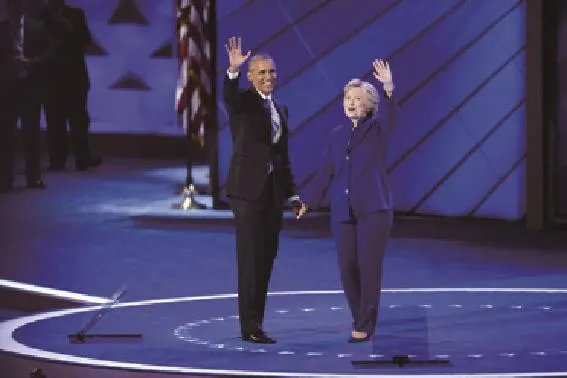
U.S. President Barack Obama endorses Hillary Clinton for president during his speech at the 2016 Democratic National Convention in Philadelphia on July 27
When President Franklin Roosevelt assumed office the following year, additionalmeasures were taken to rehabilitate the U.S. financial system, including the 1933 Bank Act. However in 1989, Wall Street successfully lobbied Congress to repeal the Glass-Steagall legislation. Many analysts believe this set the stage for the financial crisis of 2007-08.
Another major divide concerns immigration legislation. Republicans, with Trump leading the charge, greatly favor enhanced border security to combat mass illegal immigration across the southern border. But other Republican factions, such as the Wall Street-backed Paul Ryan support open borders. Today, Ryan faces a rising tide of opposition in his home district in Wisconsin for his stance.
The Democratic Party is pro-open borders in general. While behind the scenes, irrespective of political party, major U.S. corporations also favor open borders, since it gives them access to a larger pool of workers, thereby depressing American wages.

Donald Trump delivers a speech at the Republican National Convention in Cleveland after being officially nominated as the Republican presidential candidate on July 21
On foreign policy
As for foreign policy, a further area of contention, evaluations should be made from a historical perspective. There is a fundamental rift between those who believe the United States should play an active and leading role in the world as the global hegemon and those who support a more domestically focused, less hands-on approach.
The former endorses global financial capitalism and a worldwide imperial policy that requires continuous military intervention. In contrast, the latter group opposes endless foreign wars and the constant meddling in the internal affairs of other countries typified by regime change policy.
Critics accuse those who oppose interventionism of being “isolationist.” Yet, historically the United States from its very beginning in Jamestown, Virginia, in 1607, as the first permanently settled English colony, has never been isolated from international affairs.
With the exception of Trump, every Republican candidate campaigned for an imperial foreign policy. Clinton, of course, would maintain the established hegemonic policy which she herself implemented dutifully as secretary of state.
Many expect a Clinton presidency would not only maintain current U.S. foreign policy, but also add a more aggressive edge to it. Such a hawkish policy would combine the hard power dominance advocated by the influential neoconservative with increased human rights advocacy.
So far, Trump has indicated his preference for less interventionism. He has stated that U.S. allies in Asia and in Europe should be less reliant on U.S. support and has questioned NATO’s usefulness.
Would the Republican nominee also increase the role of diplomacy? Trump regularly talks up his business background in honing his negotiation skills. In this context, he says there will be greater emphasis on negotiation in U.S. foreign affairs.
U.S. foreign policy is slow in changing. In fact, the present policy is in essence an updated Cold War policy of world hegemony relying on beefed up alliances and the globalization of NATO.
If Trump became president and really desired a major shift in U.S. global policy direction, toward Russia and China in particular, it would certainly be possible. A new president could call on government professionals in diplomacy, intelligence, and the military to support a new set of policies.
Although Trump has been reticent on policy detail, his general remarks seem to indicate he would implement fundamental changes to foreign policy. The briefings he began to receive from the U.S. intelligence community after the conventions will no doubt help him to better understand the international climate and the challenges facing the United States.
His statements on cooperation with Russia indicate that he may consider relations with major powers as an integral pillar of his foreign policy. Thus, he might be amenable to Chinese President Xi Jinping’s calls for a new type of major power relations.
Trump appears to be more of a pragmatist than an ideologue. Working through discussion, consultation, and negotiation with major powers would seem to play to his strengths given his background in international business. The best path forward for the United States in Asia is to promote a “Pacific Community” focused on peace and development. Cooperation with China, Japan, and Russia as well as with all states around the Pacific Rim is called for.
As for the situation on the Korean Peninsula, new thinking is certainly required from Washington. Trump has boldly claimed that he would personally meet with Kim Jong Un, the North Korean top leader. There is no reason why a new vision for the region could not be advanced.
Using the six-party talks, a mechanism involving North Korea, South Korea, China, Japan, Russia and the United States that aims to achieve peace in the region, real progress could be made. Such a vision could involve the neutralization of the Korean Peninsula, which could be guaranteed by the six parties and by the UN, resulting in no nuclear weapons in North Korea and the removal of all U.S. troops as well as systems such as the THAAD missile defense system set up in South Korea.
The election process in the United States has been full of fluctuations and surprises. There’s little doubt there will be more twists and turns before November’s climax. Should Clinton win, we can expect more of the same from Washington. However, should Trump win, there may be some very interesting possibilities representing a clear break from the current establishment.
Copyedited by Dominic James Madar
Comments to liuyunyun@bjreview.com
