
An Economic Facelift
2016-09-12 22:28:30
Beijing Review 2016年32期
As developing countries around the world continue to face harsh economic challenges, a new approach to changing the status quo has become imperative. Enter New Structural Economics (NSE), an enlightened theory put forward by Justin Yifu Lin, former World Bank chief economist and present honorary Dean of Peking Universitys National School of Development.
Lin says economic development is a process of continuous structural change. Whereas in the past, economic theories always used high-income countries as the reference, NSE proposes the opposite. He advises developing countries to look at what they have now, what they can do well, and how to create the conditions to scale that up. Lin shares his thoughts on his theory and how it can be applied to African countries in an exclusive interview with ChinAfrica, a monthly publication of Beijing Review.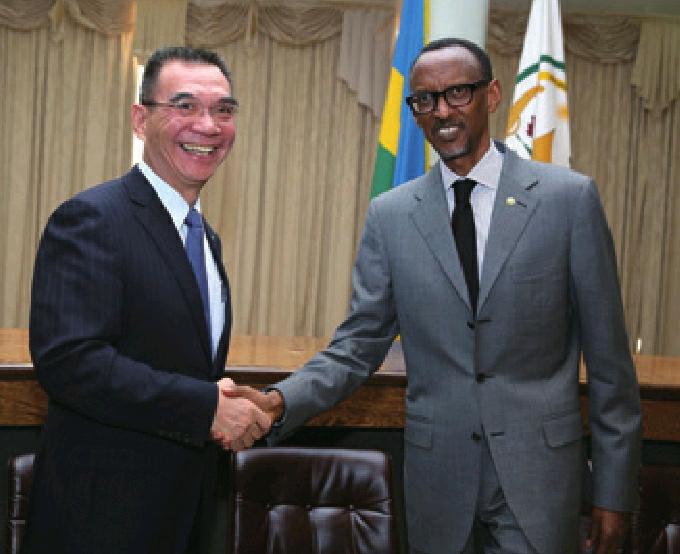
ChinAfrica: What are the main aspects of your New Structural Economics (NSE) theory?
Justin Yifu Lin: Development economics is a new sub-discipline in modern economics; it did not appear until the post-World War II period. At that time, many countries were in the process of post-war reconstruction. Many developing countries had got their political independence and started their own modernization drive. We needed to have a theory to guide those efforts. That was the origin of development economics.
We call the first edition of development economics structuralism. At the time, the understanding was that if a developing country wanted to catch up with a high-income country, their income per household should be the same as high-income countries. But to reach that, you should have the same labor productivity. If you wanted to have the same labor productivity, you needed to have the same advanced industries.
Developing countries were unable to develop those kinds of industries. And so [structuralists] advice was [for the] government [to intervene] to compensate for the market. The intention certainly was good, but the result was very poor.
By the 1980s the idea changed to neoliberalism because the gap between developed and developing countries continued to widen. Developing countries didnt do well because of too many government interventions and so, their [thought] was that the government should withdraw from the market. But the result was a disaster again. Most developing countrieseconomies stagnated and were hit by crises frequently.
NSE is considered a third way of developmental thinking. The idea is that economic development is a process of continuous structural change. There is one fundamental difference between my approach and the two previous approaches. In the past, the theories always used high-income countries as the reference. NSE is just the opposite. I advise developing countries to look at what they have now and what they can do well, and create the conditions to scale it up.
What should the government do to lead this economic development?
In the NSE, I promote an efficient market and a pro-active state. For economic development, we need to develop the industries consistent with a countrys competitive advantages. For that, we need to compensate the first movers with some incentive because they encounter all kind of difficulties, compared to the followers.
Secondly, when you have industrial upgrading, you also need to make some simultaneous improvements in infrastructure, like the power supply, highways and port facilities. You also need to improve the financial services, legal services and so on. Individual firms will not be able to do that, so they need the help of the government.
What is the path for this economic develop-ment? Can it be done by African countries? Actually its very simple. You just need to understand what your competitive advantages are and what the bottlenecks for those sectors to grow are. Then the government will try to remove those bottlenecks. For example, a lot of African countries have two advantages. One is the abundance in natural resources, the other advantage is the young labor force. So they should have competitive advantages in labor-intensive industries. But to develop labor-intensive industries, they need to have infrastructures and a good business environment.
In this kind of situation, the government can develop industrial parks, or special economic zones. They can provide reasonably good infrastructures; they can provide onestop services. With that they can promote investment to develop labor-intensive industries. If those industries are consistent with their comparative advantages they can create a large number of jobs and become competitive quickly. There is no reason why African countries cannot do it.
Critics say NSE focuses a lot on industry and not enough on agriculture. Whats your opinion on this?
I talk a lot about industrialization because if you want to improve and increase labor productivity continuously you need to do two things. One is to have technological innovation in current industries, and the other is to have new industries to give you higher added value.
Agriculture also needs technological innovation and to change its structure. In a low-income country, the farmers, in general, work on subsistence agriculture, producing everything for themselves. But if you want to increase farm income, you need to produce for the markets.
Only agriculture would not be sufficient to help developing countries get out of poverty. The main reason is that if we increase productivity in agriculture, the first farmers using the new technology can raise their incomes; but if all the farmers use those technologies, prices will drop. In the end, farmers incomes will not increase. So its necessary to have non-agricultural jobs in industrial sectors.
If you look at some successful countries, they always captured one opportunity: the global relocation of labor-intensive industries. Before World War II, the United States produced a lot of labor-intensive products—textiles, garments, and shoes. At that time Japan captured that opportunity, which helped it transform from an agrarian to a modern manufacturing economy. By the 1960s, Japans wage rate grew and [economies like] South Korea, Singapore, and Chinas Taiwan and Hong Kong (the “Asian Tigers”) went into those sectors and became newly industrialized economies.
In the 1980s, when the wage rate rose in the “Asian Tigers,” the [Chinese mainland] entered [the scene]. Now, the wage rate on the Chinese mainland has also risen and it will release those sectors for other low-income countries to enter. This time, the opportunities are huge because the Chinese mainland employs 85 million workers in manufacturing, about 10 times what Japan did in the 1960s, and about 15 times that of the “Asian Tigers” in the 1980s. Any developing country can capture that opportunity to transform themselves from low-income to middle-income, or even to a high-income country in one or two generations.
How long will it take for Africa to catch up with China?
It all depends on whether they follow the right ideas and adopt the right approach. Thirty years ago, China was much poorer than African countries. In 1979, the percapita GDP in China was less than one third of the average in Sub-Saharan African countries. Now, Chinas per-capita GDP is about five times the African average. I think if African countries take the right approach, they can have similar success.
That is the reason why I try to promote the NSE because fundamentally, peoples efforts are guided by ideas. If you have the right ideas you can be successful quickly. That was also John Keynes belief. If you read The General Theory of Employment, Interest and Money, the last sentence is: “It is ideas and not vested interest which are dangerous for good or evil.”
