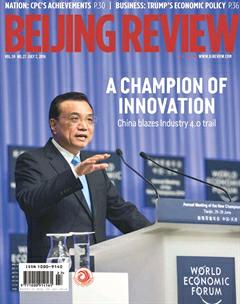
Arduous Journey
2016-07-27 02:12:05ByKerryBrown
Beijing Review 2016年27期
By+Kerry+Brown

The Communist Party of China (CPC) was founded in Shanghai in 1921. Its first congress, held in July that year, lasted for nine days. Thirteen people attended, of whom one was a Russian advisor, and another was a Dutch international Communist movement activist. After seven days, the meeting was disrupted by French Concession police. It had to be reconvened in a barge in neighboring Zhejiang Province.
The Party at that time had only a few dozen members. Ninety-five years on, it has almost 90 million. It is the ruling party in a country which has the worlds second largest economy. This is one of the most remarkable histories of any major political movement of the modern era. And yet, even in the second decade of the 21st century, the precise nature, role and function of the CPC often confuse outside observers.
Part of that confusion is simply from the word “party.” In Western multi-party democracies, political parties occupy parts of the spectrum from the left (broadly, more government involvement in economic and social affairs) to the right (less state involvement). The CPC within itself occupies all of this territory. It offers a home for a huge diversity of opinion. In that sense, conceptualizing it for Western political theorists, commentators, politicians and analysts is challenging. It sometimes looks more like a social movement, or a knowledge community, or a cultural movement. In some ways, it is all of these things. The ways in which it functions, the principles on which it operates, and how it relates to other parts of Chinese society have particularities that are often hard to convey in an easy to understand way for outsiders because of our lack of an adequate language by which to capture what precisely the CPC is.
What is more easily understood are the ways in which the CPC has presided over one of the greatest phases of wealth creation the world has ever known. This is the achievement it is most recognized for internationally. In 1949, China was emerging from a period of devastating international and then civil war. Between 1937 and 1945, as many as 20 million Chinese people perished and 50 million were left homeless. From 1946 to 1949, civil war with the Kuomintang led to even more destruction and instability. But in 1949, the CPC emerged victorious.
It was faced with a country where the average life expectancy was 32 years of age for men and where much of the railway and road infrastructure that had existed prior to World War II had been damaged or destroyed. China prior to 1949 was a country where 90 percent of inhabitants lived outside cities, some in great poverty in rural areas, where running water and electricity were rarities. From 1949, the CPC started the epic challenge of reconstructing the countrys physical and human capital.
Nearly seven decades later, by 2016, China has an average life expectancy for men and women well into the mid-70s. Adult literacy is over 97 percent. Rules introduced in the last two decades mean that all children are required to attend school till the age of 15, with many tens of millions now graduated from Chinese universities. Over 1 million Chinese have been educated abroad since 1979. China has the worlds most extensive network of high-speed rail and is well on the way to constructing a national motorway system, even into more remote western provinces. Over 50 percent of Chinese live in cities.
The CPC is recognized for its achievements under the reform and opening up since 1978 in putting in place a policy infrastructure which has supported even more rapid improvements in development. The World Bank, for instance, has acknowledged that over the last three decades, as many as 400 million people have been lifted out of poverty. Compared to India, a country of similar geographical size, population and developmental status in the 1940s, China ranks far higher in the education, literacy levels and health of women, and in general poverty alleviation. Under the reform and opening up, China has been able to feed its population. Fears in the early 1990s by researchers like Lester Brown that China would face a food shortage through lack of grain proved unfounded. The diet of the average Chinese now is as varied as that of a European or American.
For all the achievements, the CPC faces challenges in the next decade as it enters its second century in existence. Many of these are the results of rapid industrialization and development. The first is the fact that the Chinese environment has been put under enormous strain, with major air quality and water quality issues. The solution to these has proved elusive. New technology, use of renewable energy sources and rising energy efficiency have been supported under the 12th and 13th five-year programs. The Chinese Government has also supported international accords, from the Paris conference convention in late 2015 to an accord signed with the United States a year earlier.
A second side effect of rapid development over the last four decades has been its impact on Chinese society. Inequality is a far larger problem now than it was before 1978. According to the Gini Coefficient, an internationally accepted measure of inequality, in 1984 China enjoyed a relatively high level of equality. Since then, the measure has shown rising disparities between the wealthy and the poor. Differences in wealth levels have opened up between the Chinese coastal and interior regions and between cities and rural areas. Government policy has focused on these, with the lifting of tax burdens for Chinese farmers in the 2000s and the creation of a national social security system for healthcare in the last few years. Even so, addressing imbalances between different groups remains an important priority.
The third issue is the external dimension. China has travelled in the last seven decades from being a country with a small economy to one which is now of global importance. This has brought with it diplomatic prominence. People outside China take heed of it and watch its behavior as never before. Chinese leaders are global leaders, and their decisions and actions, even on the most domestic of issues, have global impact, because of the importance that China now has. Communicating Chinas message to the outside world is crucial, so that misunderstandings dont occur. Chinas views on issues from the Middle East to the crisis in Europe to problems in Latin America or elsewhere are important. The dangers of the outside world misinterpreting Chinas ambitions or behavior are very real. Ideas about the role that China wants to play in the world, through initiatives like the Belt and Road Initiative, are going to become more important.
Finally, there is the search for a new kind of economic model. Since 1978, under the CPC and through the ideas of the leadership around Deng Xiaoping, a hybrid model was developed, taking methods and processes from industrialized and developed nations like the United States and Japan and adapting them for use in China. An exportorientated, manufacturing model was created, which served as the engine of GDP growth at double digit levels for most of the period up to 2010. China is now entering a period of economic transition. GDP has inevitably slowed down (it would be impossible for any economy to continue growing so fast). Chinese policymakers are very aware of the middle income trap, where wage rises for workers in manufacturing make that sector uncompetitive, but services and other sectors have yet to fill the gap left. China is now increasing the role of the services sector in a mixed economy where new sources of domestic growth can appear. This forms the main part of the journey toward fulfilling the first centennial goal by 2021, when the CPC celebrates its 100th year in existence and hopes to preside, by then, over a middleincome country.
As in other areas, the distinguishing feature of the Chinese model is scale and speed. A transition like this to middle-income status is one that many developed economies have gone through, but none on such a scale and at such a speed as China. Therefore the issue of achieving this transition sustainably and with stability is key. The function of the CPC as the entity that gives strategic direction to this process and provides the overarching political narrative is critically important. This is one of the most important things that the outside world needs to understand, therefore, about the role of the CPC in 21st century China, and what its precise function and objectives are.