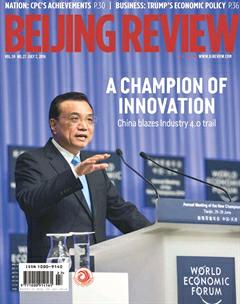
A REVOLUTION AT HAND
2016-07-27 02:00:18ByBryanMichaelGal
Beijing Review 2016年27期
By+Bryan+Michael+Galvan


‘Innovation that isnt bringing good to the people never succeeds,” declared Travis Kalanick, CEO and co-founder of Uber Technologies Inc. Speaking at a session during the World Economic Forums Annual Meeting of the New Champions, also known as the Summer Davos Forum, which was held in Tianjin from June 26 to 28, Kalanick joined a multitude of experts and leaders who tackled various aspects of the fourth industrial revolution and its potential for worldwide disruption and opportunity.
China, along with the rest of the world, is standing at the brink of a technological revolution that promises to bring about massive changes to the way that people live, work and communicate on every level.
The first industrial revolution introduced a fundamental shift in methods of production and transportation through the use of water and steam power. The second optimized mass production through the use of electricity, while the third built upon these advancements by introducing automation and information technology.
What differentiates the fourth industrial revolution from its predecessors is its potential to integrate virtually all aspects of life as we know it—from the online to the physical and biological worlds. The speed at which it is breaching conventional systems also cannot be compared to the previous revolutions, which took decades to mature.
While these changes can be seen as a type disruption, the consensus reached at the Summer Davos Forum by a majority of speakers was that the opportunities provided by this transition should be embraced and enhanced through worldwide collaboration. Despite this, governments play a large role in their nationsefforts to grasp these potential benefits.
“I think the thing we should be worried about is not what technologies are going to be bad, but instead, what great technologies that serve the people are not getting out there in the first place,” said Kalanick, who noted that government rules and regulations, which are mostly designed to protect existing players, are often an impediment to innovation.
“The physical world is highly regulated... the old rules we have today were once the new and controversial rules,” he said, adding that there is a need for “fresh rules that serve people and progress instead of holding on to old rules that are not serving people.”
China, who has historically lagged behind other countries in terms of the previous industrial revolutions, now aims to become a leader in this field through their Made in China 2025 plan. This aims to transform China from a manufacturing giant into a world manufacturing power, with an emphasis on high-end and quality-focused products as opposed to simple mass production.
Chinas Internet Plus strategy also seeks to improve traditional manufacturing technologies through the use of cyber-physical systems, cloud computing, and the Internet of Things. These plans put China into the same playing field as other countries who are looking to take the lead in the fourth industrial revolution, such as Germany and their Industry 4.0 strategy. Even so, how will these changes affect the lives of ordinary people?
Chinas evolution
As automation and information technology augurs a new era of challenges, the labor market is likely to be hit the hardest, according to analysts. Machines displacing workers has been a common theme since the first industrial revolution, and is an issue which will persist as people from all countries must learn to adapt to rapidly changing work environments.
Jacky Qian, Vice President of ManpowerGroup Greater China, told Beijing Review in an exclusive interview during the forum that Chinese companies are already feeling the effects of these challenges.
In an employment outlook survey for the third quarter of 2016, Manpower interviewed 4,228 employers in China and found that the net employment outlook is only 2 percent, the weakest since the survey began in 2005. This reflects the economic slowdown and its impact on the labor market. Qian said that China really needs to find another engine to drive economic growth which can lead to labor market growth.
Qian suggested that the fourth industrial revolution could help spur this development, despite the fact that it will eliminate low-end jobs that can be replaced by robots or automation. “We are not really concerned about people versus robots—its all about the people themselves. This brings up another topic—how can we upgrade our skills to meet our future job needs?”
Rather than purely focusing on the impact of machines on the future, the next industrial revolution is likely to bring about opportunities that were unimaginable or inaccessible before. Qian said that now, people have more job choices than they used to have and that people are thinking more about their careers.
Qian said that if you asked a Chinese person 10 years ago, “What is the kind of career and life that you want to pursue?”They might answer, “I want a job in a Fortune 500, government or state-owned enterprise.” Now they might say, “I want a career, I want development opportunities, I want exposure,” but it all requires new skills, he claimed.
George Huang, Partner-in-Charge of the Beijing office for executive search firm Heidrick& Struggles echoed similar views on the need for Chinese talent in order to take full advantage of the industrial revolution.
“I think that in the past 20 years Chinese talent has been getting better and better. But talent is still scarce in China, especially in general management skills,” said Huang.
In an exclusive interview with Beijing Review, Huang said that from a leadership assessment perspective, the people who are successful are those who can adapt to new changes and also have a good capacity to learn.
As China looks to cut overcapacity in various sectors such as the iron and steel industries, millions are expected to lose their jobs. How can such people move from a traditional industry to an Industry 4.0 sector, and what else can be done to help them move forward? “First of all what we found is that people who inherently want to learn and have this passion about learning new things... can be successful. I think thats the key thing that we found in our data,”he said.
The biggest challenge going forward will be getting the employees to shift their mindset and training them to acquire the new skills they need, Huang stated, who was still bullish on the prospect, since he saw that China is getting better at not just acquiring talent but also developing and retaining it.
“What we are seeing is that Chinese companies are putting a lot more effort into human resource programs to retain developing talents and to educate and get them better.” According to Huang, this creates a “ripple effect” wherein more and more companies will seek to do the same.
Governments should also seek to take an active role in bringing about change.“Governments by nature are not designed to be agile. Its very difficult to keep up with the scope and speed of change,” said Navdeep Bains, Canadas Minister of Innovation, Science and Economic Development, at the forum. To be more responsive, Bains claimed that a government can wield its convening powers to harness inclusion and diversity to produce innovative approaches to problems. “The challenge is not that the fourth industrial revolution is taking place, but that the benefits should help the many and not just the few,” Bains explained.“Innovation boils down to one key element—people. Diversity is so critical.”
A global effort
As people and governments across the world take on the fourth industrial revolution, will these endeavors cause economic conflict?
John B. Veihmeyer, Chairman of KPMG International who spoke at the Summer Davos Forum regarding Chinas global ambitions, told Beijing Review on the sidelines of the event that he approved the competition that is likely to ensue.
“Its a very competitive world, both from a business standpoint and a geopolitical standpoint, so Im one of those folks who believe that an aggressively growthoriented United States, Germany and China will be a very good thing for the global economy,” he said.
Each countrys individual plans may create increased friction through competition, admitted Veihmeyer, who nonetheless noted that collaboration and greater cooperation is going to be important as well.
“Just like you see companies com- peting with a different company in one day and teaming with them the next day, I think youre going to see the same trend from a geopolitical standpoint and each of these economies and countries doing what they can to stimulate growth, but also doing it in a way that where it makes sense [to do so, it] will be very collaborative with other growing economies as well,” he said.
Victor L. L. Chu, Chairman and CEO of the First Eastern Investment Group also told Beijing Review that more international cooperation and partnership is likely to occur in the future. “I dont think today that any particular area or country can [carry out the fourth industrial revolution] on its own, so I hope there will be more cooperation in China, Europe and its Eurasian partners to achieve the common good in the long term,” he said.
Commenting on Chinas economic shift and future challenges, Chu said that it is part of a long-term transition which will probably take a generation to achieve. “China can accelerate that if they have more international cooperation. What we have is a huge capacity to manufacture and a huge market, but what we need is good people and talents,” he asserted.
At the forum, the speakers emphasis on people and the role that they will play during the fourth industrial revolution was often greater than the actual technology that is designed to herald in the new age.
“The greatest danger we face in this world is the deep, deep fear that people feel about the future,” said R. May Lee, Dean of the School of Entrepreneurship and Management at ShanghaiTech University. “If we want to encourage people to innovate, we need to be forgiving of people who make mistakes.”