
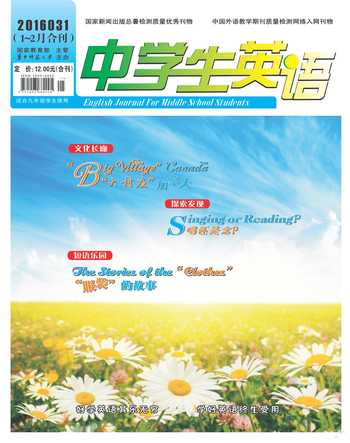
“服裝”的故事
2016-06-09 21:24:51何苗
中學(xué)生英語·中考指導(dǎo)版
2016年1期
關(guān)鍵詞:流水
何苗
Have you ever paid attention to the English expressions that include words about clothes? Lets see if I can name a few “off the cuff1”, or without any preparation.
你有沒有留意過包含和衣服相關(guān)的詞匯的英語表達(dá)?讓我們看看我是否可以即興說出一些,不預(yù)先做任何準(zhǔn)備。
We sometimes say that people who are restless or nervous “have ants in their pants2”. They might also “fly by the seat of their pants3”, or they use their natural sense to do something instead of their learned knowledge. Sometimes, people may “get caught with their pants down4”—they are found doing something they should not be doing. And, in every family, one person takes control. Sometimes a wife tells her husband what to do. Then we say “She wears the pants in the family5”.
我們有時形容緊張不安的人褲子里有螞蟻。他們也可能憑直覺而不是他們所學(xué)的知識來做一些事情。有時,有人在褲子掉下來的情況下被人發(fā)現(xiàn),意思是他們被發(fā)現(xiàn)正在做一些不應(yīng)該做的事。此外,每一個家庭都有當(dāng)家人。有時妻子會吩咐丈夫怎么做,我們就說,她在這個家里當(dāng)家做主。
Pants usually have pockets to hold things. Money that is likely to be spent quickly can “burn a hole in your pocket6”. Sometimes you need a belt to hold up your pants. If you have less money than usual, you may have to “tighten your belt7”—you may have to live on less money and spend your money carefully.
褲子上總是有裝東西的口袋,花錢如流水就像口袋被燒了洞。有時需要用腰帶勒緊褲子,當(dāng)錢不多時,你可能要節(jié)衣縮食,少花些錢,小心地花錢。
I always praise people who can save their money and not spend too much. I really “take my hat off to them8.” Yet, when it comes to my own money, I spend it “at the drop of a hat9”, immediately, without waiting. And sadly, you cannot “pull money out of a hat10”. You cannot get money by inventing or imagining it.
我總是稱贊那些能省錢不亂花錢的人,我真的佩服他們。不過,對于我自己的錢,我會毫不猶豫地、馬上花個精光。可悲的是,你不能憑空從帽子里拿出錢來。你不可能僅憑虛構(gòu)或想象就得到錢。
Boots are a heavy or strong kind of shoes. People who are “too big for their boots11” think they are more important than they really are. I dislike such people. I really do. You can bet your boots on that12! Yet, truly important people are hard to replace. Rarely can you “fill their shoes13” or replace them with someone equally effective.
靴子是種沉重而結(jié)實(shí)的鞋子,自負(fù)的人想象自己比實(shí)際的更重要。我不喜歡這種人,真的,你可以打賭。不過真正重要的人很難被取代的。你很少能取代別人,或者用能起同樣作用的某人取代他們。
My father is an important person. He runs a big company. He wears a suit and tie. Some people who do not know him well think he is too firm and severe. They think he is a real “stuffed shirt14”. But I know that my father “wears his heart on his sleeve15”, and he shows his feelings openly. And, he knows how to “keep his shirt on16”. He stays calm and never gets angry or too excited.
我父親就是個重要的人,他開了一家大公司,他穿著西裝,打著領(lǐng)帶。不熟悉他的人認(rèn)為他古板嚴(yán)厲,愛擺架子。但我知道父親很坦率,會直接表達(dá)自己的感受。他知道如何保持冷靜,從不生氣或太激動。
Also, my father has never “l(fā)ost his shirt17” in a business deal. He is too smart to lose all or most of his money. This is because my father “rolls up his sleeves18” and prepares to work hard. He often has a special plan or answer to a problem that he can use if he needs it. He is like a person who does magic tricks. We say he has “a card up his sleeve19”.
不過,我父親在生意場上從未失手。他很聰明,不會輸?shù)羧炕虼蟛垮X。這是因?yàn)楦赣H做好準(zhǔn)備,努力工作。……
登錄APP查看全文
猜你喜歡
云南畫報(bào)(2021年8期)2021-12-02 02:46:08
文苑(2020年10期)2020-11-07 03:15:26
揚(yáng)子江(2018年1期)2018-01-26 00:36:54
天津詩人(2017年2期)2017-11-29 01:24:12
數(shù)位時尚(幼兒教育)(2017年6期)2017-07-18 11:47:56
視野(2015年6期)2015-10-13 00:43:11
六盤山(2015年3期)2015-06-29 12:26:37
火花(2015年1期)2015-02-27 07:40:13
海峽姐妹(2014年5期)2014-02-27 15:09:38
閱讀與作文(小學(xué)低年級版)(2005年2期)2005-04-29 00:00:00
- 中學(xué)生英語·中考指導(dǎo)版的其它文章
- “It is+adj.”句型盤點(diǎn)
- 走出比較級用法的誤區(qū)
- 動詞的熟詞生義知多少
- “敵人”的故事
- 美元上的偉人
- 意大利趣聞