
An Investigation into the Communication Strategies Employed by the EFL Learners in Tibet University
2016-05-14 09:02:37BaimadejiMenghonglian
校園英語(yǔ)·上旬 2016年9期
關(guān)鍵詞:研究
Baimadeji Menghonglian
【Abstract】The paper investigates the result of a research of communication strategies employed by EFL learners in an oral English test. Data for the research were collected through recording and transcribing a whole session of oral test. By analyzing different types of communication strategies employed by learners, the paper attempts to figure the role of communication strategies in managing smooth communication and get enlightenment for oral English teaching in the future.
【Key words】Communication strategies; EFL learners; oral test; role of strategies
1. Introduction
With increasing attention given to oral competence in international and national English proficiency tests, the researches about the ways to facilitate learners to produce a better utterance have been studied. However, in China, learners utterance were seldom analyzed in detail to learn how learners tailor their speech to remain their conversation, especially in terms of communication strategies (CSs), not to mention the study on Tibetan students English oral production. Many Tibetan students who have entered Tibet University are from rural areas where English teaching has been given less attention. Therefore, compared with other Han-Chinese students, Tibetan students have encountered more communication problems that can rarely be solved with their limited interlanguage. In order to remain the conversation and convey the message, they have to initiate various CSs to overcome the barriers of communication. The paper attempts to analyze Tibetan students capability of using CSs, especially the strategies they have employed when they are breakdowns of communication in their oral test and get enlightenment for oral English teaching in the future.
2. Definitions of Communication Strategies
According to Tarone (1977), “the term relates to a mutual attempt of two interlocutors to agree on a meaning in situations where requisite meaning structures do not seem to be shared” (as cited in F?rch and Kasper, 1983. p. 212). In Tarones theory, leaner and interlocutor make an effort to achieve agreement on meaning by negotiation. F?rch and Kasper (1983), on the other hand, think communication strategies “are potentially conscious plans for solving what to an individual presents itself as a problem in reaching a particular communicative goal” (as cited in F?rch and Kasper, 1983. p. 212). In their understanding, the learner is the center of the CSs since the learner is the one, who is in face of problems in speech reception, and the one who plans and initiates the speech production.
Some other definitions can be found in the Bialystoks book Communication Strategies, in which she cites definitions relating to strategies of second-language learners (Bialystok, 1990:3):
(1)A systematic technique employed by a speaker to express his meaning when faced with some difficulty. (Corder, 1977)
(2)Techniques of coping with difficulties in communicating in an imperfectly known second language. (Stern, 1983)
3. Methodology
3.1 Subjects
All subjects taking part in this project were sophomore who were studying English at School of Tourism and Foreign Languages in Tibet University. Seven high-intermediate level Tibetan students were finally selected for this study, they all had learned English at least six years before they entered Tibet University, and English is the third language they have been learning.
3.2 Procedure
In order to collect the data as naturally as possible, the experiment started with an interview, in which the researcher asked participants seven questions that were related to their lives in Tibet University, and gradually moved to the second part, it required the participants to tell a story based on a series of pictures given to them. The third part was a pectoral instruction for cooking Tibetan noodle, participants were asked to describe each procedure of cooking. The content of the test was within learners control of language, though there were some aspects that might be challenging for some participants. In addition, in order to collect the data precisely, an orientation about the procedure for conducting the research had been given to each participant before they started speaking, and participants were also informed that their performance would be video-recorded entire time when they were speaking. After recording their conversations, all data would be transcribed and the communication strategies participants used would be identified and analyzed .
3.3 CSs used in this study
CSs used in this study are not only based on the theories proposed by Tarone, F?rch and Kasper, it also covers some meaning-negotiation strategies. The study additionally analyzes some L2 learners performance features since it reveals the planning process leading to speech production.
Avoidance:
C1 Topic avoidance (TA): steer the conversation away from the topic
C2 Message abandonment (MA): start with a new sentence
LI-based strategies:
C3 Approximation (App): use incorrect items that share enough semantic feature
C4 Generalization (Gen): filling the “gap” with LI item
C5 Paraphrase (Par): focus on characteristic properties of intended feature
C6 Word coinage (WC): make up new words
C7 Restructuring (Res): use alternative ways to reconstruct utterance
C8 Literal translation (LT): translate word to word form L1
C9 Language switch (LS): direct insertion of words from L1
C10 Mime: use non-verbal cues to replace the words
LI negotiation:
C11 Code-based conformation check (CCC): repeat the previous utterance for confirmation
C12 Positive confirmation check (PCC): offer information for confirmation
C13 Clarification request (CR): ask for clarification
C14 Comprehension check (CC): attempt to check comprehension
C15 Repetition (Rep): repeat an utterance
Performance features:
C16Pauses (Pau): a break in the utterance
C17 Self-repairs (SR): a self-initiated self-completed repair
4. Result and discussion
4.1 Different types of CSs employed by students
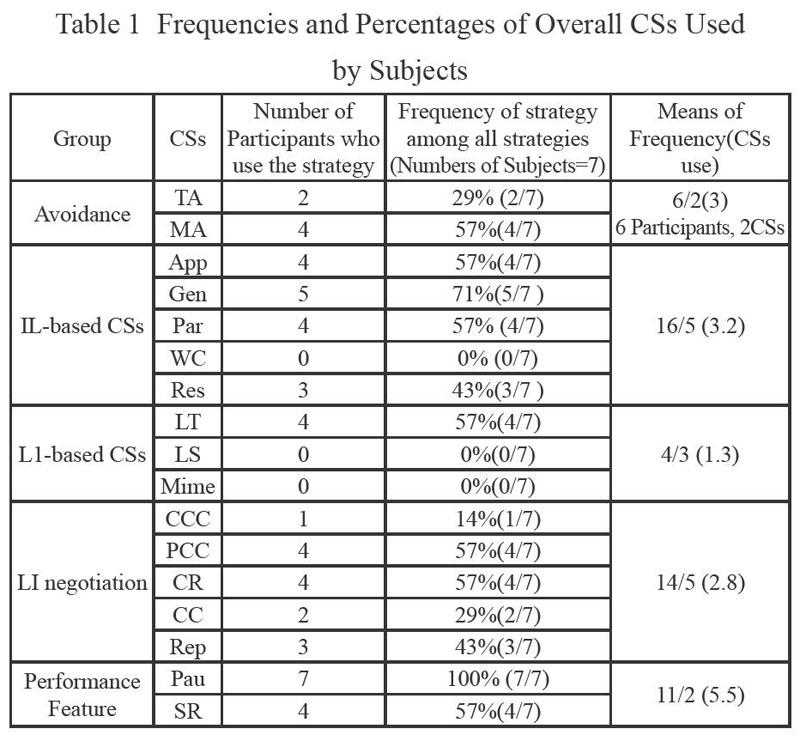
The data analysis indicates that the one-way and two-way tasks initiated in this study make it necessary for learners to utilize CSs. Table 1 presents the frequencies of overall CSs.
As can be observed, the Pau was greatly used by participants, and the strategy of MA, APP, LT, PCC, Par, CR, SR was used regularly. It not only reveals the learners low degree of automatization of their IL, but it also indicates that learners use the strategy as a time-gaining device to plan a subsequent utterance. Gen was also the strategy that commonly used by learners since they need to use it to cope with their shortage of lexical choices, even though it results in the increment of the frequency of using an item in an inappropriate context, it appeals learners needs to fill in the ‘gap in their planning of utterance. Generally, based on the Table, the one-way task elicited more IL-based strategies from the participants, such as APP, Gen, Par and Res. These strategies help learners to get their meaning across and ensure the interlocutors comprehension. In the two-way task, the strategy of LI negotiation requires learners to interact with the interlocutor in order to achieve his/ her goals for communication.
4.2 The role of communication strategies in second language acquisition
Findings from this study suggest that the one-way and two-way tasks used in this study elicit learners use CSs to fulfill their need to communicate. CSs used in this task enable the learners to prompt the interlocutor to modify their utterance; therefore, it enhances the learners self-monitoring function. In addition, CSs open tools for learners to remain their conversation, it promotes the learners performance and when learners find that their performance improve, their self-confidence for attempting more engagement in communication may enhance. Simultaneously, their anxiety for their deficiency of language sources reduced, thus, they would have more strong motivation for learning actively.
CSs enable learners to go further in their communication, however, we should be aware of the potential risk of overusing CSs. For instance, some students use CSs so successfully that they are reluctant to take risks for learning and exploring new language resources. Some other students may become so skillful for making up for lack of linguistic knowledge by using CSs. In this condition, learners rarely move to a higher level of their interlanguage system. Therefore, as teachers, we should help students foster their using of a variety of CSs, we also should make students aware that successfully using CSs is a temporary solution for the problems they meet, and they need to make efforts to learn and explore new language sources.
5. Conclusion
The analysis provides us a framework on how Tibetan students manage to express themselves in spite of their limited knowledge of English by using CSs. It also provides us a rich insight on how learners Interlanguage develop. Therefore, CSs should be encouraged to be used among students who are struggling in the production of their utterance. We also need to be aware of the limitation of overusing CSs, since it may be the obstacle of developing learners interlanugage system. Thus, teachers should combine these two aspects to develop learners communication competency. In spite of the findings from the study, the paper is limited in the number of subjects. There are only 7 participants in the study and the influence of their first language in students speaking is neglected, therefore, the conclusion is not very reliable. In addition, as non-native speakers, we still work at improving our English ability, which may affect the identification and analysis of the CSs learners used in the study.
Reference:
[1]Bialystock.E.(1990).Communication Strategies:A Psychological Analysis of Second Language Use.Oxford:Basil Blackwell.
[2]F?rch,C.,&Kasper,G.(1983a).Plans and strategies in foreign language communication.F?rch.C.,&Kasper,G.(Eds.),Strategies in interlanguage communication(pp.20-60).Harlow,England:Longman.
[3]F?rch,C.,&Kasper,G.(1983b).On identifying communication strategies in interlanguage production.F?rch.C.,&Kasper,G.(Eds.),Strategies in interlanguage communication(pp.210-238).Harlow,England:Longman.
作者簡(jiǎn)介:白瑪?shù)录?981-),女,藏族,四川甘孜人,講師,碩士研究生,主要從事翻譯理論與實(shí)踐研究、第二外語(yǔ)教學(xué)研究。
猜你喜歡
體育科技文獻(xiàn)通報(bào)(2022年3期)2022-05-23 13:46:54
天津外國(guó)語(yǔ)大學(xué)學(xué)報(bào)(2021年3期)2021-08-13 08:32:18
遼金歷史與考古(2021年0期)2021-07-29 01:06:54
科技傳播(2019年22期)2020-01-14 03:06:54
遼金歷史與考古(2019年0期)2020-01-06 07:45:20
民用飛機(jī)設(shè)計(jì)與研究(2019年4期)2019-05-21 07:21:24
電子制作(2018年11期)2018-08-04 03:26:04
汽車工程學(xué)報(bào)(2017年2期)2017-07-05 08:13:02
國(guó)際商務(wù)財(cái)會(huì)(2017年8期)2017-06-21 06:14:14
電子制作(2017年23期)2017-02-02 07:17:19

- 校園英語(yǔ)·上旬的其它文章
- Vegetation and climate changes in Central Asia during the last 28,000 yrs: A high—resolution pollen record from Valikhanovsection, Kazakhstan
- 論國(guó)際商務(wù)英語(yǔ)翻譯的多元化標(biāo)準(zhǔn)
- Work Ethics and General Morality
- Research on Application of Edible Landscape in Rural Tourism: A Case of Dendrobium Landscape in Pu’er City
- 創(chuàng)傷理論視角下的《藻海無(wú)邊》
- 從格萊斯的會(huì)話含義理論的角度分析《當(dāng)幸福來(lái)敲門(mén)》中的人物對(duì)白