食品抗氧化劑與人體健康
2016-02-13 23:38:27尤新
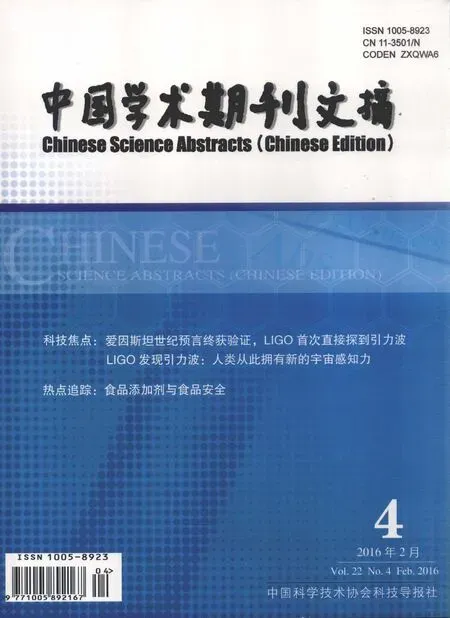
中國學術期刊文摘 2016年4期
尤新
?
食品抗氧化劑與人體健康
尤新
摘要:隨著經濟的發展和生活的改善,食品安全和健康日益成為人們關注的焦點。食品添加劑中的抗氧化劑,是保證食品安全的重要措施,作者綜述了近年國內外天然抗氧化劑對人體退行性疾病預防的研究,重點介紹了類胡蘿卜素和多酚黃酮的性質、功能及在食品工業中的應用。
關鍵詞:食品抗氧劑;健康;類胡蘿卜素;黃酮類
Bacteriocin-based strategies for food biopreservation
Galvez, Antonio; Abriouel, Hikmate; Lopez, Rosario Lucas
Abstract:Bacteriocins are ribosomally-synthesized peptides or proteins with antimicrobial activity, produced by different groups of bacteria. Many lactic acid bacteria (LAB) produce bacteriocins with rather broad spectra of inhibition. Several LAB bacteriocins offer potential applications in food preservation, and the use of bacteriocins in the food industry can help to reduce the addition of chemical preservatives as well as the intensity of heat treatments, resulting in foods which are more naturally preserved and richer in organoleptic and nutritional properties. This can be an alternative to satisfy the increasing consumers demands for safe, fresh-tasting, ready-to-eat, minimally-processed foods and also to develop “novel” food products (e.g. less acidic, or with a lower salt content). In addition to the available commercial preparations of nisin and pediocin PA-1/AcH, other bacteriocins (like for example lacticin 3147, enterocin AS-48 or variacin) also offer promising perspectives. Broad-spectrum bacteriocins present potential wider uses, while narrow-spectrum bacteriocins can be used more specifically to selectively inhibit certain high-risk bacteria in foods like Listeria monocytogenes without affecting harmless microbiota. Bacteriocins can be added to foods in the form of concentrated preparations as food preservatives, shelf-life extenders, additives or ingredients, or they can be produced in situ by bacteriocinogenic starters, adjunct or protective cultures. Immobilized bacteriocins can also find application for development of bioactive food packaging. In recent years, application of bacteriocins as part of hurdle technology has gained great attention. Several bacteriocins show additive or synergistic effects when used in combination with other antimicrobial agents, including chemical preservatives, natural phenolic compounds, as well as other antimicrobial proteins. This, as well as the combined use of different bacteriocins may also be an attractive approach to avoid development of resistant strains. The combination of bacteriocins and physical treatments like high pressure processing or pulsed electric fields also offer good opportunities for more effective preservation of foods, providing an additional barrier to more refractile forms like bacterial endospores as well. The effectiveness of bacteriocins is often dictated by environmental factors like pH, temperature, food composition and structure, as well as the food microbiota. Foods must be considered as complex ecosystems in which microbial interactions may have a great influence on the microbial balance and proliferation of beneficial or harmful bacteria. Recent developments in molecular microbial ecology can help to better understand the global effects of bacteriocins in food ecosystems, and the study of bacterial genomes may reveal new sources of bacteriocins. Antioxidants minimize oxidation of the lipid components in foods. There is an increasing interest in the use of natural and/or synthetic antioxidants in food preservation, but it is important to evaluate such compounds fully for both antioxidant and pro-oxidant properties. The properties of thymol, carvacrol, 6-gingerol, hydroxytyrosol and zingerone were characterized in detail. Thymol, carvacrol, 6-gingerol and hydroxytyrosol decreased peroxidation of phospholipid liposomes in the presence of iron(III) and ascorbate, but zingerone had only a weak inhibitory effect on the system. The compounds were good scavengers of peroxyl radicals (CCl3O2; calculated rate constants >106m?1sec?1) generated by pulse radiolysis. Thymol, carvacrol, 6-gingerol and zingerone were not able to accelerate DNA damage in the bleomycin-Fe(III) system. Hydroxytyrosol promoted deoxyribose damage in the deoxyribose assay and also promoted DNA damage in the bleomycin-Fe(III) system. This promotion was inhibited strongly in the deoxyribose assay by the addition of bovine serum albumin to the reaction mixtures. Our data suggest that thymol, carvacrol and 6-gingerol possess useful antioxidant properties and may become important in the search for ‘natural’replacements for ‘synthetic’ antioxidant food additives. Most antimicrobial food additives are lipophilic acids which prevent growth by inhibiting the transport of substrate molecules into cells. The inhibition of transport was also observed in membrane vesicles, even when they were derived from organisms for which growth and transport are not affected by the larger inhibitors. Salmonella/microsome tests (Ames tests) and chromosomal aberration tests in vitro using a Chinese hamster fibroblast cell line were carried out on 190 synthetic food additives and 52 food additives derived from natural sources, all of which are currently used in Japan. Fourteen out of 200 tested in the Ames assay showed positive effects and 54 out of 242 were positive in the chromosome test. Three additives (erythorbic acid, chlorine dioxide and beet red) were positive only in the Ames test, although their mutagenic potentials were relatively weak, while 43 additives were positive only in the chromosome test. Eleven additives (calcium hypochlorite, cinnamic aldehyde, l-cysteine monohydrochloride, Food Green No.3 (Fast Green FCF), hydrogen peroxide, potassium bromate, sodium chlorite, sodium hypochlorite, sodium nitrite, cacao pigment and caramel) were positive in both the Ames test and the chromosome test. The usefulness of such primary screening tests combining two different genetic end-points, gene mutation and chromosomal aberration, and some correlation between mutagenicity and carcinogenicity of food additives are discussed. Background: We undertook a randomised, double-blinded, placebo-controlled, crossover trial to test whether intake of artificial food colour and additives (AFCA) affected childhood behaviour. Methods: 153 3-year-old and 144 8/9-year-old children were included in the study. The challenge drink contained sodium benzoate and one of two AFCA mixes (A or B) or a placebo mix. The main outcome measure was a global hyperactivity aggregate (GHA), based on aggregated z-scores of observed behaviours and ratings by teachers and parents, plus, for 8/9-year-old children, a computerised test of attention. This clinical trial is registered with Current Controlled Trials (registration number ISRCTN74481308). Analysis was per protocol. Findings: 16 3-year-old children and 14 8/9-year-old children did not complete the study, for reasons unrelated to childhood behaviour. Mix A had a significantly adverse effect compared with placebo in GHA for all 3-year-old children (effect size 0.20 [95% CI 0.01-0.39], P=0.044) but not mix B versus placebo. This result persisted when analysis was restricted to 3-year-old children who consumed more than 85% of juice and had no missing data (0.32 [0.05-0.60], P=0.02). 8/9-year-old childrenbook=18,ebook=22showed a significantly adverse effect when given mix A (0.12 [0.02-0.23], P=0.023) or mix B (0.17 [0.07-0.28], P=0.001) when analysis was restricted to those children consuming at least 85% of drinks with no missing data. Interpretation Artificial colours or a sodium benzoate preservative (or both) in the diet result in increased hyperactivity in 3-year-old and 8/9-year-old children in the general population. A safety factor of 100-fold is commonly applied to animal data to derive the acceptable daily intake (ADI) of food additives; other factors have been used in some cases and higher values are used more frequently for determining the tolerable daily intake (TDI) of environmental chemicals. The 100-fold factor is considered to represent the product of a 10-fold factor to allow for species differences between the test animal and humans and a 10-fold factor to allow for inter-individual differences. A scheme is proposed whereby data relevant to the safety assessment of a compound, e.g. species differences in toxicokinetics, can contribute quantitatively to the safety factor and therefore to the ADI or TDI. For this to be possible, it is necessary to subdivide each of the 10-fold factors into two separate factors to allow for differences in toxicokinetics and toxicodynamics. For any compound, data on one particular aspect may be used to derive a specific data-derived factor for that aspect. The overall safety factor will then be calculated as the product of the known data-derived factor(s) and default values for the remaining unknown factors. In this way the derivation of the safety factor would be clearly defined and the potential impact of additional data on other aspects identified. Additional safety factors (over and above the 100-fold or overall data-derived factor) are also proposed to allow for the nature or severity of the toxicity and the adequacy of the database. These factors are consistent with previous evaluations and will allow the logical derivation of factors greater than either 100 or the appropriate data-derived factor. These additional factors will be of greatest value in the derivation of safety factors for the calculation of the TDIs of environmental contaminants but may also be applied if necessary to the safety assessment of food additives. In such cases the rationale and logic for a safety factor in excess of 100 will be clearly defined. Recent developments on the manufacture, purification and biological effects of xylo-oligosaccharides are reviewed. Xylo-oligosaccharides (XO) can be produced by chemical and/or enzymatic methods from a variety of xylan-containing raw materials, and then refined by physicochemical treatments. Considered as food ingredients, xylo-oligosaccharides have favourable technological properties and cause prebiotic effects derived from their ability to modulate the intestinal function. Besides the effects related to their effects in the large bowel, a range of additional biological activities have been reported for XO. Other topic discussed include the utilization of XO in synbiotic preparations, their technological properties and market perspectives. Recently, interest in plant-derived food additives has grown, mainly because synthetic antioxidants suffer from several drawbacks. Furthermore, plant extracts have been shown to possess health-promoting properties. In the present study, hydrodistilled extracts from basil, laurel, parsley, juniper, aniseed, fennel, cumin, cardamom, and ginger were assessed for their total phenol content, and antioxidant (iron(III) reduction, inhibition of linoleic acid peroxidation, iron(II) chelation, 1,1-diphenyl-2-picrylhydrazyl radical- scavenging and inhibition of hydroxyl radical-mediated 2-deoxy-D-ribose degradation, site and nonsitespecific) activities. The extracts from basil and laurel possessed the highest antioxidant activities except for iron chelation. Although parsley showed the best performance in the iron chelation assay, it was less effective at retarding the oxidation of linoleic acid. In the linoleic acid peroxidation assay, I g of the basil and laurel extracts were as effective as 177 and 212 mg of trolox, respectively. Thus, both extracts are promising alternatives to synthetic substances as food ingredients with antioxidant activity. Food-borne fungi, both yeasts and moulds, cause serious spoilage of stored food. Moulds may also produce healthdamaging mycotoxins, e.g. aflatoxins, trichothecenes, fumonisin, ochratoxin A and patulin. Consumer demands for minimally processed foods and reduced use of chemical preservatives have stimulated research on antifungal lactic acid bacteria as biopreservatives. Recently, a number of antifungal metabolites, e.g. cyclic dipeptides, phenyllactic acid, proleinaceous compounds, and 3-hydroxylated fatty acids have been isolated from lactic acid bacteria. This review summarizes these findings and suggests potential applications of antifungal lactic acid bacteria in the preservation of food and feeds. Butylated hydroxyanisole (BHA) and butylated hydroxytoluene (BHT) are widely used antioxidant food additives. They have been extensively studied for potential toxicities. This review details experimental studies of genotoxicity and carcinogenicity which bear on cancer hazard assessment of exposure to humans. We conclude that BHA and BHT pose no cancer hazard and, to the contrary, may be anticarcinogenic at current levels of food additive use.
Keywords:bacteriocin; biopreservation; hurdle technology; lactic acid bacteria; food Xylo-oligosaccharides; Xylanases; hydrothermal treatments; refining; biological effects phenolic antioxidants; butylated hydroxyanisole; butylated hydroxytoluene; anticarcinogenicity
來源出版物:International Journal of Food Microbiology, 2007, 120(1-2): 51-70
被引頻次:374
Antioxidant actions of thymol, carvacrol, 6-gingerol, zingerone and hydroxytyrosol
R. Aeschbach; J. L?liger; B.C. Scott; et al.
來源出版物:Food and Chemical Toxicology, 1994, 32(1): 31-36
被引頻次:369
Function of lipophilic acids as antimicrobial food additives
Freese, E; Sheu, CW; Galliers, E
來源出版物:Nature, 1973, 241(5388): 321-325
被引頻次:342
Primary mutagenicity screening of food-additives currently used in Japan
M. Ishidate Jr; T. Sofuni; K. Yoshikawa; et al.
來源出版物: Food and Chemical Toxicology, 1984, 22 (8): 623-636
被引頻次:283
Food additives and hyperactive behaviour in 3-year-old and 8/9-year-old children in the community: A randomised, doubleblinded, placebo-controlled trial
McCann, Donna; Barrett, Angelina; Cooper, Alison; et al.
來源出版物:Lancet, 2007, 370(9598): 1560-1567
被引頻次:199
Data-derived safety factors for the evaluation of food-additives and environmental contaminants
Renwick, AG
來源出版物:Food Additives and Contaminants, 1993, 10(3): 275-305
被引頻次:196
Advances in the manufacture, purification and applications of xylo-oligosaccharides as food additives and nutraceuticals
Moure, Andres; Gullon, Patricia; Dominguez, Herminia
來源出版物:Process Biochemistry, 2006, 41(9): 1913-1923
被引頻次:196
Antioxidant activities of extracts from selected culinary herbs and spices
Hinneburg, I; Dorman, HJD; Hiltunen, R
Keywords: antioxidant activity; culinary spices; hydrodistilled extracts; basil; laurel; parsley; juniper; aniseed; fennel; cumin; cardamom; ginger
來源出版物:Food Chemistry, 2006, 97(1): 122-129
被引頻次:192
Antifungal lactic acid bacteria as biopreservatives
Schnurer, J; Magnusson, J
來源出版物:Trends in Food Science & Technology, 2005, 16(1-3): 70-78
被引頻次:134
來源出版物:Food and Chemical Toxicology, 1999, 37(9-10): 1027-1038
·推薦論文摘要·
Safety assessment of butylated hydroxyanisole and butylated hydroxytoluene as antioxidant food additives
Williams, GM; Iatropoulos, MJ; Whysner, J
來源出版物:食品與生物技術學報, 2006, 25(2): 1-7
被引頻次:375