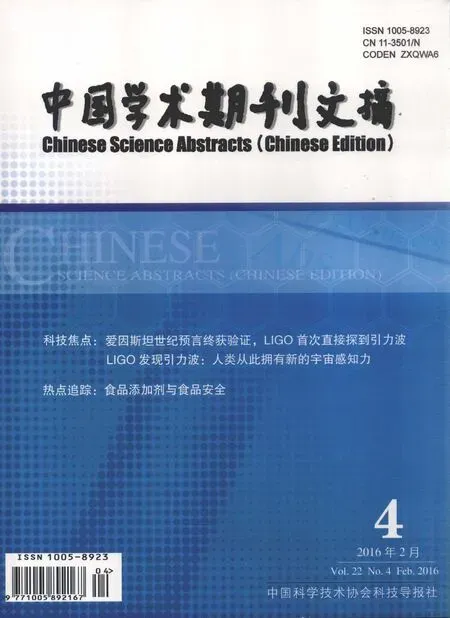
食品添加劑與食品安全
2016-03-31 06:27:32王靜,孫寶國
中國學(xué)術(shù)期刊文摘 2016年4期
?
食品添加劑與食品安全
·編者按·
隨著食品工業(yè)和添加劑工業(yè)的快速發(fā)展,食品添加劑的種類和數(shù)量越來越多,食品添加劑已經(jīng)成為食品生產(chǎn)加工和儲(chǔ)存過程中不可缺少的重要原料。然而,近年來有關(guān)食品添加劑的安全事件屢屢發(fā)生,造成了嚴(yán)重的后果,產(chǎn)生了惡劣的影響,食品添加劑的使用所引起的食品安全問題引起全社會(huì)的廣泛關(guān)注。食品添加劑是指為改善食品品質(zhì)和色、香、味以及為防腐、保鮮和加工工藝的需要而加入食品中的人工合成或天然物質(zhì),目前,我國允許使用的食品添加劑有2300多種,此外還有200多種營養(yǎng)強(qiáng)化劑。食品添加劑在食品工業(yè)中發(fā)揮著重要作用,不僅能夠改善和提高食品色、香、味及口感等感官指標(biāo),而且可以保持和提高食品的營養(yǎng)價(jià)值。但是,食品添加劑也是一把雙刃劍,它既給我們的生活帶來了便利,促進(jìn)了現(xiàn)代食品工業(yè)的發(fā)展,又易被不法分子利用超范圍、超標(biāo)準(zhǔn)使用和濫用違禁添加劑,給食品質(zhì)量、安全衛(wèi)生以及消費(fèi)者的健康帶來巨大的損害。因此,加強(qiáng)對(duì)食品添加劑安全問題的研究,提升我國食品的科技含量,推動(dòng)我國食品工業(yè)的快速發(fā)展,對(duì)于建立和完善我國食品安全體系,促進(jìn)社會(huì)和諧穩(wěn)定有著重要意義。
本專題得到了張嬋副教授(北京工商大學(xué)食品學(xué)院)的大力支持。
·熱點(diǎn)數(shù)據(jù)排行·
截至2016年1月18日,中國知網(wǎng)(CNKI)和Web of Science(WOS)的數(shù)據(jù)報(bào)告顯示,以“食品添加劑(food additive)”“食品安全(food safety)”為詞條可以檢索到的期刊文獻(xiàn)分別為5120條與4427條,本專題將相關(guān)數(shù)據(jù)按照:研究機(jī)構(gòu)發(fā)文數(shù)、作者發(fā)文數(shù)、期刊發(fā)文數(shù)、被引用頻次進(jìn)行排行,結(jié)果如下。

研究機(jī)構(gòu)發(fā)文數(shù)量排名(CNKI)

研究機(jī)構(gòu)發(fā)文數(shù)量排名(WOS)

作者發(fā)文數(shù)量排名(CNKI)

作者發(fā)文數(shù)量排名(WOS)

期刊發(fā)文數(shù)量排名(CNKI)

期刊發(fā)文數(shù)量排名(WOS)
根據(jù)中國知網(wǎng)(CNKI)數(shù)據(jù)報(bào)告,以“食品添加劑(food additive)”“食品安全(food safety)”為詞條可以檢索到的高被引論文排行結(jié)果如下。

國內(nèi)數(shù)據(jù)庫高被引論文排行
根據(jù)Web of Science統(tǒng)計(jì)數(shù)據(jù),以“食品添加劑(food additive)”“食品安全(food safety)”為詞條可以檢索到的高被引論文排行結(jié)果如下。

國外數(shù)據(jù)庫高被引論文排行
·經(jīng)典文獻(xiàn)推薦·
基于Web of Science檢索結(jié)果,利用Histcite軟件選取LCS(Local Citation Score,本地引用次數(shù))TOP 30文獻(xiàn)作為節(jié)點(diǎn)進(jìn)行分析,得到本領(lǐng)域推薦的經(jīng)典文獻(xiàn)如下。
Primary mutagenicity screening of food-additives currently used in Japan
M. Ishidate Jr; T. Sofuni; K. Yoshikawa; et al.
Abstract:Salmonella/microsome tests (Ames tests) and chromosomal aberration tests in vitro using a Chinese hamster fibroblast cell line were carried out on 190 synthetic food additives and 52 food additives derived from natural sources, all of which are currently used in Japan. Fourteen out of 200 tested in the Ames assay showed positive effects and 54 out of 242 were positive in the chromosome test. Three additives (erythorbic acid, chlorine dioxide and beet red) were positive only in the Ames test, although their mutagenic potentials were relatively weak, while 43 additives were positive only in the chromosome test. Eleven additives (calcium hypochlorite, cinnamic aldehyde, L-cysteine monohydrochloride, Food Green No.3 (Fast Green FCF), hydrogen peroxide, potassium bromate, sodium chlorite, sodium hypochlorite, sodium nitrite, cacao pigment and caramel) were positive in both the Ames test and the chromosome test. The usefulness of such primary screening tests combining two different genetic end-points, gene mutation and chromosomal aberration, and some correlation between mutagenicity and carcinogenicity of food additives are discussed. A semi-empirical model has been developed for additive diffusion in polymers. The model estimates apparent diffusion coefficients of an additive migrating through polyolefin polymers into a fatty food simulant for a range of temperatures between the glass transition and melting temperatures of the polymer. This diffusion model has been applied to several additive/polyolefin systems to determine its validity and limitations. Progress made by the Flavor and Extract Manufacturer’Association Expert Panel, which was formed in response to the provision in the 1958 Food Additive Amendment (USA) that exempted those substances generally recognized as safe (GRAS) from food additive status, is reviewed. Flavouring ingredient GRAS substances are tabulated. Use of food additives is regulated qualitatively in the European Common Market through the EEC directives on food additives, while the concept of acceptable daily intake (ADI) provides a quantitative expression of safe amounts for the guidance of regulatory agencies. It is suggested that a permissible quantity or quantities, the ceiling, should be agreed upon for each permitted additive on the basis of its ADI and in accordance with the procedure described here, the estimation of intake of food and drink starts from the child, who on the basis of body weight has the highest consumption. When dealing with total intake (expressed as energy, weight or volume per kg body weight per day), occupational and climatical variations between adults are largely contained in the difference between child and adult. It is possible to calculate the highest concentration in foodstuffs which is consistent with the ADI, under the assumption that the additive occurs evenly distributed in the whole diet of a child. This concentration is called the primary ceiling. To obtain the technological effect, however, higher concentrations may be needed, and to accomodate this the ceiling may have to be raised. This can be done if the use of the additive can be excluded from or reserved for part of the diet. A safety factor of 100-fold is commonly applied to animal data to derive the acceptable daily intake (ADI) of food additives; other factors have been used in some cases and higher values are used more frequently for determining the tolerable daily intake (TDI) of environmental chemicals. The 100-fold factor is considered to represent the product of a 10-fold factor to allow for species differences between the test animal and humans and a 10-fold factor to allow for inter-individual differences. A scheme is proposed whereby data relevant to the safety assessment of a compound, e.g. species differences in toxicokinetics, can contribute quantitatively to the safety factor and therefore to the ADI or TDI. For this to be possible, it is necessary to subdivide each of the 10-fold factors into two separate factors to allow for differences in toxicokinetics and toxicodynamics. For any compound, data on one particular aspect may be used to derive a specific data-derived factor for that aspect. The overall safety factor will then be calculated as the product of the known data-derived factor(s) and default values for the remaining unknown factors. In this way the derivation of the safety factor would be clearly defined and the potential impact of additional data on other aspects identified. Additional safety factors (over and above the 100-fold or overall data-derived factor) are also proposed to allow for the nature or severity of the toxicity and the adequacy of the database. These factors are consistent with previous evaluations and will allow the logical derivation of factors greater than either 100 or the appropriate data-derived factor. These additional factors will be of greatest value in the derivation of safety factors for the calculation of the TDIs of environmental contaminants but may also be applied if necessary to the safety assessment of food additives. In such cases the rationale and logic for a safety factor in excess of 100 will be clearly defined.
來源出版物: Food and Chemical Toxicology, 1984, 22 (8): 623-636
Modelling of additive diffusion in polyolefins
Limm, W; Hollifield HC
Keywords:antioxidant; diffusion coefficient; food additive petition; migration; polyolefin acceptable daily intake; ADI; safety factor; toxicokinetics; toxicodynamics; noael
來源出版物: Food Additives and Contaminants, 1996, 13 (8): 949-967
Recent progress in the consideration of flavoring ingredients under the food additives Amendment. 15. GRAS substances
GA Burdock; BM Wagner; RL Smith; et al.
來源出版物: Food Technology, 1990, 44(2):78-86
Conditions for use of food-additives based on a budget for an acceptable daily intake
Hansen, S?ren C.
來源出版物: Food Additives and Contaminants, 1993, 10(3): 275-305
·推薦綜述·
來源出版物: Journal of Food Protection, 1979, 42(5):429-434
Data-derived safety factors for the evaluation of food-additives and environmental contaminants
Renwick, AG
文獻(xiàn)編號(hào)本領(lǐng)域經(jīng)典文章題目第一作者 來源出版物1 Primary mutagenicity screening of food-additives currently used in Japan M. Ishidate Jr Food and Chemical Toxicology, 1984, 22 (8): 623-636 2 Modelling of additive diffusion in polyolefins Limm, W Food Additives and Contaminants, 1996, 13 (8): 949-967 3 Recent progress in the consideration of flavoring ingredients under the food additives amendment.15. GRAS substances GA Burdock Food Technology, 1990, 44(2):78-86 4 Conditions for use of food-additives based on a budget for an acceptable daily intake Hansen, S?ren C Journal of Food Protection, 1979, 42(5):429-434 5 Data-derived safety factors for the evaluation of food-additives and environmental contaminants Renwick, AG Food Additives and Contaminants, 1993, 10(3): 275-305