
THE RAP BATTLE FOR CHINA
2016-01-10 07:53:38謝燕輝
漢語世界(The World of Chinese) 2016年1期
謝燕輝

Grinding through Chinas hip hop scene
嘻哈說唱在中國:期待突破與創新
Welcome to Dada, a grungy club in the old-town heart of Beijing, most often known as a late night jaunt for expats looking for something to jump around to in the wee hours bordering on sunrise. Tonight, though, things are different; its not quite midnight, but its already time for round three. The lights are dim. Sweat flows, and the crowd jostles, pushing and shoving to get to the front for an unobstructed view of the spotlit stage. At the back of the room, three producers sit at their computers, MPC-2500s lighting their faces with blue and red flashing lights reminiscent of 2001: A Space Odyssey. Among them is Jeff Liang, an LA-native who lives and works in Beijing as a musician and producer, known to many by his stage name SoulSpeak. Liang, from his workstation, flicks a switch, sending his mix to the monitors, a stinging surge of pre-recorded piano and guitar licks hes played himself, combined with loops hes appropriated from a Bobby “Blue” Bland album.
On stage, MC Dawei, a thin man with a wispy mustache protruding from under his black fedora steps up to the stage, grabbing the microphone off the stand. You cant see his eyes from under the hat, and his oversized black suit gives the impression that hes shying away from the mic; as soon as the groove kicks in, though, hes anything but. The first beats of Liangs mix explode from the speakers, the bass drum pulsing like a magnified heart beat, and all of a sudden the crowds bumping like its 1995.
Hip hop, like many other imported American cultural art forms, is slowly bumping and grinding its way through China, propagated by the internet and a keen interest in localizing the aggressive aesthetic of this uniquely American art form.
“Hip hop culture in general has been shifting,” Liang says, from his walkup in east Chaoyang. Liang, a glasses-faced Taiwanese-American with a clean shaven head, smokes a cigarette as he lords over his kingdom, an ever growing pile of mixers, keyboards, wires and synthesizers. “Its [the shift] reflected in China, but its, maybe, a step slower than in other places.” Liang is speaking about global trends in hip hop, the change from the socially-conscious hardcore, aggressive rhymes and loop-based, drum machine tracks of NWA and Grandmaster Flash to what he considers watered-down hip hop: the likes of trap and bass music like Migos or Drake. “They simply have better music production back home,” he says. “Because if you really think about it, the hip hop scene here is really small—theres just not that many people doing it, and thats why it seems not as good.”
Improving that production element is Liangs job: to create the grooves over which the MCs can flow or rap. MCs like Dawei, Xiao Laohu, and their counterparts in Chengdu and Chongqing have to lean on producers like Liang to create music that appeals to their tastes. As an LA-born artist, Liang has the advantage, having been immersed in American hip hop culture since he was young.
“Ive been collecting drums from vinyl, from old records, since I was 15—and I have a huge pile of drums. I also record environmental noises as percussion that I can turn into pads, strings, or synths. A lot of times it depends what the goal of the project is; if Im just working on beats, then you know Ill start from a groove or a sound that I hear, or maybe a progression—theres no real set process.”
Liang is also keen for more unorthodox approaches to vary the development of his projects: “I also like to use visuals. Sometimes Ill just put on a movie, like Bladerunner, like a scene that I like, and so sometimes the changes are moving with the visuals. So I dont necessarily use the same structures Im used to. For hip hop, Im mostly just thinking about the groove, just the movement of the bass and drums and how everything fits on top.”
Being able to create for the artist on stage is what sets Liang apart from many of his cohorts. His beats draw on traditional hip hop elements that make it easy to “flow” over but also allow for specific nuances of the Chinese language to find their way into the music. Liang specifically produces for several artists who are generally considered fringe artists for their lyrical content or style.
One of them is MC Dawei, a Beijing native who is a martial arts, literature, and history buff. The visuals that accompany Daweis performances often push the envelope in both aesthetic and content. “Dawei is trying to push the envelope with history and using that in his lyrics.” Its very edgy stuff; youre just as be likely to hear him drop a reference to Lu Xun as you would about modern social issues. Theres something in his aggression, and Liangs heavy-hitting drum tracks are reminiscent of the Wu Tang Clan, which is, perhaps another bizarre layer atop this strange mix of cultures. Dawei, a veteran champion of the freestyle festivals that used to rock Beijings underground rock halls and small clubs like D22 and Yu Gong Yi Shan, is one of Chinas more edgy rap artists. His content walks a fine line between edgy and outright dangerous, especially for a Beijing-based performer—with increasing numbers of drug raids on performance venues known for hosting counterculture or underground music in the Beijing area. Many of the hip hop community have come under closer scrutiny for their involvement in these scenes. For many, this is seen as an attempt to rein in the content of a culture that might be excessively fringe in a materialistic or political nature.
At the same time, local non-profit advocacy organizations with government support such as the China Hip-Hop Union Committee, founded in 2013, have made it their goal to turn hip hop into a mainstream art form largely devoid of contrarian or even aggressively materialistic elements. As such, the cultural element of introducing American hip hop into China yields some hilarious results. Young Peach, a young MC with a growing following, headlines in a music video where the eponymous rapper pulls a pistol from his waistband, backing one of his posse into a wall after losing a game of dice, but fails to off the poor sap, having received a call on his cell phone. As a place where the idea of a gangster carrying a gun is almost as foreign as the notion of hip hop itself, such a hilarious cultural miscommunication can almost be seen as a form of legitimate cultural exchange. It shows how music may not necessarily be a universal language; Young Peachs extensive use of the N-word and its popularity among his followers perhaps belies how little they understand its context and history: “big dick, dont mess with Zohan,”? he croons in autotune. His LinkedIn page features such taglines as: “Street Hustla University” under education and lists “rap, music, party, comics, and skateboard” as his primary interests.
But not all attempts at creating hip hop culture in China are quite so blasé: Zhao Hong, or MC Little Tiger, otherwise known as Xiao Laohu, is another figure in the rap space who has made a name for himself. As a formative member of the Beijing hip hop scene, Zhao MCed in college, forming a name for himself as a freestyle rap battle warrior, during which he clinched the Dragon vs. Tiger title of champion twice. Liang, also Zhaos producer, credits him with the brilliance of his lyrics: “I think his lyrics are more abstract; its more like reading a lyrical comic book or animation where theres a very strong logic in his stuff, but you wouldnt think about unless you read or hear the lyrics a few times,” Liang says. A listen to Little Tigers latest release “Juliana” reveals a funk and jazz-inspired groove over which hes able to build his word palaces: his flow and rhythm lead the listener down halls of vivid and scenic imagery.
One of the challenges of rapping in Mandarin is the difficulty of the rhythmic syncopation—the stretching and contracting of rhythm—that makes English rap such an attractive listening experience. As a language of single syllables, making these rhythmic stretches is incredibly difficult for artists and their strings of single syllables tend to borderline on the monotonous.
The stretching and contracting of the pulse atop the groove is what gives hip hop its distinctively edgy and tense feel, also known as syncopation. Unfortunately, these single syllables are difficult to stretch into tension and resolution. Shuochang(說唱, literally, “talk and sing”), an age-old form of balladic artistry, tends to stress the longer form of the song, rather than smaller micro-subdivisions that give English rap its tooth and bite. That being said, as a language with hundreds of dialects, rapping in Mandarin, while difficult, can be an incredible crossroads of identity, language and culture. Rappers from Chengdu, who often rap in their standard Sichuanese, often maintain a laid back flow and pulse over their grooves that hint at the syncopation that English-language rap-listeners often crave for. Rappers from Beijing, on the other hand, have the advantage of the lip-curling snarl of er-hua(兒化)that delivers extra sting to their rhymes.
While a few of the champions of hip hop have even gone on to make full careers out of their extemporaneous verbal skills, its a rarity still, in the scene, today. Many of Beijings rappers still have day jobs or perform other kinds of music. “The scene is really still very small, if you think about it,” Liang says. “And while that means there isnt as much money to be made from it, it also means theres less control over it.” What that means is that despite hip hops lack of popularity (and general failure to break into mainstream pop music) its got enough inertia to develop on its own. And despite walking a fine line between contrarian elements and downright shock-worthy hooks, MCs like Dawei, who have found themselves before on the wrong end of the stick, have also found ways of getting around censorship, in order to deliver their music to audiences. The internet has played a huge role in delivering content—websites like Xiami and Douban, who host huge databases of music, dont have much issue when it comes to hosting smaller independent artists, even if it means having edgier content.
As a form of music thats not fully developed, theres a lot of work to be done to build a Chinese hip hop dream. On one hand, some artists are still imitating American musicians as a way of becoming famous. On the other hand, others have removed some key elements from the groove or production elements that create huge aesthetic problems for their music. “How to make the music stick? Thats a good question,” Liang says, his street drawl lingering on the word “question”. “When I say hip hop is shifting, I mean that there are purists out there who grew up on hip hop culture with graffiti and breakdancing and stuff, but now there are places where kids grew up and it wasnt like that.” Liang might be referring to the popularity of breakout artists like Macklemore, a white surburban Portland rapper who won a Grammy for Best Hip Hop Album in 2012, but also seemed to signal the end of hip hop as a form of black history. “Thats what I mean when I say that those changes reflect a step behind, in China.”
Building a better scene for hip hop is about many things, but getting up to date on history is one. “People need to do things that are more, just...more unique. In order to do something with your own voice, you need to understand everything thats come before you and the history of it, and you summarize those influences and you put your own voice on top,” Liang laments. Whether its digging into Grandmaster Flash, Little Tiger or the annals of shuochang, knowing and internalizing that vocabulary, flow, process and aesthetic is key to creating a hip hop culture thats rich in both the musical and philosophical elements of East and West. The twin specters of artistry and commercialism plague all artists, and rap artists are certainly no exceptions to the rule: the allure of becoming a mainstream pop artist on rap is one of those temptations that leads many of them astray. But artists balancing the individuality and edginess of their content and the temptations of popularity is key to building an authentic and creative hip hop scene that can compete with the likes of LA, Atlanta and Harlem.
“And because I think the voice of hip hop culture isnt so strong in China, thats harder for people to do. So mainly, its just for people to come out and do some different shit, mainly, or just take some fucking risks.”
Caption:? The Freedom performing in Nantong, Jiangsu Province, 2015
MC Webber performing after the launch of his album
Fans cheer MC Webber at his album launch concert. Hip hop in Beijing is building a growing fan base.
pullquote:One of the challenges of rapping in Mandarin is the difficulty of the rhythmic syncopation—the stretching and contracting of rhythm—that makes English rap such an attractive listening experience
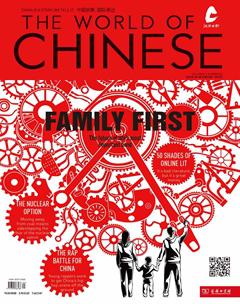 漢語世界(The World of Chinese)2016年1期
- 漢語世界(The World of Chinese)的其它文章
- 酷漫
- You’ve got questions, she’s got answers
- Nerd News
- 育
- Saving kids at Sun Village
- CAUTIONARY TALES