約
2016-01-10 12:15:40黃偉嘉劉玨
漢語世界(The World of Chinese) 2016年3期
黃偉嘉 劉玨

Going on a date is no casual affair
是花前月下的浪漫,也是共同遵守的協定,請慎重回答:約嗎?
If you go around explaining to an average person over 40 what it means to be casually “seeing” someone, you might see their eyes dart open with the implicit implication that you are downright promiscuous. Three dates in without labeling your partner as “boyfriend/girlfriend” is considered, by many, to be kind of odd. Five dates later? They should have already met the parents and set the wedding date.
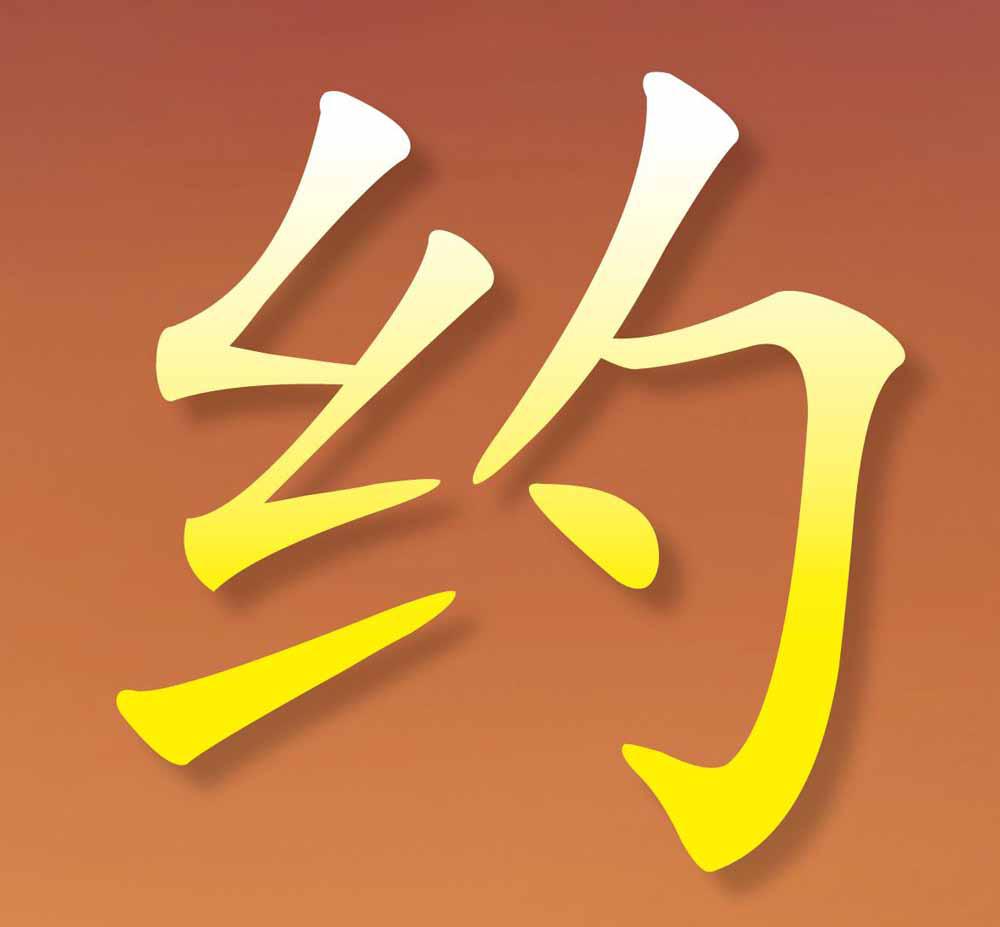
The Chinese phrase for “date” is約會(yu8hu#), with the character 約having a less than casual original meaning. As a matter of fact, its exactly the opposite of casual. Like many other characters, 約is connected to “silk”, or絲, which you can see from the “silk” radical, 纟, on the left. In seal script, the silk radical appears as a bundle of tied silk treads. So, the original meaning for約is “to bind, to tie up”. Its right radical, 勺, was supposed to represent the characters pronunciation, but the sound changed over time.
Later, 約developed more abstract meanings along these lines. 約束(yu8sh&) means “to keep within bounds; 制約(zh#yu8) means “to check, to restrict” as in 制約平衡(zh#yu8 p!ngh9ng) or “checks and balances”; and約 could also mean “limit” as in 節約?(ji9yu8), or “to economize, to save”. For instance, a common sign in an environmental campaign is 節約用水?(ji9yu8 y7ngshu@), or “save water”.
With 約, things often have a binding effect, from more serious international affairs such as international conventions ( 國際公約gu5j# g4ngyu8), treaties (條約ti1oyu8), and legal contracts (合約h9yu8)—to personal, quasi-religious contracts like an engagement, or marriage contract as in婚約(h$nyu8) .
To honor an agreement is to 履約?(l)yu8). To break ones promise and violate the contract is 違約 (w9iyu8).
約represents rules and regulations that are necessary for a group to function. A famous story in history gave rise to the term 約法三章(yu8f2 s`nzh`ng), or “agree on a three-point decree”. It was the great founder of the Han Dynasty (206 BCE – 220 CE), Liu Bang (劉邦) who coined this term when he overthrew the previous ruler and became the conqueror of the old capital. He then declared a three-point decree to regulate his army and protect the civilians: murder is punished by death; causing harm is criminal activity; robbery is also criminal activity, and all will be punished accordingly. It may seem obvious today, but at the time and amidst the chaos, this simple decree won him enough public support to be the new emperor. Today, we often use this term to mean “lay some ground rules”, for instance, 他們約法三章,婚后家務一律共同分擔。(T1men yu8f2 s`nzh`ng, h$nh7u ji`w&y!l_ g7ngt5ng f8nd`n. They made a basic agreement to share all house work after they get married.)
Unwritten rules are 約定俗成?(yu8d#ng s%ch9ng), meaning “drawn from popular usage or common practice”. In the case of “great minds think alike”, we use the term 不約而同(b&yu8 9rt5ng).
Because agreements involve previous arrangements, 約also took on the meaning of “to arrange, to make an appointment”, as in 預約?(y&yu8). On diplomatic occasions, to make an appointment to see someone is 約見?(yu8ji3n). The phrase約會?(yu8hu#) began as a universal phrase for any appointment to meet, but in our modern society it just means the romantic kind—a date.
Failing to show up for a previous engagement is 失約?(sh~yu8) or 爽約?(shu2ngyu8), famously seen in an 11th-century poem describing unrequited love. It starts with the memory of a happy scene from the previous years Lanterns Festival when the couple went to the night market together: 月上柳梢頭,人約黃昏后。(Yu- sh3ng li^sh`ot5u, r9n yu8 hu1ngh$n h7u. We arranged to meet after dusk, when the moon rose over the willow trees.) But, the guy never showed up: 不見去年人, 淚濕春衫袖。(B% ji3n q&ni1n r9n, l-ish~ ch$nsh`n xi&. Tears soaked the sleeves of her spring dress in his absence.)
Keen linguists might have noticed that約?also has an alternative meaning that seems totally unrelated to the above: “approximately, by estimation”, such as in 大約?(d3yu8) and 約莫?(yu8mo). Because its an estimation, 約can also mean “unclear, unobvious”, such as in 隱約?(y@nyu8, dim, vague).
Mostly, 約?is something that brings people together under the same terms. As to the dating scene in China, though the power of tradition remains, the younger generation are actively redefining customs so that the concept of 約會?(yu8hu#) is a lot more隱約(y@nyu8).