自閉癥兒童社會技能的錄像示范干預研究綜述
2015-12-26 13:31:54洪曉敏
綏化學院學報 2015年10期
洪曉敏
(華東師范大學特殊教育系 上海 200062)
自閉癥兒童社會技能的錄像示范干預研究綜述
洪曉敏
(華東師范大學特殊教育系 上海 200062)
社會技能是影響兒童社會交往效果的直接因素,自閉癥兒童社會技能存在缺陷,對他們的社會交往、情感認知產生一定的影響。錄像示范是一種有效的基于經驗和實證的干預方法。文章通過對現有的錄像示范干預自閉癥兒童社會技能的研究進行綜述,梳理其干預模式、干預目標和干預效果,分析優勢以及可能存在的挑戰,以期為國內的相關研究和實踐提供參考和依據。
自閉癥兒童;社會技能;錄像示范;干預
自閉癥是一類神經發育譜系障礙,社會交往障礙是其核心特征之一,具體表現在以下三個方面,社會-情感交互缺陷、用于社交的非言語溝通行為缺陷、建立和維持與其發展水平相符的人際關系缺陷(不僅是與照顧者之間的關系)(DSM-V,2013)[1]。
社會技能作為影響兒童社會交往效果的直接因素,對于兒童社會性發展以及社會化目標的實現起到了至關重要的作用。社會技能不足會影響與他人的互動,以及社交的開展、情感、認知的發展[2]。對自閉癥兒童的社會技能,研究者根據實際情況進行了不同的界定和描述。Brian等人在對社會技能干預文獻的元分析中發現,大多數干預研究中所指的社會技能包括一般的社會技能(主要指社會認知)、社會交往技能(游戲技能、社會參與、輪流、社會交往的主動發起與回應)和社會溝通技能(會話技能、共同注意等)[3]。
自閉癥兒童在社會性和語言方面上存在較為復雜的問題,因此需要進行專業化、個性化的指導和干預[4]。目前,針對自閉癥兒童社會技能進行干預的方法和策略有很多,包括社會故事、錄像示范、關鍵反應訓練和以同伴為中介的干預等等。錄像示范(VideoModeling)的干預方法基于行為主義理論和社會認知理論的觀察學習模型。該方法通過采用錄像技術,來呈現一個目標技能的模擬表現,并要求個體模擬錄像中所描述的行為,以此來改變個體目前的行為或學習新的行為技能[5][6][7]。在此過程中,兒童通過觀看錄像,增加其對某一特定情境的敏感性,同時學習應對相應情境的適當的方法。已有研究表明,錄像示范是一種有效干預自閉癥社會技能的方法[2][8]。
本研究對近五年現有的錄像示范干預自閉癥兒童社會技能的研究進行綜述,梳理其干預模式、干預目標和干預效果,分析優勢及可能存在的挑戰,以期為國內的相關研究和實踐提供參考和依據。
一、研究方法
研究以“socialskill”“initiation”“response”“communic-ation”“perspection”分別與“videomodel*”及”auti*”進行組合作為關鍵詞,選定EBSCOHOST文獻庫進行檢索,并限定檢索范圍為同行評審(peer-reviewed),檢索日期范圍為2009至2014年的文獻。通過瀏覽,刪除重復文獻、完全與自閉癥兒童錄像示范干預無關的文獻,將剩余文獻進行整理,獲得28篇關于自閉癥兒童社會技能的錄像示范個案干預實證研究文獻。
三、研究結果
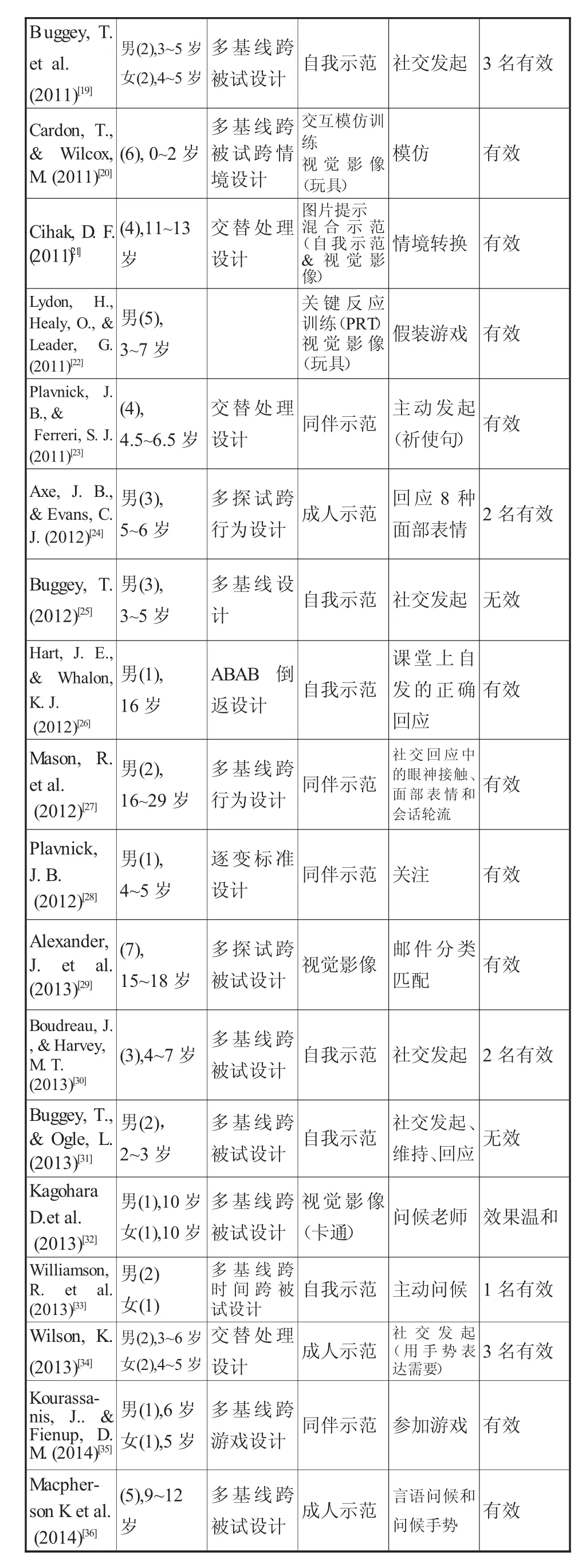
通過對2009~2014年的28篇文獻進行整理,結果如下表所示。
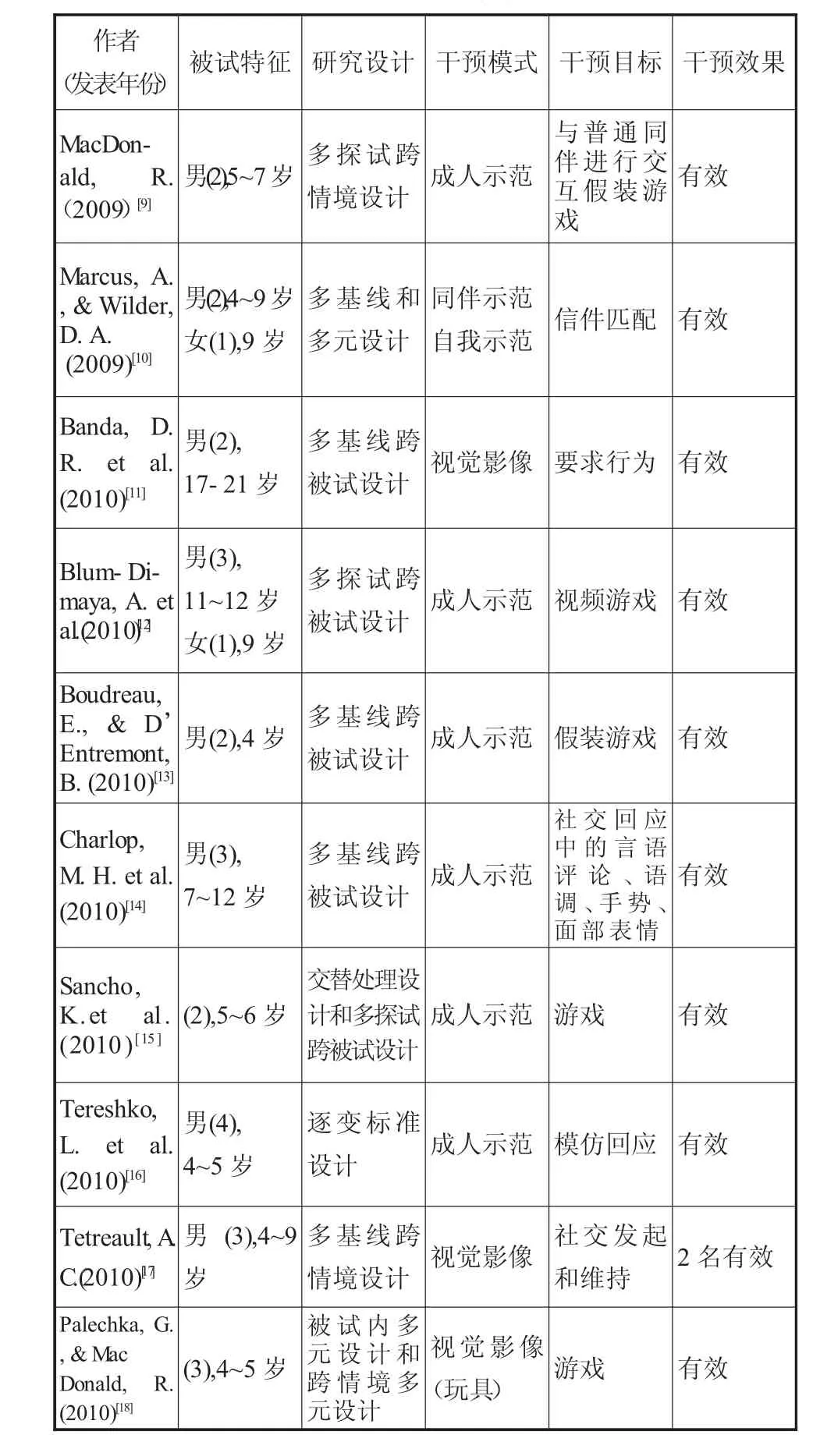
表1 文獻基本信息
Buggey,T.et al.(2011)[19]男(2),3~5歲女(2),4~5歲多基線跨被試設計 自我示范 社交發起 3名有效Cardon,T.,& Wilcox,M.(2011)[20](6),0~2歲多基線跨被試跨情境設計交互模仿訓練視覺影像(玩具)模仿 有效Cihak,D.F.(2011)[21](4),11~13歲交替處理設計圖片提示混合示范(自我示范&視覺影像)男(5),3~7歲Lydon, H.,Healy,O.,&Leader, G.(2011)[22]關鍵反應訓練(PRT)視覺影像(玩具)假裝游戲 有效交替處理(4),4.5~6.5歲Plavnick,J.B.,&Ferreri,S.J.(2011)[23]設計 同伴示范 主動發起(祈使句)有效多探試跨Axe,J.B.,&Evans,C.J.(2012)[24]男(3),5~6歲 行為設計 成人示范 回應8種面部表情 2名有效Buggey,T.(2012)[25]Hart,J.E.,& Whalon,K.J.(2012)[26]男(1),16歲男(3),3~5歲課堂上自發的正確回應多基線設計 自我示范社交發起無效社交回應中的眼神接觸、面部表情和會話輪流有效ABAB倒返設計 自我示范男(2),16~29歲Mason,R.et al.(2012)[27]男(1),4~5歲逐變標準設計 同伴示范 關注 有效多基線跨行為設計 同伴示范Plavnick,J.B.(2012)[28](7),15~18歲多探試跨被試設計 視覺影像 郵件分類匹配 有效(3),4~7歲 多基線跨被試設計 自我示范 社交發起 2名有效Boudreau,J.,&Harvey,M.T.(2013)[30]Buggey,T.,&Ogle,L.(2013)[31]男(2),2~3歲多基線跨被試設計 自我示范 社交發起、維持、回應無效多基線跨被試設計Kagohara D.et al.(2013)[32]男(1),10歲女(1),10歲視覺影像(卡通) 問候老師 效果溫和交替處理設計 成人示范Williamson,R. et al.(2013)[33]男(2)女(1)自我示范 主動問候 1名有效Wilson,K.(2013)[34]多基線跨時間跨被試設計男(2),3~6歲女(2),4~5歲社交發起(用手勢表達需要)3名有效Kourassanis,J..&Fienup,D.M.(2014)[35]Macpherson Ket al.(2014)[36]Alexander,J. et al.(2013)[29]多基線跨游戲設計 同伴示范 參加游戲 有效情境轉換 有效(5),9~12歲男(1),6歲女(1),5歲多基線跨被試設計 成人示范 言語問候和問候手勢有效有效
(一)研究對象。28篇實證研究中共包含89名被試,基本信息見表1。被試年齡范圍為0~29歲,其中2篇研究涉及到3歲以下的自閉癥幼兒,占9%(n=8),4篇研究涉及到13歲以上的自閉癥青少年,占13.5%(n=12),除此之外,其余研究的研究對象均為學齡前兒童和學齡兒童(n=69)。
(二)干預模式。總的來說,錄像示范是指通過示范者演示目標行為或技能,并將其編輯成為錄像,讓目標兒童對錄像中的行為和技能進行觀察、模仿、學習[37]。根據示范者的特征,將錄像示范的干預模式分為:成人示范,即由成人來示范目標行為,包括家長、教師,或兒童不熟悉的人;同伴示范,即由與自閉癥兒童年齡相近的典型發展同伴來示范目標行為,如兄弟姐妹、同學,或不熟悉的人;自我示范,即對個體自身所表現的積極行為或技能的觀察;視覺影像,指從示范者的視角來拍攝目標行為,視頻中僅出現示范的目標行為而非示范者,如僅記錄示范者系鞋帶時手部的動作[38];以及混合示范,即包含兩種或兩種以上模式相結合的干預模式[39]。圖1呈現了不同類型干預模式的實證研究數量對比。
本研究所涉及的研究文獻中,成人示范模式使用最為廣泛(n=9),其次為自我示范和視覺影像模式。其中,視覺影像作為一種較新的示范模式,能夠避免示范者個人特征對干預效果的影響,因此在現今的干預中得到較為廣泛的使用。此外,有研究對比了同伴示范和自我示范兩種方法對3名自閉癥兒童的適當匹配信件行為干預的效果,結果發現,自我示范能夠有效的干預全部被試,而在同伴示范后,只有1名被試達到了要求[40]。呈現了不同干預目標的實證研究數量對比。
社交發起是指個體指向另一個體的言語或非言語行為,包括表達感情、提供信息、打招呼、發起游戲、尋求幫助、問候、共同關注及模仿等等。有研究指出,與智力障礙兒童相比,自閉癥兒童的社交發起無論是在數量還是質量上都有明顯的不足[41],因此,對自閉癥兒童社交發起的干預很有必要。本研究所涉及的實證研究中,以社交發起技能為干預目標的研究最多,并且多數研究表示,錄像示范能夠有效地干預自閉癥兒童社交發起行為。因此,可以將錄像示范更多地應用在自閉癥兒童社交發起的干預中。

圖1 不同類型干預模式的實證研究數量對比
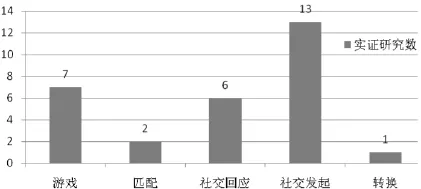
圖2 不同干預目標的實證研究數量對比
(四)干預效果。與已有研究相同,在本研究中,大多數自閉癥兒童社會技能干預的實證研究表示,在干預期間,自閉癥兒童的社會技能有明顯提高,干預的效果明顯,證明錄像示范這一干預方法是有效的。在自閉癥兒童社會技能的泛化和維持方面,不同研究的結果不盡相同。有研究表示,自閉癥兒童所獲得的社會回應技能能夠泛化到其他情境中,但也有研究表示,自閉癥兒童所獲得的問候技能只能在與同樣的老師進行問候,當面對其他老師或同伴時,難以泛化[32]。
三、討論
(三)干預目標。錄像示范法的干預目標主要包括自閉癥兒童的游戲(單獨的和相互的)、觀點采擇(如對心理理論任務的正確回應、假設另一個人物或形象的角色)、對話、問候、適應性或功能性技能(如清潔、購買)及社交發起等[40]。圖2
(一)錄像示范干預的有效性。大多數研究表明,錄像示范能夠有效地提高自閉癥兒童的社會技能,包括游戲、社交發起和社交回應等。錄像示范干預有效性的原因在于:
第一,自閉癥兒童偏愛電視或錄像這類呈現形式,因此,觀看錄像可以成為自閉癥兒童內在的一種強化,吸引兒童注意錄像中的相關線索,提高兒童觀看并學習其中內容的動機,從而模仿示范者的活動。
第二,錄像示范能夠自閉癥兒童視覺上的優勢。自閉癥兒童往往逃避面對面的溝通情境。有效的錄像不僅能夠為自閉癥兒童提供視覺偏好,讓兒童關注其本身正在進行的活動,同時避免面對面給自閉癥兒童帶來的消極反應。
第三,自閉癥兒童在以言語編碼形式存儲信息方面存在困難,而錄像示范為自閉癥兒童提供了具體、形象的表象信息,自閉癥兒童能夠更好地將示范者的行為以表象的方式存儲在記憶中。
第四,錄像資料可以重復利用,并與其他多種干預方法將結合(如社會故事、提示和強化等)。
第五,隨著科學技術不斷發展,電子產品不斷更新,應用軟件的不斷開發,都為錄像示范提供了更廣大的資源空間,不僅是研究者,家長和教師也能夠更好地對自閉癥兒童進行干預。
(二)錄像示范干預存在的挑戰及建議。第一,研究對象低齡化。在現有研究中,雖有針對3歲以下幼兒的社會技能進行干預的研究,但相比于3歲以上兒童的干預,還存在較大的差異。其原因可能是因為錄像示范這一干預策略對兒童觀察學習能力的要求較高,但有研究者認為,模仿干預策略完全有可能作為一種有效的自閉癥行為的干預方法[42],并且有研究證明了錄像示范對3歲以下兒童社會技能干預的有效性,因此,如何選擇更好的材料或方式,對3歲以下的自閉癥兒童進行干預,需要在今后的研究中進行更多的探索。
第二,多種策略進行比較。在現有研究中,對錄像示范與其他策略進行比較或錄像示范的不同模式不同設置進行比較的研究數量較少,干預效果也存在差異。Lydon和Leader(2011)將錄像示范與關鍵反應訓練(PRT)進行對比,對5名自閉癥兒童的假裝游戲技能進行干預,結果發現,兩種干預方法均有效,但在遷移過程中,關鍵反應訓練的效果要優于錄像示范[22]。此外,Plavnick和Ferreri(2011)通過交替處理設計對比了基于功能分析和不基于功能分析的錄像示范干預自閉癥兒童言語表達的效果,結果發現,基于功能分析的干預要更有效[23]。而對干預策略進行比較能夠幫助研究者和實踐者選擇更有效的干預方法、制定和實施更合適的干預計劃,因此,在今后的干預中,可以更多地從比較研究的角度出發,探索不同干預策略的干預效果。
[1]AmericanPsychiatricAssociation..Diagnosticandstatisticalmanualofmentaldisorders(5thed.).Arlington,VA:American PsychiatricPublishing.2013.
[2]Bellini S,Akullian J.A Meta-Analysis of Video Modeling andVideoSelf-ModelingInterventionsforChildrenand AdolescentsWithAutismSpectrumDisorders.Exceptional Children,2007,73(3):264-287.
[3]BrianReichow,FredR.Volkmar.Socialskillsinterventions for individuals with autism:Evaluation for evidence-based practiceswithinabestevidencesynthesisframework[J].Journalof AutismandDevelopmentalDisorders,2009,8(3):149-166.
[4]Taylor,B.A..Teaching peer social skills to children with autism [M]//Maurice,C.,Green,G.,&Foxx,R.M.Making a difference:Behavioral intervention for autism.Austin,TX,US:PRO-ED,2001:83-96.
[5]Cihak,D.,Fahrenkrog,C.,Ayres,K.M.,&Smith,C..Theuse ofvideomodelingviaavideoiPodandasystemofleastpromptsto improve transitional behaviors for students with autism spectrum disordersinthegeneraleducationclassroom[J].JournalofPositive BehaviorInterventions.2010,12(2):103-143.
[6]Wang S,Cui Y,Parrila R.Examining the Effectiveness of Peer-MediatedandVideo-ModelingSocialSkillsInterventionsfor Children with Autism Spectrum Disorders:A Meta-Analysis in Single-Case Research Using HLM [J].Research In Autism SpectrumDisorders,2011,5(1):562-569.
[7]Christos K Nikopoulos and Michael Keenan.Promoting social initiations in children with autism using video modeling[J].BehaviorInterventions,2003,18(2):87-108.
[8]Flynn L,Healy O.A review of treatments for deficits in social skills and self-help skills in autism spectrum disorder[J].ResearchInAutismSpectrumDisorders,2012,6(1):431-441.
[9]MacDonald,R.,Sacramone,S.,Mansfield,R.,Wiltz,K.,&Ahearn,W.H..UsingVideoModelingtoTeachReciprocalPretend Play to Children with Autism [J].Journal Of Applied Behavior Analysis,2009,42(1):43-55.
[10]Marcus,A.,&Wilder,D.A..Comparison of Peer Video Modeling and Self Video Modeling to Teach Textual Responses in Children with Autism [J].Journal Of Applied Behavior Analysis,2009,42(2):335-341.
[11]Banda,D.R.,Copple,K.S.,Koul,R.K.,Sancibrian,S.L.,&Bogschutz,R.J..Video modelling interventions to teach spontaneous requesting using AAC devices to individuals with autism:apreliminaryinvestigation[J].Disability&Rehabilitation,2010,32(16):1364-1372.
[12]Blum-Dimaya,A.,Reeve,S.A.,Reeve,K.F.,&Hoch,H..Teaching Children with Autism to Play a Video Game Using Activity Schedules and Game-Embedded Simultaneous Video Modeling[J].Education&Treatment Of Children,2010,33(3):351-370.
[13]Boudreau,E.,&D’Entremont,B..ImprovingthePretend Play Skills of Preschoolers with Autism Spectrum Disorders:The Effects of Video Modeling [J].Journal Of Developmental&PhysicalDisabilities,2010,22(4):415-431.
[14]Charlop,M.H.,Dennis,B.,Carpenter,M.H.,&Greenberg,A.L..TeachingSociallyExpressiveBehaviorstoChildrenwith AutismthroughVideoModeling[J].Education And Treatment Of Children,2010,33(3):371-393.
[15]Sancho,K.,Sidener,T.M.,Reeve,S.A.,&Sidener,D.W..Two variations of video modeling interventions for teaching play skills to children with autism [J].Education&Treatment Of Children,2010,33(3):421-442.
[16]Tereshko,L.,MacDonald,R.,&Ahearn,W.H..Strategies for teaching children with autism to imitate response chains using videomodeling[J].ResearchInAutismSpectrumDisorders,2010,4(3):479-489.
[17]Tetreault,A.C..Teaching Social Skills to Children with Autism using Point-of-View Video Modeling[J].Education&TreatmentOfChildren,2010,33(3):395-419.
[18]Palechka,G.,&MacDonald,R..A Comparison of the Acquisition of Play Skills Using Instructor-Created Video Models andCommerciallyAvailableVideos[J].Education&TreatmentOf Children,2010,33(3):457-474.
[19]Buggey,T.,Hoomes,G.,Sherberger,M.E.,&Williams,S..Facilitating Social Initiations of Preschoolers with Autism Spectrum Disorders Using Video Self-Modeling[J].Focus On AutismAndOtherDevelopmentalDisabilities,2011,26(1):25-36.
[20]Cardon,T.,&Wilcox,M..Promoting Imitation in Young Children with Autism:A Comparison of Reciprocal Imitation Training and Video Modeling [J].Journal Of Autism &DevelopmentalDisorders,2011,41(5):654-666.
[21]Cihak,D.F..Comparing Pictorial and Video Modeling Activity Schedules during Transitions for Students with Autism Spectrum Disorders[J].Research In Autism Spectrum Disorders,2011,5(1):433-441.
[22]Lydon,H.,Healy,O.,&Leader,G..AComparisonofVideo Modeling and Pivotal Response Training to Teach Pretend Play SkillstoChildrenwithAutismSpectrumDisorder[J].ResearchIn AutismSpectrumDisorders,2011,5(2):872-884.
[23]Plavnick,J.B.,&Ferreri,S.J..Establishing Verbal RepertoiresinChildrenwithAutismUsing Function-Based Video Modeling[J].JournalOf Applied Behavior Analysis,2011,44(4):747-766.
[24]Axe,J.B.,&Evans,C.J..Using video modeling to teach children with PDD-NOS to respond to facial expressions[J].ResearchInAutismSpectrumDisorders,2012,6(3):1176-1185.
[25]Buggey,T..EffectivenessofVideoSelf-Modelingto PromoteSocialInitiationsby3-Year-OldsWithAutismSpectrum Disorders[J].FocusOnAutism&OtherDevelopmentalDisabilities,2012,27(2):102-110.
[26]Hart,J.E.,&Whalon,K.J..UsingVideoSelf-Modeling viaiPadstoIncreaseAcademicRespondingofanAdolescent with Autism Spectrum Disorder and Intellectual Disability[J].Education And TrainingIn Autism And Developmental Disabilities,2012,47(4):438-446.
[27]Mason,R.A.,Rispoli,M.,Ganz,J.B.,Boles,M.B.,&Orr,K..Effects of video modeling on communicative social skills of college studentswith Aspergersyndrome.Developmental Neurorehabilitation,2012,15(6):425-434.
[28]Plavnick,J.B..A Practical Strategy for Teaching a Child With Autism to Attend to and Imitate a Portable Video Model[J].Research&Practice For Persons With Severe Disabilities,2012,37(4):263-270.
[29]Alexander,J.L.,Ayres,K.M.,Smith,K.A.,Shepley,S.B.,&Mataras,T.K..Using video modeling on an iPad to teach generalized matching on a sorting mail task to adolescents with autism [J].Research In Autism Spectrum Disorders,2013,7(11):1346-1357.
[30]Boudreau,J.,&Harvey,M.T..Increasing recreational initiationsforchildrenwhohaveASDusingvideoselfmodeling[J].Education&TreatmentOfChildren,2013,36(1):49-60.
[31]Buggey,T.,&Ogle,L..TheUseofSelf-ModelingtoPromote SocialInteractionsAmongYoungChildren[J].FocusOnAutism&OtherDevelopmentalDisabilities,2013,28(4):202-211.
[32]Kagohara,D.,Achmadi,D.,Meer,L.,Lancioni,G.,O'Reilly,M.,Lang,R.,&...Sigafoos,J..Teaching Two Students with Asperger Syndrome to Greet Adults Using Social Stories and Video Modeling [J].Journal Of Developmental&Physical Disabilities,2013,25(2):241-251.
[33]Williamson,R.L.,Casey,L.B.,Robertson,J.S.,&Buggey,T..Video self-modeling in children with autism:a pilot study validating prerequisite skills and extending the utilization of VSM across skill sets[J].Assistive Technology:The Official Journal of RESNA,2013,25(2):63-71.
[34]Wilson,K..Teaching Social-Communication Skills to Preschoolers with Autism:Efficacy of Video Versus In Vivo ModelingintheClassroom[J].JournalOfAutism&Developmental Disorders,2013,43(8):1819-1831.
[35]Kourassanis,J.,Jones,E.A.,&Fienup,D.M..Peer-video modeling:Teachingchainedsocialgamebehaviorstochildrenwith ASD [J].Journal Of Developmental And Physical Disabilities,2014,27(1):25-36.
[36]Macpherson,K.,Charlop,M.H.,&Miltenberger,C.A..Using portable video modeling technology to increase the complimentbehaviorsofchildrenwithautismduringathleticgroup play[J].Journal Of Autism And Developmental Disorders,2014,doi:10.1007/s10803-014-2072-3.
[37]Nikopoulos,C.,&Keenan,M..Promotingsocialinitiations in children with autism using video modeling [J].Behavioral Interventions,2003,18(2):87-108.
[38]張國棟.視頻示范法在兒童自閉癥干預中的應用研究[J].社會福利(理論版).2012,(7):35-37.
[39]McCoy,K.,&Hermansen,E..Video Modeling for Individuals with Autism:A Review of Model Types and Effects[J].EducationAndTreatmentOfChildren,2007,30(4):183-213.
[40]Keen D,Brannigan K.L,Cuskelly M..Toilet training for children with autism:the effects of video modeling[J].Journal of DevelopmentalandPhysicalDisabilities,2007,19(4):291-303.
[41]Tzanakaki,P.,Grindle,C.F.,Dungait,S.,Hulson-Jones,A.,Saville,M.,Hughes,J.C.,&Hastings,R.P..Use of a tactile prompt to increase social initiations in children with autism[J].ResearchInAutismSpectrumDisorders,2014,8(6):726-736.
[42]陳光華,方俊明.解析模仿策略在自閉早期干預中的應用[J].中國特殊教育,2009(5):23-29.
[責任編輯 王占峰]
A Review of Intervention on Social Skills of Children with Autism Spectrum Disorder Using Video Modeling
Hong Xiaomin
(Department of Special Education,East China Normal University,Shanghai 200062)
Social skills directly affect the effect of social interaction between children.Children with autism spectrum disorder(ASD)have difficult in social interaction and feeling recognization because of the lack of social skills.Video modeling is an effective way based on evidences and practices.This paper,based on the intervention research literature on social skills of children with autism spectrum disorder and by using video modeling,sums up the mode,the target and the effect of the intervention,and analyzes the advantages and challenges,and offers proposals for the future researches and practices.
children with autism;social skills;video modeling;intervention
G766
A
2095-0438(2015)10-0103-06
2015-06-12
洪曉敏(1991-),女,廣東潮州人,華東師范大學特殊教育系碩士研究生,研究方向:特殊兒童發展與教育。
猜你喜歡
故事作文·高年級(2023年10期)2023-10-23 11:21:18
文萃報·周五版(2021年14期)2021-06-08 22:33:19
中國生殖健康(2020年7期)2021-01-18 03:02:02
中國公路(2017年19期)2018-01-23 03:06:33
學苑創造·A版(2017年6期)2017-06-23 14:10:46
海峽姐妹(2017年5期)2017-06-05 08:53:17
丹青少年(2017年2期)2017-02-26 09:11:05
雜文選刊(2016年7期)2016-08-02 08:39:56
小天使·一年級語數英綜合(2016年6期)2016-05-14 12:21:05
Coco薇(2015年11期)2015-11-09 13:03:51