The ASEAN Economic Community beyond 2015
2015-12-12 06:36:14ByCiriloNoel
中國-東盟博覽(政經版) 2015年11期
By Cirilo P. Noel
The ASEAN Economic Community beyond 2015
By Cirilo P. Noel
As we approach the formal establishment of the ASEAN Economic Community (AEC) by the end of the year, now is a good time to consider broader targets beyond 2015. After all, a competitive, sustainable, and inclusive region is a grand and worthy project that deserves careful tending and collaboration.
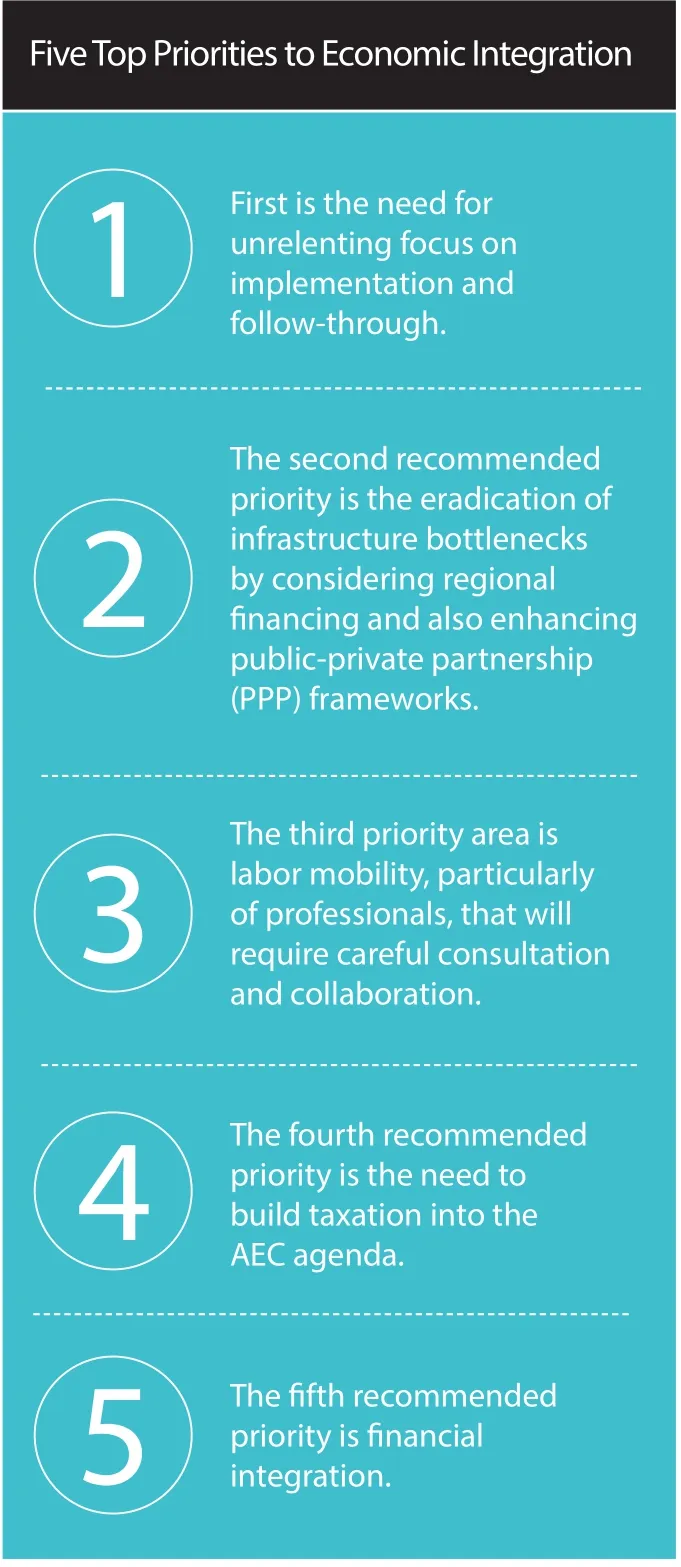
Calls for mindfulness and dialogue are central to part two of Ernst & Young’s (EY) Trade Secrets series. The report, titled ASEAN Economic Community: The last mile toward 2015 and beyond lists five top priorities for the public and private sectors to consider on the journey to full economic integration.
First is the need for unrelenting focus on implementation and follow-through. This is especially true for initiatives having to do with cross-border flow of trade. Besides tariffs, much can still be done to ease the movement of goods across various Customs regimes.
The ASEAN Single Window, for instance, is a work in progress that is meant to link the 10 National Single Windows and enable the single submission and processing of data for customs clearance and qualification for tariff privileges. ASEAN members will also need to improve on their ports and airports to handle large shipment volumes. Furthermore, ports will need to invest rapidly in automation to minimize human error, save time, and enhance overall eff i ciency. Above all, continuous dialogue between governments and the business community is recommended to manage change and pave the way for continued reforms.
The second recommended priority is the eradication of infrastructure bottlenecks by considering regional financing and also enhancing publicprivate partnership (PPP) frameworks.
For ASEAN to be a truly competitive region, infrastructure development is crucial. The Asian Development Bank has estimated that ASEAN requires an annual infrastructure investment of US$ 60 billion annually until 2020. Most private fi nancing of infrastructure projects in ASEAN has been bankfunded, with projects in Malaysia, the Philippines, and Singapore, for instance, being largely supported by domestic institutions. The EY report recommends the development of alternative funding sources such as debt capital markets to address the longer-term capital constraints posed by largescale projects. Further development of investment and legal frameworks, as well as enhanced disclosure requirements, are essential to develop such bond markets. In this connection, the report points to some existing initiatives; for example, the Asian Bond Market Initiative (ABMI) was endorsed in 2003 and a new ABMI road map was agreed upon in 2008 to further develop the regional bond markets to be more accessible for investors and users. The Credit Guarantee and Investment Facility was set up under the framework of the ABMI to provide credit enhancement to investment-grade companies in the region to issue bonds in the local currency bond markets. Furthermore, the ASEAN Infrastructure Fund was created in 2011 comprising equity contributions from ASEAN member countries and co-financed by the Asian Development Bank to address the region’s critical infrastructure development needs.
Such financing projects require not only government support but also greater private sector investment and expertise to ensure that infrastructure p r o g r a m s a r e s u c c e s s f u l l y implemented. Such collaboration is likewise needed in establishing and implementing appropriate PPP regulations and frameworks, as well as building government capacity to manage complex infrastructure projects.
The third priority area is labor mobility, particularly of professionals, that will require careful consultation and collaboration. This is an issue that is recognized in the AEC Blueprint. When investing or expanding in the region, companies may want to use a mix of manpower from headquarters as well as the local work force or have local talent trained elsewhere in the region. In such scenarios, the movement of labor will be critical.
The report notes that ASEAN private and public sector decision makers will have to weigh all sides of the issue to move forward. On the one hand, mobility encourages diversity of experience and access to the best talent from a larger population. On the other hand, developing member states face the risk of brain drain, while schemes to give mobility preferences to ASEAN members could also create an uneven playing fi eld for talent from outside the region.
Just like other priority areas, this issue will require great care as well as continued dialogue because it will certainly be an important part of the longer-term goals to create an integrated region.
The fourth recommended priority is the need to build taxation into the AEC agenda. The global tax environment is undergoing large changes driven by the Organization for Economic Cooperation and Development’s (OECD’s) Base Erosion and Profi t Shifting (BEPS) initiative.
The OECD released the 15-point BEPS Action Plan in July 2013. It sets out the organization’s views that weaknesses in the international tax system are underpinned by gaps in the interaction of domestic tax rules of various countries, the application of bilateral tax treaties to multijurisdictional arrangements, and the rise of the digital economy with the resulting relocation of core business functions. Recommendations to address these are expected to make the global tax landscape more challenging and, perhaps, uncertain for companies and investors.
The repor t notes that ASEAN governments would do well to consider having a specific tax agenda as a key workstream for the AEC after 2015 given this looming backdrop. As a group, ASEAN members may be able to speak with a single voice and exert a collective and authoritative infl uence on future global tax discussions if taxation is highlighted as a key area of discussion.
The fi fth recommended priority is fi nancial integration. As this can arguably be one of the most challenging goals for ASEAN members, the report emphasizes the need for careful action to manage the risks of liberalization.
In terms of fi nancial services liberalization, clear and adequate provisions are needed to distinguish Qualified ASEAN Banks. Dedicated attention to monitoring the progress of fi nancial integration is essential. Human resource capacity building as well as legal, tax, and regulatory systems are also critical to support the fi nancial market infrastructure.
In terms of capital account liberalization, the private and public sectors need to be wary of the risk of excess flows of capital that may arise from capital account liberalization. ASEAN members should consider capital controls and macro-prudential regulations to manage such risks.
In terms of the harmonization of payment and settlement systems, there remains an issue where ASEAN members currently adopt varying standards which make regional payment and settlement systems non-interoperable and linkages costly. To resolve this, there will be a need to adopt common best practices and standards.
Among all three financial areas, the report highlights the need to be careful of excessive deregulation as this could create an overly complex banking system with active international banks that are too large and difficult to supervise. Above all, banking services should be developed with an eye to serving the real economy.
All fi ve priority areas will require continued dialogue and deliberation between and among ASEAN members even beyond 2015. Full regional economic integration is truly a complex project. With proactive and sound collaboration between the private and public sectors, there can only be more milestones of success for the AEC.
Resource: www.bworldonline.com
(The writer is the Chairman and Managing Partner of SGV & Co.)