
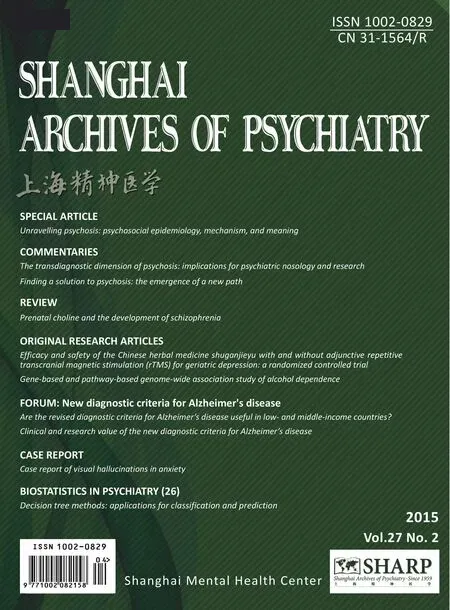
Finding a solution to psychosis: the emergence of a new path
2015-12-09 05:19:35XinYU
上海精神醫學 2015年2期
Xin YU
Finding a solution to psychosis: the emergence of a new path
Xin YU
dichotomous classi fication; biopsychosocial model; psychotic disorders; psychosis; psychiatric epidemiology
Dichotomous classifications of diagnoses used to be very popular both in psychiatry and in general medicine. In psychiatry this approach engendered several widely popularized distinctions: organic versus functional, neurotic versus psychotic, and genetic versus environmental.[1]This kind of dichotomy had practical advantages in the past when the limited repertoire of treatments available for mental disorders(e.g., electroconvulsive therapy, catharsis, large oral administration of reserpine, injection of tranquilizers,etc.) often had quite serious adverse effects and, thus,were intended for individuals who had severe mental disorders. More recently the value of dichotomous approach to diagnostic classifications has been challenged in psychiatry and in medicine more generally.One alternative approach that arose in the 1970s was the so-called bio-psycho-social model (BPSM),[2]a model that remains popular at the present. Many academics continue to advocate for the application of the BPSM in medical education, research, and practice.[3]
Moving from dichotomous conceptualizations of health and disease to a more nuanced understanding based on the BPSM is certainly a progressive step.However, I am not sure that it is best to use the BPSM as the foundation on which to build our understanding of mental disorders. The BPSM offers a Yin-Yang Tai Ji diagram of causes that encompasses everything,but its all-inclusive appeal conceals its lack of methodological rigor. Ghaemi discussed the advantages and disadvantages of the BPSM, and pointed out that overemphasizing the BPSM may lead psychiatry research into agnosticism.[4]Although psychiatric disorders are complicated, the constant emergence of new technologies and discoveries brings us closer and closer to the goal of understanding the brain and the disorders of the brain. Bebbington’s Special Article in this issue,‘Unravelling psychosis: psychosocial epidemiology,mechanism, and meaning’,[5]is an attempt to avoid agnosticism and draw a roadmap of the development of psychosis that integrates these various approaches.
Bebbington cites an extensive literature of epidemiological studies, most of which go well beyond simple head counts and descriptive epidemiology, to analyze the development and prognosis of psychosis cross-sectionally and longitudinally. This review highlights an unfamiliar side of the ‘familiar’ psychotic disorders: non-psychotic symptoms, especially mood symptoms, play an important role in the onset and progression of psychosis. Even for schizophrenia, a condition that has an estimated genetic heritability of 80%, psychosocial factors have a major impact on the development and course of the disorder. There are over 300 known susceptibility genes for schizophrenia,each with its own specific functional pathway andphenotypic expression.[6]Moreover, it is highly unlikely for one individual with schizophrenia to carry more than two susceptibility genes. For such a genetically heterogeneous population to show similar psychotic symptoms, the power of environmental factors in molding this relatively consistent symptomatic presentation must be considerable.
Bebbington’s analysis of studies about early intervention is particularly useful. He introduced intervention research targeting adolescents with nonpsychotic symptoms, such as poor sleep quality and disturbed mood, in order to prevent their progression to psychotic symptoms. This approach has been supported by various studies. For example, Arango[7]emphasized that attention should be paid to mood problems in adolescents, and recommended the use of medication(when necessary) to prevent their progression to psychosis. Yung and colleagues[8]introduced special services for adolescents in Australia, which they consider an effective method to prevent the development of psychosis. Although these interventions are costly and may be ethically controversial, they should be promoted to limit the long-lasting damage that psychosis can have for affected individuals and their families.
On the other hand, I disagree with some of Bebbington’s arguments. Psychotic episodes are unique psychological experiences, the core characteristic of which is the loss or severe damage of contact with reality. Psychotic episodes are frequently accompanied with many so-called non-psychotic symptoms, but the diagnostic and prognostic value of these symptoms should not be overestimated. Unrealistic perceptions and distorted beliefs are much rarer than mood and sleep disturbances, so achieving the goal of improving the validity and predictive power of diagnostic criteria may be best achieved by basing sub-classifications of schizophrenia (and other psychosis) on the characteristics of the psychotic symptoms rather than on the presence or absence of concurrent sleep or mood problems. Bebbington uses the reported effectiveness of cognitive behavioral therapy for psychosis (CBT-p)as confirmation of the important role psychosocial factors play in the onset and development of psychosis;I find this argument no more convincing than the assertion that improvement of psychotic symptoms after administration of an antipsychotic medication is evidence of the presence of a psychotic disorder. I agree with Bebbington that CBT-p should be studied further to explore its target symptoms and to better understand the psychological and biological mechanisms underlying its effectiveness in individuals with psychotic conditions,but it is misleading to infer the etiology of an illness based on the effectiveness of a treatment method.
Psychosis is similar to a difficult mathematical problem for which there are multiple solutions.Bebbington has bypassed the traditional entree to the problem – hallucinations and delusions – seeking an alternative pathway that starts with psychosocial environmental factors and common psychological symptoms to arrive at an alternative conceptualization of psychotic disorders. None of these solutions is perfect, but Bebbington has helped us understand that there may be multiple, equally-valid approaches to understanding and, eventually, addressing the problem of psychotic disorders such as schizophrenia.
1. Langfeld G. The significance of a dichotomy in clinical psychiatric classification.Am J Psychiatry. 1959; 116(6): 537-539
2. Engel GL. The need of a new medical model: a challenge for biomedicine.Science. 1977; 196: 129-136
3. Adler RH. Engel's biopsychosocial model is still relevant today.J Psychosom Res. 2009; 67(6): 607-611. doi: http://dx.doi.org/10.1016/j.jpsychores.2009.08.008
4. Ghaemi SN.The Rise and Fall of the Biopsychosocial Model:Reconciling Art and Science in Psychiatry. Maryland: Johns Hopkins University Press; 2010
5. Bebbington, P. Unravelling psychosis: psychosocial epidemiology, mechanism, and meaning.Shanghai Arch Psychiatry.2015; 27(2): 70-81. Epub 2015 Apr 2. doi: http://dx.doi.org/10.11919/j.issn.1002-0829.215027
6. Escudero I, Johnstone M. Genetics of schizophrenia.Curr Psychiatry Rep. 2014; 16(11): 1-6. doi: http://dx.doi.org/10.1007/s11920-014-0502-8
7. Arango C. Present and future of developmental neuropsychopharmacology.European Neuropsychopharmacology.2014; ISSN 0924-977X. Epub 15 Nov 2014. doi: http://dx.doi.org/10.1016/j.euroneuro.2014.11.003
8. Yung AR, McGorry PD, McFarlane CA, Jackson HJ, Patton GC,Rakkar A. Monitoring and care of young people at incipient risk of psychosis.Schizophr Bull. 1996; 22(2): 283-303. doi:http://dx.doi.org/10.1093/schbul/22.2.283
, 2015-04-07; accepted, 2014-04-13)

Dr. Xin Yu is Professor of Clinical Psychiatry at the Peking University Institute of Mental Health.He is the current President of the Chinese Society of Psychiatry, Founding president of the Chinese Psychiatrists Association, and Vice Chairman of the China Alzheimer’s Association. Dr.Yu has received training in Psychiatry in China and also received fellowships to study abroad at St. George Hospital, Melbourne University, Australia and at John Hopkins University, USA. Dr.Yu’s major areas of research include: dementia, late life depression and psychosis, substance abuse, first onset schizophrenia, neurocognitive function of HIV/AIDS, and bipolar disorder.He has co-authored more than 70 original articles and 15 book chapters. Dr. Yu is also on the editorial board of more than 10 domestic and international peer-reviewed journals, and is the editor-in-chief of the Chinese Mental Health Journal.
Tang W, Hu J, Zhang H, Wu P, He H. Kappa coefficient: a popular measure of rater agreement.Shanghai Arch Psychiatry.2015; 27(1): 62-67. doi: http://dx.doi.org/10.11919/j.issn.1002-0829.215010
In the 2ndparagraph of section 2 of the paper, the parenthetical remark “(in this example, 35.5% [(19+50)/200])”should read “(in this example, 65.5% [(66+65)/200])”. The corrected sentence should read “'Intuitively, we may think that the proportion of cases in which the two ratings are the same (in this example, 65.5% [(66+65)/200])would be a reasonable measure of agreement.” This change was made to the online version on theShanghai Archives of Psychiatrywebsite as of 3 April 2015.
Meng ML, Li W, Zhang SW, Wang HY, Sheng JH, Li CB. Using aripiprazole to reduce antipsychotic-induced hyperprolactinemia: meta-analysis of currently available randomized controlled trials.Shanghai Arch Psychiatry.2015;27(1): 4-17. doi: http://dx.doi.org/10.11919/j.issn.1002-0829.215014
In the Forrest plot shown in Figure 2 in the printed issue the reference numbers for three of the studies listed in the figure were incorrect: 'Wang 2009[46]' should be 'Wang 2009[41]', 'Zhou 2012[50]' should be ‘Zhou 2012[47]', and 'Zhu 2012[52]' should be 'Zhu 2012[48]'. The online version of the article is correct.
尋找解答精神病的方法:一個新的答案的出現
于欣
二分法分類;生物心理社會模式;精神病性障礙;精神病;精神病流行病學
Summary:The transition from a dichotomous diagnostic classification system to the more holistic approach to understanding mental disorders engendered by the so-called biopsychosocial model has de finite advantages, but it runs the risk of sacri ficing methodological rigor to achieve all-inclusiveness. The Special Article by Bebbington on understanding psychosis in this issue attempts to show that high-quality psychosocial epidemiological research on the development of psychosis can, at least partially, overcome these limitations. Bebbington’s emphasis on the importance of non-psychotic symptoms such as disturbance in sleep and mood in the development of psychosis provides a new perspective on the conceptualization of psychosis, but I remain unconvinced about the usefulness of such symptoms in the differentiation of valid sub-categories of schizophrenia or other psychoses.
[Shanghai Arch Psychiatry.2015; 27(2): 87-89.
http://dx.doi.org/10.11919/j.issn.1002-0829.215043]
Institute of Mental Health, Peking University, Beijing, China
correspondence: yuxin@bjmu.edu.cn
概述:受所謂的生物心理社會模式的推動,對精神障礙的認識從二分法診斷分類轉向更為全面綜合的方法。雖然這種認識轉變有一定的好處,但是為了顧及生物心理社會各個方面的因素,勢必要冒著犧牲嚴謹方法的風險。本期對精神病認識的特別報道中,Bebbington試圖表明關于精神病發生的高質量心理社會流行病學研究至少可以部分克服上述認識轉變的局限性。Bebbington強調睡眠、情緒等非精神病性癥狀在精神病發生中的重要性,這為精神病的概念提供了一個新的視角。然而,上述非精神病性癥狀對于有效鑒別精神分裂癥或其他精神病性障礙亞類的有用性,我是心存疑慮的。
本文全文中文版從2015年06月06日起在http://dx.doi.org/10.11919/j.issn.1002-0829.215043可供免費閱覽下載
猜你喜歡
天天愛科學(2022年9期)2022-09-15 01:12:54
天天愛科學(2022年4期)2022-05-23 12:41:48
當代水產(2022年3期)2022-04-26 14:26:56
現代畜牧科技(2021年9期)2021-10-13 06:39:12
現代畜牧科技(2021年3期)2021-07-21 08:42:02
數學小靈通(1-2年級)(2021年4期)2021-06-09 06:25:56
世界科學技術-中醫藥現代化(2020年2期)2020-07-25 02:05:36
航空世界(2020年10期)2020-01-19 14:36:20
中學生數理化·七年級數學人教版(2019年4期)2019-05-20 10:06:32
中學生數理化·七年級數學人教版(2018年6期)2018-06-26 08:36:06
- 上海精神醫學的其它文章
- Decision tree methods: applications for classi fication and prediction
- Case report of visual hallucinations in anxiety
- Clinical and research value of the new diagnostic criteria for Alzheimer’s disease
- Are the revised diagnostic criteria for Alzheimer’s disease useful in low- and middle-income countries?
- Gene-based and pathway-based genome-wide association study of alcohol dependence
- Efficacy and safety of the Chinese herbal medicine shuganjieyu with and without adjunctive repetitive transcranial magnetic stimulation (rTMS) for geriatric depression: a randomized controlled trial