
Attenuated psychosis syndrome: bene fits of explicit recognition
2015-12-09 03:02:22JasonSCHIFFMANWilliamCARPENTER
上海精神醫學 2015年1期
Jason SCHIFFMAN*, William T. CARPENTER*
Attenuated psychosis syndrome: bene fits of explicit recognition
Jason SCHIFFMAN1*, William T. CARPENTER2*
attenuated psychosis syndrome; schizophrenia; diagnosis; mental disorder; DSM-5
Prevention of psychotic illness - which can be a devastating condition - has become a growing priority of mental health clinicians and researchers. Advances in the identification of people with attenuated psychotic symptoms, a group generally at increased risk for psychosis, have allowed for the development of novel intervention strategies. These interventions have had promising results, including symptom improvement,better functioning, delayed onset of psychosis, and reduced rates of transition from attenuated to fullthreshold psychosis.[1-2]Moreover, identifying and potentially treating individuals with attenuated psychosis will shorten or completely eliminate the period during which individuals destined to develop psychosis experience psychotic symptoms without treatment (i.e., the ‘duration of untreated psychosis’or DUP), a change that is related to several positive outcomes, including better response to treatment,higher quality of life, and reduced mortality after the onset of psychotic illness.[3-4]
Given this tremendous potential benefit of early intervention, the importance of a reliable category to identify people with attenuated psychosis is hard to overstate. The field has created a variety of related labels to represent an attenuated, at-risk state, including ‘clinical high-risk,’ ‘ultra high-risk,’ ‘the prodrome,’ and ‘psychosis-risk syndrome.’ The term‘Attenuated Psychosis Syndrome’ (APS), a construct characterized by attenuated psychotic symptoms that overlap with an at-risk status, has been added to the DSM-5 both as a condition for future study and as one of the possible presentations of Other Specified Schizophrenia Spectrum and Other Psychotic Disorders,298.8 (F28).[5]Thus, the DSM-5 currently acknowledges APS as a potential disorder and provides clinicians and researchers a mechanism to recognize a clinically meaningful attenuated form of psychosis that is associated with risk for progression to full psychosis.Despite ongoing debate about the inclusion of APS in the DSM-5,[6-7]including the Forum commentary by Dr. Xu and colleagues[8], there has been substantial validating evidence for the construct.[9-10]
Approximately 64% of persons meeting criteria for APS do not develop a psychotic disorder within three years of the onset of APS.[11]They are, nevertheless,at risk for a variety of mental health problems thatmerit clinical monitoring and management including,but not limited to, subthreshold psychotic symptoms,depression, anxiety, attention-deficit and hyperactivity disorder (ADHD), cognitive deficits, impaired social functioning, family stress, substance abuse, exposure to trauma, and lower quality of life. Moreover, the pattern of distress and symptomatology experienced by individuals with APS is distinct both from that seen in community members who do not seek treatment and from non-APS treatment seekers. Thus the clinical identi fication of APS is not only important as a method for identifying persons at high-risk of subsequent psychosis; it is also a broad marker for identifying individuals who merit active treatment to address a variety of psychological symptoms.[11-13]
Much more high-quality research among individuals with APS is needed to characterize the level of morbidity and to identify the predictors of outcome. DSM-5 already provides a diagnostic label that includes APS (Other Specified Schizophrenia Spectrum and Other Psychotic Disorders), but the subsequent definition of a specific APS diagnostic category (currently under discussion for the forthcoming DSM-5.1) could greatly facilitate research on APS by promoting improved communication and integration of knowledge between the increasing number of expert centers conducting research on APS or other high-risk syndromes. For instance, prior to the publication of the DSM-5, characteristic symptoms of ‘clinical high-risk’(CHR) were not well captured under any existing DSM category, indicating the need and potential utility of defining such a category. Using vignette methodology in a study of community-based mental health providers, we found that when given a list of DSMIV-TR diagnoses the majority of providers diagnosed our validated APS vignette as having a full psychotic illness and 69% of them recommended treatment with antipsychotic medication, a treatment that is explicitly not recommended for this population.[14-15]This work suggests that over-diagnosis and consequent overtreatment is likely common for patients with APS; having a speci fic APS category in DSM-5 should facilitate more accurate classi fication and, hopefully, more appropriate treatment for this important population.
Another important advantage of the recognition of APS in the DSM-5 involves workforce development.Despite the fact that at least 50% of people who ultimately develop schizophrenia report attenuated psychotic symptoms in adolescence, psychosis tends to be considered an “adult” disorder. In a recent pilot poll of mental health providers, we found that providers who self-label as child or adolescent-focused providers reported being relatively unfamiliar with psychosis, while those who self-label as adult-focused providers (who were less comfortable working with youth) report more familiarity with psychosis.[16]These findings suggest that the current mental health workforce is not effectively trained to both be sensitive to early signs of psychosis,and to be aware of the developmental needs of adolescents. The APS diagnosis, which primarily occurs among adolescents and young adults, has the potential to shift attention to psychotic and pre-psychotic symptoms in a younger age range and, thus, lead to increased training and sensitivity to risk for psychosis among youth-oriented mental health providers. We have found that even brief training sessions can increase the understanding and awareness of risk signs for psychosis among youth-focused providers.[17]
A potential strategy that may help improve the reliability of the APS diagnosis is the use of prescreening measures. Our research has shown that a variety of methods designed to assess APS symptoms,including both self-report measures and family member-reported measures, are effective for improving diagnostic reliability in real-world clinical settings.[18-21]Further, when these measures are used to determine whether or not to refer an individual to a specialized clinic for early psychosis, the positive predictive values for future psychosis have ranged from 39 to 53%. Although untested at this point, these results suggest that pre-screened individuals who then meet APS criteria are a subgroup of persons with APS who are at elevated risk of subsequent psychosis. Screening may identify more individuals in need of APS-tailored care, both among those who do and do not subsequently transition to full psychosis.[22].
The inclusion of APS in DSM-5’s Section 3 (for conditions meriting further study) and under the Other Speci fied Schizophrenia Spectrum and Other Psychotic Disorders diagnosis is an important advance for the field of psychiatry. Given the unique characteristics of people who meet criteria for APS and the growing literature on the clinical bene fits of providing services to individuals who meet these criteria, the APS diagnosis serves an important, and previously missing, role in psychiatry.Use of the APS category has the potential to identify,diagnose, and appropriately treat individuals who were likely misclassified and mismanaged in the past.Furthermore, recognition of APS as a common condition among adolescents should promote expanded training about psychosis and attenuated psychosis among clinicians who primarily provide services to children and youth. Only some of the individuals with APS subsequently develop psychosis (i.e., there are many‘false positives’), but all of them have existing clinical needs - regardless of subsequent conversion. The formal recognition of APS in DSM-5 will facilitate the research needed to identify and meet those needs.
Conflict of interest
The authors report no con flict of interest related to this manuscript.
Funding
This work was supported in part by funding from the Mental Hygiene Administration of the Maryland Department of Health and Mental Hygiene to the Center for Excellence on Early Intervention for Serious Mental Illness (OPASS# 14-13717G/M00B4400241).
1. Okuzawa N, Kline E, Fuertes J, Negi S, Reeves G, Himelhoch S, et al. Psychotherapy for adolescents and young adults at high risk for psychosis: a systematic review.Early Interv Psychiatry. 2014; 8(4): 307-322. doi: http://dx.doi.org/10.1111/eip.12129
2. Stafford MR, Jackson H, Mayo-Wilson E, Morrison AP, Kendall T. Early interventions to prevent psychosis: systematic review and meta-analysis.Br Med J. 2013; 346: f185. doi:http://dx.doi.org/10.1136/bmj.f185
3. Marshall M, Lewis S, Lockwood A, Drake R, Jones P, Croudace T. Association between duration of untreated psychosis and outcome in cohorts of first-episode patients: a systematic review.Arch Gen Psychiatry. 2005; 62(9): 975-983. doi:http://dx.doi.org/10.1001/archpsyc.62.9.975
4. Schiffman J, Stephan S, Hong LE, Reeves G. School-based approaches to reducing the duration of untreated psychosis.Child Adolesc Psychiatr Clin N Am. In press. doi: http://dx.doi.org/10.1016/j.chc.2014.11.004
5. American Psychiatric Association.Diagnostic and Statistical Manual of Mental Disorders, 5th ed. Washington: American Psychiatric Association; 2013
6. Carpenter WT. Attenuated psychosis syndrome: need for debate on a new disorder.Psychopathology. 2014; 47 (5): 287-291. doi: http://dx.doi.org/10.1159/000365221
7. Nelson B. Attenuated psychosis syndrome: don’t jump the gun.Psychopathology. 2014; 47(5): 292-296. doi: http://dx.doi.org/10.1159/000365291
8. Xu L, Zhang T, Wang J. Psychosis risk syndrome is not prodromal psychosis.Shanghai Arch Psychiatry. 2015; 27(1): 42-44.doi: http://dx.doi.org/10.11919/j.issn.1002-0829.214178
9. Fusar-Poli P, Borgwardt S, Bechdolf A, Addington J, Riecher-R?ssler A, Schultze-Lutter F, et al. The psychosis high-risk state: a comprehensive state-of-the-art review.JAMA Psychiatry. 2013; 70(1): 107-120. doi: http://dx.doi.org/10.1001/jamapsychiatry.2013.269
10. Fusar-Poli P, Carpenter WT, Woods SW, McGlashan TH. Attenuated psychosis syndrome: ready for DSM-5.1?Annu Rev Clin Psychol. 2014; 10: 155-192. doi: http://dx.doi.org/10.1146/annurev-clinpsy-032813-153645
11. Fusar-Poli P, Bonoldi I, Yung AR, et al. Predicting psychosis:meta-analysis of transition outcomes in individuals at high clinical risk.Arch Gen Psychiatry. 2012; 69(3): 220-229. doi:http://dx.doi.org/10.1001/archgenpsychiatry.2011.1472
12. Thompson E, Kline E, Ellman LM, Mittal V, Reeves GM, Schiff-man J. Emotional and behavioral symptomatology reported by help-seeking youth at clinical high-risk for psychosis.Schizophr Res. In press; doi: http://dx.doi.org/10.1016/j.schres.2015.01.023
13. Thompson E, Millman ZB, Bussell K, Mittal VA, DeVylder J,Skadberg T, et al. Psychosocial interventions for young people at risk for psychosis: a flexible, multidimensional, and individualized approach.J Nerv Ment Dis. Accepted pending minor revisions
14. Jacobs E, Kline E, Schiffman J. Practitioner perceptions of attenuated psychosis syndrome.Schizophr Res. 2011; 131(1-3):24-30. doi: http://dx.doi.org/10.1016/j.schres.2011.06.022
15. Jacobs E, Kline E, Schiffman J. De fining treatment as usual for attenuated psychosis syndrome: a survey of community practitioners.Psychiatr Serv. 2012; 63(12): 1252-1256.doi: http://dx.doi.org/10.1176/appi.ps.201200045
16. Kline E, Davis B, Schiffman J. Who should treat youth with emerging psychosis?Schizophr Res. 2014; 157(1-3): 310-311.doi: http://dx.doi.org/10.1016/j.schres.2014.06.010
17. Golembo-Smith S, Denenny D, Kishimoto E, Schiffman J.Training service-providers regarding youth at risk for psychosis.Asia-Paci fic Psychiatry. 2011; 3(1): 17-22. doi: http://dx.doi.org/10.1111/j.1758-5872.2011.00110.x
18. Kline E. Wilson C. Ereshefsky S. Denenny D. Thompson E.Pitts SC, et al. Psychosis risk screening in youth: a validation study of three self-report measures of attenuated psychosis symptoms.Schizophr Res. 2012; 141(1): 72-77. doi: http://dx.doi.org/10.1016/j.schres.2012.07.022
19. Kline E, Thompson E, Schimunek C, Reeves G, Bussell K, Pitts SC, et al. Parent-adolescent agreement on psychosis risk symptoms.Schizophr Res. 2013; 147(1): 147-152. doi: http://dx.doi.org/10.1016/j.schres.2013.03.007
20. Thompson E, Kline E, Reeves G, Pitts SC, Schiffman J. Identi-fying youth at risk for psychosis using the Behavior Assessment System for Children, Second Edition.Schizophr Res.2013; 151(1-3): 238-244. doi: http://dx.doi.org/10.1016/j.schres.2013.09.022
21. Thompson E, Kline E, Reeves G, Pitts SC, Bussell K, Schiffman J. Using parent and youth reports from the Behavior Assessment System for Children, Second Edition to identify individuals at clinical high-risk for psychosis.Schizophr Res.2014; 154(1-3): 107-112. doi: http://dx.doi.org/10.1016/j.schres.2014.02.009
22. Kline E, Schiffman J. Psychosis risk screening: a systematic review.Schizophr Res. 2014; 158(1-3): 11-18. doi: http://dx.doi.org/10.1016/j.schres.2014.06.036
, 2015-02-01; accepted, 2015-02-05)

Jason Schiffman received his Ph.D. in psychology from the University of Southern California in 2003.Currently, he is an Associate Professor of Psychology and Director of Clinical Training at University of Maryland, Baltimore County (UMBC) where he has been since 2009. Dr. Schiffman is the Co-Director of the Maryland Early Intervention Program’s Strive for Wellness Clinic, a research, training, and services program designed to understand and improve the lives of young people with or at risk for serious mental health concerns, and of their families. Dr. Schiffman has held grants with the National Institute of Mental Health, the National Alliance for Research on Schizophrenia and Depression, the Mental Health Foundation, the State of Hawaii Departments of Education and Health, and the Department of Health and Human Services in the State of Maryland. Dr. Schiffman’s research seeks to improve the identification of young people at risk for psychotic disorders, better understand the effects of psychosocial interventions for adolescents with psychosis, and uncover mechanisms that can reduce stigma against people with serious mental health concerns.
輕微精神病綜合征:明確識別的好處
Schiffman J, Carpenter WT
精神分裂癥;診斷;精神障礙;DSM-5
Summary:Given the unique characteristics of people who meet criteria for attenuated psychosis syndrome(APS) and the growing literature on the clinical bene fits of providing services to individuals who meet these criteria, the APS diagnosis serves an important, and previously missing, role in psychiatry. The promotion of the APS diagnosis should help reduce the over-diagnosis and over-treatment of individuals with prodromal psychotic conditions and it should also encourage expanded training about attenuated psychosis among clinicians who primarily provide services to youth (a primary group who are diagnosed with APS). Only some of the individuals with APS subsequently develop psychosis, but all have existing clinical needs - regardless of subsequent conversion. The formal recognition of APS in DSM-5 will facilitate the research needed to identify and meet those needs.
[Shanghai Arch Psychiatry. 2015; 27(1): 48-51.
10.11919/j.issn.1002-0829.215015]
1Department of Psychology, University of Maryland, Baltimore County, Baltimore, Maryland, United States
2Department of Psychiatry, University of Maryland School of Medicine, Maryland Psychiatric Research Center, and VA Capitol Health Care Network(VISN 5) MIRECC, Baltimore, Maryland, United States
*correspondence: (JS) schiffman@umbc.edu; (WC) wcarpent@mprc.umaryland.edu
概述:符合輕微精神病綜合征(attenuated psychosis syndrome ,APS)標準的個體具有獨有的特征,越來越多的文獻認為對符合APS標準的個體提供服務在臨床上能獲益,因而APS的診斷在精神病學中有著重要作用,但過去卻被忽視了。推行這一診斷將有助于減少對具有前驅期精神病性狀態個體的過度診斷和治療。因為青少年是被診斷為APS的主要群體,所以也應鼓勵那些主要為青少年服務的醫生接受關于輕微精神病綜合征的全面培訓。雖然只有一部分APS個體最終會發展為精神病,但是臨床上所有的APS個體都需要得到幫助——無論他們的轉歸如何。DSM-5正式列出APS,這將有利于開展如何識別這類個體的臨床需求以及如何滿足這些需求的研究。
本文全文中文版從2015年03月25日起在www.shanghaiarchivesofpsychiatry.org/cn可供免費閱覽下載
猜你喜歡
城市道橋與防洪(2022年4期)2022-07-01 06:04:12
瘋狂英語·新讀寫(2021年7期)2021-10-13 06:35:44
今日農業(2019年12期)2019-08-15 00:56:32
當代陜西(2019年8期)2019-05-09 02:22:48
動漫星空(興趣百科)(2019年3期)2019-03-07 07:23:10
今日農業(2019年10期)2019-01-04 04:28:15
今日農業(2019年16期)2019-01-03 11:39:20
商周刊(2017年9期)2017-08-22 02:57:56
專用汽車(2016年4期)2016-03-01 04:13:43
中國火炬(2014年4期)2014-07-24 14:22:19
- 上海精神醫學的其它文章
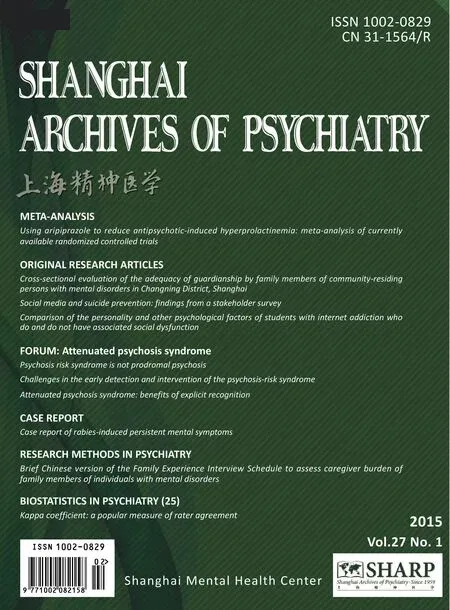
- Kappa coefficient: a popular measure of rater agreement
- Brief Chinese version of the Family Experience Interview Schedule to assess caregiver burden of family members of individuals with mental disorders
- Case report of rabies-induced persistent mental symptoms
- Psychosis risk syndrome is not prodromal psychosis
- Comparison of the personality and other psychological factors of students with internet addiction who do and do not have associated social dysfunction
- Social media and suicide prevention: findings from a stakeholder survey