
A Blissful Tibetan Family:Three Generations under One Roof
2015-10-15 01:40:15BystaffreporterZHANGXIAO
今日中國·中文版 2015年11期
By staff reporter ZHANG XIAO
A Blissful Tibetan Family:Three Generations under One Roof
By staff reporter ZHANG XIAO
TASHI Badzong is a 32-yearold woman from Tibet. Like many other young Tibetans,Tashi is happy to share interesting stories about her everyday life on WeChat (a popular social networking app in China). She has recently been enthusing over photographing three generations of her big,blithe family's life together.
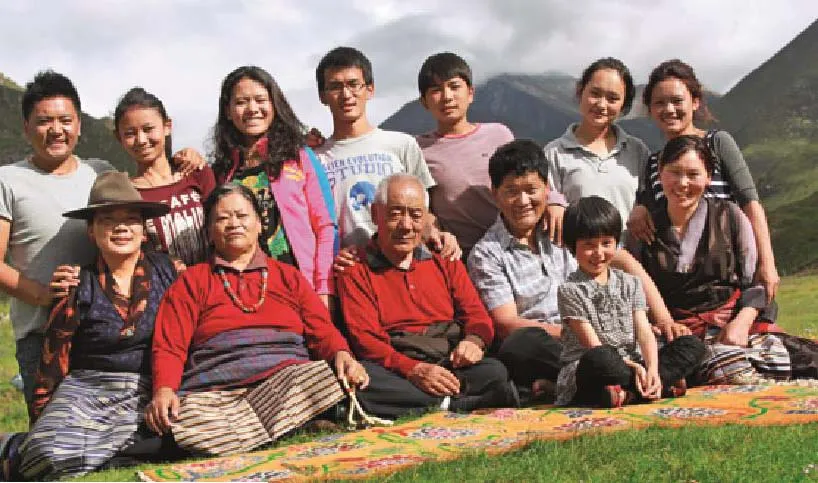
Tashi Badzong (back row,frst right) and the three generations of her family under one roof.
Parental Wisdom
Tashi's family has 16 members in total,three generations dwelling together in their home in Lhasa. After she and her five brothers and sisters married,they nevertheless decided to carry on living together at the family home,because they cherish seeing each other and dining together each day. At holidays,they lug along a hamper of tasty treats and drive en famille to a lovely scenic spot to picnic and enjoy quality time together.
This harmonious family was built up by their parents,whose hometown is a small village in Qamdo of eastern Tibet. Alang,Tashi's elder brother,recalls his family's poverty in his boyhood. “At that time,we mostly grew highland barley and potatoes in barely subsistence quantities,so my father started to think about quitting the village to ply a business,” Alang said.
Flashback to the 1970-1980s: the Chinese government had just initiated the contract responsibility system,which gave a signifcant fllip to rural productive forces. The reform and opening-up policy was a fresh spring breeze blowing through all of China. The snow-topped Tibetan plateau proved no exception.
In an effort to better the family's life,Tashi's father launched various businesses,selling caterpillar fungus,Dzi beads and timber. Dad's industry uplifted the family to a better life: they had such foods as roasted barley four,Tsampa and buttered tea,as well as rice and wheat four - rarer in Tibet in those days - in their daily diet. For Tibetan New Year,mom and dad bought the kids new leather shoes. The family had become quite affluent by village standards.
The wisdom that each family member draws from life enables them to better understand the importance of family unity.
Tashi's dad is now 74. He retired some years ago to dedicate his golden years to his family's domestic bliss. However,his wide experience in youth has made him far-sighted and bold. His wisdom has not just improved the family's life,but also influenced the education of the next generation.
Modern education got off to a late start in Tibet. When Tashi's elder brother and two older sisters hit school age,Qamdo had no school in the modern sense. The parents sent them to study with a venerable village elder,who taught them to understand,speak,read and write Tibetan through study of Buddhist texts. Schools were appearing in Tibet when Tashi and her youngest brother and sister reached their school age. Their dad resolved to up stakes and move the family to Lhasa,the regional capital,so the kids could gain access to better education.
The six offspring have never disappointed their parents. Tashi and her younger brother became police offcers. Her youngest sister passed the entrance exam for Beijing Language and Culture University to study Japanese. Tashi's elder brother and two elder sisters followed in their dad's footsteps and today run their own businesses. Alang quoted his father's dicta: “At the state level,business that violates the law is expressly prohibited. At an ethnic level,business that offends our religion is forbidden,and from a person-to-person level,business that involves sacrifcing animal life or the interests of others is also forbidden.” He believes that his father's teachings are not only about business,but even more about how one should conduct oneself in society.
Tashi's parents built the foundations of the family prosperity and harmony. The wisdom that each family member draws from life enables them to better understand the importance of family unity. During the day,everyone is busy at work. When evening approaches,they retire to their cozy home. The 45-year-old Alang,the eldest son,runs true to form here. He manages to make it home before 10 'clock every night so his parents won't worry. “All of my siblings eat dinner at home unless they have important outside work. If I'm late getting home,my brother calls me to check if I'm OK,” says Tashi. Such a family tradition is rare in cities today.
Lucky Conch: Alang's Hotel Business
Alang has followed his father by traveling extensively since age 18. He started his own business in the 1990s,and has never stopped tweaking his operating model to better adapt to changing Tibetan consumption patterns.
As early as in the 1990s,Tashi's family bought a plot by the Nyangchu River in Nyingchi. There they built a small guesthouse. With the rapid development of tourism in Tibet,Nyingchi,which enjoys picturesque scenery comparable to areas south of the lower Yangtze reaches,is welcoming ever more tourists these days. In 2012,Alang resolved to renovate and upgrade the guesthouse. Through two years of unremitting efforts,the once tiny guesthouse has now transformed into a high-grade hotel boasting more than 90 rooms,over 30 staff,a restaurant and a teahouse.
Alang has devoted a great deal to the hotel operation. He agonized long and hard over décor. If this were to be in an entirely modern style,the hotel would lack a Tibetan motif. However,purely Tibetan styles normally consist of wooden structures. These are not durable and are also inconvenient for tourists in many ways. In order to gain more practical experience,Alang and his youngest brother visited many hotels until they fnally hit upon a design mingling Tibetan and modern features.
Alang relates an anecdote about the origin of the hotel's name. The family had wished for a name that was resounding,as well as auspicious. However,they could come up with nothing after racking their brains. One day,Alang happened upon a roadside peddler of stone curios on his way back to Nyingchi from Lhasa. Alang espied a stone that resembled a conch among his wares. He bought it on sight and drew great inspiration from it.
The white conch is one of the “eight treasures” in Tibetan Buddhism. Because the Buddha loudly proclaimed his doctrines while preaching,the sound of a blowing conch came to symbolize his voice. Buddhist monks often sound conch shells ceremonially for this reason. After discussion,the family reached a consensus,and named the hotel “The Conch.” This was emblematic of their earnest hope that the hotel would become well-known among tourists,just as the trumpeting of a conch carries great distances. The white conch further represents simplicity of heart,and this also expresses their desire that the hotel's sincere service would make their guests' stays congenial.
The Conch Hotel has been operating nigh on a year now. Alang shoulders the major tasks of running it,but other family members also chip in their bit. “My youngest brother and I run the business during holidays. Now my youngest sister has graduated from college,she divides her time between looking for a job and helping the family business. We seldom have time for our own holidays these days,” Tashi said.
Nyingchi has become a hot tourist destination and competition in the hospitality industry here is accordingly intense. As a start-up,the Conch Hotel labors under heavy pressure,particularly as its publicity and promotional efforts still lag. However,Alang remains highly optimistic. “I believe a wider future market will open up as ever more tourists come to Nyingchi,” he said.
Though stamped with the hallmarks of their era,Tashi's family still epitomizes and showcases the endless panoply of traditional Tibetan culture.

Alang's Conch Hotel features a mix of modern and Tibetan style.
Hopes for the Future
“Go forth from Tibet and explore the market in regions beyond” is Alang's plan for the future. He values the good prospects presented by the vast market of China's inland. His ambition is to found more Tibetan-style hotels around the nation. The frst step in his “investment” here is the education of his children.
Kunsang,Alang's eldest son,excels at school. He passed an exam and so won the opportunity to study at a middle school in Shanghai,and later in a high school in Zhejiang Province. He is now a freshman at University of Science and Technology Beijing,where he pursues a degree in environmental engineering.
“I missed home very much in my frst year of middle school but,after acclimatizing,I realized the advantages of leaving home and studying away. Especially since entering university,I have found that the miscellaneous challenges in my new environment foster my abilities. Tibet is my home and I greatly miss it,but the extra-Tibetan region offers me the opportunity to access novel ideas and experience,and this broadens my vision,” Kunsang said.
Asked if he will return to Tibet after graduation,he replied in the affrmative. As the eldest grandson of a large clan,he has his own ideals and responsibilities. “I will most certainly help with the family business; however,I also aspire to do something that interests me in my spare time. My major is environmental engineering and I hope I can make a ftting contribution to my hometown with the knowledge I have acquired,” Kunsang said.
Alang has adopted his father's way of educating children,but also heeds the kids' own wishes. Alang is proud of Kunsang's maturity and sense. “While renovating the Conch Hotel,a dispute arose with a construction crew because of language barriers and differing opinions,but my son helped me defuse it by chiding me,telling me my reaction was unseemly. At that time I felt as if he were a grown man,” Alang says. His future hopes revolve around Kunsang's growth and development.
“Pass along what you inherit” is an axiom of traditional Chinese culture. Though stamped with the hallmarks of their era,Tashi's family still epitomizes and showcases the endless panoply of traditional Tibetan culture. The life of Tashi's family is,however,just one cameo appearing from among a countless array of ordinary,contented Tibetan families.