Leapfrog Economic Development in Tibet
2015-10-15 01:34:05ByspecialcorrespondentLUMINGWEN
今日中國·中文版 2015年11期
By special correspondent LU MINGWEN
Leapfrog Economic Development in Tibet
By special correspondent LU MINGWEN

SINCE its establishment in 1965,Tibet Autonomous Region has made remarkable achievements. The region's GDP soared from RMB 327 million in 1965 to RMB 92.08 billion in 2014,an almost 300-fold increase. Particularly since the Third National Conference on Work in Tibet was held in 1994,local GDP has grown at an annual average rate of 12.4 percent,registering double-digit growth for 20 consecutive years and marking an alltime high in the history of Tibet's development.
Local GDP Skyrockets in Half a Century
According to Chen Pu,an assistant research fellow at the Tibetan Academy of Social Sciences,from 1959 to 1979,the central government's policy concerning Tibet had three characteristics. First,it overturned feudal serfdom under theocracy and established a socialist system. Second,it set out a path of socialist modernization. Last,it launched core and supporting policies that underpin the first two characteristics.
Previous national conferences on work in Tibet,all of which greatly promoted social development at different stages,embodied the importance the central government attached in this regard. At the conferences held in 1980,1984,1994,2001,and 2010,the central government launched policies pairing-up support for Tibet while the concepts guiding Tibetan economic construction changed from assisting local constructions to boosting local economic progress. The emphasis of the Sixth National Conference on Work in Tibet last August was on more favorable policies,including increasing financial allocations from the central government,intensifying financial support,and enhancing pairingup support.
Chen Pu participated in a research project on rural development of China's border areas in 2007. Liuwu Village in southern Lhasa was his case study. Almost all land in this village was expropriated to build the Lhasa Railway Station and create a new district. Consequently,researchers focused on farmers who had lost their farmlands and the impact on them of construction of the railway station. During their one-month study,Chen and his colleagues lived with the villagers and collected valuable firsthand information.

Tourists from home and abroad fock to Lhasa's Barkor Street.
The emphasis of the Sixth National Conference on Work in Tibet last August was on more favorable policies,including increasing financial allocations from the central government,intensifying financial support,and enhancing pairing-up support.
Tsegye Dawa lived close to the railway station. His farmland covered an area of 12 mu (0.8 hectares) but was expropriated at the price of RMB 15,000 per mu and his old house was acquired for RMB 150,000. He used these sums to purchase three new houses. His wife has since passed away and his children have all grown up,so today Tsegye Dawa lives alone in one of the houses and rents out the other two,which bring him a total monthly income of RMB 3,000. “This district is adjacent to downtown Lhasa and I often walk along the Lhasa ring road,” Tsegye Dawa said. “I'm quite satisfied with my life,it's comfortable.”Today,most of the villagers in Liuwu have moved to bigger and better houses. In addition,some have ventured into various businesses like transportation and live a relatively affluent life.
Ever since the Fourth National Conference on Work in Tibet in 2001,the central government has provided fiscal subsidies and earmarked funds for fixed assets in the region. A good number of projects like the Qinghai-Tibet Railway have effectively facilitated leapfrog development and offered opportunities to farmers and herdsmen to make their life better.
Structural Transformation of Local Economy
Tibet's economic structure has been transitioning from small-scale farming by individual owners to modern agriculture and animal husbandry since the 1990s.
Chen Pu was deeply impressed withhow this change had materialized in a village in Nagqu County that he studied in 2007. Up until the 1990s,the industrial structure of the village,or No. 22 Village as it was known,had been rudimentary and inefficient. With a weak collective economy,the per capita annual income never surpassed RMB 1,800. The primary industry of the village was unsatisfactory while the secondary industry and service sector did not take shape at all.
Local leaders were determined to change the unfavorable economic situation by applying development concepts that used urban areas as a platform while bringing the village's advantages into full play to stimulate the local economy. The village had a convenient location next to the Qinghai-Tibet Highway and close to a big city. With the support of the local government,villagers started businesses,including small-scale resorts and commodity retailing. Moreover,40 families formed over 10 herdsmen's associations to produce and sell local specialties such as milk,yoghurt,and other dairy products.
Local leaders were determined to change the unfavorable economic situation by applying development concepts used in urban areas as a platform while bringing the village's advantages into full play.
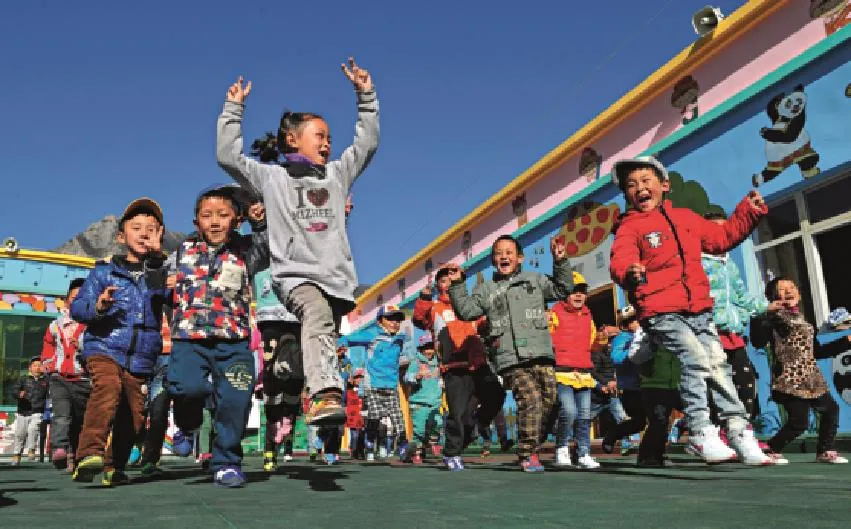
Rural Tibetan children at play in a kindergarten.
In recent years,suburban stock farming initiated by villagers has developed into a highlight of Nagqu County. The village committee has formulated development plans for the medium and long term that are expected to promote tourism,the warehousing industry and catering services.
Over the years,Chen Pu has visited nearly all counties in Tibet for his research. He has come to realize that the key to advancing Tibetan economic structure to a higher degree of modernization and marketization lies in accelerating the progress of characteristic agriculture and animal husbandry as well as beefing up the secondary and tertiary industries that are in accordance with Tibetan characteristics.
In 2003,the regional government put forward proposals to take advantage of favorable districts,industries,andresources,and to expand production scales,enhance quality of products,and improve effciency. By 2014,characteristic agriculture and animal husbandry in Tibet had increased the average income by RMB 1.315 billion,benefiting 1.756 million people. The average increase of household income has reached RMB 3,305 and the per capita fgure stands at RMB 748.
The Belt and Road Initiative Generates New Opportunities
Last January,Chairman of Tibet Autonomous Region Losang Jamcan vowed to accelerate the building of a large-scale channel to connect Tibet with South Asia,which echoes the Belt and Road Initiative and the Bangladesh-China-India-Myanmar (BCIM) Economic Corridor. It is expected to facilitate trans-Himalayan economic growth in the region.
In Chen Pu's opinion,Tibet has always been a hub linking China and the world. Throughout history,it has been a part of the main commercial roads between China and South Asia. At the same time,it is close to several provinces along today's Silk Road Economic Belt,as well as neighboring South Asian countries like India,Nepal,Myanmar,and Bhutan. Chen suggested Tibet seize the opportunities generated by the Belt and Road Initiative to upgrade such fields as transportation,trade,finance,tourism,energy,and logistics,thus enhancing social and economic progress.
However,the harmonious development of Tibet's society,economy,and environment should be stressed. Chen Pu gave an example of the integration of traditional Tibetan handicrafts into modern tourism. Adding time-honored cultural elements with Tibetan features to the tourism provision is helpful to create new markets that will motivate farmers and herdsmen to revive traditional handicrafts to increase their incomes. Meanwhile,people's awareness of protecting the environment will be strengthened,laying a foundation to better develop eco-tourism in Tibet.
Environmentally fragile lands in Tibet require special care. In this regard the Plan for Ecological Safety Barrier Protection and Improvement in Tibet was fully carried out in 2010. The investment totaled RMB 15.5 billion,covering 10 projects in three categories. An ecological safety barrier is expected to be completed in Tibet by 2030 which will benefit the environment and climate of China and even the world.
With support from the central government and the people,Tibet has explored a development mode with local features and Chinese characteristics. In half a century,leapfrog progress has been achieved in the region's economic system,structure and size. Previously impoverished and isolated areas have become open and prosperous. What we see today is a new society in which traditional culture and modern development complement each other.
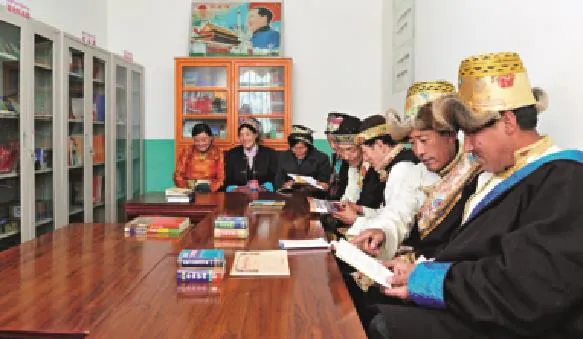
Tibetan farmers in their reading room.

A carpet factory in Tibet Autonomous Region whose products are mainly for export to Europe and America.