
Research on Breakage and Mass Loss of Kapok Textiles
2015-07-03 10:05:54CollegeofTextilesDonghuaUniversityShanghai201620China
紡織科學與工程學報
2015年4期
(College of Textiles,Donghua University,Shanghai 201620,China)
0 Introduction
Kapok is a kind of natural green fiber with high hollowness between 80%and 90%.The interest of the public in kapok fibers has grown because of kapok fibers’ability,such as light quality,anti-mite,antibacterial and good heat retention.Kapok fibers are usually blended with other fibers because of the low tenacity and poor cohesion[1-2].Kapok textiles such as kapok towel,kapok underwear and kapok quilt can be found in the market.However,some has the phenomenon of serious hair loss in the using process,like kapok towels and kapok quilts.Study about abrasion and breakage mechanism of kapok textiles has rarely been reported now.In this paper,breakage and loss of kapok fiber textiles in production and use are discussed and analyzed by the contrast tests.The abrasion degree,kapok fragments’morphology and length are also analyzed to discuss the damage mechanism.
1 Material and Methods
The change of percentage of kapok fibers in processing and use is used to evaluate the breakage and loss of kapok fibers in this paper.Generally,blending ratio(which is weight ratio)is adopted to indicate the fiber ratio in textiles.Given that there isn’t mature test method or standard which could be used to measure the blending ratio of kapok fibers yet,blending ratio of kapok fibers is replaced by the filament number ratio to indicate the fiber ratio[3-4].Based on the different longitudinal morphology,microscopic method is used to identify various kinds of fibers.
1.1 Samples
14.58 tex blended spun yarn of kapok/cotton 20/80 and its downproof fabric are tested to evaluate the kapok fibers’damage during processing.
New towels and towels which had been used for 6 weeks were tested to evaluate the kapok fibers’abrasion during use.The loop yarns of the towel are blended with three kinds of fibers,cotton/viscose/kapok,35/35/30.Kapok quilts used for 6 years have fiber fragments which are tested to evaluate the kapok fibers’abrasion degree.
1.2 Test methods
1.2.1 Filament number ratio test
(1)Make glass slides samples.For the downproof fabric and towels,disassemble them first.Then cut off the yarns for 40μm with Hardy fiber microtome,put them onto the glass slides,add a little glycerin on the yarn,use tweezers to separate the yarns into fibers and cover them with coverslips.
(2)Count the fiber number.While using a fiber projector to identify the fibers,counting the kapok fibers and others.The total number of fibers is more than 1000.
1.2.2 The morphology and length measurement of Kapok fibers’fragments
Observe the kapok fibers’fragments’morphology which fall off the textiles with biological microscope and electron microscope privately and measure the fragments’length under biological microscope.
2 Experimental
2.1 Kapok fibers loss during processing
Kapok fiber’s smooth surface makes it easier to be distributed in the outer layer of the yarn.During the yarns weaved into fabric,processing like weaving friction,dyeing and finishing,singeing will make it easier for kapok fibers to fall off the yarns.To get the different fibers’number ratio in the fabric during processing,kapok blended yarns and high density weaving downproof fabric after finishing and bleaching are tested,results as shown in Table 1.Here number ratio is defined as kapok fiber number to the other fiber number ratio.
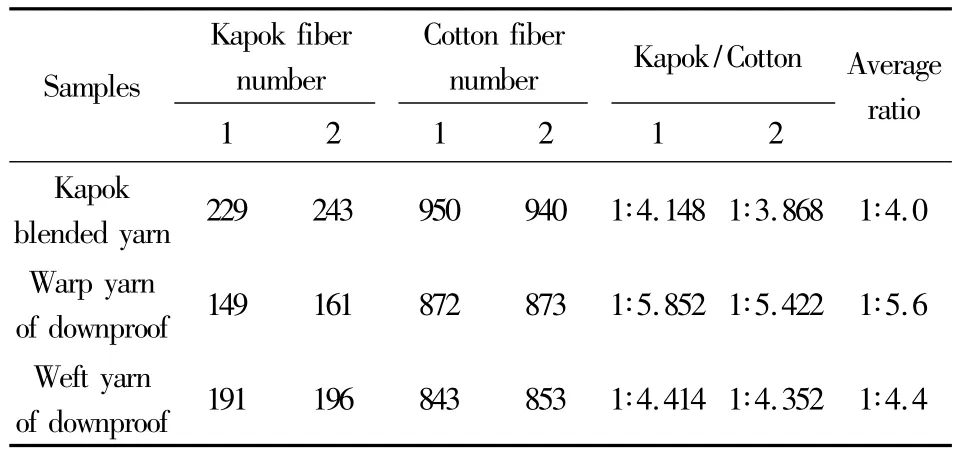
Table 1 Kapok fiber number to cotton fiber number ratio in the kapok blended yarn and downproof fabric
Compared to the kapok blended yarn,the kapok to cotton ratio of warp yarn and weft yarn in the downproof had changed from 1∶4.0 to 1∶5.6 and 1∶4.4.It went an apparent decline in kapok fiber ratio which proved that kapok fiber had higher loss during processing.It might result from the kapok fibers’distribution(in the outer layer),or the frequent friction yarns had been gone through.Besides that,the kapok to cotton ratio of warp yarn and weft yarn in the downproof are different.The warp yarns had been gone through more frequent friction than weft yarns which may lead to the higher kapok fiber abrasion.
To make further study about the kapok fibers’distribution in the yarns,the hairiness of cotton yarns and kapok blended yarns are looked under the microscope,as shown in Fig 1.
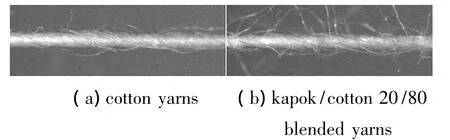
Fig.1 cotton yarn and kapok blended yarns’hairiness
From the images,cotton yarns could be found smoother and had less hairiness[5].Most of kapok fibers exist in the yarns’hairiness.That’s why kapok blended yarns lose more kapok fibers.
2.2 Kapok fibers’abrasion during use
Kapok towels lose fibers during use.To find the reason and evaluate the kapok fibers’abrasion during use,new towels and towels which had been used for 6 weeks are tested.The number ratios of kapok fibers are shown in Table 2.

Table 2 The fibers’number ratio in the kapok towels
The number ratios of kapok fibers in the new towels and used towels are 1∶3.6 and 1∶5.6 respectively.The ratio in the used towels is much smaller which proves that the kapok fibers have lost more than cotton fibers during use.Because the kapok fibers are soft,smooth and they have low strength,they mostly distribute in the outer layer of the yarns.All these lead to the kapok fibers’higher loss.
To know the kapok fibers’damage morphology during use,a large number of pictures of kapok fiber’damage morphology are recorded,as shown in Fig 2.
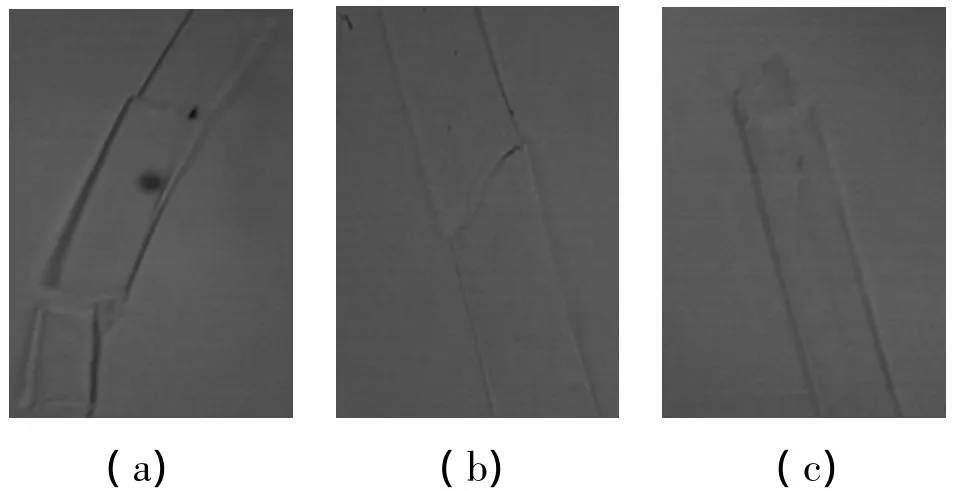
Fig.2 Images of kapok fiber’damage morphology in used towels
The fracture morphology of kapok fiber has lateral distribution in the picture.It could be concluded that the kapok fiber broke up along the transverse crack.
2.3 Kapok fibers’abrasion
The kapok fiber’damage morphology might prove the fiber broken in sections,but the smallest broken unit is unknown.This unit’s size might reflect something like weak link distributing in the cell wall of the kapok fiber.It might constitute the structure unit which needs quantitative analysis.Kapok fiber fragments in kapok quilts which had been used for 6 years are tested to get the fragments’length in this paper,as shown in Fig 3.
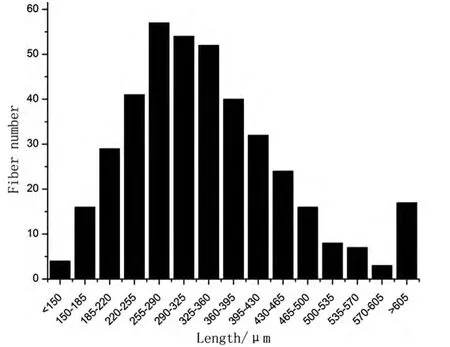
Fig.3 Kapok fiber fragments’length distribution histogram
From the Fig 3,it can be found that kapok fiber fragments’length concentrates between 185μm and 465μm.Length between 255μm and 290μm has the largest number.Kapok fiber fragments’length is relatively centralized which provides evidence to the study about the structure unit’s size of kapok fiber’s cell wall.
Fig 4 is the kapok fiber fragments’morphology images taken with SEM.

Fig.4 kapok fiber fragments of quilts
Kapok fiber is originally straight.But Fig.4(a)proves that long-term use left kapok fiber so many creases which are perpendicular to fiber axis.Kapok fibers might break at the crease and the fragments’length might be equal to the length of two adjacent creases.This proves about 20-micrometer long horizontal weak links exist in the cell wall of kapok fibers[6].Fig.4(b)is the further proof that kapok fiber break along the horizontal weak link or the crease.And the fracture surface is not a plane which shows the fracture should be a process from the part to the whole instead of one-off brittle fracture.
3 Conclusions
(1)During high density weaving,dyeing and finishing,kapok yarns used as warps are wore greater than weft yarns.
(2)Among the kapok products,wear amount of kapok fiber is obviously larger than that of cotton fiber.Abrasion makes the kapok fiber into fragments whose length distributions is mainly between 185 μm and 465 μm.And length between 255μm and 290μm has the largest number.The fracture surface is perpendicular to fiber axis which proves that horizontal weak links exist in the cell wall of kapok fibers.
(3)Long-term use left kapok fiber so many creases which are perpendicular to fiber axis.This proves that about 20-micrometer long horizontal weak links exist in the cell wall of kapok fibers.Kapok fibers might break at the crease and the fragments’length might be equal to the length of two adjacent creases.Cross section of kapok fragment is not uniform.Breakage of kapok fibers is a gradually developed process from the part to the whole instead of one-off brittle fracture.
[1]Xiao Hong,Yu Weidong,Shi Meiwu.Kapok Fibers’Character and Application Prospect[J].The Journal of DongHua University(Natural Sciences),2005,31(2):121-125.
[2]Du Qun.A Kind of Natural Green Environmental Fiber’s Application and Future[J].The Journal of Zhe Jiang textile and apparel Polytechnic,2013,12(1):18-21.
[3]Li Xuan.Experimental Research of Kapok Fiber’s Shape Correlation Coefficient[J].Dyeing and finishing,2009,(8):70-72.
[4]Dong Xiang.Uncertainty Evaluation of Cotton and Kapok Fiber’s Content Determination[J].Dyeing and finishing,2009,35(4):40-42.
[5]Cao Hongmei.Process Study of Kapok/Cotton Blends[J].ShangHai Textile Technology,2012,40(6):19-20.
[6]LiuJie,WangFumei.Alkali Treatment’s Influence on the Kapok Yarns’Morpholological Structures and Performances[J].The Journal of Textile,2009,30(12):55-60.
登錄APP查看全文
